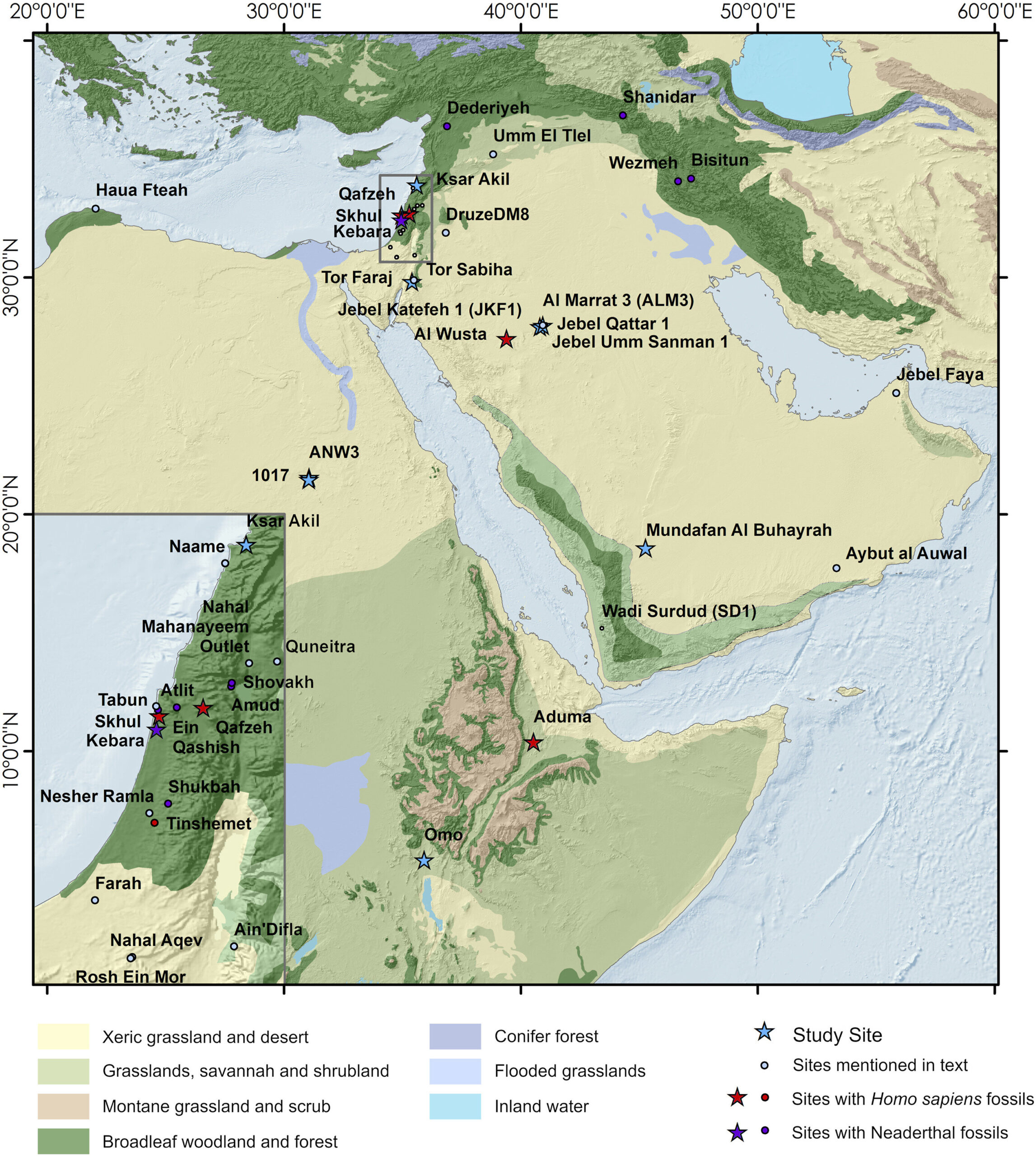
Stone tools from northern Arabia dating to about 60,000 to 50,000 years ago show a closer technological match to Neanderthal-associated assemblages than to those linked with Homo sapiens, suggesting that Neanderthals may have expanded southward beyond the Levant.
For years, the stone tools from Jebel Katefeh-1, or JKF-1, in northern Arabia have stood out from other Middle Palaeolithic assemblages in the region. The site contains a large collection of Levallois blanks, the prepared stone pieces produced through a carefully organized method of stone-tool making. But the shapes and production patterns of these blanks did not fit neatly with the better-known Arabian record.
That difference was difficult to interpret because the age of the occupation was poorly constrained. Earlier dating placed JKF-1 broadly between about 90,000 and 50,000 years ago. That range spans a major change in the known hominin populations of Southwest Asia.
During the earlier part of this period, Homo sapiens occupied parts of Arabia and the Levant. Later, Neanderthal populations expanded southward through Southwest Asia. Without a more precise age for JKF-1, it was difficult to determine whether its unusual technology reflected differences in climate, raw materials, site use, or population history.
New dating now places the occupation much later than some earlier estimates suggested.
New dating places the occupation around 60,000 to 50,000 years ago
Researchers carried out new optically stimulated luminescence dating at a second trench at JKF-1, located 5 meters from the original trench.
The results show a sequence that changed from arid conditions, represented by wind-deposited sediments dated between about 85,000 and 64,000 years ago, to wetter conditions represented by lake sediments dated to about 60,000 and 59,000 years ago.
The stone-tool-bearing layer lies at the transition between these two phases and marks the beginning of the wetter period. Two previously obtained ages from this layer were about 53,000 and 49,000 years old.
Together, the evidence places the hominin occupation of JKF-1 at roughly 60,000 to 50,000 years ago.
That timing is important because it places the site in Marine Isotope Stage 3, a period when Neanderthals are documented elsewhere in Southwest Asia and when evidence for human occupation of Arabia becomes comparatively sparse.
The revised chronology also fits the ages of other early Marine Isotope Stage 3 occupations in Arabia, including Al-Marrat, Shibat Dihya-1 and Buhais Rockshelter.
The researchers compared 704 stone tools
To investigate why Arabian stone tools differ from one another, the researchers assembled a comparative dataset of 704 complete Levallois blanks from 12 archaeological sites across Northeast Africa, eastern Africa, Arabia and the Levant.
The sites date between about 100,000 and 50,000 years ago.
The researchers measured each blank in several ways, including its length, width at different points, thickness, platform dimensions and the number of dorsal scars left by earlier stages of stone preparation. They also recorded the raw material and the pattern of scars on the dorsal surface.
These measurements allowed the researchers to examine the size and shape of the tools without relying only on traditional names for archaeological industries.
They then used principal component analysis to reduce the many measurements into a smaller number of variables describing the major patterns of variation.
The first two principal components accounted for 70% of the variation in the dataset. The first mainly represented differences in blank size. The second captured important differences in shape.
That second component became especially important because the Arabian assemblages showed a pattern that resembled a division already visible between different populations in the broader comparison.
Population history explained the strongest pattern in tool shape
The researchers tested several possible explanations for differences in Levallois blank shape.
These included the age of an assemblage, distance between sites, altitude, terrain ruggedness, climate, raw material, site type, measures related to occupation intensity, provisioning patterns and population history.
The statistical tests showed that several factors were associated with some aspects of technological variation. But population history stood out when the researchers tested whether individual factors could explain differences independently of the others.
For the second principal component, which captured the strongest shape-related pattern, species attribution was consistently identified as an independent explanatory variable across all 1,000 multiple-matrix regression iterations.
Site type was also independently associated with this component.
The amount of variation explained by the statistical models was modest for several principal components. For PC2, however, the mean R² was 0.19, substantially higher than for PC1, PC3 and PC4. The estimated effect associated with population history was also considerably stronger than the effect associated with site type and the other variables examined for PC2.
This did not mean that every difference in a stone tool could be attributed to the species that made it. The researchers explicitly caution against linking particular technologies exclusively to particular hominin populations.
Instead, their finding was narrower. Within this particular geographic and chronological setting, the two population histories represented in the comparative dataset were associated with different patterns in Levallois blank shape, even after other potential explanations were examined.
The Arabian tools matched the Neanderthal pattern
The researchers next used the observed relationship to build a statistical classification model.
They trained logistic regression models on the comparative assemblages whose population histories had been assigned as either Neanderthal or Homo sapiens. JKF-1 and another Arabian assemblage, Al-Marrat-3, were initially excluded from this training because their population histories were uncertain.
The models reproduced the original population classifications with more than 93% agreement during cross-validation. The mean area under the receiver operating characteristic curve was 0.941 when the first four principal components were used and 0.937 when the model focused on PC2 and PC3.
The researchers then applied the models to the Arabian test assemblages.
The results were strongest for JKF-1. Using the PC2-3 model, the median probability that a JKF-1 blank belonged to the Neanderthal-associated group was 78%.
Only four JKF-1 blanks had probabilities consistent with an attribution to Homo sapiens under that model. About 24% of the JKF-1 blanks had Neanderthal attribution probabilities above 95%.
The second Arabian assemblage, Al-Marrat-3, contained only seven artefacts in the test sample, making its result less secure. Four of those seven artefacts had Neanderthal attribution probabilities above 78% under the PC2-3 model.
The researchers therefore found that the early Marine Isotope Stage 3 Arabian assemblages had stronger technological affinities to assemblages associated with Neanderthals than to those associated with Homo sapiens in their comparative framework.
The result points to a possible Neanderthal presence in northern Arabia
The findings lead the researchers to propose that Neanderthal expansion was not confined to the Levant but extended southward into northern Arabia during early Marine Isotope Stage 3.
The proposed expansion is based on the combination of the revised age of JKF-1, the distinctive shape of its Levallois blanks and the statistical relationship between tool morphology and population history in the comparative dataset.
The evidence does not include a Neanderthal fossil from JKF-1. Hominin fossils are scarce in Arabia, and the researchers emphasize that recovery of fossils would be needed to test the proposed expansion directly.
The argument instead comes from the stone-tool record. The researchers interpret the technological difference between the earlier Arabian assemblages and the early Marine Isotope Stage 3 assemblages as most likely reflecting a change in population history.
In their interpretation, the Levallois blanks from JKF-1 and Al-Marrat-3 were more likely produced by Neanderthals than by Homo sapiens.
The findings broaden the proposed range of Neanderthals
The proposed Arabian expansion also bears on how Neanderthal populations are understood geographically.
Most Neanderthal fossils and associated archaeological sites are concentrated farther north, particularly in Europe. The researchers argue that this distribution has contributed to an emphasis on northern environments when considering Neanderthal ecology.
The Arabian evidence adds a different setting to that discussion. The researchers note that Neanderthals were already known to have occupied open environments in Southwest Asia, including settings where they exploited animals such as camels and ostrich.
Their results therefore support a model in which Neanderthals reached farther south than the Levant during early Marine Isotope Stage 3.
They also point to Arabia as a possible area where Homo sapiens and Neanderthal populations could have come into contact. The researchers emphasize that this remains a proposed possibility rather than evidence that such contact occurred at JKF-1.
Testing the extent of the proposed expansion will require additional archaeological sites and, especially, hominin fossils from Arabia.
The study was published in Quaternary Science Reviews.