Imagine standing beneath a night sky and looking toward the distant planets of our Solar System. Somewhere far beyond Mars lies a realm dominated by worlds so enormous that they seem almost impossible to comprehend. These planets are not rocky landscapes like Earth. They are vast spheres made mostly of gases and fluids, swirling with powerful storms, surrounded by dozens of moons, and wrapped in complex systems of rings. They are the giants of our planetary neighborhood.
These extraordinary worlds are known as gas giants.
For centuries, people could see some of them shining in the night sky, but they had little understanding of what they truly were. Modern astronomy has transformed that picture. Today, scientists know that gas giants are among the most fascinating objects in the Solar System. They helped shape the formation of planets, influence the paths of comets and asteroids, and provide clues about how planetary systems form throughout the universe.
Gas giants are not simply larger versions of Earth. They are fundamentally different worlds. Their immense size, unusual composition, powerful magnetic fields, and extreme weather make them unlike anything humans have ever experienced.
Understanding gas giants is more than learning about distant planets. It is a journey into some of the most dramatic and awe-inspiring environments nature has created.
Defining a Gas Giant
A gas giant is a large planet composed primarily of hydrogen and helium, the two lightest and most abundant elements in the universe.
Unlike terrestrial planets such as Earth, Mercury, Venus, and Mars, gas giants do not have solid surfaces that you could stand on. Instead, they consist mostly of thick layers of gas that gradually become denser and hotter as you move deeper into the planet.
The term “gas giant” traditionally refers to Jupiter and Saturn, the two largest planets in the Solar System. Both are dominated by hydrogen and helium and possess enormous atmospheres extending thousands of kilometers into space.
However, modern planetary science sometimes uses a broader classification. Uranus and Neptune are often called “ice giants” because they contain greater amounts of water, methane, and ammonia. Although different from Jupiter and Saturn, they share many characteristics associated with giant planets.
Together, these massive worlds dominate the outer Solar System.
The Giants of Our Solar System
The Solar System contains four giant planets.
Jupiter is the largest planet, so massive that more than 1,300 Earths could fit inside it by volume. It is the undisputed king of the planetary family.
Saturn is famous for its spectacular ring system and is the second-largest planet.
Farther away lie Uranus and Neptune, which are somewhat smaller but still vastly larger than Earth.
These four worlds contain most of the planetary mass in the Solar System. In fact, Jupiter alone contains more than twice the mass of all the other planets combined.
Their enormous size makes them dominant gravitational forces that influence countless objects throughout the Solar System.
Without the giant planets, our planetary neighborhood would look very different.
Why Are They Called Gas Giants?
The name comes from their composition.
Earth and the other inner planets are primarily made of rock and metal. Their surfaces are solid and relatively dense.
Gas giants, by contrast, consist mostly of gases and fluid layers.
Hydrogen is the primary ingredient. Helium is the second most abundant component. These are the same elements that make up most stars, including the Sun.
When viewed through telescopes, gas giants appear as enormous balls of cloud rather than rocky worlds.
Their visible surfaces are actually the tops of cloud layers floating high in their atmospheres.
If you descended into a gas giant, you would not encounter a solid ground. Instead, the atmosphere would become increasingly dense until gases gradually transitioned into exotic fluid states under immense pressure.
This unusual structure is one of the defining features of gas giants.
The Birth of the Gas Giants
To understand gas giants, we must travel back about 4.6 billion years to the formation of the Solar System.
At that time, a giant cloud of gas and dust collapsed under gravity. Most of the material collected at the center and formed the Sun.
The remaining material spread into a rotating disk surrounding the young star.
Within this disk, tiny particles began sticking together. Over time, these particles formed larger and larger bodies known as planetesimals.
In the colder outer regions of the disk, icy materials could survive. This allowed planetary cores to grow rapidly.
Once these cores became massive enough, their gravity started capturing enormous amounts of hydrogen and helium from the surrounding disk.
The result was the formation of giant planets.
Because hydrogen and helium were abundant during the Solar System’s early history, these planets accumulated vast gaseous envelopes that eventually made them the enormous worlds we see today.
Why Gas Giants Formed Far from the Sun
Distance from the Sun played a crucial role in the formation of gas giants.
Closer to the Sun, temperatures were too high for many volatile substances to condense into solid particles.
Only metals and rocky materials could survive.
Farther from the Sun, temperatures were much lower.
Water, methane, ammonia, and other compounds froze into solid ice particles.
This additional material allowed planetary cores to grow much larger.
The increased mass helped these cores attract tremendous quantities of hydrogen and helium before the young Sun’s radiation dispersed the remaining gas in the disk.
As a result, giant planets formed primarily in the outer Solar System.
This pattern is not unique to our planetary system. Astronomers observe similar processes around many other stars.
Inside a Gas Giant
One of the most fascinating aspects of gas giants is their internal structure.
Unlike Earth, they do not have a sharp boundary between atmosphere and surface.
Instead, conditions change gradually with depth.
The outermost region consists of clouds and atmospheric gases.
As pressure increases deeper inside, hydrogen becomes compressed into a liquid state.
Still deeper, pressures become so extreme that hydrogen behaves in ways rarely seen elsewhere.
In Jupiter and Saturn, hydrogen eventually transforms into metallic hydrogen, a remarkable form of matter capable of conducting electricity.
At the center, scientists believe giant planets may contain dense cores composed of rock, metal, and ice.
However, the exact nature of these cores remains one of planetary science’s most active areas of research.
The interiors of gas giants remain mysterious because direct exploration is extremely difficult.
Jupiter: The King of the Planets
No discussion of gas giants would be complete without Jupiter.
Jupiter is the largest planet in the Solar System and one of its most spectacular worlds.
Its diameter is approximately eleven times greater than Earth’s.
Its mass exceeds Earth’s by more than 300 times.
Yet despite its enormous size, Jupiter is composed primarily of hydrogen and helium.
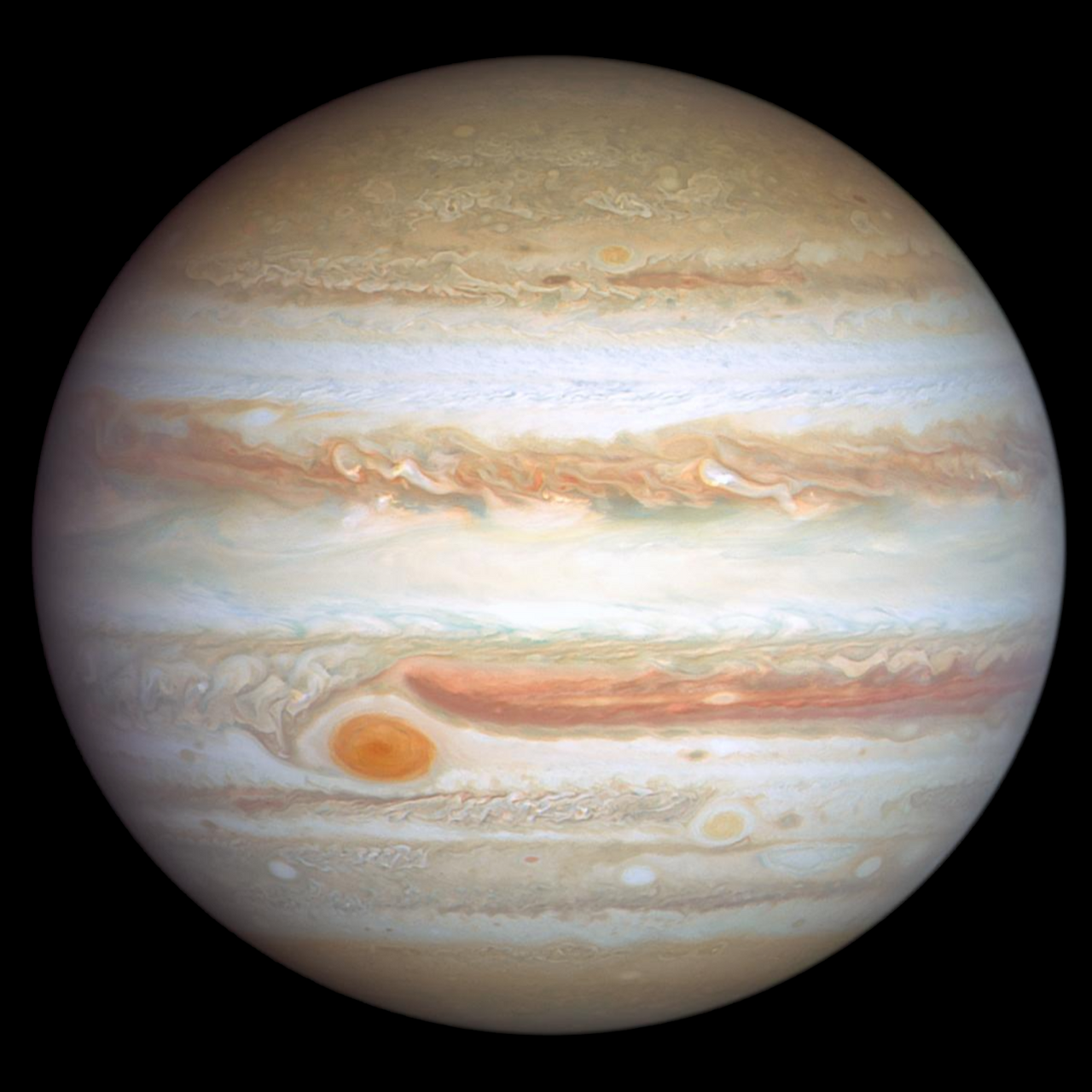
The planet’s colorful appearance comes from cloud bands encircling its atmosphere.
These bands are created by powerful winds flowing in opposite directions.
The atmosphere is a dynamic environment filled with storms, turbulence, and constant motion.
Perhaps the most famous feature is the Great Red Spot, a gigantic storm larger than Earth that has been raging for centuries.
Jupiter is not merely large. It is a world of astonishing energy and complexity.
The Great Red Spot
Among all the features in the Solar System, few are as recognizable as Jupiter’s Great Red Spot.
This enormous storm has fascinated astronomers for hundreds of years.
The storm rotates in a counterclockwise direction and spans thousands of kilometers.
Although its size has decreased over time, it remains one of the largest atmospheric storms known.
The exact reason for its reddish color remains uncertain.
Scientists suspect that chemical reactions involving compounds in Jupiter’s atmosphere may play a role.
The persistence of the Great Red Spot highlights the unique nature of giant planet atmospheres.
Unlike storms on Earth, which eventually dissipate, some Jovian storms can survive for decades or even centuries.
Saturn: The Jewel of the Solar System
Saturn is often considered the most beautiful planet in the Solar System.
Its magnificent ring system creates a breathtaking appearance unmatched by any other planet.
Although Saturn is slightly smaller than Jupiter, it remains an enormous world.
Like Jupiter, Saturn consists mostly of hydrogen and helium.
Its atmosphere contains cloud bands, storms, and strong winds.
One of Saturn’s most surprising characteristics is its low density.
If an ocean large enough existed, Saturn would theoretically float because its average density is lower than water.
Of course, such an ocean is impossible, but the comparison illustrates how different Saturn is from rocky planets.
Saturn’s elegance and mystery have captivated observers since ancient times.
The Magnificent Rings of Saturn
Saturn’s rings are among the most spectacular structures in the Solar System.
Although they appear solid through small telescopes, they actually consist of countless individual particles.
These particles range in size from tiny grains to objects as large as houses.
Most are composed of water ice.
Sunlight reflecting from these icy fragments gives the rings their brilliant appearance.
Scientists believe the rings may have formed from material torn apart by Saturn’s gravity.
The exact age of the rings remains debated.
Some evidence suggests they may be relatively young in astronomical terms.
Whatever their origin, Saturn’s rings remain one of nature’s greatest masterpieces.
Uranus: The Sideways Planet
Uranus differs significantly from Jupiter and Saturn.
It is classified as an ice giant because its composition includes larger amounts of water, ammonia, and methane.
One of Uranus’s strangest features is its extreme tilt.
The planet rotates almost on its side.
Scientists believe a massive collision early in its history may have knocked it into this unusual orientation.
As Uranus travels around the Sun, its poles experience decades of continuous sunlight followed by decades of darkness.
Methane in the atmosphere absorbs red light, giving Uranus its distinctive blue-green appearance.
Although it appears calm compared to Jupiter, Uranus possesses its own complex weather systems and atmospheric dynamics.
Neptune: The Windy Giant
Neptune is the most distant major planet in the Solar System.
Despite receiving far less sunlight than Earth, Neptune exhibits remarkably active weather.
The planet experiences some of the fastest winds ever observed in the Solar System.
These winds can exceed 2,000 kilometers per hour.
Like Uranus, Neptune’s blue color comes largely from methane in its atmosphere.
The planet contains powerful storms and dynamic cloud formations.
One famous feature, known as the Great Dark Spot, resembled Jupiter’s Great Red Spot but eventually disappeared.
Neptune demonstrates that even in the cold outer reaches of the Solar System, giant planets remain energetic and active worlds.
Weather on Gas Giants
Weather on gas giants is unlike anything found on Earth.
Their atmospheres extend thousands of kilometers deep and contain enormous amounts of energy.
Powerful winds race around the planets at extraordinary speeds.
Massive storms can grow larger than entire continents.
Clouds form from substances unfamiliar to terrestrial weather systems.
Depending on temperature and pressure, clouds may contain ammonia, water, methane, or other compounds.
Lightning storms have been detected on several giant planets.
Some lightning bolts may be far more powerful than those on Earth.
Studying giant planet weather helps scientists understand atmospheric processes across the universe.
The Immense Gravity of Giant Planets
Gas giants possess tremendous gravitational strength.
Their massive size allows them to exert powerful influence over surrounding objects.
Jupiter’s gravity is particularly significant.
It affects asteroids, comets, and even the orbits of other planets.
Many scientists believe Jupiter played a crucial role in shaping the early Solar System.
Its gravity may have redirected countless objects and influenced where planets ultimately formed.
Even today, giant planets continue acting as cosmic architects, helping shape the structure of the Solar System.
Magnetic Fields Beyond Imagination
Gas giants possess some of the most powerful magnetic fields in the Solar System.
These magnetic fields are generated by electrically conducting materials deep within the planets.
In Jupiter and Saturn, metallic hydrogen likely plays a major role.
The resulting magnetic environments are enormous.
Jupiter’s magnetosphere is so large that if it were visible in the night sky, it would appear several times larger than the Moon.
These magnetic fields trap charged particles and create intense radiation belts.
They also produce spectacular auroras near the planets’ poles.
The magnetic worlds of giant planets reveal nature operating on a colossal scale.
The Many Moons of the Giant Planets
One reason giant planets are so fascinating is that they possess extensive systems of moons.
Jupiter alone has dozens of known moons.
Some are small and irregular, while others rival planets in size.
Several giant planet moons are among the most exciting places in the Solar System.
Europa may contain a global ocean beneath its icy crust.
Ganymede is the largest moon in the Solar System.
Callisto preserves an ancient surface marked by countless impacts.
Saturn’s moon Titan possesses lakes and rivers of liquid methane.
Enceladus sprays water vapor into space from beneath its icy shell.
These moons have become prime targets in the search for environments that might support life.
Could Life Exist Around Gas Giants?
Gas giants themselves appear unlikely places for life as we know it.
Their extreme pressures, powerful storms, and lack of solid surfaces create challenging conditions.
However, their moons tell a different story.
Several moons orbiting giant planets possess subsurface oceans.
These hidden oceans may contain liquid water, one of life’s essential ingredients.
Some also appear to have energy sources capable of supporting chemical reactions.
Scientists are increasingly interested in these environments.
Future missions may reveal whether any of these distant oceans harbor life.
In this way, gas giants indirectly contribute to one of humanity’s greatest scientific quests.
Exploring Gas Giants with Spacecraft
Much of what we know about giant planets comes from robotic exploration.
Early observations relied entirely on telescopes.
The space age changed everything.
Spacecraft began providing close-up views of these distant worlds.
The Voyager missions transformed our understanding of the outer Solar System.
They revealed active atmospheres, complex rings, and fascinating moons.
Later missions provided even more detailed information.
The Galileo spacecraft studied Jupiter for years.
The Cassini mission revolutionized knowledge of Saturn and its moons.
The Juno spacecraft continues exploring Jupiter today, probing its atmosphere, gravity, and magnetic field.
These missions have revealed giant planets to be far more dynamic and complex than anyone once imagined.
Gas Giants Beyond the Solar System
The discovery of exoplanets has expanded the importance of gas giants even further.
Astronomers have identified thousands of planets orbiting distant stars.
Many of the first exoplanets discovered were giant worlds similar to Jupiter.
Some orbit extremely close to their stars.
These planets, known as “hot Jupiters,” challenge traditional ideas about planetary formation.
Others occupy distant orbits resembling those of our own giant planets.
The diversity of giant exoplanets has shown that planetary systems can be extraordinarily varied.
Studying these worlds helps scientists place our Solar System within a broader cosmic context.
Why Gas Giants Matter
Gas giants are more than just distant curiosities.
They play a crucial role in understanding how planetary systems form and evolve.
Their enormous gravity shapes surrounding environments.
Their atmospheres provide natural laboratories for studying fluid dynamics and weather.
Their moons may contain some of the most promising locations for extraterrestrial life.
Their formation reveals important clues about the early Solar System.
By studying giant planets, scientists gain insight into processes occurring throughout the galaxy.
These worlds serve as bridges between planetary science, astronomy, physics, and the search for life.
The Future of Gas Giant Exploration
The exploration of giant planets is far from complete.
New missions are already planned to investigate their moons and atmospheres.
Advanced telescopes will continue studying giant planets both within and beyond the Solar System.
Scientists hope to learn more about their internal structures, magnetic fields, weather systems, and origins.
Future spacecraft may explore subsurface oceans hidden beneath icy moons.
New discoveries could reveal entirely unexpected phenomena.
History has shown that giant planets rarely fail to surprise us.
Every mission uncovers new mysteries.
Every observation raises new questions.
The giant worlds of the outer Solar System remain among the most exciting frontiers in modern science.
Conclusion
Gas giants are the colossal rulers of the outer Solar System. Composed primarily of hydrogen and helium, these immense planets differ fundamentally from the rocky worlds closer to the Sun. They possess deep atmospheres, powerful magnetic fields, extraordinary weather systems, and families of fascinating moons.
Jupiter and Saturn represent the classic gas giants, while Uranus and Neptune expand the category into the related realm of ice giants. Together, they contain most of the planetary mass in our Solar System and have played a major role in shaping its history.
Yet their importance extends far beyond their size. Gas giants help scientists understand planetary formation, atmospheric physics, magnetic phenomena, and the potential for life elsewhere in the cosmos. Their moons may even hold clues about whether living organisms exist beyond Earth.
When we gaze toward the outer Solar System, we are looking at worlds that challenge imagination. They are places of giant storms, immense gravity, dazzling rings, hidden oceans, and mysteries still waiting to be solved. Understanding gas giants is not merely about studying distant planets. It is about exploring some of the grandest creations in the universe and discovering how they fit into the larger story of cosmic evolution.