Imagine standing on the surface of a world where the Sun appears more than three times larger than it does from Earth. Above you, there is no blue sky, no drifting clouds, no wind, and no weather. The horizon is sharp and black even in daylight. The ground beneath your feet is scarred by billions of years of impacts. During the day, temperatures soar high enough to melt lead. During the night, they plunge to levels cold enough to rival the darkest regions of Antarctica.
This is Mercury, the smallest planet in our Solar System and the closest one to the Sun.
For centuries, Mercury remained mysterious. Because it stays so close to the Sun in the sky, it is difficult to observe from Earth. Ancient astronomers knew it existed, but they could only glimpse it briefly before sunrise or after sunset. Even after the invention of telescopes, Mercury remained elusive.
Today, thanks to spacecraft missions and decades of scientific research, we know far more about this strange world. Yet one question continues to fascinate scientists and space enthusiasts alike:
Why does Mercury have almost no atmosphere?
After all, Mercury is a planet. Earth has an atmosphere. Venus has an incredibly thick atmosphere. Mars possesses a thin atmosphere. Even some moons have atmospheres of their own.
So why is Mercury nearly naked in space?
The answer is not simple. It is a story involving gravity, heat, solar radiation, violent impacts, and billions of years of cosmic punishment. It is the story of a planet that never managed to hold onto the protective blanket that most worlds rely upon.
To understand why Mercury lacks an atmosphere, we first need to understand what an atmosphere actually is and how planets acquire one.
What Is an Atmosphere?
An atmosphere is a layer of gases surrounding a planet or other celestial body.
Earth’s atmosphere is made mostly of nitrogen and oxygen. It protects us from harmful solar radiation, regulates temperature, creates weather, and allows life to flourish.
When we look up at the sky, we are actually looking through a vast ocean of air extending hundreds of kilometers above the surface.
Atmospheres are not permanent features. They are constantly changing.
Gas molecules can escape into space. Volcanoes can release new gases. Asteroid impacts can add or remove atmospheric material. Solar radiation can alter atmospheric chemistry.
A planet must continuously balance the processes that add gases with those that remove them.
If a planet loses gases faster than it gains them, its atmosphere gradually disappears.
This is exactly the challenge Mercury has faced for billions of years.
Mercury Is Not Completely Airless
Before going further, it is important to clarify something.
Scientists often say Mercury has no atmosphere, but this statement is not entirely accurate.
Mercury actually possesses an extremely thin layer of particles surrounding it. This layer is called an exosphere.
An exosphere is different from a true atmosphere.
In Earth’s atmosphere, gas molecules constantly collide with one another. The air behaves like a connected fluid.
Mercury’s exosphere is so thin that individual atoms can travel long distances without ever encountering another particle.
If you stood on Mercury’s surface, you would not experience air pressure. You could not breathe. You would not feel wind.
The exosphere contains tiny amounts of oxygen, sodium, hydrogen, helium, potassium, and other elements.
Yet it is so incredibly sparse that it would be considered a near vacuum by Earth standards.
The real mystery is not why Mercury has no particles around it at all.
The mystery is why Mercury failed to develop and maintain a substantial atmosphere like its planetary neighbors.
Mercury’s Battle with the Sun
The biggest factor shaping Mercury’s fate is its location.
Mercury orbits the Sun at an average distance of about 58 million kilometers, or roughly 36 million miles.
That might sound far away, but in cosmic terms it is extremely close.
Mercury receives roughly seven times more solar energy than Earth.
The Sun dominates every aspect of Mercury’s existence.
Its radiation bombards the planet constantly.
Its gravity influences Mercury’s orbit.
Its solar wind relentlessly strikes the surface.
Living so close to the Sun is both a privilege and a curse.
Mercury experiences intense sunlight, but that same proximity makes it extraordinarily difficult for the planet to retain atmospheric gases.
The Sun is essentially stripping Mercury bare.
The Problem of Weak Gravity
Gravity is one of the most important factors determining whether a planet can keep an atmosphere.
Every planet pulls objects toward itself through gravity.
The stronger a planet’s gravity, the harder it becomes for gas molecules to escape into space.
Earth’s gravity is strong enough to retain a substantial atmosphere.
Jupiter’s gravity is even stronger, allowing it to hold enormous quantities of hydrogen and helium.
Mercury, however, is small.
Its diameter is only about 4,880 kilometers, making it slightly larger than Earth’s Moon.
Because Mercury is relatively small, its gravitational pull is much weaker than Earth’s.
This means atmospheric particles can escape more easily.
Imagine throwing a ball upward.
On Earth, the ball falls back because Earth’s gravity holds it.
If you were on a smaller world with weaker gravity, the ball would travel higher.
For gas molecules moving at high speeds, weak gravity makes escape much easier.
Mercury’s low gravity is one of the main reasons it struggles to hold onto atmospheric gases.
Heat Gives Molecules an Escape Route
Gravity alone does not determine whether a gas remains on a planet.
Temperature matters too.
Heat increases the speed of gas molecules.
The hotter the environment becomes, the faster molecules move.
Some molecules move so rapidly that they eventually exceed the planet’s escape velocity—the speed required to break free from gravity.
Once that happens, they are lost forever.
Mercury’s dayside temperatures can reach approximately 430 degrees Celsius, or about 800 degrees Fahrenheit.
At these temperatures, gas molecules gain tremendous energy.
Lighter elements such as hydrogen and helium become especially difficult to retain.
They simply move too fast.
Mercury’s weak gravity combined with its extreme heat creates ideal conditions for atmospheric escape.
It is like trying to keep steam trapped inside a pot with no lid.
Eventually, the gas escapes.
The Solar Wind Never Stops
If Mercury’s challenges ended with heat and gravity, the planet might still possess a somewhat thicker atmosphere.
Unfortunately, another powerful force is involved.
The solar wind.
The Sun constantly emits streams of charged particles traveling throughout the Solar System.
These particles race through space at incredible speeds.
Earth is protected from much of this bombardment by its magnetic field and atmosphere.
Mercury has a magnetic field too, but it is far weaker than Earth’s.
As a result, solar wind particles can interact more directly with the planet and its surroundings.
Imagine a constant cosmic sandblasting machine operating for billions of years.
That is essentially what Mercury experiences.
The solar wind strikes the planet relentlessly.
It can knock atoms away from the surface and sweep atmospheric particles into space.
Over immense periods of time, this process has contributed significantly to Mercury’s atmospheric losses.
A World Scarred by Violence
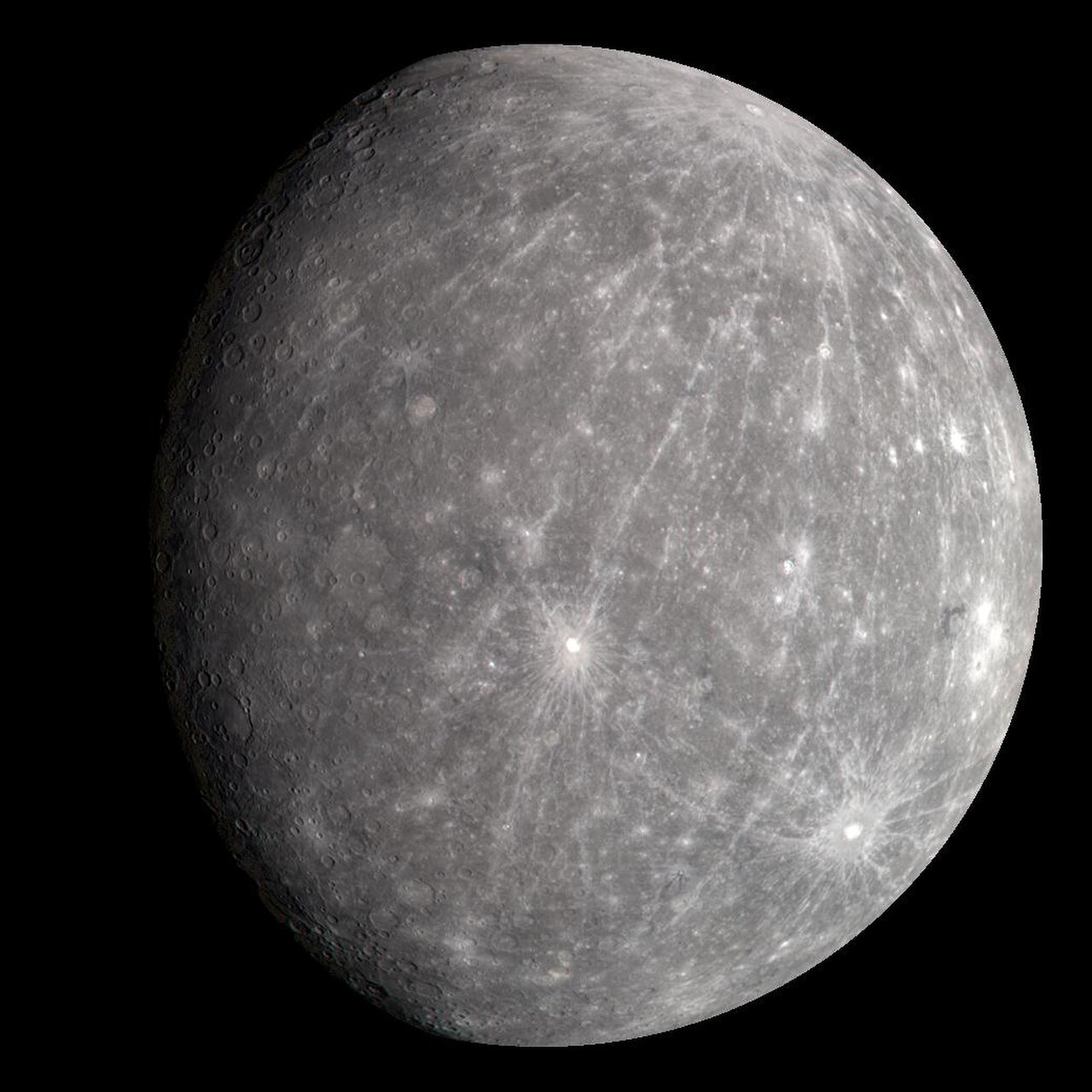
Mercury’s surface tells a story of destruction.
The planet is covered with impact craters.
Some are small.
Others are enormous.
These scars reveal that Mercury has endured countless collisions throughout its history.
During the early Solar System, impacts were particularly common.
Asteroids and comets frequently slammed into planets and moons.
Large impacts can dramatically affect atmospheres.
A sufficiently powerful collision can blast enormous quantities of gas into space.
Some impacts can strip away entire portions of an atmosphere.
Scientists believe Mercury experienced many such events during its early history.
Each collision may have removed atmospheric material, making it increasingly difficult for the planet to maintain a stable gaseous envelope.
Mercury’s battered appearance is evidence of a long history of cosmic violence.
Did Mercury Ever Have a Thick Atmosphere?
This question remains an active area of scientific research.
Some scientists suspect Mercury may once have possessed a more substantial atmosphere.
Shortly after a planet forms, volcanic activity often releases gases trapped inside its interior.
This process, known as outgassing, can create an atmosphere.
Earth, Venus, and Mars all likely gained early atmospheres through volcanic activity.
Mercury probably experienced similar processes.
Ancient volcanic eruptions likely released water vapor, carbon dioxide, sulfur compounds, and other gases.
For a brief period in its early history, Mercury may have looked very different.
However, maintaining an atmosphere is harder than creating one.
Even if Mercury once possessed a thicker atmosphere, the combined effects of solar radiation, weak gravity, and solar wind erosion would have gradually removed it.
Over billions of years, the atmosphere likely faded away.
The planet became increasingly exposed.
Eventually, only traces remained.
The Surprising Discovery of Mercury’s Magnetic Field
For many years, scientists assumed Mercury lacked a magnetic field.
Then spacecraft observations revealed something unexpected.
Mercury actually possesses a global magnetic field.
This discovery was surprising because small planets generally cool quickly.
When planetary interiors cool, the processes generating magnetic fields often weaken or stop.
Mercury’s magnetic field is only about one percent as strong as Earth’s.
Nevertheless, its existence provides important clues about the planet’s interior.
Scientists believe Mercury contains an unusually large metallic core.
In fact, the core occupies a much greater fraction of the planet than Earth’s core does.
Part of this core remains molten.
Movement within the liquid metal generates Mercury’s magnetic field.
Although this magnetic field provides some protection, it is not strong enough to fully shield the planet from solar assault.
The Sun still exerts tremendous influence over Mercury’s environment.
Mercury’s Giant Iron Heart
One of Mercury’s strangest features lies beneath its surface.
The planet possesses an enormous iron-rich core.
Compared with its overall size, Mercury’s core is gigantic.
Scientists estimate that the core makes up about 85 percent of the planet’s radius.
This is unusually large for a rocky planet.
Why Mercury developed such a massive core remains uncertain.
One theory suggests a giant impact stripped away much of the planet’s original rocky outer layers.
Another possibility is that conditions near the young Sun favored the formation of metal-rich bodies.
Whatever the explanation, Mercury’s oversized core influences many aspects of the planet, including its density, magnetic field, and geological evolution.
Yet even this enormous iron heart could not save Mercury’s atmosphere.
The Strange World of Mercury’s Exosphere
Although Mercury lacks a true atmosphere, its exosphere is surprisingly dynamic.
It is constantly changing.
Atoms are continuously added and removed.
Some particles originate from the solar wind.
Others are blasted from the surface by incoming radiation.
Micrometeorite impacts also contribute material.
Sodium is one of the most fascinating components.
Scientists have observed giant sodium clouds extending far from Mercury.
Sunlight can liberate sodium atoms from surface rocks, allowing them to drift into space.
These glowing clouds demonstrate that Mercury remains an active world despite its apparent barrenness.
The exosphere may be thin, but it is far from static.
It is constantly shaped by interactions between the planet, the Sun, and the surrounding space environment.
Why Venus Kept Its Atmosphere
Mercury’s fate becomes even more interesting when compared with Venus.
Venus is the second planet from the Sun.
It also receives intense solar radiation.
Yet Venus possesses an atmosphere so thick that surface pressures are more than ninety times greater than those on Earth.
Why did Venus succeed where Mercury failed?
The answer lies largely in gravity and atmospheric mass.
Venus is much larger than Mercury.
Its stronger gravity helps retain gases.
Venus also accumulated a vast atmosphere early in its history.
Once a thick atmosphere exists, it can help protect itself by absorbing and redistributing energy.
Mercury never enjoyed that advantage.
Its smaller size placed it at a disadvantage from the beginning.
The comparison highlights how even relatively small differences in planetary properties can produce dramatically different outcomes.
Why Mars Lost Much of Its Atmosphere
Mars provides another useful comparison.
Like Mercury, Mars has lost a significant portion of its original atmosphere.
Mars is larger than Mercury but smaller than Earth.
Its gravity is weaker than Earth’s.
Its magnetic field largely disappeared billions of years ago.
Without strong protection, the solar wind gradually eroded the Martian atmosphere.
Scientists believe Mars once had rivers, lakes, and perhaps even oceans.
As the atmosphere thinned, the planet became colder and drier.
Mercury experienced a similar struggle, though under much harsher conditions.
Both worlds demonstrate how difficult it can be for smaller planets to retain atmospheres over geological timescales.
The Temperature Extremes of a Bare World
Mercury’s lack of atmosphere has another dramatic consequence.
Extreme temperature swings.
Earth’s atmosphere helps distribute heat around the globe.
It acts like a thermal blanket.
Mercury lacks this protection.
As a result, the dayside becomes scorching hot.
The nightside becomes brutally cold.
Nighttime temperatures can plunge below minus 170 degrees Celsius.
The difference between day and night exceeds 600 degrees Celsius.
These are among the most extreme temperature variations anywhere in the Solar System.
An atmosphere would moderate these swings.
Without one, Mercury’s surface experiences a relentless cycle of intense heating and cooling.
Water Ice on the Hottest Planet?
One of the greatest surprises in planetary science emerged when scientists discovered evidence of water ice on Mercury.
At first glance, this seems impossible.
How could ice survive on the closest planet to the Sun?
The answer lies near Mercury’s poles.
Some craters are so deep that sunlight never reaches their floors.
These permanently shadowed regions remain extremely cold.
Temperatures inside them can stay low enough for ice to persist for billions of years.
Radar observations and spacecraft measurements strongly suggest substantial deposits of water ice exist within these frozen shadows.
This discovery transformed our understanding of Mercury.
Even on a world famous for extreme heat, hidden reservoirs of ice can survive.
Nature often proves more surprising than expected.
What Spacecraft Have Revealed
For much of history, Mercury remained poorly understood.
That changed with spacecraft exploration.
NASA’s Mariner 10 became the first spacecraft to visit Mercury during the 1970s.
It revealed a heavily cratered surface resembling the Moon.
Decades later, NASA’s MESSENGER revolutionized our understanding of the planet.
MESSENGER mapped Mercury in unprecedented detail.
It studied the magnetic field, chemical composition, exosphere, and geology.
The mission revealed evidence of volcanic activity, water ice deposits, and complex interactions between Mercury and the solar wind.
Today, the joint European and Japanese mission BepiColombo continues the exploration of this fascinating world.
Each mission brings new insights into Mercury’s history and evolution.
Mercury as a Window into Planetary Evolution
Mercury is more than just a strange planet.
It serves as a natural laboratory.
By studying Mercury, scientists learn about planetary formation, atmospheric evolution, and interactions with stars.
The lessons extend far beyond our Solar System.
Thousands of planets have been discovered orbiting distant stars.
Many of them circle extremely close to their suns.
Some may experience conditions similar to Mercury’s.
Understanding why Mercury lost its atmosphere helps scientists interpret these distant worlds.
It provides clues about which planets might remain habitable and which become scorched wastelands.
In this way, Mercury helps us understand planets across the galaxy.
A Survivor of the Solar System’s Harshest Neighborhood
Mercury’s story is ultimately one of survival.
The planet has spent more than four billion years enduring conditions that would challenge any world.
It has faced relentless solar radiation.
It has suffered countless impacts.
It has lost nearly all of its atmosphere.
It experiences some of the most extreme temperatures in the Solar System.
Yet Mercury remains.
Its cratered surface preserves ancient history.
Its magnetic field continues to operate.
Its giant iron core still influences its evolution.
Its exosphere persists despite constant erosion.
Far from being a dead world, Mercury is an active participant in the ongoing story of our Solar System.
Conclusion
Mercury does not completely lack an atmosphere, but it possesses only a tenuous exosphere rather than the thick gaseous envelope found on Earth or Venus. The reason lies in a combination of factors that have worked together for billions of years.
The planet’s small size gives it relatively weak gravity, making it difficult to hold onto gas molecules. Its close proximity to the Sun subjects it to intense heat, causing atmospheric particles to move fast enough to escape into space. Constant bombardment by the solar wind further strips away material, while ancient impacts likely removed additional gases throughout Mercury’s history.
Together, these forces transformed Mercury into the scorched and nearly airless world we see today.
Yet Mercury’s apparent simplicity hides remarkable complexity. It possesses a magnetic field, a giant metallic core, dynamic exospheric processes, evidence of ancient volcanism, and even deposits of water ice hidden in permanently shadowed craters. Every new discovery reveals that this small planet is far more fascinating than scientists once imagined.
Mercury’s story reminds us that planets are shaped by delicate balances between gravity, heat, radiation, and time. A slightly larger size, a greater distance from the Sun, or a stronger magnetic field might have produced a very different world.
Instead, Mercury became the Solar System’s scorched survivor—a planet stripped nearly bare by the Sun itself, standing as a powerful example of how harsh and beautiful planetary evolution can be.