On a clear night, when we look up at the sky, the stars seem scattered randomly across the darkness. Some appear bright, some faint, and most seem isolated from one another. Yet hidden within our galaxy and countless others are extraordinary places where stars are packed together in astonishing numbers.
Imagine traveling to a region of space where hundreds of thousands—or even millions—of stars are crowded into a relatively small volume. Instead of the vast emptiness that typically separates stars, brilliant suns would fill the sky in every direction. The night would never truly be dark. The heavens would glow continuously with the light of neighboring stars.
These remarkable stellar gatherings are known as globular clusters.
Globular clusters are among the oldest structures in the universe. They are ancient relics that formed when galaxies themselves were still young. Long before Earth existed, before the Sun was born, and before our Solar System took shape, these dense collections of stars were already shining.
To astronomers, globular clusters are much more than beautiful celestial objects. They are cosmic time capsules. They preserve clues about the earliest chapters of galactic history and help scientists understand how the universe evolved over billions of years.
Their age, density, beauty, and mystery make globular clusters some of the most fascinating objects in astronomy.
Understanding What a Globular Cluster Is
A globular cluster is a tightly bound collection of stars held together by gravity.
Unlike ordinary groups of stars that may slowly drift apart over time, globular clusters are incredibly stable systems. Their stars orbit around a common center of gravity, creating a roughly spherical shape that can persist for billions of years.
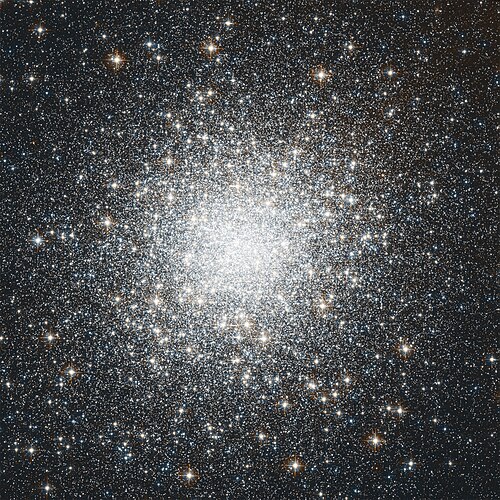
The term “globular” comes from the word “globe,” reflecting their round appearance. When viewed through powerful telescopes, they resemble glowing balls composed of countless stars packed closely together.
A typical globular cluster may contain anywhere from tens of thousands to several million stars.
These stars are concentrated toward the cluster’s center, where stellar density becomes extraordinarily high. Near the core, stars can be separated by only a fraction of a light-year, compared to the several light-years that commonly separate stars in regions like our local neighborhood.
Despite this crowding, collisions between stars remain relatively rare because stars themselves are tiny compared to the vast distances between them.
Nevertheless, globular clusters are among the densest stellar environments known.
The Difference Between Globular Clusters and Open Clusters
Many people confuse globular clusters with another type of stellar grouping called an open cluster.
Although both contain collections of stars, they are dramatically different.
Open clusters are relatively young groups of stars that formed from the same cloud of gas and dust. They usually contain hundreds or thousands of stars and are often found within the spiral arms of galaxies.
Globular clusters are much older and much larger.
Their stars are packed more tightly together, and they contain vastly greater numbers of stars. While open clusters often disperse over time, globular clusters can survive for billions of years.
If open clusters are small towns in the cosmic landscape, globular clusters are massive ancient cities.
Their populations are enormous, their histories are long, and their structures are remarkably resilient.
The First Observations of Globular Clusters
Globular clusters have fascinated observers for centuries.
Before telescopes existed, most appeared merely as faint fuzzy patches in the sky. Their true nature remained hidden.
As telescopes improved during the seventeenth and eighteenth centuries, astronomers began noticing these mysterious objects more clearly.
One of the earliest known globular clusters to attract scientific attention was Messier 13, often called the Great Globular Cluster in Hercules.
Through small telescopes, it appeared as a glowing ball of light.
With larger instruments, astronomers realized it was not a nebula at all. Instead, it consisted of countless individual stars crowded together.
This revelation transformed our understanding of the cosmos.
Objects once thought to be simple fuzzy patches turned out to be immense stellar systems.
Why Globular Clusters Are So Important
Globular clusters occupy a special place in astronomy because they are incredibly old.
Many formed more than 10 billion years ago.
Some may be nearly as old as the universe itself.
This extraordinary age means they preserve information about conditions that existed during the early history of galaxies.
Imagine finding a perfectly preserved city from thousands of years ago on Earth. Archaeologists would eagerly study it because it could reveal details about ancient civilizations.
Globular clusters serve a similar purpose for astronomers.
They are ancient survivors that contain clues about how galaxies formed, how stars evolved, and how the universe changed over time.
Every globular cluster is like a historical archive written in starlight.
The Ancient Nature of Globular Clusters
One of the most remarkable facts about globular clusters is their age.
Most stars in globular clusters are extremely old.
In astronomy, age is often linked to chemical composition. The earliest generations of stars formed before many heavy elements existed in the universe.
As stars lived and died, they created heavier elements and scattered them into space.
Because globular cluster stars formed early, they contain relatively low amounts of these heavy elements.
This characteristic provides evidence that they originated during the youth of the universe.
Many globular clusters are estimated to be between 11 and 13 billion years old.
For comparison, Earth is about 4.5 billion years old.
This means globular clusters were already ancient when our planet formed.
Where Globular Clusters Are Found
Globular clusters are not randomly distributed throughout galaxies.
In the Milky Way, they are primarily located in a vast spherical region known as the galactic halo.
This halo surrounds the galaxy’s disk and extends far beyond its visible structure.
While most stars in the Milky Way reside within the galactic disk, globular clusters orbit far above and below it.
Their orbits can carry them enormous distances from the galactic center.
This distribution provides important clues about how galaxies formed.
Astronomers believe many globular clusters formed during the earliest stages of galactic assembly, long before the modern structure of galaxies fully developed.
The Milky Way’s Collection of Globular Clusters
The Milky Way contains roughly 150 known globular clusters, though new discoveries occasionally increase this number.
These clusters vary in size, brightness, and population.
Some are relatively small, containing tens of thousands of stars.
Others host hundreds of thousands or even millions.
Among the most famous is Omega Centauri.
This colossal cluster contains several million stars and is visible to the naked eye under dark skies in the Southern Hemisphere.
Omega Centauri is so massive and unusual that some astronomers suspect it may actually be the remnant core of a dwarf galaxy that was absorbed by the Milky Way long ago.
Its existence hints at dramatic events in our galaxy’s distant past.
A Journey into a Globular Cluster
Imagine standing on a planet inside a globular cluster.
The view would be unlike anything humans experience on Earth.
In our Solar System, the nearest star beyond the Sun is about 4.24 light-years away.
This distance creates a relatively dark night sky.
Inside a globular cluster, neighboring stars may be much closer.
The sky could contain dozens or hundreds of bright stars shining more brilliantly than any star visible from Earth.
Some stars might appear large enough to cast noticeable shadows.
The heavens would sparkle continuously with light.
Night would feel more like a permanent twilight illuminated by countless distant suns.
It would be one of the most breathtaking sights imaginable.
The Role of Gravity
Gravity is the force that holds globular clusters together.
Without gravity, their stars would drift apart and disperse into space.
Every star within a cluster exerts gravitational influence on every other star.
Together, these countless interactions create a stable system.
Stars orbit the cluster’s center of mass, continually moving through the cluster’s gravitational field.
The balance between motion and gravity maintains the cluster’s structure over immense periods of time.
This stability is one reason globular clusters can survive for billions of years.
Stellar Density and Crowding
One of the defining characteristics of globular clusters is their extraordinary density.
Near the cluster’s center, stars become packed together at astonishing levels.
If you could travel toward the core of a globular cluster, the number of visible stars would increase dramatically.
Astronomers observing cluster centers often encounter challenges because so many stars occupy such small regions of the sky.
Advanced telescopes and sophisticated image-processing techniques are required to distinguish individual stars.
The crowded conditions also create opportunities for unusual interactions.
Binary star systems, stellar encounters, and exotic objects become more common in these dense environments.
The Stars Inside Globular Clusters
Most stars within globular clusters belong to older stellar populations.
These stars tend to be smaller, cooler, and longer-lived than massive young stars.
Many appear yellow, orange, or red.
Because massive stars burn through their fuel quickly, they have long since disappeared from ancient globular clusters.
Only the longer-lived stars remain.
This aging population gives globular clusters a distinctive appearance and provides evidence of their great age.
Studying these stars helps astronomers test theories of stellar evolution and understand how stars change over time.
How Stars Evolve in Globular Clusters
Globular clusters serve as natural laboratories for studying stellar evolution.
One major advantage is that most cluster stars formed at roughly the same time.
This means differences among stars primarily reflect their masses rather than their ages.
Astronomers can observe stars at various stages of life within a single cluster.
Some remain on the main sequence, steadily fusing hydrogen.
Others have expanded into red giants.
Still others have reached later evolutionary stages.
Because all these stars share similar origins, scientists can compare them and refine models of stellar behavior.
Globular clusters have become essential tools for understanding how stars live and die.
The Mystery of Blue Stragglers
Among the ancient stars of globular clusters lurk puzzling objects called blue stragglers.
These stars appear younger and hotter than they should be.
Given the cluster’s age, such stars should have evolved long ago.
Yet there they are, shining brightly among much older companions.
Astronomers believe blue stragglers may form when stars merge or transfer material between binary partners.
These processes effectively rejuvenate the stars, making them appear younger than their true ages.
Blue stragglers remain one of the most intriguing stellar mysteries found within globular clusters.
Black Holes and Neutron Stars
Globular clusters are not composed solely of ordinary stars.
Many also contain exotic remnants of stellar evolution.
When massive stars die, they can leave behind neutron stars or black holes.
Although most massive stars disappeared billions of years ago, their remnants may still inhabit clusters today.
Recent observations suggest that some globular clusters contain numerous stellar-mass black holes.
These hidden objects influence the motions of surrounding stars and contribute to the cluster’s complex gravitational environment.
The presence of such remnants makes globular clusters valuable laboratories for studying extreme physics.
Pulsars in Globular Clusters
Globular clusters are famous for hosting large numbers of pulsars.
A pulsar is a rapidly spinning neutron star that emits beams of radiation.
As the star rotates, these beams sweep across space like lighthouse beams.
When one of the beams points toward Earth, astronomers detect a pulse.
The dense stellar environment of globular clusters encourages interactions that can create unusual binary systems and recycled pulsars.
Some clusters contain dozens of known pulsars.
These remarkable objects provide insights into gravity, stellar evolution, and the behavior of matter under extreme conditions.
How Globular Clusters Formed
The exact origin of globular clusters remains an active area of research.
Most astronomers believe they formed during the earliest stages of galaxy formation.
Billions of years ago, enormous clouds of gas collapsed under gravity.
In certain regions, conditions allowed vast numbers of stars to form simultaneously.
The result was a dense, gravitationally bound cluster.
Some globular clusters may have formed within their host galaxies.
Others may have originated in smaller galaxies that were later absorbed.
Evidence suggests that both processes likely contributed to the populations observed today.
Their origins are closely tied to the broader story of galactic evolution.
Clues About the Early Universe
Because globular clusters are so old, they offer a direct connection to the early universe.
When astronomers study their stars, they effectively examine fossils from cosmic history.
The chemical compositions of cluster stars reveal information about the materials available shortly after the Big Bang.
Their ages help constrain estimates of the universe’s age.
Their motions provide clues about how galaxies assembled.
Every globular cluster preserves a chapter of the universe’s earliest history.
Together, they help scientists reconstruct events that occurred billions of years before Earth existed.
Globular Clusters Beyond the Milky Way
The Milky Way is not unique in possessing globular clusters.
Many galaxies contain extensive systems of these stellar groupings.
Large galaxies often host hundreds or even thousands.
The giant elliptical galaxy Messier 87 contains an enormous population of globular clusters numbering in the thousands.
Observing globular clusters in other galaxies allows astronomers to compare galactic histories and investigate universal patterns.
These studies reveal that globular clusters are a common feature throughout the cosmos.
They appear wherever large galaxies exist.
The Beauty of Globular Clusters
Few astronomical objects rival globular clusters in visual beauty.
Images captured by modern telescopes reveal dazzling swarms of stars packed together like cosmic jewels.
Their spherical shapes create an impression of elegance and harmony.
Bright stars sparkle against dense backgrounds of countless fainter companions.
Toward the center, the stellar population becomes so concentrated that individual stars blend into a glowing core.
These images inspire both scientists and the public alike.
They remind us that the universe contains structures of extraordinary complexity and beauty.
Challenges of Studying Globular Clusters
Despite their prominence, globular clusters present significant observational challenges.
Their dense stellar populations can make individual stars difficult to distinguish.
Accurately measuring stellar motions requires precise instruments.
Determining exact ages remains complex.
Questions about their formation and evolution continue to spark debate.
Advances in telescope technology, computational modeling, and space-based observatories have greatly improved our understanding.
Yet many mysteries remain unsolved.
Like all great scientific subjects, globular clusters continue to surprise researchers.
Could Planets Exist in Globular Clusters?
The possibility of planets within globular clusters fascinates both scientists and the public.
At first glance, such environments seem unfavorable.
Close stellar encounters could disrupt planetary systems.
The low abundance of heavy elements might reduce planet formation.
However, evidence suggests that planets can exist in at least some globular clusters.
The discovery of planets associated with pulsars demonstrated that planetary systems can arise under unusual circumstances.
Whether Earth-like worlds are common within globular clusters remains uncertain.
If such planets exist, their skies would likely be among the most spectacular in the universe.
The Long-Term Future of Globular Clusters
Although globular clusters are remarkably stable, they are not eternal.
Over immense timescales, stars gradually escape through gravitational interactions.
Tidal forces exerted by host galaxies can strip stars away.
Eventually, clusters may lose enough mass to dissolve.
However, this process unfolds incredibly slowly.
Many globular clusters have already survived for more than 10 billion years and may continue existing for billions more.
Their longevity makes them among the most enduring structures in the cosmos.
Why Globular Clusters Capture Human Imagination
There is something profoundly moving about globular clusters.
Perhaps it is their age.
Perhaps it is the realization that these stars were already shining long before Earth formed.
Or perhaps it is the image of millions of stars gathered together in a single gravitational community.
Globular clusters connect us to deep cosmic time.
They remind us that the universe possesses a history stretching far beyond human experience.
Every cluster is a surviving witness to epochs we can barely imagine.
When we observe one, we are looking at an ancient structure that has endured through almost the entire history of the cosmos.
Conclusion
Globular clusters are among the oldest, densest, and most fascinating structures in the universe. These roughly spherical collections of stars contain tens of thousands to millions of members bound together by gravity and preserved across billions of years. Often residing in the halos of galaxies, they serve as living fossils that provide invaluable clues about stellar evolution, galaxy formation, and the early universe.
Far more than simple groups of stars, globular clusters are ancient cosmic cities. Their crowded environments host exotic objects, unusual stellar interactions, and some of the oldest known stars in existence. From the magnificent Omega Centauri to distant clusters orbiting other galaxies, these stellar systems continue to reveal new secrets about the cosmos.
As we study globular clusters, we are not merely observing beautiful celestial objects. We are looking back into deep time, witnessing relics from the universe’s youth. Their enduring presence reminds us that long before our planet existed, before the Sun ignited, and before life emerged on Earth, these magnificent gatherings of stars were already illuminating the darkness of space.