On a clear night beneath a dark sky, the stars seem countless. The Milky Way stretches overhead like a glowing river, a reminder that our Solar System is part of something unimaginably vast. For many people, galaxies are associated with grandeur. They are enormous cities of stars containing hundreds of billions, sometimes even trillions, of suns. They dominate the cosmic landscape and inspire awe through their sheer scale.
Yet not every galaxy is a giant.
Scattered throughout the universe are much smaller galactic systems that often go unnoticed. They lack the magnificent spiral arms of large galaxies and the immense populations of stars found in cosmic giants. Some contain only a few million stars. Others are so faint that astronomers struggle to detect them even with powerful telescopes.
These are dwarf galaxies.
At first glance, they might seem insignificant compared to massive galaxies like the Milky Way or the Andromeda Galaxy. But appearances can be deceiving. Dwarf galaxies are among the most important objects in modern astronomy. They help scientists understand galaxy formation, dark matter, the history of the universe, and even the origins of our own galactic home.
In many ways, dwarf galaxies are the quiet neighborhoods surrounding the great cities of the cosmos. Though small and often overlooked, they hold some of the biggest secrets in astronomy.
Understanding What a Dwarf Galaxy Is
A dwarf galaxy is a relatively small galaxy containing far fewer stars than large galaxies such as the Milky Way.
While the Milky Way contains hundreds of billions of stars, many dwarf galaxies contain only a few million or a few billion. Some possess even fewer.
The term “dwarf” refers to their size and mass rather than their importance. Even though they are small by galactic standards, dwarf galaxies remain enormous structures when compared to individual star systems.
A typical dwarf galaxy may span several thousand light-years. By comparison, the Milky Way stretches across roughly 100,000 light-years.
Despite their smaller dimensions, dwarf galaxies still contain stars, gas, dust, planets, star clusters, and large amounts of dark matter. They are genuine galaxies in every sense, simply scaled down compared to the cosmic giants that often dominate astronomy textbooks.
Why Dwarf Galaxies Matter
When astronomers first began studying galaxies, attention naturally focused on the largest and brightest examples. Massive spiral galaxies and giant elliptical galaxies were easier to observe and classify.
Dwarf galaxies seemed secondary.
Over time, however, scientists realized that dwarf galaxies may actually be among the most important building blocks of the universe.
Many theories suggest that large galaxies formed through the merging and accumulation of smaller systems. In other words, the giant galaxies we see today may have grown from dwarf galaxies long ago.
Studying dwarf galaxies allows astronomers to look at structures that resemble the earliest stages of galactic evolution.
They provide clues about how galaxies form, grow, interact, and change over billions of years.
In some respects, dwarf galaxies are cosmic fossils preserving information from the universe’s distant past.
The Most Common Galaxies in the Universe
One surprising fact about dwarf galaxies is how common they are.
When people imagine the universe, they often think about enormous galaxies filled with hundreds of billions of stars. Yet those giants are actually outnumbered by much smaller systems.
Astronomers believe dwarf galaxies may represent the most abundant type of galaxy in the cosmos.
Many are difficult to detect because they are faint and contain relatively few stars. As telescope technology improves, scientists continue discovering new dwarf galaxies hidden in the darkness around larger galaxies.
This means the universe may contain countless dwarf galaxies that remain undiscovered.
Far from being rare curiosities, dwarf galaxies appear to be fundamental components of the cosmic landscape.
A Galaxy’s Place in the Cosmic Neighborhood
To understand dwarf galaxies, it helps to think about neighborhoods.
Large galaxies often function like major cities. They attract smaller companions through gravity and become centers of local galactic communities.
The Milky Way serves as an example.
Our galaxy is surrounded by numerous dwarf galaxies orbiting around it like small towns surrounding a metropolitan center.
These satellite galaxies remain gravitationally bound to the Milky Way.
Some have accompanied our galaxy for billions of years.
Others may eventually merge with it.
The relationship between large galaxies and their dwarf companions creates a dynamic cosmic neighborhood filled with interactions, migrations, and long-term evolution.
The Milky Way’s Family of Dwarf Galaxies
The Milky Way is not alone in space.
It is surrounded by dozens of known dwarf galaxies, and astronomers continue finding more.
Some orbit relatively close to our galaxy, while others lie farther away.
These dwarf companions form a kind of galactic family.
Among the most famous are the Large Magellanic Cloud and the Small Magellanic Cloud.
Visible from the Southern Hemisphere, these neighboring galaxies have been known for centuries. They appear as faint cloudy patches in the night sky and serve as excellent laboratories for studying star formation and galactic evolution.
The Magellanic Clouds remind us that even our own galaxy exists within a broader community of cosmic companions.
How Dwarf Galaxies Form
The origins of dwarf galaxies remain an active area of research.
Many likely formed during the early stages of cosmic history.
Shortly after the Big Bang, matter in the universe began clumping together under the influence of gravity.
Small concentrations of matter grew denser over time, eventually forming the first galaxies.
Some of these early systems evolved into large galaxies.
Others remained relatively small and became dwarf galaxies.
In some cases, dwarf galaxies may represent ancient structures that have survived largely unchanged for billions of years.
In other cases, they may have formed through interactions between larger galaxies, where streams of gas and stars condensed into new galactic systems.
Nature often creates dwarf galaxies through multiple pathways rather than a single universal process.
The Role of Dark Matter
One of the most fascinating aspects of dwarf galaxies involves dark matter.
Dark matter is an invisible substance that does not emit, reflect, or absorb light. Scientists cannot observe it directly, yet its gravitational effects are evident throughout the universe.
Dwarf galaxies appear to contain enormous amounts of dark matter relative to their visible matter.
In some cases, the stars we can see make up only a small fraction of the galaxy’s total mass.
This makes dwarf galaxies especially valuable for studying dark matter.
Because they contain relatively few stars and simple structures, astronomers can more easily analyze how gravity behaves within them.
Many researchers consider dwarf galaxies among the best natural laboratories for investigating one of the greatest mysteries in modern science.
Different Types of Dwarf Galaxies
Although all dwarf galaxies are smaller than giant galaxies, they are not all alike.
Some possess irregular shapes and active star-forming regions.
Others appear smooth and contain mostly old stars.
Certain dwarf galaxies still contain large amounts of gas, while others have almost none.
These differences reflect unique histories shaped by environment, interactions, and internal evolution.
Just as cities around the world can look dramatically different despite sharing common features, dwarf galaxies exhibit remarkable diversity.
Each one tells its own story about how galaxies live and change.
Dwarf Irregular Galaxies
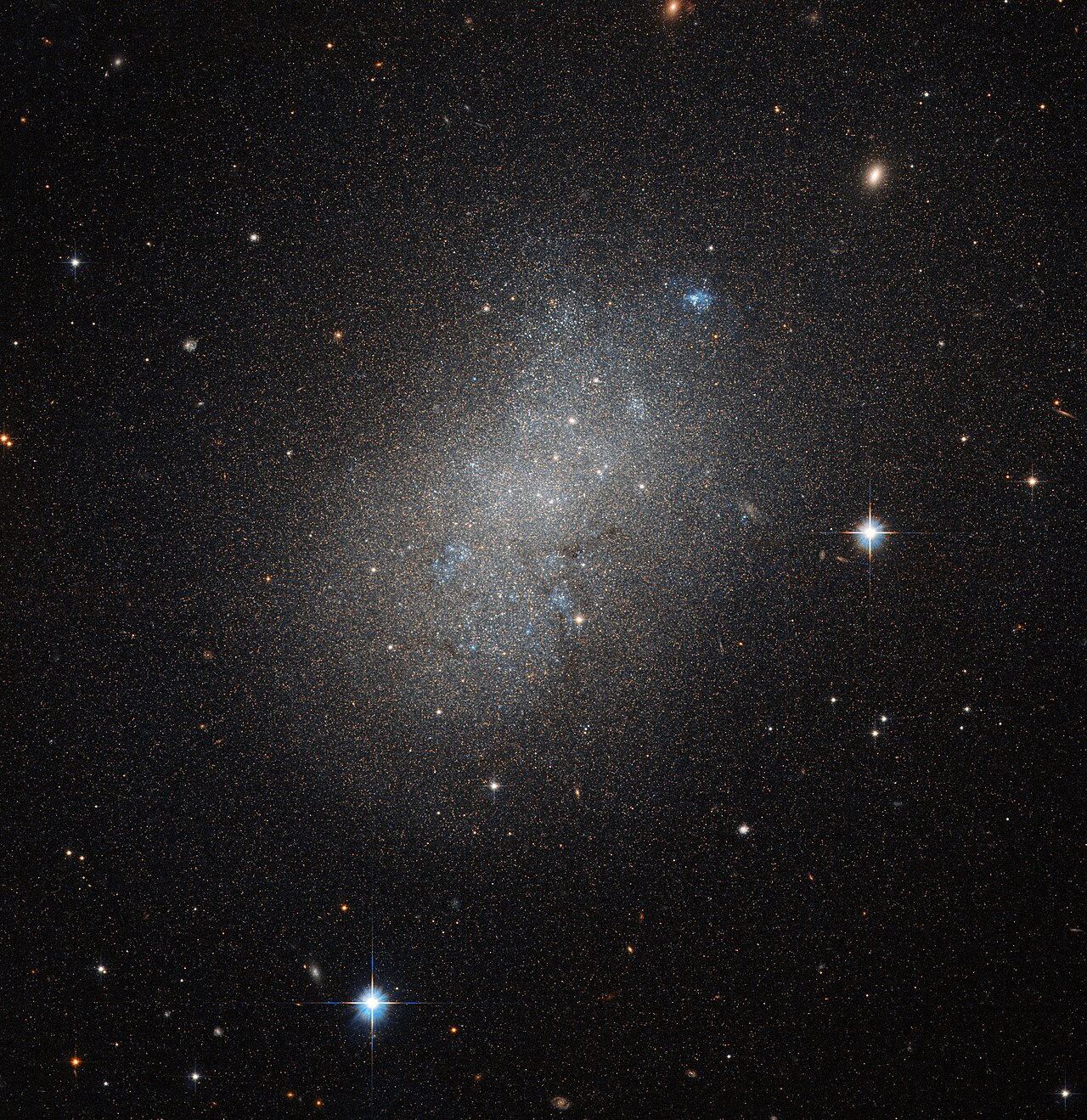
Some of the most visually interesting dwarf galaxies are dwarf irregular galaxies.
These systems lack obvious structure and often appear chaotic.
Instead of neat spiral arms or smooth elliptical shapes, they display scattered regions of stars, gas, and dust.
Many dwarf irregular galaxies actively form new stars.
Their abundant gas supplies fuel stellar nurseries where bright young stars emerge.
Because they continue producing stars, these galaxies often appear blue due to the presence of hot, massive stars.
The Large and Small Magellanic Clouds belong to this category.
Their ongoing star formation offers valuable opportunities for astronomers to study how stars are born.
Dwarf Elliptical Galaxies
Dwarf elliptical galaxies present a very different appearance.
They generally possess smooth, rounded shapes and contain older stellar populations.
Unlike dwarf irregular galaxies, they often have little gas available for creating new stars.
As a result, dwarf ellipticals tend to appear redder and less active.
Many reside near larger galaxies, suggesting that environmental effects may have stripped away their gas over time.
Though less dramatic in appearance, dwarf elliptical galaxies provide important insights into galactic aging and evolution.
Dwarf Spheroidal Galaxies
Among the faintest known galaxies are dwarf spheroidal galaxies.
These systems are extremely diffuse and contain relatively few stars spread across large volumes of space.
They often possess almost no gas and exhibit little or no current star formation.
Many dwarf spheroidal galaxies orbit larger galaxies such as the Milky Way.
Their faintness makes them difficult to detect, and numerous examples have only been discovered in recent decades.
Interestingly, dwarf spheroidals appear to be heavily dominated by dark matter, making them especially important for cosmological research.
The Large Magellanic Cloud
The Large Magellanic Cloud is one of the most famous dwarf galaxies in the sky.
Located approximately 163,000 light-years from Earth, it serves as a satellite galaxy of the Milky Way.
Although classified as a dwarf galaxy, it still contains billions of stars.
Its proximity allows astronomers to study individual stars and star-forming regions in exceptional detail.
One of its most spectacular features is the Tarantula Nebula, an enormous stellar nursery producing massive stars at an extraordinary rate.
The Large Magellanic Cloud demonstrates that dwarf galaxies can be highly active and scientifically valuable despite their smaller size.
The Small Magellanic Cloud
The Small Magellanic Cloud lies near its larger companion and also orbits the Milky Way.
This dwarf galaxy has experienced a long history of gravitational interactions with both the Large Magellanic Cloud and our galaxy.
These interactions have influenced its structure and triggered episodes of star formation.
Astronomers have observed streams of gas connecting the Magellanic Clouds, evidence of their ongoing relationship.
Studying these neighboring galaxies helps scientists understand how gravitational encounters shape galactic evolution.
Ancient Relics of the Early Universe
Some dwarf galaxies may be among the oldest surviving structures in existence.
Because many experienced relatively little growth compared to larger galaxies, they can preserve information about conditions shortly after the Big Bang.
Their stars often contain very low concentrations of heavy elements.
This suggests they formed early in cosmic history before multiple generations of stars enriched the universe with heavier materials.
By studying these ancient stars, astronomers gain insight into the first stages of galaxy formation and the chemical evolution of the cosmos.
In this way, dwarf galaxies function as time capsules carrying messages from the distant past.
Star Formation in Dwarf Galaxies
Despite their modest sizes, many dwarf galaxies are surprisingly productive when it comes to creating stars.
Gas clouds within these galaxies collapse under gravity, forming stellar nurseries.
Newborn stars illuminate surrounding gas, producing beautiful glowing regions visible across vast distances.
Star formation in dwarf galaxies can be strongly influenced by external forces.
Interactions with larger galaxies may compress gas and trigger bursts of stellar birth.
Conversely, powerful stellar winds and supernova explosions can remove gas and slow future star formation.
The balance between these competing processes shapes the destiny of each dwarf galaxy.
Gravitational Relationships with Larger Galaxies
Dwarf galaxies often live under the gravitational influence of larger neighbors.
The Milky Way, for example, exerts powerful tidal forces on its satellite galaxies.
Over billions of years, these forces can stretch dwarf galaxies, remove stars, and strip away gas.
Sometimes entire dwarf galaxies are gradually torn apart.
Their stars become incorporated into the larger galaxy, contributing to its growth.
Astronomers have found evidence that the Milky Way has absorbed numerous dwarf galaxies throughout its history.
The process continues today and will likely continue far into the future.
Galactic Cannibalism
The idea of one galaxy consuming another may sound dramatic, but it is a normal part of cosmic evolution.
Large galaxies often grow by absorbing smaller companions.
This process is sometimes called galactic cannibalism.
When a dwarf galaxy approaches a larger galaxy, gravitational forces can gradually dismantle it.
Its stars spread out into streams that eventually blend into the larger system.
Evidence of these stellar streams surrounds the Milky Way.
They serve as visible reminders of past mergers and ongoing galactic growth.
Every absorbed dwarf galaxy leaves behind clues about its existence.
Dwarf Galaxies and the Growth of the Milky Way
The Milky Way did not appear fully formed.
Like many galaxies, it likely grew through repeated mergers and accretion events.
Dwarf galaxies played a major role in this process.
Over billions of years, our galaxy absorbed smaller companions, adding stars, gas, and dark matter to its structure.
Modern observations reveal remnants of these ancient mergers.
Some star clusters and stellar populations within the Milky Way may have originated in long-destroyed dwarf galaxies.
Understanding these events helps reconstruct the history of our galactic home.
Searching for Hidden Dwarf Galaxies
One of the biggest challenges in astronomy involves finding dwarf galaxies.
Many are extremely faint.
Some contain so few stars that they blend into the background of space.
Advanced surveys and powerful telescopes have dramatically increased the number of known dwarf galaxies.
Yet astronomers suspect many more remain undiscovered.
Future observatories may reveal hundreds or even thousands of additional dwarf galaxies surrounding the Milky Way and other galaxies.
Each new discovery provides another opportunity to test theories of galaxy formation and dark matter.
Dwarf Galaxies Beyond the Local Group
The Milky Way belongs to a collection of galaxies known as the Local Group.
This group contains more than fifty known galaxies, most of which are dwarfs.
However, dwarf galaxies exist far beyond our local region.
They populate galaxy clusters, galaxy groups, and isolated regions throughout the observable universe.
Their abundance suggests they are a fundamental feature of cosmic structure.
Studying dwarf galaxies across different environments helps astronomers understand how surroundings influence galactic evolution.
Challenges to Cosmological Theories
Interestingly, dwarf galaxies have sometimes posed problems for theoretical models.
Computer simulations often predict more dwarf galaxies than astronomers observe.
This discrepancy became known as the “missing satellites problem.”
Although improved observations have discovered many additional dwarf galaxies, questions remain.
Researchers continue refining models of galaxy formation to explain the distribution and properties of dwarf galaxies.
These challenges illustrate how even the smallest galaxies can influence our understanding of the universe on the largest scales.
The Beauty of Small Galaxies
In a universe filled with spectacular giants, dwarf galaxies possess a quieter kind of beauty.
They lack the dramatic spiral arms of large galaxies.
They rarely dominate astronomical photographs.
Yet their subtle glow reflects billions of years of cosmic history.
Many contain ancient stars older than most structures in the Milky Way.
Others shine with fresh star formation and youthful energy.
Their diversity reminds us that nature’s creativity is not limited by size.
Even the smallest galaxies can be remarkable.
What Dwarf Galaxies Teach Us About Ourselves
There is something surprisingly relatable about dwarf galaxies.
Human attention often gravitates toward the biggest, brightest, and most powerful objects.
Yet dwarf galaxies demonstrate that significance is not measured solely by size.
Though small compared to cosmic giants, they hold essential clues about the history and structure of the universe.
Without dwarf galaxies, astronomers would struggle to understand how galaxies form, how dark matter behaves, and how cosmic evolution unfolds.
The universe depends on its smaller members just as much as its larger ones.
In that sense, dwarf galaxies teach a lesson extending beyond astronomy itself.
The Future of Dwarf Galaxy Research
The coming decades promise exciting discoveries.
New telescopes and surveys will reveal previously hidden dwarf galaxies throughout the cosmos.
Researchers will continue investigating their dark matter content, star formation histories, and relationships with larger galaxies.
Observations may uncover entirely new classes of dwarf galaxies.
They may also help solve longstanding mysteries concerning galaxy formation and the nature of dark matter.
As technology advances, dwarf galaxies will remain at the forefront of astronomical research.
Their small size belies their enormous scientific importance.
Conclusion
Dwarf galaxies are the small but essential members of the cosmic community. Containing far fewer stars than giant galaxies like the Milky Way, they nevertheless play a central role in understanding the universe. Many serve as satellite companions orbiting larger galaxies, while others exist independently across the cosmos. Rich in history, dark matter, and scientific significance, they offer unique insights into galaxy formation, stellar evolution, and the earliest eras of cosmic history.
Often overlooked beside their larger neighbors, dwarf galaxies are far more than cosmic side characters. They are ancient survivors, active star factories, and crucial building blocks in the grand story of the universe. From the nearby Magellanic Clouds to the faintest newly discovered satellite galaxies, these small celestial neighborhoods continue to reveal profound truths about how the cosmos came to be.
In the end, dwarf galaxies remind us that in astronomy, as in life, greatness is not always measured by size. Sometimes the smallest members of a community hold the biggest secrets.