Supergiant stars are among the most breathtaking objects in the universe. They are enormous, brilliant, and incredibly powerful—true cosmic giants that outshine hundreds of thousands, or even millions, of ordinary stars. If our Sun were a candle, many supergiant stars would be like enormous searchlights visible from across vast cosmic distances.
Yet these magnificent stars are also living on borrowed time. Their immense brightness comes at a tremendous cost. They burn through their nuclear fuel at astonishing rates, live only a tiny fraction of the Sun’s lifetime, and often end their lives in some of the most violent explosions the universe has ever seen.
Without supergiant stars, many of the elements that make up planets, oceans, and even our own bodies would never have existed. The calcium in your bones, the oxygen you breathe, the iron in your blood, and much of the carbon essential for life were forged inside massive stars and scattered across space when they died.
Understanding supergiant stars is not just about learning how giant stars live. It is also about understanding where the building blocks of life came from and how the universe continually creates new generations of stars and planets.
What Is a Supergiant Star?
A supergiant star is an extremely massive and luminous star that has evolved beyond the main stage of its life. These stars are much larger, brighter, and more massive than the Sun and most other stars in the Milky Way.
Astronomers classify stars according to their brightness, temperature, and size. Supergiants belong to the highest luminosity class, known as luminosity class I. This means they are among the brightest stars known.
While the Sun has a diameter of about 1.39 million kilometers (864,000 miles), many supergiants are hundreds or even more than a thousand times wider. Some are so enormous that if placed at the center of our Solar System, their outer atmosphere would extend beyond the orbit of Jupiter or even Saturn.
Despite their immense size, supergiants are relatively rare. Most stars in the universe, including our Sun, will never become supergiants.
How Supergiant Stars Form
Every star begins inside a vast cloud of gas and dust called a molecular cloud. Gravity slowly pulls the cloud together, forming dense regions that become protostars.
Most newborn stars gather only a modest amount of material before their formation ends. However, occasionally a protostar accumulates an enormous amount of hydrogen, giving birth to a truly massive star.
A star generally needs to begin its life with at least about eight times the Sun’s mass to eventually become a supergiant. Some of the largest known supergiants were born with more than fifty or even one hundred times the Sun’s mass.
The greater a star’s mass, the stronger its gravity becomes. This enormous gravity compresses the star’s core to incredible temperatures and pressures, allowing nuclear fusion to occur much more rapidly than in smaller stars.
Ironically, being more massive means a much shorter life. Although they contain far more fuel than the Sun, supergiants consume it so quickly that they exhaust it in only millions of years instead of billions.
The Main-Sequence Life of a Massive Star
Before becoming a supergiant, a massive star spends its youth on what astronomers call the main sequence.
During this stage, hydrogen atoms in the core fuse together to create helium. This nuclear fusion releases tremendous amounts of energy that push outward against gravity.
This delicate balance between inward gravity and outward pressure keeps the star stable.
Massive stars perform this balancing act at extraordinary rates. They may shine tens of thousands or even millions of times brighter than the Sun.
Eventually, however, the hydrogen fuel in the core begins to run out.
The Transformation into a Supergiant
As hydrogen becomes depleted in the core, the balance inside the star changes dramatically.
Without enough fusion in the center, gravity begins to compress the core. The compression raises the temperature even further until helium fusion begins.
At the same time, the outer layers expand enormously.
The star grows larger and cooler at its surface while becoming even more luminous overall. At this stage, it has transformed into a supergiant.
The exact appearance of the star depends largely on its surface temperature.
Red Supergiants
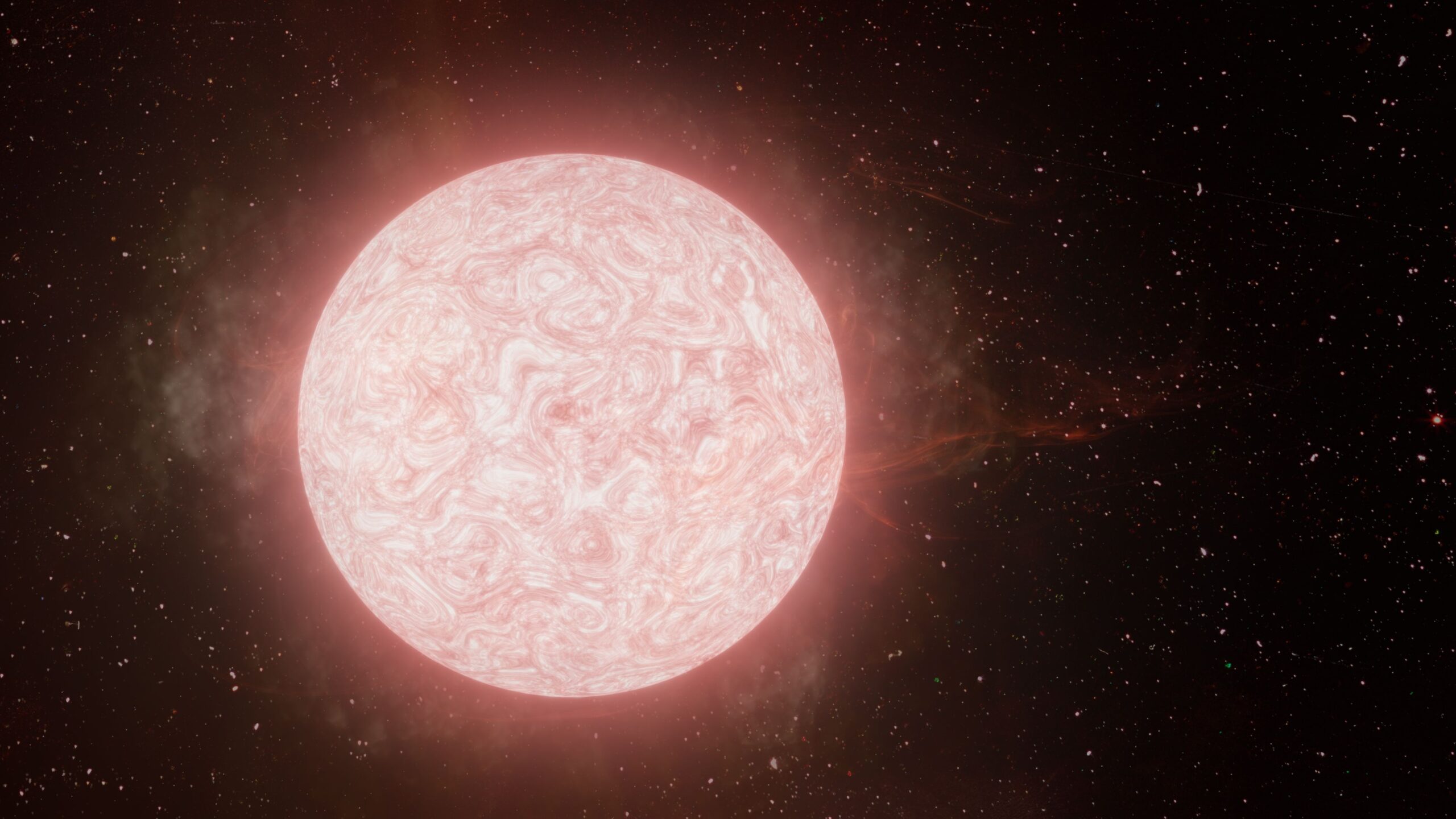
Red supergiants are among the largest stars by physical size.
Their surfaces are relatively cool compared with many other stars, usually ranging from about 3,500 to 4,500 kelvin. Because cooler stars emit more red light, they appear orange-red to our eyes.
Although their surfaces are cooler than the Sun’s, red supergiants remain extremely luminous simply because they possess such enormous surface areas.
One of the most famous examples is Betelgeuse, the bright reddish star marking the shoulder of the constellation Orion.
Betelgeuse is estimated to be hundreds of times wider than the Sun. If placed at the center of our Solar System, its outer atmosphere would likely extend beyond the orbit of Mars and possibly approach Jupiter, depending on its changing size.
Red supergiants have very extended atmospheres that slowly lose gas into surrounding space through powerful stellar winds.
Blue Supergiants
Not all supergiants are red.
Some remain incredibly hot, with surface temperatures exceeding 10,000 kelvin and sometimes reaching well above 30,000 kelvin.
These stars appear blue because hotter objects emit more short-wavelength light.
Blue supergiants are among the brightest stars in entire galaxies.
They produce intense ultraviolet radiation capable of ionizing nearby clouds of gas, creating beautiful glowing nebulae.
Rigel, another bright star in Orion, is a well-known blue supergiant.
Although blue supergiants are generally smaller than red supergiants in physical diameter, they are often hotter and even more luminous.
Yellow and White Supergiants
Some supergiants occupy intermediate temperatures.
Yellow supergiants have temperatures between red and blue supergiants and often represent transitional phases during stellar evolution.
White supergiants are hotter than yellow ones but cooler than many blue supergiants.
These stages may last only relatively short periods as the star continues evolving toward its final fate.
Just How Big Can Supergiant Stars Become?
The size of some supergiants stretches the imagination.
The Sun’s radius is approximately 696,000 kilometers.
Some red supergiants exceed one thousand solar radii.
A few of the largest known stars approach or exceed 1,500 times the Sun’s radius, although exact measurements remain challenging because these stars have diffuse outer atmospheres rather than sharply defined surfaces.
If one of these enormous stars replaced the Sun, Mercury, Venus, Earth, and Mars would all lie deep inside the star.
Even Jupiter could be engulfed by the largest known examples.
Yet despite their colossal size, these stars are surprisingly diffuse.
Their average density can be millions or billions of times lower than Earth’s atmosphere at sea level. In some outer regions, the gas is so thin that it resembles an almost perfect vacuum by terrestrial standards.
Why Supergiants Shine So Brightly
A star’s brightness depends on both its size and temperature.
Supergiants combine enormous surface areas with extremely high energy production inside their cores.
The result is staggering luminosity.
Some supergiants emit hundreds of thousands of times more energy than the Sun every second.
The brightest known examples produce over a million times the Sun’s luminosity.
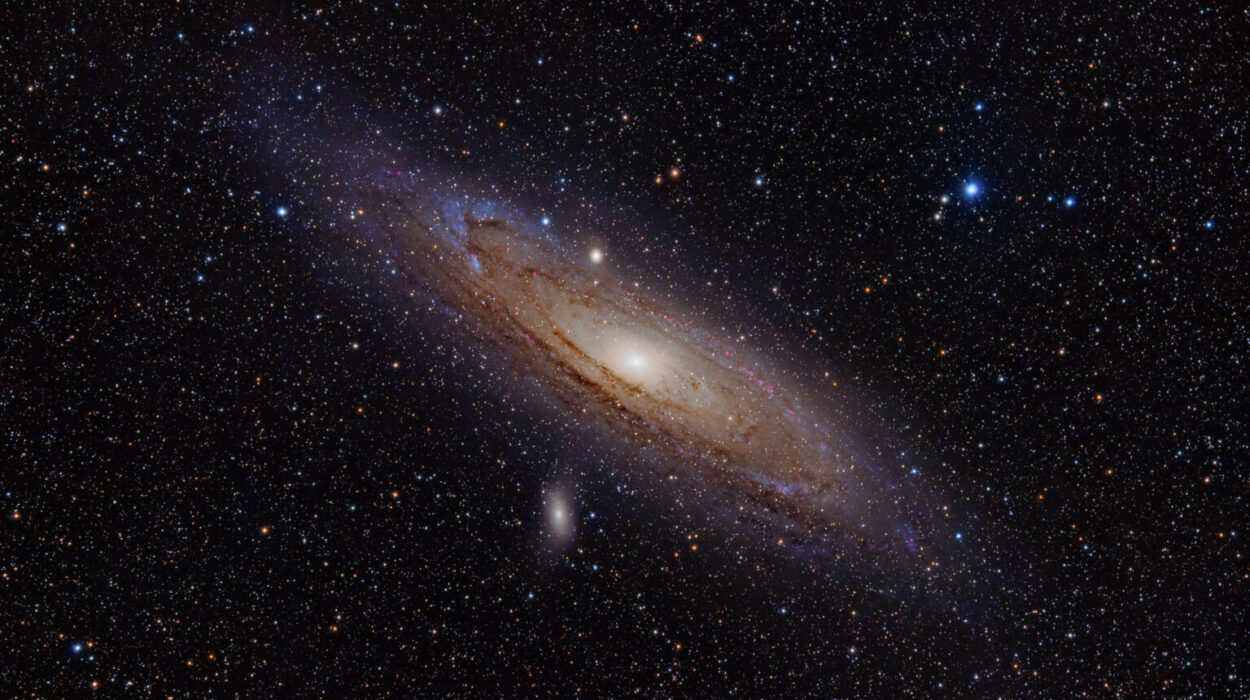
Because of their brilliance, astronomers can observe supergiants in distant galaxies millions of light-years away.
The Nuclear Furnace Inside a Supergiant
The interior of a supergiant is an extraordinary nuclear factory.
Unlike the Sun, which currently fuses only hydrogen into helium, supergiants eventually fuse many heavier elements.
After helium becomes exhausted, the core contracts again until carbon fusion begins.
Later come neon fusion, oxygen fusion, and silicon fusion.
Each new stage requires even higher temperatures and pressures.
The sequence continues until the star begins producing iron.
This marks the beginning of the end.
Why Iron Changes Everything
Fusion normally releases energy.
Iron is different.
Fusing iron consumes energy instead of releasing it.
Once the core becomes mostly iron, nuclear fusion can no longer support the star against gravity.
The core suddenly collapses under its own enormous weight.
Within fractions of a second, matter falls inward at astonishing speeds.
Temperatures soar into the billions of degrees.
The collapse halts only when atomic nuclei are crushed together so tightly that the core becomes incredibly dense.
The rebound from this collapse triggers one of nature’s greatest explosions.
The Spectacular Death of a Supergiant
Most massive supergiants end their lives as core-collapse supernovae.
These explosions briefly outshine entire galaxies.
For weeks or months, a single dying star can emit more visible light than billions of ordinary stars combined.
The explosion blasts newly created elements into surrounding space at thousands of kilometers per second.
These expanding clouds enrich the galaxy with heavy elements that later become part of new stars, planets, and eventually living organisms.
In a very real sense, much of the matter around us was once inside ancient supergiant stars.
What Is Left Behind?
The explosion does not always completely destroy the core.
If the remaining core has enough mass, gravity compresses it into a neutron star.
A neutron star packs more mass than the Sun into a sphere only about twenty kilometers across.
Its density is so extraordinary that a teaspoon of neutron-star material would weigh billions of tons on Earth.
If the remaining core is even more massive, gravity overwhelms every known force.
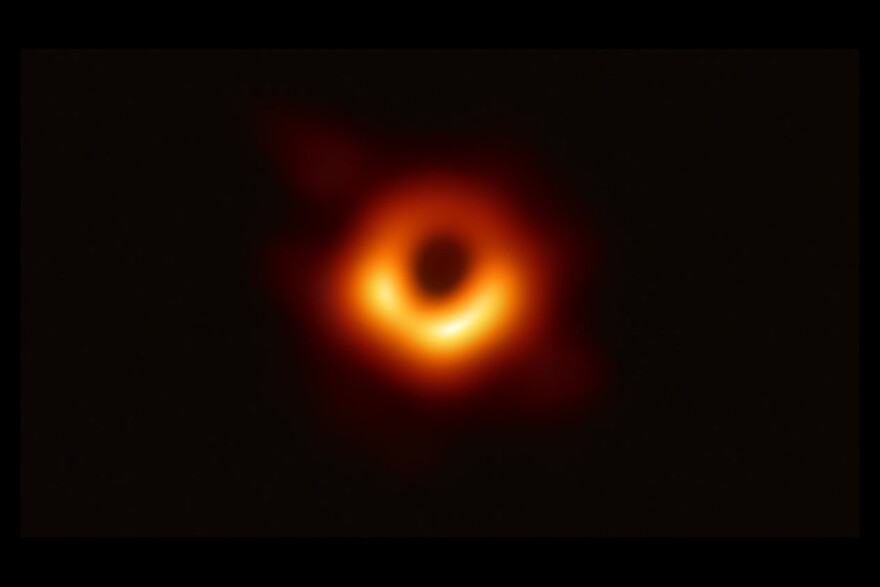
The core collapses into a black hole, a region where gravity becomes so strong that not even light can escape.
Many of the stellar-mass black holes known today were likely born from supergiant stars.
Do All Supergiants Explode?
Not every supergiant follows exactly the same path.
The star’s initial mass, chemical composition, rotation, magnetic fields, and interactions with nearby companion stars all influence its evolution.
Some lose enormous amounts of mass before exploding.
Others may collapse almost directly into black holes with relatively faint explosions.
Astronomers continue studying these differences using telescopes across the electromagnetic spectrum and advanced computer simulations.
Supergiants and the Creation of the Elements
The universe began mostly with hydrogen and helium.
Nearly all heavier elements were created inside stars.
Supergiants are particularly important because they manufacture many of the elements essential for rocky planets and life.
During their lifetimes and especially during their explosive deaths, they release oxygen, carbon, magnesium, silicon, sulfur, calcium, iron, and many other elements into space.
Future generations of stars inherit these enriched materials.
Our Solar System formed from such recycled stellar debris about 4.6 billion years ago.
Every person on Earth is literally made from atoms forged in ancient stars.
As astronomer Carl Sagan famously expressed it, we are “star stuff.”
How Long Do Supergiant Stars Live?
Compared with the Sun, supergiants live remarkably short lives.
The Sun is expected to remain on the main sequence for about ten billion years.
Many supergiants survive only around ten million years.
The most massive may live only a few million years before exploding.
Although these lifetimes seem unimaginably long from a human perspective, they are extremely brief on cosmic timescales.
Their short lives are the price they pay for their extraordinary brilliance.
How Astronomers Study Supergiants
Modern telescopes allow astronomers to investigate supergiants in remarkable detail.
Optical telescopes reveal their brightness, color, and changing atmospheres.
Infrared observations penetrate surrounding dust and detect cool material flowing away from the stars.
Ultraviolet telescopes study their hot outer layers.
Radio telescopes trace expanding clouds of gas.
Space observatories detect X-rays and gamma rays produced by energetic processes associated with massive stars and supernova remnants.
Computer models help researchers reconstruct the complex physical processes occurring deep inside these stellar giants.
Together, these observations improve our understanding of how massive stars evolve.
Famous Supergiant Stars
Several supergiants have become well known because of their extraordinary properties.
Betelgeuse is perhaps the most famous red supergiant. Its noticeable reddish color makes it easy to identify in the winter sky of the Northern Hemisphere. Because it is nearing the end of its life, astronomers closely monitor its changing brightness and enormous atmosphere.
Rigel is a brilliant blue supergiant that shines intensely despite being much farther away than many bright stars visible from Earth.
Antares, located in the constellation Scorpius, is another spectacular red supergiant whose name means “rival of Mars” because of its striking reddish appearance.
Deneb, one of the brightest stars in the summer sky, is a luminous blue-white supergiant and one of the most intrinsically luminous stars visible without a telescope.
These stars serve as natural laboratories for studying the life cycles of the most massive stars.
Why Supergiant Stars Matter
Supergiant stars are much more than oversized versions of the Sun.
They are cosmic engines that shape galaxies, create the elements of life, trigger the birth of new stars, and produce some of the universe’s most spectacular explosions.
Without them, the universe would contain far fewer of the chemical elements needed to build rocky planets, oceans, and living organisms.
Every supergiant is a reminder that creation and destruction are deeply connected in the cosmos. A star spends millions of years forging the ingredients of future worlds, only to scatter them across space in a final, brilliant explosion. From that stellar debris, new stars ignite, new planets form, and perhaps somewhere, new life begins.
When we look at a glowing supergiant through a telescope, we are witnessing one of nature’s greatest masterpieces—a colossal star burning with unimaginable power, illuminating the darkness of space, and quietly preparing the raw materials for the next generation of the universe.