On a clear night, the stars scattered across the sky may all appear similar. Some shine brighter than others, some twinkle with hints of color, but to the naked eye they seem like tiny points of light. In reality, those distant lights represent an astonishing variety of stars. Some are small and cool, while others are unimaginably large and incredibly powerful. Among the most spectacular of them are supergiant stars—the true giants of the cosmos.
Supergiant stars are among the biggest, brightest, and most massive stars ever discovered. They are so enormous that if one replaced our Sun, it could stretch far beyond the orbit of Mars or even Jupiter, depending on the star. Their brilliant light can outshine hundreds of thousands or even millions of Suns, making them visible across vast distances in our galaxy and beyond.
Yet despite their enormous size and incredible brightness, supergiant stars live surprisingly short lives. They burn through their nuclear fuel at an astonishing rate, ending their existence in some of the most violent explosions the universe has ever seen. These cosmic giants are responsible for creating many of the elements that eventually become planets, oceans, and even living organisms.
Understanding supergiant stars is not just about learning how massive stars work. It is also about understanding how galaxies evolve, how heavy elements are created, and ultimately how the ingredients for life came to exist.
What Is a Supergiant Star?
A supergiant star is an extremely large and luminous star that has evolved beyond the main stage of its life. These stars are significantly larger and more massive than ordinary stars like the Sun and belong to the highest luminosity classes in stellar classification.
Astronomers generally classify a star as a supergiant based on its brightness, size, and stage of evolution. Most supergiants began their lives with at least eight times the mass of the Sun, although some formed with more than one hundred solar masses.
As these stars age, dramatic changes occur deep inside their cores. The balance between gravity pulling inward and pressure pushing outward begins to shift, causing the star to expand enormously. This expansion transforms an already massive star into a supergiant.
Although the term “supergiant” suggests that these stars are simply larger versions of ordinary stars, they are actually very different. Their internal structure, energy production, lifespan, and eventual fate all differ dramatically from stars like our Sun.
How Big Are Supergiant Stars?
The size of a supergiant star is almost impossible to imagine using everyday experience.
Our Sun has a diameter of about 1.39 million kilometers (864,000 miles), which already seems enormous. More than one million Earths could fit inside the Sun.
Now consider a red supergiant like Betelgeuse. Depending on how its outer atmosphere is measured, its radius is roughly several hundred to around one thousand times that of the Sun. If placed at the center of our Solar System, its outer layers would extend beyond the orbit of Mars and could approach the orbit of Jupiter.
Some of the largest known red supergiants and hypergiants, such as Stephenson 2-18 or WOH G64, are estimated to have radii exceeding 1,500 times that of the Sun, though these estimates remain uncertain because defining the outer edges of such stars is challenging.
Despite their enormous size, supergiants are not always the most massive stars. As they expand, their outer layers become extremely diffuse. In many cases, their average density is astonishingly low. If it were somehow possible to place part of a supergiant’s atmosphere in a container, it would resemble an extremely thin vacuum compared with Earth’s atmosphere.
How Bright Are Supergiant Stars?
Supergiants rank among the brightest stars in the universe.
Their tremendous brightness comes from two important factors: their large size and their high energy output.
Some supergiants shine tens of thousands of times brighter than the Sun. The most luminous blue supergiants and related massive evolved stars can exceed a million times the Sun’s luminosity.
Because they are so bright, astronomers can observe them across enormous cosmic distances. Supergiant stars help scientists measure the structure of galaxies and investigate regions where new stars are forming.
Their brilliant light also influences nearby gas clouds, heating and ionizing them while helping shape future generations of stars.
How Do Supergiant Stars Form?
Every supergiant begins its life inside a giant cloud of cold gas and dust called a molecular cloud.
Gravity gradually pulls material together until a dense region forms. As more gas falls inward, pressure and temperature rise dramatically.
Eventually, the core becomes hot enough for hydrogen nuclei to fuse into helium. At this point, a new star is born.
Only the most massive newborn stars have enough material to eventually become supergiants. During the main sequence stage, these stars burn hydrogen in their cores at extraordinary rates.
While the Sun can continue this process for roughly 10 billion years, a very massive star may exhaust its hydrogen in only a few million years.
This rapid consumption of fuel sets the stage for the star’s transformation into a supergiant.
The Different Types of Supergiant Stars
Supergiants come in several varieties, each representing different temperatures and evolutionary stages.
Blue Supergiants
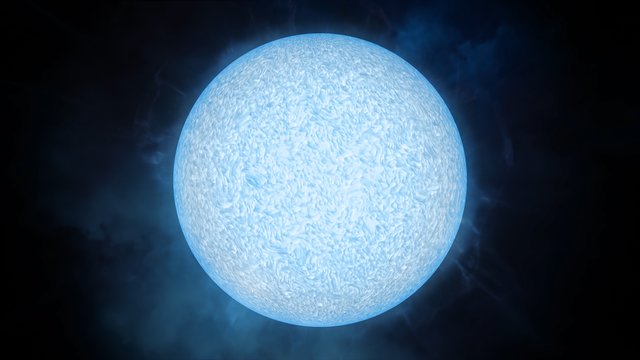
Blue supergiants are among the hottest stars in the universe.
Their surface temperatures often exceed 10,000 kelvins and can reach more than 30,000 kelvins. They appear brilliant blue because they emit enormous amounts of high-energy light.
Although blue supergiants are extremely hot, they are usually smaller in radius than red supergiants. Their intense heat allows them to produce extraordinary amounts of energy despite their comparatively smaller size.
Many blue supergiants eventually evolve into red supergiants, although the exact path depends on their initial mass and the amount of mass they lose through powerful stellar winds.
Red Supergiants
Red supergiants represent one of the final evolutionary stages of many massive stars.
As hydrogen fusion in the core ends, the star expands dramatically while its outer layers cool. This cooler surface gives the star its reddish appearance.
Even though their surfaces are cooler than those of blue supergiants, red supergiants remain incredibly luminous because of their enormous size.
Famous examples include Betelgeuse in the constellation Orion and Antares in Scorpius.
Yellow Supergiants
Yellow supergiants are relatively rare.
These stars often represent transitional stages between blue and red supergiants. Some are evolving toward cooler temperatures, while others are becoming hotter again after shedding large amounts of mass.
Because this evolutionary phase is relatively brief, astronomers observe fewer yellow supergiants than red or blue ones.
What Happens Inside a Supergiant?
The interior of a supergiant is one of the most fascinating environments in astrophysics.
While ordinary stars like the Sun mainly fuse hydrogen into helium, supergiants continue creating increasingly heavier elements as they age.
Once hydrogen is exhausted in the core, helium begins fusing into carbon and oxygen.
As temperatures rise further, the star starts producing neon, magnesium, oxygen, silicon, sulfur, and other elements.
Each new stage requires even higher temperatures and pressures than the one before.
Eventually, the core begins producing iron.
This marks the beginning of the end.
Unlike lighter elements, iron fusion does not release energy. Instead, it consumes energy. Without sufficient outward pressure from nuclear fusion, gravity suddenly gains the upper hand.
The core collapses in a matter of seconds.
The Life Cycle of a Supergiant Star
The life of a supergiant is dramatic from beginning to end.
It begins as a massive young star forming within a dense molecular cloud.
During its main sequence stage, it rapidly converts hydrogen into helium through nuclear fusion.
Once the hydrogen in the core is depleted, the star expands into a supergiant while beginning new stages of nuclear burning.
Over time, heavier and heavier elements are created inside concentric layers surrounding the core, resembling the layers of an onion.
As iron accumulates in the center, nuclear fusion can no longer support the star.
Gravity causes the core to collapse almost instantly.
The outer layers rebound in a catastrophic explosion known as a core-collapse supernova.
This explosion briefly outshines entire galaxies.
Depending on the star’s remaining core mass, the explosion leaves behind either a neutron star or a black hole.
Why Do Supergiants Die So Quickly?
It seems surprising that the universe’s largest stars live much shorter lives than smaller ones.
The reason lies in how rapidly they consume fuel.
Imagine two candles. One burns slowly for many hours, while another burns with an enormous flame and quickly melts away.
Massive stars behave like the brighter candle.
Although they begin with far more hydrogen than smaller stars, their immense gravitational pressure forces nuclear fusion to occur at an extraordinary rate.
As a result, many supergiants survive only a few million to a few tens of millions of years.
By comparison, our Sun will remain stable for about 10 billion years.
Supernova Explosions and Cosmic Recycling
When a supergiant explodes as a supernova, it does far more than destroy a star.
The explosion creates and disperses many of the universe’s heavy elements.
Gold, uranium, iodine, calcium, and many other elements essential for planets and life are either forged or scattered during the deaths of massive stars.
These materials become part of giant clouds of gas and dust.
Over millions of years, new stars and planetary systems form from this enriched material.
Every atom of calcium in your bones and much of the iron in your blood originated inside ancient stars that lived and died billions of years before the Solar System formed.
In this sense, supergiants help recycle matter throughout the universe.
Famous Supergiant Stars
One of the best-known supergiants is Betelgeuse, located in the constellation Orion. Its reddish color makes it one of the easiest supergiants to recognize in the night sky. Betelgeuse has attracted enormous scientific attention because it is nearing the end of its life, although “nearing” in astronomical terms could still mean tens of thousands of years.
Another famous example is Rigel, a brilliant blue supergiant that is also found in Orion. It is one of the brightest stars visible from Earth and shines with tens of thousands of times the Sun’s luminosity.
Antares, the heart of the constellation Scorpius, is another spectacular red supergiant known for its deep reddish color.
More extreme examples include Deneb, Mu Cephei, VY Canis Majoris, and several enormous hypergiants whose exact sizes remain active areas of research.
Supergiants Versus Hypergiants
The terms “supergiant” and “hypergiant” are sometimes confused.
Hypergiants represent an even rarer class of extremely massive and luminous stars. They experience extraordinary mass loss through powerful stellar winds and are often unstable.
Not every supergiant becomes a hypergiant.
Only the most massive stars evolve into this exceptional category.
Hypergiants are among the most luminous individual stars known, but they are also among the shortest-lived.
Can Our Sun Become a Supergiant?
The answer is no.
The Sun simply does not have enough mass.
Instead of becoming a supergiant, the Sun will eventually expand into a red giant about five billion years from now.
Although it will grow large enough to engulf or severely affect the inner planets, it will never approach the size or luminosity of a true supergiant.
After shedding its outer layers, the Sun will leave behind a white dwarf rather than exploding as a supernova.
This peaceful ending is very different from the violent deaths experienced by supergiants.
How Astronomers Study Supergiant Stars
Modern astronomy uses a wide range of techniques to investigate these remarkable stars.
Powerful telescopes collect visible light, infrared radiation, ultraviolet light, radio waves, and X-rays emitted by supergiants.
Spectroscopy allows astronomers to determine a star’s temperature, chemical composition, motion, and surface gravity by analyzing its light.
Space telescopes observe wavelengths that Earth’s atmosphere blocks, revealing details invisible from the ground.
Computer simulations help scientists model the internal structure of supergiants, their turbulent atmospheres, their powerful stellar winds, and their explosive deaths.
Each new observation improves our understanding of stellar evolution and the history of the universe.
Why Supergiant Stars Matter
Supergiant stars are much more than giant celestial objects.
They are cosmic factories that create and distribute the chemical elements needed for rocky planets and life. They shape galaxies through their intense radiation and powerful stellar winds. Their explosive deaths trigger the birth of new generations of stars while leaving behind neutron stars and black holes that continue influencing the cosmos.
Without supergiants, the universe would contain far fewer of the heavy elements that make planets, oceans, mountains, and living organisms possible.
Studying these extraordinary stars allows astronomers to reconstruct the life stories of galaxies and understand how matter evolves across billions of years.
The Lasting Legacy of Cosmic Giants
Supergiant stars remind us that the universe operates on scales far beyond ordinary imagination. They are immense, brilliant, and short-lived, yet their influence extends across entire galaxies and billions of years of cosmic history.
Although these stellar giants eventually meet spectacular ends, their deaths are not simply endings. They are beginnings. Every supernova enriches the universe with new elements, making future stars, planets, and perhaps even life itself possible.
When you look up at a bright star like Betelgeuse or Rigel, you are witnessing a chapter in one of nature’s greatest stories—a story of creation, transformation, destruction, and renewal. Supergiant stars stand among the most magnificent objects in the cosmos, reminding us that even the mightiest stars have lifetimes, and that their final acts help shape the future of the universe itself.