When most people imagine our Solar System, they picture the eight planets circling the Sun in orderly paths. Mercury races closest to the Sun, while Neptune drifts in the cold darkness nearly 4.5 billion kilometers away. But this familiar image tells only a small part of the story.
The Sun’s gravitational influence extends far beyond the planets. Billions of natural objects—asteroids, dwarf planets, comets, icy worlds, mysterious interstellar visitors, and even pieces of human technology—travel through the Solar System. Some are nearly spherical worlds with underground oceans. Others are oddly shaped mountains of rock tumbling through space. A few follow bizarre orbits so elongated that they spend thousands of years in deep darkness before briefly approaching the Sun.
Over the past few decades, increasingly powerful telescopes and spacecraft have revealed that the Solar System is far stranger than astronomers once imagined. Many of these objects challenge traditional definitions of planets, while others preserve clues about the earliest days of the Solar System nearly 4.6 billion years ago.
Some may even help scientists understand how Earth acquired its water, how planets formed, or how life-friendly environments can exist far from sunlight.
Here are fifteen of the strangest known objects orbiting the Sun and the fascinating science behind them.
1. Pluto: The Dwarf Planet That Refused to Be Ordinary
For more than seventy years, Pluto was celebrated as the Solar System’s ninth planet. Then, in 2006, the International Astronomical Union reclassified it as a dwarf planet because it does not gravitationally dominate its orbital neighborhood.
Far from diminishing Pluto’s importance, this change sparked one of the most exciting eras in planetary science.
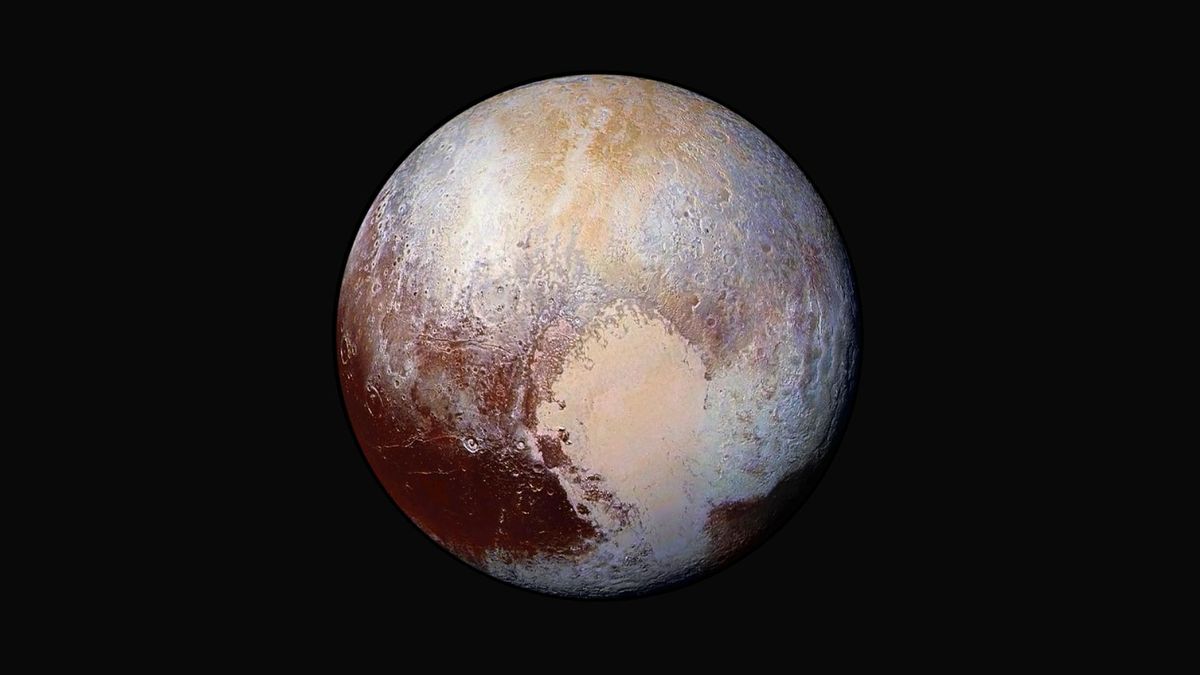
When NASA’s New Horizons spacecraft flew past Pluto in 2015, it revealed a remarkably active world. Scientists expected a frozen, heavily cratered object. Instead, they found enormous nitrogen glaciers, towering mountains made of water ice, possible cryovolcanoes, layered atmospheric haze, and a vast heart-shaped basin called Tombaugh Regio.
The most surprising feature may be Sputnik Planitia, a giant nitrogen-ice plain that appears geologically young. Evidence suggests that convection within the ice slowly reshapes the surface, meaning Pluto remains active despite its great distance from the Sun.
Beneath its icy crust, many researchers believe Pluto may even harbor a subsurface ocean.
Rather than becoming less interesting after losing planetary status, Pluto became one of the Solar System’s most scientifically intriguing worlds.
2. Sedna: The Lonely World from the Edge of the Solar System
Few known objects possess an orbit as extraordinary as Sedna.
Its highly elongated path carries it from about 76 astronomical units (AU) from the Sun at closest approach to nearly 1,000 AU at its most distant point. One AU is the average distance between Earth and the Sun.
A single orbit takes approximately 11,400 years.
Sedna spends almost all of its existence in extreme darkness, where sunlight is hundreds of thousands of times weaker than on Earth.
Its orbit is difficult to explain using the known planets alone. Astronomers have proposed several possibilities.
Perhaps a passing star disturbed its orbit billions of years ago when the Sun was still inside its birth star cluster.
Perhaps it belongs to the inner Oort Cloud.
Or perhaps an undiscovered massive planet influenced its motion.
Whatever its origin, Sedna preserves valuable clues about the Solar System’s earliest environment.
3. ʻOumuamua: The First Known Interstellar Visitor
In October 2017, astronomers detected an object unlike anything previously observed.
Named ʻOumuamua, a Hawaiian word meaning “scout” or “messenger from afar,” it was the first confirmed object known to have entered the Solar System from interstellar space.
Unlike ordinary asteroids or comets, ʻOumuamua followed a hyperbolic trajectory, meaning it was not gravitationally bound to the Sun.
Its elongated shape surprised astronomers, although later observations suggested it may instead resemble a flattened disk or pancake-like object.
Even stranger, it accelerated slightly as it departed the Solar System.
Traditional comets experience similar acceleration due to gas escaping from their surfaces. Yet ʻOumuamua showed no visible coma or dust tail.
Scientists have proposed several explanations.
Invisible hydrogen release.
Nitrogen ice sublimation.
Water ice hidden beneath unusual material.
Or complex rotational effects.
No single explanation has gained universal acceptance.
Its true nature remains one of modern astronomy’s most fascinating mysteries.
4. Ceres: The Ocean World Hidden in the Asteroid Belt
Ceres is both the largest asteroid-belt object and the smallest recognized dwarf planet.
Located between Mars and Jupiter, it contains roughly one-third of the asteroid belt’s total mass.
NASA’s Dawn spacecraft transformed scientific understanding of Ceres.
Instead of a simple rocky body, Dawn discovered bright deposits composed largely of sodium carbonate and other salts.
These brilliant white regions, especially within Occator Crater, appear to have formed when salty liquid reached the surface and evaporated.
Gravity measurements and geological observations suggest that Ceres may contain a deep layer of salty water or muddy brines beneath its crust.
Cryovolcanic activity may have occurred relatively recently in geological history.
This means that even within the asteroid belt, scientists found evidence for a world shaped by internal water activity.
5. Bennu: The Asteroid Carrying the Ingredients of Life
At first glance, Bennu resembles an ordinary dark asteroid.
In reality, it has become one of the most carefully studied small worlds in history.
NASA’s OSIRIS-REx spacecraft orbited Bennu for more than two years before collecting a sample and returning it safely to Earth.
Laboratory analysis has revealed carbon-rich minerals, water-bearing clays, phosphates, and thousands of organic molecules.
Organic molecules are not evidence of life.
However, they are the chemical building blocks from which biology can emerge.
Bennu preserves material dating back to the Solar System’s formation.
By studying these ancient compounds, scientists hope to better understand how Earth acquired the ingredients necessary for life.
6. Arrokoth: A Frozen Time Capsule
Billions of kilometers beyond Pluto lies Arrokoth, a tiny Kuiper Belt object explored by New Horizons in 2019.
Its appearance astonished scientists.
Rather than a single body, Arrokoth consists of two lobes gently joined together, resembling a snowman.
Unlike many objects that formed through violent collisions, Arrokoth appears to have formed through extremely slow merging of two separate bodies.
This gentle formation preserved its original structure.
Because Arrokoth has remained extremely cold since the Solar System formed, it serves as a nearly pristine fossil from planetary infancy.
Its chemistry and structure provide direct evidence for how planetesimals—the building blocks of planets—may have formed.
7. Haumea: The Football-Shaped Dwarf Planet
Most large astronomical objects become nearly spherical under their own gravity.
Haumea is different.
Its rapid rotation—once every four hours—has stretched it into an elongated shape resembling an American football or rugby ball.
Even more unusual, Haumea possesses a thin ring system.
It is currently the only known dwarf planet with confirmed rings.
Its surface consists largely of crystalline water ice, suggesting a violent history involving major collisions.
Astronomers believe Haumea may have suffered a massive impact that spun it up while ejecting fragments that became its moons and members of a collisional family.
8. 16 Psyche: A World Made Mostly of Metal
Most asteroids consist primarily of rock or carbon-rich material.
16 Psyche appears dramatically different.
Radar observations suggest it contains unusually large amounts of iron and nickel.
Some scientists believe Psyche could represent the exposed metallic core of an ancient protoplanet whose rocky outer layers were stripped away by enormous collisions.
If true, studying Psyche would provide the first direct opportunity to examine material resembling a planetary core.
NASA’s Psyche spacecraft is currently traveling toward this remarkable object.
Its observations could reveal how rocky planets—including Earth—developed their internal metallic cores.
9. Chiron: Neither Asteroid Nor Comet
Chiron occupies an unusual category known as a centaur.
These objects orbit between Jupiter and Neptune and exhibit characteristics of both asteroids and comets.
Discovered in 1977, Chiron initially appeared asteroid-like.
Later observations revealed a faint coma of gas and dust surrounding it, indicating cometary activity.
Remarkably, evidence also suggests Chiron may possess a ring system.
Its dual identity challenges traditional classifications.
Rather than fitting neatly into one category, Chiron demonstrates that the Solar System contains transitional objects evolving between different states.
10. Apophis: The Asteroid That Once Raised Alarm
When asteroid Apophis was discovered in 2004, initial calculations suggested a small possibility of Earth impact in 2029.
Further observations eliminated this risk.
Instead of colliding with Earth, Apophis will make an exceptionally close flyby on April 13, 2029.
It will pass within the orbits of many geostationary satellites.
The event provides an extraordinary scientific opportunity.
Astronomers will observe how Earth’s gravity influences the asteroid’s rotation, internal structure, and surface.
Close approaches like this help scientists improve planetary defense strategies while expanding understanding of asteroid physics.
11. Quaoar: The Dwarf Planet with an Impossible Ring
Quaoar orbits beyond Neptune in the Kuiper Belt.
In 2023, astronomers made a surprising discovery.
It possesses a ring located farther from the dwarf planet than classical orbital theory predicts should be stable.
Normally, particles beyond a certain distance—the Roche limit—are expected to clump together into moons.
Instead, Quaoar’s ring persists.
Researchers continue investigating why.
The discovery suggests that ring dynamics around small bodies are more complicated than previously believed.
12. Comet Hale-Bopp: The Giant Visible to Millions
Comet Hale-Bopp became one of history’s brightest comets after its discovery in 1995.
Visible to the naked eye for an unprecedented eighteen months, it inspired widespread public fascination.
Its enormous nucleus measures roughly 60 kilometers across, making it one of the largest known active comets.
Hale-Bopp displayed multiple tails created by interactions between solar radiation, dust, and electrically charged particles.
Its exceptional brightness allowed scientists to study cometary chemistry in extraordinary detail, revealing numerous volatile compounds preserved since the Solar System formed.
13. 3200 Phaethon: The Asteroid That Behaves Like a Comet
Most meteor showers originate from comets.
The Geminid meteor shower is different.
Its parent body is 3200 Phaethon, classified as an asteroid.
Yet Phaethon produces streams of debris despite lacking traditional cometary activity.
Its orbit carries it extremely close to the Sun, where temperatures exceed 700°C.
Scientists suspect thermal fracturing causes rocks to crack and shed particles.
Instead of evaporating ice driving activity, extreme heat itself may gradually break the asteroid apart.
Phaethon blurs the distinction between asteroids and comets.
14. Eris: The Discovery That Changed Planetary Science
When Eris was discovered in 2005, it appeared slightly more massive than Pluto.
Its discovery forced astronomers to confront an important question.
If Pluto was a planet, should Eris also become one?
What about future discoveries?
The resulting debate ultimately led to the creation of the dwarf planet category.
Ironically, Eris never became the tenth planet.
Instead, it reshaped the very definition of what constitutes a planet.
Located far beyond Neptune, Eris follows a highly elliptical orbit requiring roughly 558 years to complete.
Its icy surface reflects most incoming sunlight, making it one of the brightest large bodies in the Solar System.
15. Comet 67P/Churyumov–Gerasimenko: The Rubber Duck of Space
Few Solar System objects have been explored as intimately as Comet 67P.
The European Space Agency’s Rosetta mission became the first spacecraft to orbit a comet and deploy a lander onto its surface.
Images revealed an astonishing shape resembling a rubber duck, with two distinct lobes connected by a narrow neck.
Scientists believe the comet formed when two separate bodies merged gently early in Solar System history.
Rosetta detected water, carbon dioxide, molecular oxygen, phosphorus, organic compounds, and numerous other chemicals.
These discoveries strengthened the idea that comets may have delivered some of Earth’s water and organic molecules billions of years ago.
The mission transformed comet science, revealing these icy wanderers to be far more complex than previously imagined.
Why Strange Objects Matter
At first glance, these objects may appear to be cosmic oddities scattered randomly throughout the Solar System.
In reality, they are scientific archives.
Unlike Earth, whose geology continually recycles ancient material, many small Solar System bodies have remained relatively unchanged for billions of years.
They preserve information about the conditions under which planets formed.
Some contain primitive organic chemistry.
Others reveal violent collisions that reshaped young worlds.
Still others record gravitational interactions during the Solar System’s chaotic infancy.
Every unusual orbit, strange composition, and unexpected surface tells part of a much larger story.
The Solar System Is Far Stranger Than We Once Imagined
Only a generation ago, school textbooks presented the Solar System as a tidy collection of planets surrounded by a few asteroids and comets.
Modern astronomy has revealed a far richer reality.
There are icy dwarf planets with possible underground oceans, metallic worlds that may be exposed planetary cores, asteroids carrying life’s chemical ingredients, comets shaped like rubber ducks, objects with impossible rings, and visitors that originated between the stars.
Thousands of new Solar System objects are discovered every year. Future observatories, spacecraft, and sample-return missions will almost certainly uncover even stranger worlds orbiting our Sun.
The Solar System is not a finished map.
It is a vast, dynamic, and continually surprising cosmic neighborhood, where every new discovery reminds us that the universe is far more imaginative than our earliest ideas ever allowed.