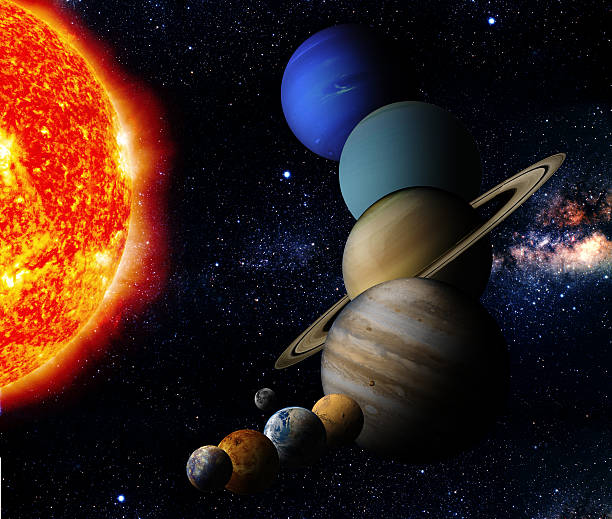
For centuries, people believed the Solar System was a simple, orderly place. The Sun sat at the center, the planets traveled around it in predictable paths, and beyond them stretched a vast emptiness filled with little more than stars. It seemed almost completely understood.
Then science began looking closer.
Powerful telescopes revealed giant storms larger than Earth, frozen worlds hiding oceans beneath their icy crusts, moons with active volcanoes, mysterious objects beyond Neptune, and planets unlike anything early astronomers could have imagined. Robotic spacecraft flew past nearly every major world, landed on planets and moons, orbited distant giants, and even touched asteroids and comets.
With every mission came astonishing discoveries—but also entirely new questions.
The Solar System has become less mysterious in many ways, yet far more fascinating. Scientists now know that hidden oceans may contain more water than all of Earth’s seas combined. They know that giant planets migrate, asteroids preserve material older than Earth, and the outer Solar System remains only partially explored.
The greatest mysteries are no longer simple questions like “What are the planets made of?” Instead, they are profound scientific puzzles involving planetary formation, hidden oceans, missing planets, unusual atmospheres, unexplained magnetic fields, and the possibility that life may exist somewhere beyond Earth.
Here are ten of the biggest mysteries that continue to challenge planetary scientists today.
1. Is There Life Hidden Somewhere in the Solar System?
For thousands of years, humanity wondered whether Earth is unique.
Modern planetary science has transformed that philosophical question into a scientific investigation.
Although no confirmed evidence of extraterrestrial life has been found anywhere in the Solar System, several worlds possess environments that could potentially support simple microorganisms.
Among the strongest candidates is Europa, one of Jupiter’s largest moons.
Its icy surface conceals a global ocean beneath tens of kilometers of ice. Measurements from spacecraft indicate that this ocean contains liquid water, likely kept warm by tidal heating generated through Jupiter’s immense gravity.
Water alone is not enough for life, however.
Scientists also seek chemical nutrients and energy sources.
Observations suggest that Europa’s ocean may interact with a rocky seafloor, potentially creating hydrothermal vents similar to those supporting rich ecosystems on Earth’s ocean floor.
Another compelling candidate is Enceladus.
This small moon ejects enormous geysers of water vapor, ice particles, salts, silica grains, and complex organic molecules through fractures near its south pole.
Analysis of these plumes by NASA’s Cassini spacecraft provided strong evidence for an underground ocean with hydrothermal activity.
Saturn’s moon Titan presents a different possibility.
Its thick nitrogen-rich atmosphere, methane lakes, and rich organic chemistry resemble conditions that may have existed on the young Earth before life emerged.
Meanwhile, Mars continues to attract attention because ancient river valleys, lake sediments, and mineral deposits indicate that liquid water once flowed across its surface for long periods.
Whether life ever arose—or still survives underground—remains unknown.
Finding even microbial life elsewhere in the Solar System would rank among the greatest scientific discoveries in history.
2. What Exactly Lies Beneath Europa’s Ice?
Europa deserves its own mystery because its hidden ocean may represent one of the most habitable environments beyond Earth.
The moon’s smooth icy shell is crossed by thousands of fractures, ridges, and chaotic terrains.
These features strongly suggest interactions between the surface and the ocean below.
But no spacecraft has ever drilled through the ice.
Scientists still do not know how thick the icy shell actually is.
Some estimates suggest only a few kilometers in certain regions.
Others indicate more than twenty kilometers.
The difference matters enormously.
A thinner shell would allow easier exchange between the ocean and surface, transporting nutrients and chemical compounds essential for potential life.
The ocean itself may contain twice as much water as all of Earth’s oceans combined.
Does it have underwater volcanoes?
Hydrothermal vents?
Ocean currents?
Chemically rich sediments?
No one knows.
NASA’s upcoming Europa Clipper mission will perform dozens of close flybys, using ice-penetrating radar, spectrometers, magnetometers, and high-resolution cameras to investigate the moon in unprecedented detail.
Yet even that ambitious mission will not directly sample the ocean.
Europa remains one of the Solar System’s greatest hidden worlds.
3. Why Is Venus So Different from Earth?
Venus is often called Earth’s twin because the two planets are remarkably similar in size, mass, and composition.
Yet their present conditions could hardly be more different.
Earth is filled with oceans, forests, and life.
Venus possesses surface temperatures around 465°C (869°F), hot enough to melt lead.
Its atmosphere is more than 96 percent carbon dioxide.
Surface pressure is about ninety times greater than Earth’s.
Sulfuric acid clouds fill the sky.
How did two apparently similar planets evolve into such radically different worlds?
Scientists believe Venus may once have possessed liquid water.
Some climate models suggest that early Venus could even have maintained oceans for extended periods before a runaway greenhouse effect transformed the planet.
But exactly when and how this occurred remains uncertain.
Another mystery involves Venus’s geological activity.
Radar observations suggest the surface may have been extensively reshaped hundreds of millions of years ago.
Did nearly the entire crust melt or overturn?
Is the planet still volcanically active today?
Recent observations have identified possible volcanic changes, but confirmation remains elusive.
Understanding Venus is more than an exercise in planetary science.
It may reveal how planetary climates evolve—and help scientists understand the long-term future of Earth-like worlds.
4. Why Did Mars Lose Its Water?
Billions of years ago, Mars looked dramatically different.
Orbital images reveal dried river channels stretching for hundreds of kilometers.
Ancient deltas preserve evidence of flowing water.
Lake basins, flood channels, and mineral deposits all indicate that liquid water once covered large portions of the planet.
Today, Mars is cold and dry.
Most remaining water exists as ice beneath the surface or at the poles.
What happened?
Scientists know that Mars gradually lost much of its atmosphere after its global magnetic field weakened billions of years ago.
Without magnetic protection, charged particles from the solar wind slowly stripped atmospheric gases into space.
As atmospheric pressure decreased, liquid water became increasingly unstable.
Yet many questions remain unanswered.
Exactly how much water escaped into space?
How much became trapped underground?
Could enormous groundwater reservoirs still exist?
Might liquid water persist deep beneath the surface where geothermal heat remains?
NASA orbiters continue mapping buried ice deposits, while rovers examine ancient rocks for evidence of long-lived lakes and habitable environments.
Mars preserves the record of one of the Solar System’s greatest environmental transformations.
5. What Created the Strange Hexagon on Saturn?
Near Saturn’s north pole lies one of the most unusual weather systems ever discovered.
A gigantic six-sided jet stream circles the pole, spanning roughly 30,000 kilometers—large enough to fit several Earths inside.
Unlike ordinary storms, this hexagon has remained remarkably stable for decades.
It was first observed by the Voyager spacecraft in the early 1980s and later studied extensively by Cassini.
Despite continuous observation, scientists still debate exactly why such a perfect polygon forms.
Laboratory experiments demonstrate that rotating fluids can naturally produce polygonal patterns under certain conditions.
Computer simulations reproduce similar structures when powerful jet streams interact with surrounding atmospheric flows.
Yet the precise atmospheric dynamics maintaining Saturn’s hexagon remain incompletely understood.
The storm rotates with astonishing regularity while maintaining its geometric shape despite surrounding turbulence.
No comparable structure exists elsewhere in the Solar System.
Saturn continues reminding scientists that giant planets possess atmospheric behaviors unlike anything found on Earth.
6. Is There a Giant Planet Beyond Neptune?
For years, astronomers have noticed something unusual about several distant icy bodies orbiting far beyond Neptune.
Their elongated orbits appear clustered in ways that seem statistically unlikely if only the known planets influence them.
One possible explanation is the existence of an undiscovered giant planet, commonly called Planet Nine.
According to this hypothesis, the unseen planet could be roughly five to ten times Earth’s mass and orbit hundreds of astronomical units from the Sun.
Its gravity might explain the peculiar orbital alignments observed among certain trans-Neptunian objects.
However, the evidence remains indirect.
No telescope has yet detected the proposed planet.
Alternative explanations also exist.
Some researchers argue that observational bias influences which distant objects astronomers discover.
Others suggest collective gravitational effects from numerous smaller bodies.
Whether Planet Nine truly exists remains one of modern astronomy’s most exciting unanswered questions.
If found, it would fundamentally reshape understanding of Solar System formation.
7. Why Does Uranus Rotate on Its Side?
Among all the planets, Uranus behaves in perhaps the strangest way.
Instead of rotating almost upright like Earth or Jupiter, Uranus is tilted by approximately 98 degrees.
It essentially spins while lying on its side.
This extreme orientation produces extraordinary seasons.
Each pole experiences decades of continuous sunlight followed by decades of darkness.
What caused such an unusual tilt?
The leading hypothesis proposes that Uranus suffered one or more colossal impacts during the Solar System’s early history.
A massive collision could have knocked the planet sideways.
However, some simulations suggest that multiple smaller impacts better explain the current configuration.
The mystery extends beyond orientation.
Uranus also possesses an unusually complex magnetic field that is significantly offset from the planet’s center.
Scientists still lack sufficient data because only Voyager 2 has visited Uranus, briefly flying past in 1986.
Future missions may finally reveal why this distant ice giant is so unlike every other planet.
8. What Are Comets Really Telling Us About the Beginning of the Solar System?
Comets are often called frozen time capsules.
Unlike planets, many comets have remained relatively unchanged since the Solar System formed approximately 4.6 billion years ago.
Their icy nuclei preserve ancient material from the protoplanetary disk that surrounded the young Sun.
Spacecraft such as Rosetta transformed understanding of cometary chemistry.
Scientists discovered complex organic molecules, unexpected surface structures, and surprising geological activity.
Yet major questions remain.
Did comets deliver much of Earth’s water?
Did they transport organic compounds essential for life’s emergence?
Why do different comet families possess different chemical compositions?
How representative are the comets scientists have studied compared with the countless others still unseen?
Each newly explored comet provides another piece of the Solar System’s earliest history.
9. How Did the Giant Planets Form So Quickly?
Jupiter and Saturn are enormous.
Their formation poses one of planetary science’s greatest theoretical challenges.
The leading model suggests that rocky cores first formed through collisions among smaller bodies.
Once these cores became sufficiently massive, they rapidly accumulated surrounding hydrogen and helium gas.
The problem is timing.
Protoplanetary gas disks around young stars disappear within only a few million years.
Planetary cores therefore had to grow extremely quickly before the gas vanished.
Exactly how this occurred remains uncertain.
Some models favor gradual accumulation.
Others invoke pebble accretion, where countless small particles rapidly build planetary cores.
Planetary migration further complicates the picture.
Evidence suggests that giant planets may have moved significantly from their birth locations, reshaping the architecture of the early Solar System.
Understanding giant planet formation also helps astronomers interpret thousands of exoplanetary systems discovered around other stars.
10. How Did the Solar System Begin—and Is the Story Complete?
The biggest mystery encompasses all the others.
Scientists possess an impressive overall model for Solar System formation.
About 4.6 billion years ago, a giant cloud of gas and dust collapsed under gravity.
The Sun formed at the center.
The remaining material flattened into a rotating disk where planets gradually assembled.
Countless observations support this general picture.
Astronomers directly observe similar disks surrounding young stars throughout the galaxy.
Meteorites preserve the Solar System’s earliest minerals.
Computer simulations successfully reproduce many planetary characteristics.
Yet many details remain unresolved.
Why does the Solar System possess its specific architecture?
How common are planetary migrations?
Why are Mars and Mercury relatively small?
Why do some moons appear more geologically active than expected?
How did Earth’s water arrive?
What role did giant impacts play?
Why do countless small bodies exhibit such enormous diversity?
Every answer generates additional questions.
The Solar System is not a solved puzzle.
It is an active scientific laboratory still revealing new surprises.
Why These Mysteries Matter
It is easy to think these mysteries concern only distant worlds.
In reality, they help answer questions about Earth itself.
Understanding Venus improves climate science.
Studying Mars reveals how planets change over billions of years.
Investigating Europa and Enceladus expands knowledge of life’s possible environments.
Learning how planets form helps explain Earth’s own origins.
Even distant comets preserve chemical ingredients that eventually became oceans, continents, and living organisms.
The Solar System is humanity’s nearest cosmic laboratory.
Every mission teaches scientists something about our own world.
The Next Generation of Exploration
The coming decades promise remarkable advances.
NASA’s Europa Clipper will investigate Europa’s hidden ocean.
ESA’s JUICE mission is exploring Jupiter’s icy moons.
China, Japan, Europe, India, and the United States are planning increasingly ambitious planetary missions.
Future spacecraft may return samples from Mars, explore Uranus and Neptune, investigate Enceladus’s plumes, and search directly for Planet Nine.
Powerful new observatories on Earth and in space will continue discovering distant objects beyond Neptune.
Artificial intelligence will assist researchers in analyzing enormous quantities of planetary data.
Each mission is designed not merely to answer existing questions but to uncover entirely new mysteries.
A Solar System Still Full of Secrets
The history of astronomy teaches one consistent lesson.
Whenever humanity builds better instruments, the universe becomes more surprising.
The Solar System once appeared to consist of a handful of wandering lights moving across the night sky.
Today it is understood as a vast family of worlds containing active volcanoes, underground oceans, methane lakes, towering ice cliffs, supersonic winds, magnetic anomalies, mysterious atmospheres, ancient time capsules, and perhaps even environments where life could exist.
Yet despite centuries of observation and decades of robotic exploration, we have visited only a tiny fraction of its landscapes.
Countless valleys on Mars remain unexplored.
The oceans beneath Europa and Enceladus have never been seen.
The deepest layers of the giant planets remain hidden beneath thousands of kilometers of clouds.
Objects beyond Neptune continue to emerge from darkness as telescopes grow more powerful.
The greatest mysteries of the Solar System are not signs of ignorance—they are invitations to discover. Every unanswered question reminds us that our cosmic neighborhood is far more dynamic, diverse, and extraordinary than anyone imagined only a generation ago. Somewhere among these distant worlds, the next great scientific discovery is almost certainly waiting.