Our Solar System is home to eight extraordinary planets, each shaped by billions of years of cosmic history. Some are small, rocky worlds with cratered landscapes and towering volcanoes. Others are enormous balls of gas and ice so massive that hundreds—or even more than a thousand—Earths could fit inside them. Together, they reveal the astonishing diversity of planetary formation and evolution.
Ranking the planets from smallest to largest is more than an exercise in comparing sizes. Each step upward tells a story about how planets form, what they are made of, and how different environments can exist within the same planetary family. The smallest planets are dense worlds built from rock and metal, while the largest are giant planets composed primarily of hydrogen, helium, and icy materials surrounding deeper interiors.
Scientists measure planetary size in several ways, but the most common comparison is by diameter, which measures the distance across a planet through its center. Diameter gives a straightforward sense of how physically large each world is, although mass, density, and volume can tell different stories about their composition.
Let’s journey outward through the Solar System and explore the eight planets, ranked from the smallest to the largest.
1. Mercury
Average Diameter: Approximately 4,879 kilometers (3,032 miles)
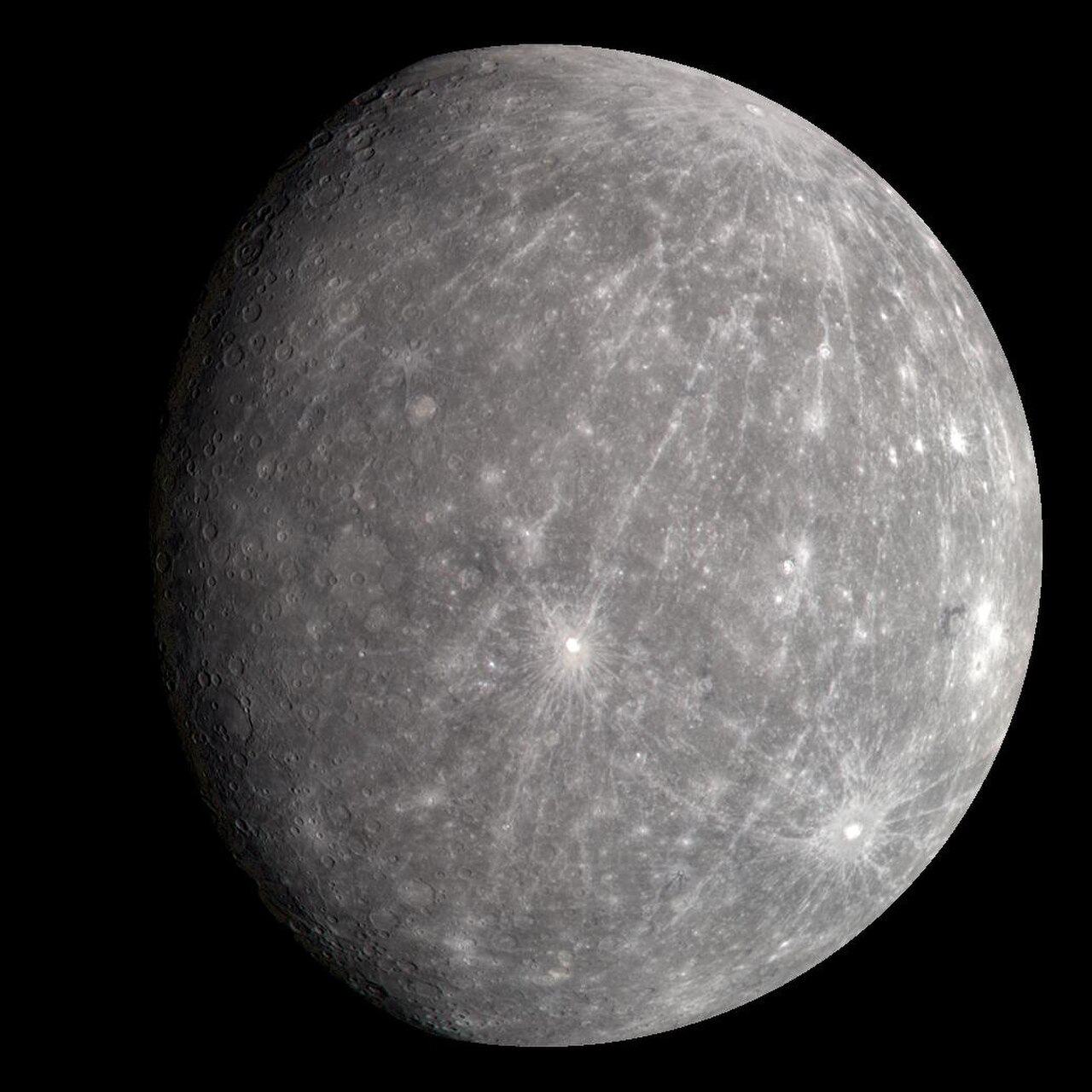
Mercury is the smallest planet in our Solar System, yet it possesses an outsized place in planetary science. Orbiting closest to the Sun, it completes one trip around our star in just 88 Earth days.
At first glance, Mercury resembles Earth’s Moon. Its surface is covered with impact craters formed over billions of years. Gigantic basins record ancient collisions during the Solar System’s violent early history.
Despite its modest size, Mercury contains an unusually large iron core. Scientists estimate that this metallic core occupies roughly 85% of the planet’s radius. This gives Mercury an exceptionally high average density, second only to Earth among the Solar System’s planets.
Mercury experiences some of the most extreme temperature variations of any planet. During the day, surface temperatures can exceed 430°C (800°F). At night, with almost no atmosphere to retain heat, temperatures can plunge below −180°C (−290°F).
Although it lies closest to the Sun, Mercury is not the hottest planet. Its extremely thin atmosphere—technically called an exosphere—cannot trap heat. That distinction belongs to Venus.
Scientists continue studying Mercury to understand how such a small planet developed such a massive metallic interior. Its unusual composition offers important clues about the formation of rocky planets.
2. Mars
Average Diameter: Approximately 6,779 kilometers (4,212 miles)
Mars is only slightly more than half the size of Earth, making it the second-smallest planet in the Solar System.
Known as the Red Planet, Mars owes its distinctive color to iron oxide—essentially rust—that coats much of its surface.
Although relatively small, Mars hosts some of the largest geological features known anywhere in the Solar System. Olympus Mons rises about 22 kilometers (14 miles) above the surrounding plains, making it the tallest volcano currently known on any planet. The immense canyon system Valles Marineris stretches over 4,000 kilometers (2,500 miles) across the Martian surface.
Evidence collected by orbiters and rovers has revealed that billions of years ago, Mars possessed rivers, lakes, groundwater systems, and perhaps even shallow seas. Ancient sedimentary rocks preserve signs of long-lasting interactions between liquid water and the Martian surface.
Today, the planet is cold and dry, with an atmosphere less than one percent as dense as Earth’s. Yet polar ice caps, underground ice deposits, and seasonal weather continue to shape its landscape.
Mars remains one of the most intensively studied planets because it may once have possessed environments capable of supporting microbial life.
3. Venus
Average Diameter: Approximately 12,104 kilometers (7,521 miles)
Venus is often called Earth’s twin because its diameter differs from Earth’s by only about five percent.
At first glance, this similarity might suggest two nearly identical worlds. In reality, Venus is one of the most hostile environments known.
Its atmosphere consists primarily of carbon dioxide and is about 90 times denser than Earth’s at the surface. Thick clouds composed largely of sulfuric acid completely hide the surface from visible light.
The immense atmospheric pressure and runaway greenhouse effect create surface temperatures around 465°C (869°F)—hot enough to melt lead.
Radar mapping has revealed a landscape covered with volcanic plains, mountain ranges, and numerous volcanic features. Scientists believe that volcanic activity has played a major role in shaping Venus throughout its history.
One of the great mysteries surrounding Venus is why it evolved so differently from Earth despite their similar sizes. Understanding this divergence helps scientists investigate climate evolution not only in our Solar System but also on rocky exoplanets orbiting distant stars.
4. Earth
Average Diameter: Approximately 12,742 kilometers (7,918 miles)
Earth is the largest of the four rocky planets and the only known planet where life exists.
Although only slightly larger than Venus, Earth possesses an environment unlike any other in the Solar System.
About 71 percent of Earth’s surface is covered by liquid water. A nitrogen-oxygen atmosphere protects life from harmful radiation while helping regulate global temperatures.
Earth also possesses active plate tectonics. Massive sections of the crust slowly move across the planet’s surface, recycling rocks, building mountains, and influencing long-term climate.
Its magnetic field, generated by motion within the liquid outer core, shields the atmosphere from much of the solar wind.
Earth’s size plays an important role in its habitability. It is large enough to retain a substantial atmosphere over billions of years but not so massive that it developed into a gas giant.
Life itself has profoundly reshaped Earth’s atmosphere and surface. Photosynthetic organisms gradually filled the atmosphere with oxygen, transforming planetary chemistry and enabling the evolution of complex life.
Among countless known worlds, Earth remains unique because it is the only place where biology has been confirmed.
5. Neptune
Average Diameter: Approximately 49,244 kilometers (30,598 miles)
Neptune is the smaller of the Solar System’s two ice giants, although “smaller” is a relative term—it is nearly four times wider than Earth.
Discovered in 1846 through mathematical prediction before direct observation, Neptune represents one of astronomy’s greatest scientific achievements.
Its striking blue appearance results primarily from methane in its atmosphere, which absorbs red wavelengths of sunlight while reflecting blue light.
Neptune experiences some of the fastest winds measured anywhere in the Solar System. Atmospheric storms can generate winds exceeding 2,000 kilometers per hour (1,200 miles per hour).
Despite receiving only about one nine-hundredth as much sunlight as Earth, Neptune radiates significantly more internal heat than it receives from the Sun. Scientists continue investigating the source of this excess energy.
Its interior likely contains layers of water, ammonia, and methane under enormous pressures, surrounding a rocky core.
Neptune’s largest moon, Triton, follows a retrograde orbit, suggesting it was probably captured from the Kuiper Belt rather than forming alongside the planet.
6. Uranus
Average Diameter: Approximately 50,724 kilometers (31,518 miles)
Slightly larger than Neptune, Uranus occupies sixth place in the size ranking.
Perhaps its most unusual characteristic is its extreme axial tilt. Uranus rotates on its side, tilted by about 98 degrees relative to its orbit around the Sun.
This remarkable orientation likely resulted from one or more enormous collisions during the Solar System’s early history.
As Uranus orbits the Sun over 84 Earth years, each pole experiences approximately 42 years of continuous sunlight followed by 42 years of darkness.
Like Neptune, Uranus belongs to the ice giant category. Its interior contains water, methane, and ammonia under immense pressure.
Methane in the upper atmosphere gives Uranus its distinctive blue-green color.
Unlike Neptune, Uranus emits surprisingly little internal heat. Scientists still do not fully understand why its interior appears comparatively inactive.
The planet possesses faint rings and dozens of known moons, each contributing to the complexity of this distant planetary system.
7. Saturn
Average Diameter: Approximately 116,460 kilometers (72,367 miles)
Saturn is the second-largest planet in the Solar System and perhaps the most visually recognizable.
Its magnificent ring system has fascinated observers since the invention of the telescope. Although the rings span hundreds of thousands of kilometers, they are surprisingly thin—often only tens of meters thick.
The rings consist primarily of countless particles of water ice mixed with smaller amounts of rocky material.
Saturn is composed mostly of hydrogen and helium. Beneath its cloud tops, pressure increases dramatically, transforming hydrogen into exotic forms that cannot exist naturally on Earth’s surface.
Despite its enormous size, Saturn has an unusually low average density. In fact, its average density is less than that of liquid water.
This does not mean Saturn would literally float in a gigantic ocean, since no such body of water could exist on that scale, but it illustrates just how light the planet is relative to its immense volume.
Saturn hosts an extraordinary collection of moons. Titan, its largest moon, possesses a thick nitrogen atmosphere and lakes of liquid methane and ethane, making it one of the most scientifically intriguing worlds in the Solar System.
8. Jupiter
Average Diameter: Approximately 139,820 kilometers (86,881 miles)
Jupiter stands as the undisputed giant of our Solar System.
More than eleven Earths could fit side by side across Jupiter’s diameter, and over 1,300 Earth-sized planets could fit inside its volume.
Its immense gravity has profoundly influenced the evolution of the Solar System. Jupiter likely affected the formation and migration of smaller planets while helping shape the distribution of asteroids and comets.
The planet consists primarily of hydrogen and helium, gradually becoming denser with increasing depth. Scientists believe enormous pressures transform hydrogen into metallic hydrogen deep within the interior, creating powerful electrical currents responsible for Jupiter’s immense magnetic field.
One of Jupiter’s defining features is the Great Red Spot—a gigantic storm that has persisted for centuries. Larger than Earth itself, this massive atmospheric vortex demonstrates the extraordinary dynamics of Jupiter’s atmosphere.
Jupiter also possesses faint rings and an extensive family of moons. Among them are the four large Galilean moons discovered by Galileo Galilei in 1610: Io, Europa, Ganymede, and Callisto.
Each is a remarkable world in its own right. Europa likely hides a global ocean beneath its icy crust, while Ganymede is the largest moon in the Solar System—larger even than the planet Mercury.
Jupiter represents the extreme upper end of planetary size within our Solar System. Had it accumulated significantly more mass during formation, it might have approached the threshold of becoming a brown dwarf rather than a planet.
Why Planet Size Matters
Planetary size influences nearly every aspect of a world’s evolution.
Larger planets possess stronger gravity, allowing them to retain thick atmospheres over billions of years. Smaller planets lose atmospheric gases more easily, especially if they lack strong magnetic fields.
Size also affects geological activity. Massive planets and moons retain internal heat longer, driving volcanism, tectonic activity, and magnetic field generation. Smaller worlds cool more rapidly, becoming geologically quieter over time.
The distinction between rocky planets and giant planets also reflects planetary size during formation. Close to the young Sun, only rock and metal could condense, producing relatively small terrestrial planets. Farther from the Sun, abundant ice allowed planetary cores to grow much larger, eventually capturing enormous envelopes of hydrogen and helium.
Planetary size therefore records the history of Solar System formation itself.
Comparing the Worlds
If Mercury were the size of a small marble, Mars would be only somewhat larger. Venus and Earth would resemble nearly identical grapefruits. Neptune and Uranus would suddenly become basketball-sized worlds, while Saturn would dwarf them all with a diameter more than twice as large.
Then comes Jupiter.
Compared with Earth, Jupiter is so enormous that it almost seems to belong to a different category of object altogether. Yet despite its immense size, it is still only a tiny fraction of the Sun’s diameter.
This perspective reminds us that even the largest planets are small compared with stars.
The Diversity of Our Planetary Family
Ranking the eight planets by size reveals far more than numerical differences. It tells the story of how our Solar System formed from a swirling cloud of gas and dust about 4.6 billion years ago.
From Mercury’s iron-rich interior to Mars’ ancient river valleys, from Venus’ crushing atmosphere to Earth’s life-filled oceans, from the icy giants Uranus and Neptune to the majestic gas giants Saturn and Jupiter, every planet represents a unique outcome of planetary evolution.
Together, these worlds demonstrate that there is no single blueprint for a planet. Some are scorching hot, while others are unimaginably cold. Some are rocky and solid, while others are composed mostly of gas and fluid layers. Some possess dozens of moons, while others have none.
Their differences are as important as their similarities. Each planet teaches scientists something new about gravity, geology, atmospheres, climate, chemistry, and the processes that shape worlds throughout the universe.
As astronomers continue discovering thousands of planets orbiting distant stars, the eight planets of our own Solar System remain the foundation of planetary science—a remarkable collection of worlds that ranges from the tiny, cratered surface of Mercury to the colossal majesty of Jupiter, reminding us just how diverse a single planetary system can be.