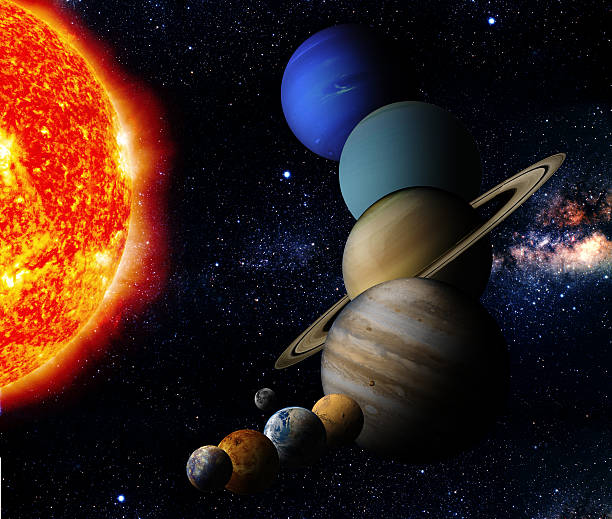
The Solar System feels familiar. After all, it is our cosmic neighborhood—the place where Earth, the Moon, the planets, and countless smaller worlds orbit the Sun. We learn about it in school, see breathtaking images from space telescopes, and follow the latest missions exploring its distant reaches. It might seem as though there are few surprises left.
But the deeper scientists investigate the Solar System, the stranger it becomes.
This is a place where diamonds may fall from the skies, where volcanoes erupt hundreds of kilometers into space, where entire oceans hide beneath frozen crusts, and where a single day can last longer than a year. It is a region filled with bizarre worlds that challenge our understanding of how planets form, evolve, and sometimes even harbor the ingredients necessary for life.
Modern spacecraft, robotic landers, orbiters, and powerful telescopes have transformed our view of the Solar System. Instead of a collection of simple planets circling the Sun, we now recognize a dynamic family of worlds, each with its own history, geology, atmosphere, weather, and mysteries.
The following ten facts reveal just how extraordinary our cosmic home truly is.
1. The Sun Contains Almost All the Solar System’s Mass
When people imagine the Solar System, they often picture eight planets moving around the Sun, each appearing to share roughly equal importance. In reality, the planets contribute only a tiny fraction of the Solar System’s total mass.
The Sun dominates everything.
It contains approximately 99.86% of all the mass in the Solar System. Every planet, moon, asteroid, comet, dwarf planet, and grain of interplanetary dust combined account for only about 0.14%.
To appreciate this imbalance, imagine placing every planet together into a single pile. Even then, the Sun would outweigh that pile by hundreds of times.
This enormous concentration of mass explains why the Sun’s gravity governs the motions of every object throughout the Solar System. From tiny icy bodies in the distant Oort Cloud to massive planets like Jupiter, everything follows paths determined primarily by the Sun’s gravitational pull.
The Sun itself is an enormous sphere of hot plasma about 1.39 million kilometers (864,000 miles) across. Nuclear fusion deep within its core converts hydrogen into helium, releasing the energy that powers sunlight and makes life on Earth possible.
Every second, the Sun converts roughly 600 million metric tons of hydrogen into helium. A small fraction of that mass becomes energy according to Einstein’s famous equation, E = mc², producing the light and heat that have sustained our planet for billions of years.
Despite losing millions of tons of mass every second through fusion, the Sun has enough hydrogen fuel to continue shining for approximately another five billion years.
2. Venus Has a Day Longer Than Its Year
Most people assume that a planet completes one rotation on its axis much faster than it completes an orbit around the Sun. Earth certainly does. One day lasts 24 hours, while one year lasts about 365 days.
Venus completely breaks this expectation.
A single rotation of Venus takes about 243 Earth days.
Its orbit around the Sun, however, requires only 225 Earth days.
That means one Venusian day is actually longer than one Venusian year.
Even stranger, Venus rotates backward compared with most planets. If viewed from above the Solar System’s north pole, nearly every planet spins counterclockwise. Venus rotates clockwise.
Scientists still debate why.
One possibility is that a gigantic collision early in the planet’s history altered its rotation. Another idea suggests that gravitational interactions between the atmosphere and the solid planet gradually slowed and reversed its spin.
Venus is also the hottest planet in the Solar System, even though Mercury lies much closer to the Sun.
Its thick atmosphere consists primarily of carbon dioxide, creating an extreme greenhouse effect that traps heat. Surface temperatures average around 465°C (869°F)—hot enough to melt lead.
The crushing atmospheric pressure is about 92 times greater than Earth’s, equivalent to the pressure nearly one kilometer beneath Earth’s oceans.
Venus reminds us that distance from the Sun alone does not determine a planet’s environment.
3. Jupiter Is So Massive That It Almost Became a Star
Jupiter is the largest planet in the Solar System by an enormous margin.
Its diameter exceeds Earth’s by about eleven times, and its mass is more than 318 times greater.
If all the other planets were combined into one object, Jupiter would still outweigh them more than twice over.
Yet despite its immense size, Jupiter never became a star.
Why not?
Stars shine because their immense gravity compresses their cores until temperatures become high enough for sustained hydrogen fusion.
Jupiter simply isn’t massive enough.
Scientists estimate that an object would need roughly 75 to 80 times Jupiter’s mass to ignite hydrogen fusion and become a true star.
This places Jupiter firmly in the category of planets rather than stars.
Nevertheless, Jupiter plays an extraordinary role within the Solar System.
Its gravity influences countless asteroids and comets. Some researchers believe Jupiter has helped protect Earth by deflecting or capturing many potentially dangerous objects, although in some situations it can also redirect objects toward the inner Solar System.
Jupiter possesses a magnetic field stronger than any other planet’s. It generates intense radiation belts capable of damaging spacecraft.
Its famous Great Red Spot is an enormous storm that has persisted for at least several centuries. Large enough to engulf Earth, it remains one of the most remarkable weather systems ever observed.
4. Saturn Would Float in a Giant Ocean
Saturn is famous for its spectacular ring system, but another remarkable fact is even more surprising.
It is the only planet in the Solar System with an average density lower than water.
Saturn’s average density is approximately 0.69 grams per cubic centimeter, while pure water has a density of about 1 gram per cubic centimeter.
In theory, if an unimaginably enormous ocean could exist, Saturn would float.
Of course, such an ocean is physically impossible because Saturn itself is nearly 120,000 kilometers wide.
The low density results from Saturn’s composition.
Like Jupiter, Saturn consists primarily of hydrogen and helium. Although enormously massive, these lightweight elements spread across a tremendous volume, reducing the planet’s average density.
Saturn’s rings themselves are astonishingly thin.
Despite stretching hundreds of thousands of kilometers across, many portions are only tens of meters thick.
The rings consist mostly of water ice ranging in size from microscopic particles to house-sized chunks.
Scientists believe the rings are relatively young compared with the age of the Solar System, perhaps formed from the breakup of an icy moon or comet.
5. There Are Oceans Hidden Beneath Ice Across the Solar System
For much of scientific history, Earth appeared unique because of its liquid water oceans.
Today, scientists know our Solar System contains multiple hidden oceans beyond Earth.
These are not surface seas.
Instead, they lie beneath thick shells of ice.
One of the most famous examples is Jupiter’s moon Europa.
Its frozen surface conceals a global ocean that may contain more water than all of Earth’s oceans combined.
Gravitational interactions with Jupiter generate internal heat through tidal flexing, preventing the ocean from freezing completely.
Saturn’s moon Enceladus offers even more dramatic evidence.
The Cassini–Huygens spacecraft observed towering plumes of water vapor erupting from fractures near the moon’s south pole.
These geysers contain water, salts, silica particles, and organic molecules.
Together, these discoveries indicate the presence of a warm subsurface ocean interacting with a rocky seafloor.
Saturn’s largest moon, Titan, likely also possesses an underground water ocean beneath its icy crust.
Even distant dwarf planets may contain internal oceans sustained by radioactive heating.
These hidden seas have transformed the search for extraterrestrial life.
Rather than focusing only on planets within the Sun’s habitable zone, scientists now investigate icy moons where liquid water exists beneath frozen surfaces.
6. Mercury Has Ice at the Hottest End of the Solar System
Mercury orbits closer to the Sun than any other planet.
Daytime temperatures can exceed 430°C (800°F).
Finding water ice there might seem impossible.
Yet radar observations and spacecraft measurements have confirmed exactly that.
The explanation lies in Mercury’s unusual geography.
Although much of the planet becomes intensely hot, some deep craters near the poles never receive direct sunlight.
Because Mercury has almost no atmosphere to transport heat, these permanently shadowed regions remain extraordinarily cold.
Temperatures can stay below −170°C (−274°F).
Water delivered by comets or asteroids can accumulate in these frozen traps and survive for millions or even billions of years.
NASA’s MESSENGER mission confirmed the presence of substantial ice deposits hidden within these permanently shaded craters.
The discovery demonstrates that even the hottest planetary neighborhood can preserve frozen water under the right conditions.
7. Io Is the Most Volcanically Active World Ever Found
Earth has impressive volcanoes.
Mars possesses the tallest known volcano.
But neither compares to Jupiter’s moon Io.
Io is the most volcanically active object in the Solar System.
More than 400 active volcanoes have been identified across its surface.
Some eruptions send material hundreds of kilometers into space.
This extraordinary activity results from tidal heating.
As Io orbits Jupiter, the immense gravitational pull of the giant planet continuously stretches and squeezes the moon.
Neighboring moons Europa and Ganymede further complicate Io’s orbit, preventing it from becoming perfectly circular.
The continual flexing generates enormous internal friction.
That friction melts rock, producing widespread volcanic activity.
Instead of impact craters like many other moons, Io’s surface is constantly renewed by fresh lava flows.
Its colorful appearance results from sulfur compounds deposited by volcanic eruptions.
Yellow plains, red deposits, black lava fields, and white frost create one of the Solar System’s most striking landscapes.
Io demonstrates that planetary heat does not always come from radioactive decay.
Gravity itself can become a powerful internal energy source.
8. Neptune Has Some of the Fastest Winds in the Solar System
Neptune receives only about one nine-hundredth as much sunlight as Earth.
One might expect such a distant world to be quiet and inactive.
Instead, Neptune hosts some of the most powerful winds ever measured.
Speeds can exceed 2,000 kilometers per hour (1,200 miles per hour).
These winds are faster than the speed of sound under Earth’s atmospheric conditions.
Scientists continue investigating how Neptune maintains such energetic weather despite receiving so little solar energy.
Internal heat appears to play a major role.
Unlike Uranus, Neptune radiates significantly more energy into space than it receives from the Sun.
That internal heat helps drive atmospheric circulation.
The Voyager 2 spacecraft observed enormous dark storms resembling Jupiter’s Great Red Spot.
Later observations from the Hubble Space Telescope revealed that these storms can appear, evolve, and disappear over relatively short periods.
Neptune reminds scientists that weather throughout the Solar System can be driven by many different energy sources.
9. Pluto Is More Complex Than Anyone Expected
When Pluto was discovered in 1930, it appeared to be little more than a tiny point of light.
Many imagined it as a frozen, inactive world.
Everything changed in 2015 when NASA’s New Horizons spacecraft flew past Pluto.
The images stunned scientists.
Instead of a dead world, Pluto revealed towering mountains made of water ice.
It possessed enormous plains of frozen nitrogen displaying evidence of slow glacial movement.
Scientists observed possible cryovolcanic features where icy materials rather than molten rock may have erupted.
The heart-shaped region known as Tombaugh Regio became one of the most recognizable landscapes in planetary science.
Its western half, Sputnik Planitia, is a vast basin filled with nitrogen ice showing polygonal convection cells created by slow movement within the frozen material.
Despite surface temperatures near −230°C (−382°F), Pluto exhibits active geological processes.
Some models even suggest that a subsurface liquid ocean may persist beneath its icy crust.
The New Horizons mission fundamentally changed humanity’s view of distant dwarf planets.
10. The Solar System Is Surrounded by a Vast Bubble Created by the Sun
The Sun’s influence extends far beyond the planets.
It continuously emits a stream of charged particles known as the solar wind.
This wind expands outward in every direction, creating a gigantic protective bubble called the heliosphere.
The heliosphere extends far beyond Pluto and acts as a shield against many high-energy cosmic rays arriving from interstellar space.
Its outer boundary is not fixed.
Instead, it changes in response to both solar activity and the surrounding interstellar environment.
NASA’s Voyager 1 and Voyager 2 became the first spacecraft to cross the heliosphere’s outer boundary, known as the heliopause.
Although these spacecraft have entered interstellar space, they remain gravitationally bound to the Sun and will continue traveling through the Milky Way for billions of years.
The heliosphere reminds us that the Solar System is not an isolated island.
Instead, it exists within a larger galactic environment where our star interacts continuously with interstellar gas, dust, and magnetic fields.
The Solar System Is Far Stranger Than We Once Imagined
Only a few generations ago, most of the Solar System was little more than blurry dots viewed through telescopes. Scientists knew almost nothing about the landscapes of distant moons, the chemistry of planetary atmospheres, or the hidden oceans beneath icy crusts.
Today, thanks to robotic spacecraft, advanced telescopes, laboratory experiments, and sophisticated computer models, we know that our cosmic neighborhood is astonishingly diverse.
The Solar System contains planets with backward rotations, moons with erupting geysers, hidden oceans beneath kilometers of ice, storms larger than Earth, volcanoes powered by gravity, rings made of billions of icy fragments, and dwarf planets that remain geologically active despite their immense distance from the Sun.
Yet perhaps the most remarkable fact is this: every major mission has revealed surprises that scientists never expected.
Each spacecraft sent into the Solar System has answered old questions while creating entirely new ones.
As future missions explore Europa’s ocean, return samples from asteroids, investigate Saturn’s moons, and journey toward the icy worlds beyond Neptune, one thing seems certain.
The Solar System still holds countless astonishing secrets waiting to be discovered.