On a clear night, when we look up at the sky, thousands of stars shine above us. For most of human history, those stars seemed unreachable and mysterious. People wondered whether other worlds existed beyond our own. Were there planets circling those distant suns? Could some of them have oceans, mountains, clouds, or even life?
For centuries, these questions belonged mostly to philosophy and imagination. There was no way to know whether planets existed around other stars. Earth seemed unique simply because it was the only planet we knew.
Today, that has changed dramatically.
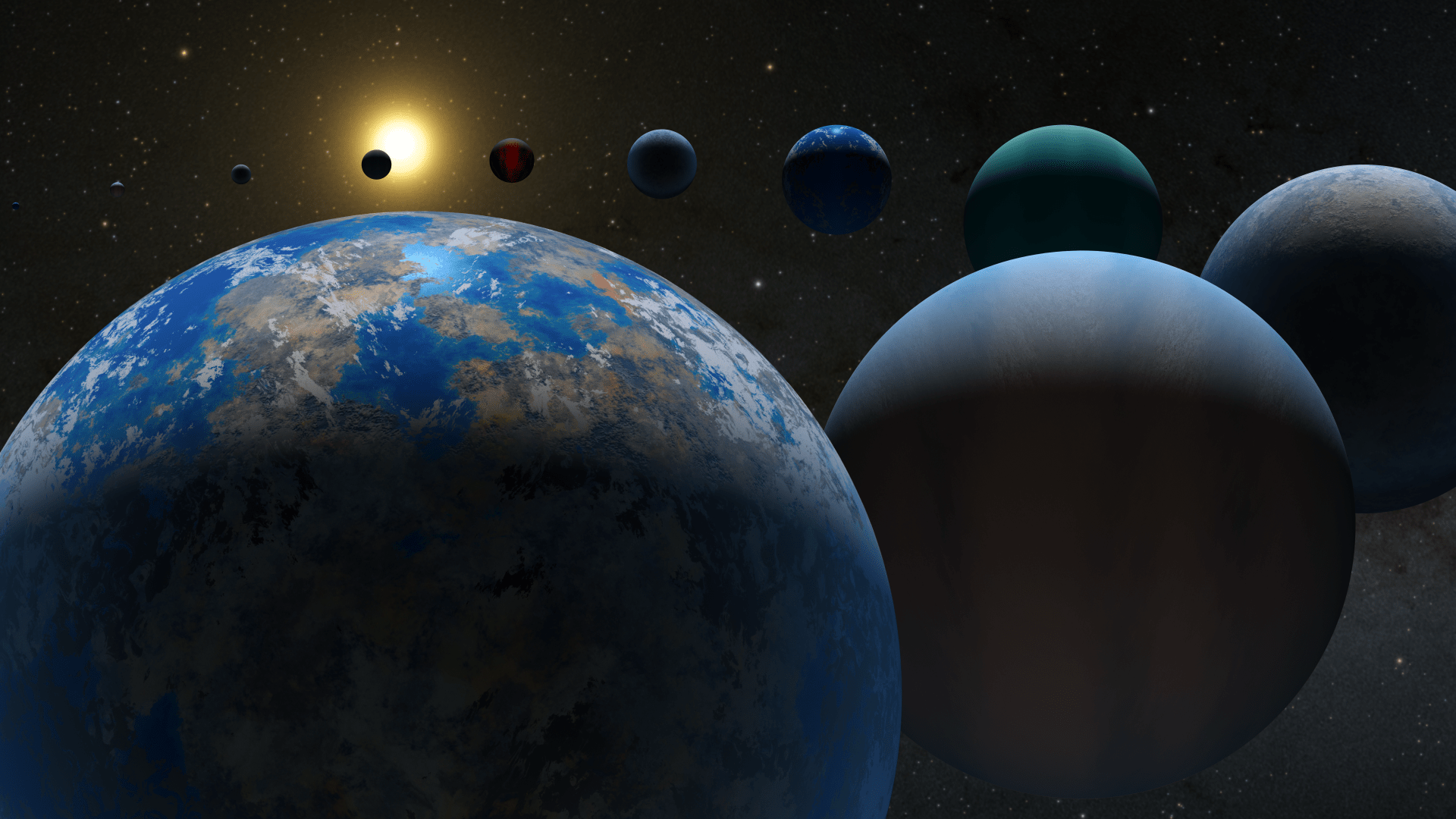
Astronomers have discovered thousands of planets beyond our Solar System. These distant worlds are known as exoplanets, short for “extrasolar planets.” Some are giant worlds larger than Jupiter. Others are rocky planets that may resemble Earth. A few orbit two stars instead of one. Some are so hot that metal may vaporize in their atmospheres, while others are frozen worlds drifting through darkness.
The discovery of exoplanets represents one of the greatest scientific revolutions of modern times. It has transformed our understanding of the universe and raised exciting new questions about life beyond Earth.
But what exactly is an exoplanet? How do scientists find worlds that are often trillions of kilometers away and hidden in the glare of their parent stars? And what have these discoveries taught us about our place in the cosmos?
The answers reveal a fascinating story of technology, creativity, and humanity’s endless curiosity about what lies beyond the horizon.
Understanding What an Exoplanet Is
An exoplanet is any planet that orbits a star outside our Solar System.
Earth, Mars, Jupiter, and the other planets orbit the Sun. They belong to our local planetary family. Exoplanets, by contrast, orbit distant stars scattered throughout the Milky Way Galaxy and beyond.
The term itself is relatively simple. “Exo” means outside or beyond, while “planet” refers to a celestial body orbiting a star.
Although the concept sounds straightforward, exoplanets can be incredibly diverse. They come in sizes, temperatures, and environments that challenge our imagination.
Some exoplanets are larger than any planet in our Solar System. Others are smaller than Earth. Some complete an orbit around their stars in only a few hours, while others take centuries.
The variety of these worlds has revealed something profound: nature creates planetary systems in many different ways.
The Solar System is not necessarily the standard model for all planetary systems. Instead, it is just one example among countless possibilities.
The Long Search for Other Worlds
The idea of planets beyond the Solar System is not new.
Ancient philosophers wondered whether other stars might have their own worlds. In ancient Greece, thinkers such as Democritus speculated that countless worlds might exist throughout the universe.
However, these ideas remained philosophical rather than scientific. There was no evidence.
For centuries, humanity lacked the tools needed to investigate distant stars in detail.
Even after the invention of the telescope, detecting exoplanets remained nearly impossible. Stars are extraordinarily bright compared with the planets orbiting them. Trying to observe a planet beside its star is like trying to spot a firefly next to a powerful searchlight.
The challenge was enormous.
Astronomers suspected that planets probably existed elsewhere, but suspicion is not proof.
Science requires evidence.
That evidence finally arrived near the end of the twentieth century.
The First Confirmed Exoplanets
One of the most surprising moments in astronomy occurred in 1992.
Astronomers discovered planets orbiting a pulsar, which is the dense remnant of a dead star.
These worlds were the first confirmed exoplanets ever detected.
Although exciting, they were not what scientists expected. Most researchers had imagined that the first exoplanets would be found around ordinary stars similar to the Sun.
That breakthrough came in 1995.
Astronomers discovered a planet orbiting a Sun-like star called 51 Pegasi.
The planet, known as 51 Pegasi b, shocked scientists.
Instead of resembling Jupiter’s distant orbit around the Sun, it orbited extremely close to its star and completed an orbit in only a few days.
This was something entirely unexpected.
The discovery proved that planets around other stars truly existed and that planetary systems could differ dramatically from our own.
Astronomy entered a new era.
Why Exoplanets Are So Difficult to See
Finding exoplanets is one of the greatest observational challenges in science.
Stars produce enormous amounts of light.
Planets do not.
A typical star can be millions or even billions of times brighter than the planets surrounding it.
Imagine standing on a mountaintop and trying to see a tiny grain of dust floating beside a powerful spotlight hundreds of kilometers away. That comparison barely captures the difficulty.
Distance makes the challenge even greater.
Many exoplanets are located dozens, hundreds, or thousands of light-years from Earth.
A light-year is the distance light travels in one year, nearly 9.5 trillion kilometers.
At such distances, planets appear unimaginably small.
For this reason, astronomers often cannot observe exoplanets directly. Instead, they detect them indirectly by studying how planets affect their parent stars.
This clever approach has led to most exoplanet discoveries.
The Transit Method
One of the most successful ways to discover exoplanets is called the transit method.
Imagine watching a distant star.
If a planet happens to pass directly between that star and Earth, it blocks a tiny fraction of the star’s light.
The star becomes slightly dimmer for a short period.
This event is known as a transit.
The decrease in brightness is often extremely small. In many cases, the change may be less than one percent.
Detecting such subtle variations requires highly sensitive instruments.
Astronomers monitor stars continuously, looking for regular dips in brightness that repeat at predictable intervals.
If the pattern repeats consistently, it suggests that a planet is orbiting the star.
The amount of dimming helps scientists estimate the planet’s size.
A larger planet blocks more light.
A smaller planet blocks less.
The transit method has become one of the most productive tools in exoplanet research.
Thousands of worlds have been discovered using this technique.
The Kepler Revolution
The transit method achieved spectacular success through the work of the Kepler Space Telescope.
Launched by NASA in 2009, Kepler was designed specifically to search for exoplanets.
The telescope continuously monitored more than 150,000 stars.
Rather than looking at the entire sky, it focused on a specific region and carefully measured changes in stellar brightness.
The results transformed astronomy.
Kepler discovered thousands of candidate exoplanets and confirmed many of them.
More importantly, it revealed that planets are extraordinarily common throughout the galaxy.
Before Kepler, scientists suspected this might be true.
After Kepler, they knew it.
The mission showed that planets likely outnumber stars in the Milky Way.
In other words, our galaxy may contain hundreds of billions of planets.
The realization was astonishing.
Worlds once imagined only in science fiction suddenly appeared everywhere.
The Radial Velocity Method
Another powerful technique for discovering exoplanets is known as the radial velocity method.
Many people assume that planets orbit stars while stars remain perfectly still.
In reality, both objects orbit a shared center of mass.
As a planet moves around its star, the star experiences a slight gravitational tug.
This causes the star to wobble back and forth.
The movement is usually tiny, but sensitive instruments can detect it.
Astronomers analyze the star’s light to measure these subtle motions.
When the star moves toward Earth, its light shifts slightly toward shorter wavelengths.
When it moves away, the light shifts toward longer wavelengths.
This phenomenon is known as the Doppler effect.
By measuring these shifts, scientists can infer the presence of an orbiting planet.
The radial velocity method has played a crucial role in exoplanet discovery and remains one of the most important tools in the field.
Direct Imaging
Although difficult, astronomers can sometimes photograph exoplanets directly.
This method is called direct imaging.
The challenge lies in suppressing the overwhelming brightness of the parent star.
Special instruments block or reduce starlight, allowing nearby planets to become visible.
Direct imaging works best for large planets located far from their stars.
Young planets are particularly good targets because they often emit heat and glow in infrared wavelengths.
Direct images provide valuable information about planetary atmospheres, temperatures, and compositions.
While only a relatively small number of exoplanets have been directly photographed, advances in technology continue to improve this technique.
Future telescopes may dramatically expand its capabilities.
Gravitational Microlensing
Sometimes gravity itself helps astronomers discover distant worlds.
According to Einstein’s theory of relativity, gravity bends light.
When a star passes in front of a more distant star, its gravity can act like a lens, magnifying the background star’s light.
This effect is known as gravitational microlensing.
If a planet accompanies the foreground star, it can create an additional signal within the lensing event.
Astronomers carefully analyze these signals to identify planets.
Microlensing is particularly useful because it can detect planets that other methods might miss.
It can even reveal planets located thousands of light-years away.
The technique provides another powerful window into the diversity of planetary systems throughout the galaxy.
Timing Methods
Some exoplanets are discovered through precise timing measurements.
Certain stars and pulsars emit signals at remarkably regular intervals.
An orbiting planet can alter the timing of those signals.
By studying these changes, astronomers can infer the presence of planets.
Although timing methods account for fewer discoveries than transit or radial velocity techniques, they remain valuable in specific situations.
They demonstrate the extraordinary ingenuity scientists employ when searching for distant worlds.
Types of Exoplanets
One of the most exciting discoveries of exoplanet research is the incredible diversity of planetary types.
Before exoplanets were found, many scientists assumed that planetary systems would resemble our Solar System.
Reality proved far more interesting.
Some planets, known as hot Jupiters, are giant gas worlds orbiting extremely close to their stars.
Temperatures on these planets can reach thousands of degrees Celsius.
Some are so hot that clouds may contain vaporized metals.
Other worlds known as super-Earths are larger than Earth but smaller than Neptune.
Interestingly, our Solar System contains no super-Earths, yet they appear to be among the most common planets in the galaxy.
Mini-Neptunes occupy another category.
These planets are smaller than Neptune but possess thick gaseous atmospheres.
Scientists have also identified ocean worlds, lava worlds, and planets orbiting multiple stars.
The diversity continues to surprise researchers.
Nature seems far more creative than anyone anticipated.
Rocky Planets and Earth-Like Worlds
Among all exoplanets, rocky planets receive the most attention.
These worlds are composed primarily of rock and metal, much like Earth, Venus, Mars, and Mercury.
Scientists are particularly interested in rocky planets because they may offer environments suitable for life.
An Earth-sized planet with the right temperature and atmospheric conditions could potentially support liquid water.
Water is considered one of the most important ingredients for life as we know it.
The search for rocky exoplanets has become one of astronomy’s most exciting pursuits.
Each new discovery brings us closer to understanding whether Earth is unique or merely one example among countless inhabited worlds.
The Habitable Zone
A key concept in exoplanet research is the habitable zone.
This is the region around a star where temperatures may allow liquid water to exist on a planet’s surface.
If a planet is too close to its star, water may evaporate.
If it is too far away, water may freeze.
The habitable zone represents the middle ground.
However, habitability is more complex than distance alone.
Atmospheric composition, planetary mass, magnetic fields, and geological activity all influence whether a planet can support life.
Even so, planets located within habitable zones remain prime targets for study.
They offer some of the best opportunities for finding environments similar to Earth’s.
Studying Alien Atmospheres
Discovering an exoplanet is only the beginning.
Scientists also want to understand what these worlds are like.
One powerful technique involves studying planetary atmospheres.
During a transit, a small portion of starlight passes through the planet’s atmosphere before reaching Earth.
Different gases absorb specific wavelengths of light.
By analyzing these patterns, astronomers can identify atmospheric components.
Researchers have detected water vapor, carbon dioxide, methane, sodium, and other substances in exoplanet atmospheres.
These measurements provide valuable clues about planetary environments.
They help scientists assess temperature, weather, chemistry, and potential habitability.
Weather on Alien Worlds
Exoplanet weather can be astonishing.
Some planets experience winds traveling thousands of kilometers per hour.
Others may have clouds made of silicate particles, essentially tiny grains of sand suspended in the atmosphere.
Certain worlds could experience iron rain.
On extremely hot planets, metals may evaporate into the atmosphere before condensing and falling elsewhere.
These exotic environments reveal how diverse planetary climates can be.
They challenge assumptions based solely on Earth’s experience.
The universe contains weather systems unlike anything found in our Solar System.
Searching for Life
Perhaps the most profound goal of exoplanet research is the search for life.
For thousands of years, humanity has wondered whether we are alone.
Exoplanets provide a way to investigate that question scientifically.
Scientists look for biosignatures, which are signs that biological activity may exist.
Certain combinations of atmospheric gases could indicate life.
For example, large amounts of oxygen and methane existing together might be difficult to explain without biological processes.
However, interpreting such signals is challenging.
Nature can produce false positives.
Extraordinary claims require extraordinary evidence.
Researchers therefore approach potential biosignatures with great caution.
Even so, the search continues.
The discovery of life beyond Earth would rank among the most important events in human history.
The Role of Modern Space Telescopes
Modern telescopes are revolutionizing exoplanet science.
The James Webb Space Telescope is providing unprecedented observations of distant planetary atmospheres.
Its powerful instruments can analyze starlight with extraordinary precision.
Scientists are using Webb to investigate atmospheric chemistry, temperature structures, and cloud properties on exoplanets.
Future observatories promise even greater capabilities.
These instruments may eventually detect Earth-like planets and examine their atmospheres for signs of habitability.
Each technological advance expands our ability to explore worlds we cannot physically visit.
How Many Exoplanets Exist?
Current evidence suggests that exoplanets are extremely common.
Astronomers estimate that the Milky Way alone may contain hundreds of billions of planets.
Many stars likely host multiple worlds.
Considering that our galaxy contains hundreds of billions of stars, the total number of planets becomes staggering.
And the Milky Way is only one galaxy among perhaps hundreds of billions in the observable universe.
The numbers are almost impossible to comprehend.
The universe may contain more planets than there are grains of sand on Earth’s beaches.
This realization has transformed humanity’s perspective.
Planets are not rare exceptions.
They appear to be a natural consequence of star formation.
What Exoplanets Teach Us About Earth
Studying exoplanets helps us better understand our own world.
By comparing Earth with thousands of other planets, scientists gain insight into planetary evolution.
They learn why some worlds become habitable while others remain hostile.
They study atmospheric processes, climate systems, and geological histories.
Exoplanet research provides a broader context for understanding Earth.
Our planet becomes part of a larger cosmic story.
Rather than viewing Earth in isolation, we can compare it with countless planetary experiments conducted by nature.
The Future of Exoplanet Exploration
The future of exoplanet science is incredibly exciting.
New telescopes, observatories, and analytical techniques are continually improving our ability to detect distant worlds.
Scientists hope to identify planets that closely resemble Earth.
They aim to study atmospheres in unprecedented detail.
Future missions may discover compelling evidence of biological activity.
Some researchers even envision technologies capable of directly imaging Earth-like planets as tiny blue dots orbiting distant stars.
Although interstellar travel remains far beyond current capabilities, observation technology continues advancing rapidly.
Each year brings new discoveries and new surprises.
The exploration of exoplanets has only just begun.
Conclusion
Exoplanets are planets that orbit stars beyond our Solar System, and their discovery has transformed our understanding of the universe. Once considered speculative, these distant worlds are now known to exist in extraordinary numbers. Through ingenious techniques such as the transit method, radial velocity measurements, direct imaging, and gravitational microlensing, astronomers have revealed a galaxy filled with planetary diversity.
Some exoplanets are giant worlds hugging their stars. Others are rocky planets located within habitable zones. Many possess environments unlike anything found in our Solar System. Their existence demonstrates that planetary systems come in countless forms.
More importantly, exoplanets have revived one of humanity’s oldest questions: Are we alone?
Every new discovery brings us closer to answering that question. By studying distant atmospheres, searching for biosignatures, and exploring the conditions that make life possible, scientists are gradually turning a philosophical mystery into a scientific investigation.
The search for exoplanets is ultimately about more than distant worlds. It is about understanding our own place in the cosmos. Each planet discovered around a faraway star reminds us that the universe is larger, richer, and more astonishing than previous generations ever imagined.
Somewhere among the countless stars scattered across the night sky, there may be worlds with oceans, clouds, mountains, and perhaps even living beings looking back at their own skies and wondering whether they are alone. The ongoing search for exoplanets is humanity’s attempt to find out.