Every star in the night sky has a beginning story. Before it shines brilliantly for millions or even billions of years, before it lights up planets and warms distant worlds, it starts life as something far less impressive. Hidden deep inside cold clouds of gas and dust, a future star begins its journey in darkness.
This early stage is known as a protostar.
A protostar is essentially a baby star, but it is not yet a true star. It has not begun the nuclear fusion that powers mature stars like our Sun. Instead, it is an object caught between a cloud and a star, slowly gathering mass, heating up, and struggling against powerful forces that shape its future.
The birth of a star is not a gentle process. It is chaotic, violent, and surprisingly messy. Gigantic clouds collapse under gravity. Powerful jets blast material across space. Magnetic fields twist and interact. Matter crashes inward at incredible speeds. Entire stellar systems can emerge from this turmoil.
For astronomers, protostars offer a glimpse into one of the most important processes in the universe. Every star that has ever existed—from tiny red dwarfs to enormous blue giants—passed through a protostellar phase. Understanding protostars means understanding how stars, planets, solar systems, and ultimately life itself come into existence.
The Cosmic Cradle of Stars
The story of a protostar begins long before the protostar itself exists.
Throughout galaxies, enormous clouds of gas and dust drift through space. These clouds are known as molecular clouds because much of their hydrogen exists in molecular form.
At first glance, these clouds might seem empty. Yet they contain vast amounts of material. Some molecular clouds are so massive that they contain enough matter to create thousands or even millions of stars.
These regions are among the coldest places in the universe. Temperatures often hover around minus 260 degrees Celsius. In such frigid conditions, particles move slowly, allowing molecules to form and survive.
Despite their immense size, molecular clouds are surprisingly diffuse. Even the densest regions contain far fewer particles than the best vacuum chambers on Earth.
For millions of years, a molecular cloud may remain relatively stable. But eventually, something disturbs the balance.
A nearby supernova explosion might send shockwaves through the cloud. Collisions with other clouds may compress portions of the gas. Spiral arms within galaxies can squeeze material together. Sometimes gravity alone gradually overwhelms internal pressure.
When this happens, star formation begins.
Gravity Takes Control
Gravity is the true architect of every star.
Once a region within a molecular cloud becomes sufficiently dense, gravity starts pulling material inward.
This collapse marks the beginning of a long transformation.
At first, the cloud fragment contracts slowly. As it shrinks, more material is drawn toward the center. The denser the region becomes, the stronger its gravitational pull grows.
This creates a runaway effect.
More matter increases gravity.
More gravity attracts additional matter.
Additional matter further strengthens gravity.
The process accelerates.
As particles fall inward, they collide with one another. These collisions convert motion into heat.
Slowly but steadily, the center of the collapsing cloud begins to warm.
This growing concentration of matter is the embryo of a future star.
The Birth of a Protostar
Eventually, enough material accumulates at the center of the collapsing cloud that a distinct object forms.
This object is a protostar.
A protostar is not yet powered by nuclear fusion. Instead, its energy comes primarily from gravitational contraction.
As material continues falling inward, gravitational energy is converted into heat.
The protostar grows hotter and brighter.
However, much of its light cannot escape.
The newborn object remains buried inside thick cocoons of dust and gas. Visible light is often blocked completely.
For this reason, protostars remained hidden from astronomers for much of history.
Only with modern infrared and radio telescopes have scientists been able to peer through the surrounding dust and observe these stellar infants.
What they discovered was far more dramatic than anyone expected.
Why Protostars Are So Chaotic
It is tempting to imagine a protostar simply gathering matter like a calm snowball rolling downhill.
Reality is much more turbulent.
The environment around a protostar is chaotic and dynamic.
Gas does not fall inward smoothly. It swirls, twists, and collides.
Magnetic fields thread through the collapsing material.
Radiation from the growing protostar affects nearby gas.
Rotational forces complicate the process.
Jets and outflows erupt from the system.
Competing gravitational influences alter the flow of matter.
Everything happens simultaneously.
The result resembles a cosmic storm rather than a peaceful birth.
Astronomers studying protostars frequently observe rapidly changing structures, complex gas motions, and energetic phenomena that challenge theoretical models.
Far from being orderly, stellar birth is one of the most turbulent processes in nature.
The Importance of Angular Momentum
One of the biggest challenges during star formation involves angular momentum.
Every cloud in space possesses at least a tiny amount of rotation.
As the cloud collapses, this rotation becomes increasingly important.
A familiar analogy comes from figure skaters. When a skater pulls their arms inward while spinning, their rotation speeds up.
The same thing happens during cloud collapse.
As the cloud shrinks, its rotation accelerates dramatically.
This creates a problem.
Rapid rotation prevents some material from falling directly into the protostar.
Instead, matter begins orbiting around it.
This leads to the formation of one of the most important structures in astronomy: the protoplanetary disk.
The Formation of a Protoplanetary Disk
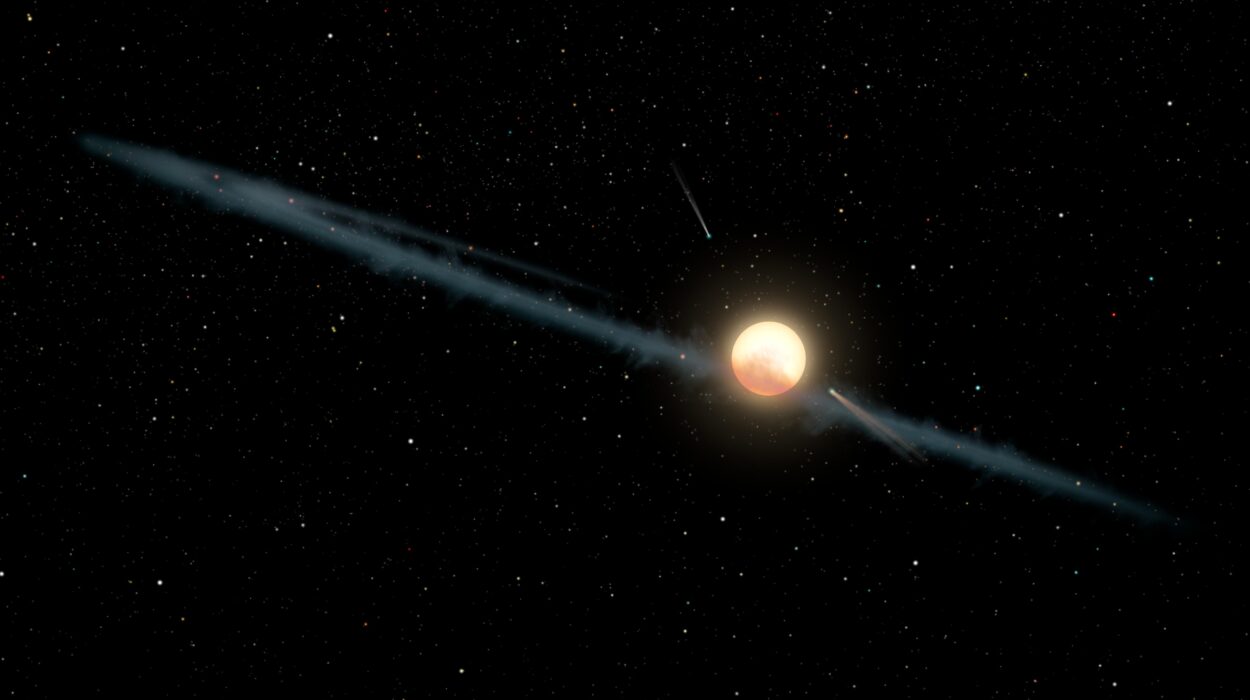
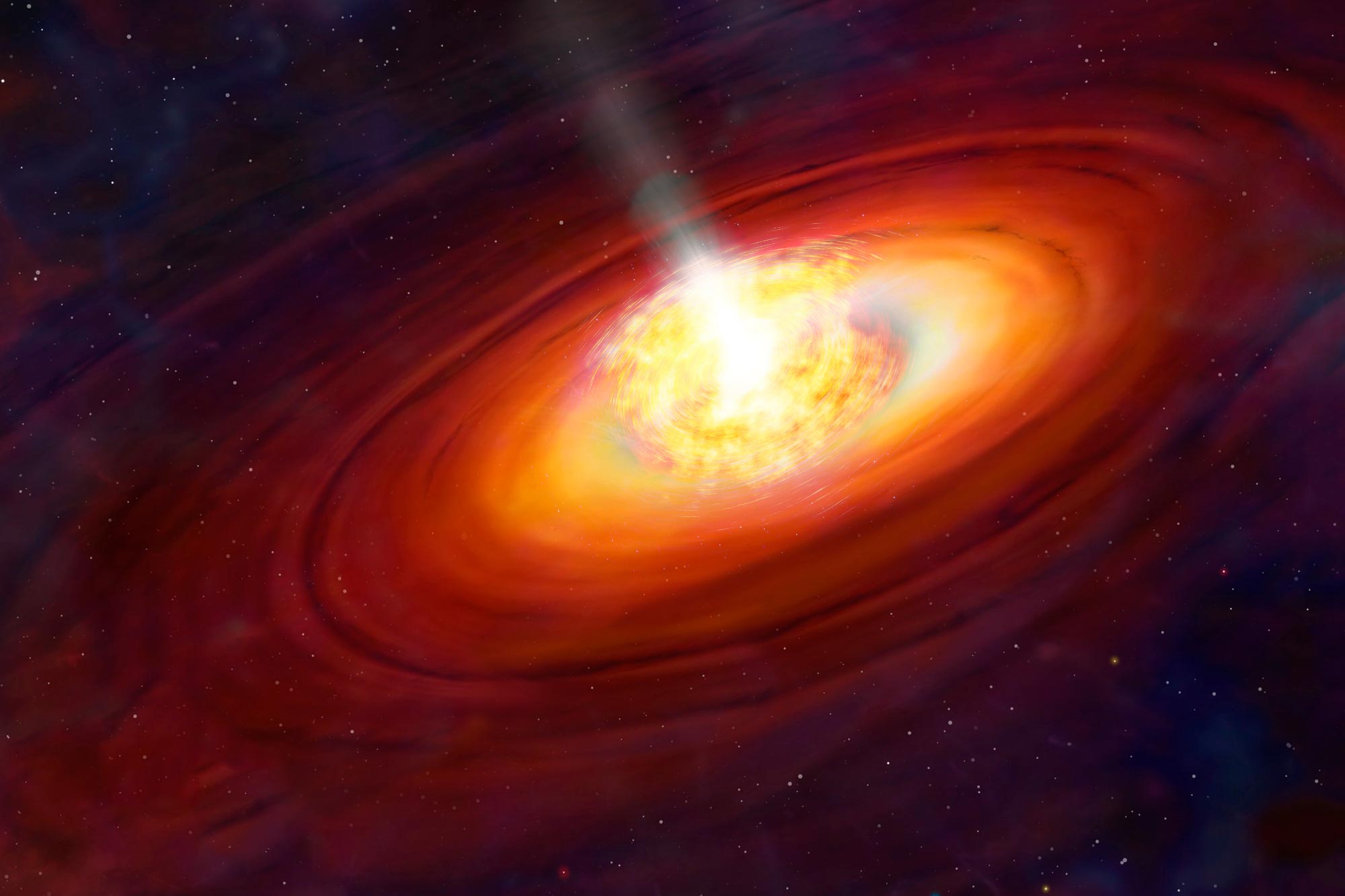
Surrounding many protostars is a flattened disk of gas and dust.
This structure forms because rotating material cannot fall directly into the central object.
Instead, it spreads into a spinning disk.
These disks are extraordinarily important.
They serve as reservoirs feeding the growing protostar.
At the same time, they are the birthplaces of planets.
Within these disks, tiny dust grains collide and stick together.
Over time, larger structures emerge.
Eventually, entire planets, moons, asteroids, and comets may form.
In other words, the same process creating a star also lays the foundation for future planetary systems.
Our own Solar System likely originated from such a disk about 4.6 billion years ago.
Every planet, including Earth, traces its origins back to material that once orbited the young Sun during its protostellar phase.
The Surprising Power of Protostellar Jets
One of the most astonishing discoveries about protostars involves the enormous jets they produce.
These jets can extend for light-years into space.
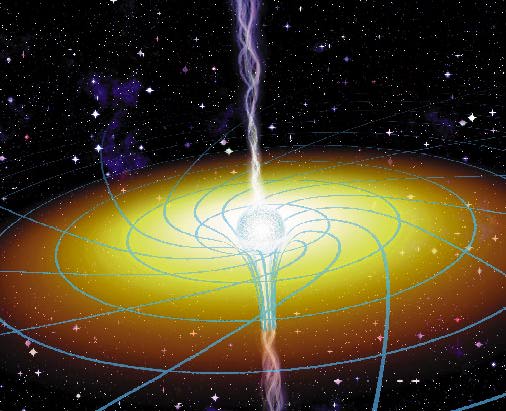
They emerge from regions near the protostar’s poles and travel at hundreds of kilometers per second.
For decades, astronomers wondered why baby stars launch such spectacular outflows.
The answer involves a complex interaction between magnetic fields, rotation, and infalling matter.
As material spirals inward through the disk, magnetic fields can channel some of it away from the protostar.
The result is a pair of narrow, high-speed jets shooting in opposite directions.
These jets help solve a critical problem.
Remember the excess angular momentum generated during collapse?
The jets help carry some of that angular momentum away.
Without them, many stars might struggle to form efficiently.
Far from being minor side effects, these outflows play a central role in stellar birth.
Herbig-Haro Objects: Signatures of Stellar Youth
When protostellar jets slam into surrounding gas, they create glowing regions known as Herbig-Haro objects.
These structures are among the most beautiful sights in astronomy.
They appear as luminous knots, arcs, and shock fronts scattered around star-forming regions.
The glow occurs because fast-moving material collides with slower gas, heating it and causing it to emit light.
Herbig-Haro objects provide important clues about the behavior of young stars.
By studying them, astronomers can measure jet velocities, track changes over time, and better understand the processes occurring around protostars.
These glowing structures serve as visible signposts marking stellar nurseries throughout the galaxy.
The Different Stages of Protostellar Evolution
Protostars do not remain unchanged.
As they evolve, astronomers classify them into several stages based on their physical properties and surrounding environments.
In the earliest phases, the protostar remains deeply embedded within a dense envelope of gas and dust.
Most of its radiation emerges at infrared wavelengths.
The surrounding envelope gradually shrinks as material falls inward.
Over time, more of the central object becomes visible.
The protoplanetary disk becomes increasingly prominent.
Eventually, much of the original envelope disappears.
The protostar continues contracting and heating until conditions become suitable for the next major milestone.
That milestone is nuclear fusion.
When a Protostar Becomes a Star
The defining difference between a protostar and a true star is nuclear fusion.
During the protostellar phase, energy comes primarily from gravitational contraction.
As the object grows more massive, its core temperature rises steadily.
Eventually, temperatures exceed approximately 10 million degrees Celsius.
At this point, hydrogen nuclei begin fusing into helium.
Fusion releases enormous amounts of energy.
A new star is born.
The outward pressure generated by fusion balances the inward pull of gravity.
This balance creates stability.
The object has officially entered the main sequence phase of stellar evolution.
For stars like the Sun, this stable period can last billions of years.
But everything begins with the protostar.
Why Some Protostars Never Become Stars
Not every protostar successfully reaches stellar status.
Some fail.
The determining factor is mass.
If a protostar does not accumulate enough material, its core never becomes hot enough for sustained hydrogen fusion.
These objects become brown dwarfs.
Brown dwarfs occupy a strange middle ground between planets and stars.
They are larger than giant planets but smaller than true stars.
Some can briefly fuse deuterium, a heavier form of hydrogen, but they cannot sustain ordinary hydrogen fusion.
As a result, they never become fully fledged stars.
This highlights how delicate the star-formation process can be.
Small differences in mass can dramatically alter an object’s destiny.
Massive Protostars and Stellar Giants
The birth of massive stars is even more dramatic.
Massive protostars accumulate material at extraordinary rates.
They heat up quickly and produce intense radiation.
Their powerful light can push against incoming gas, potentially disrupting further growth.
This creates a puzzle.
How do massive stars continue gaining mass despite their intense radiation?
Astronomers are still investigating the answer.
Evidence suggests that accretion disks, magnetic fields, and complex gas flows help channel material inward despite the powerful radiation.
Massive protostars are among the most challenging objects to study because they evolve rapidly and remain deeply embedded in dense clouds.
Yet understanding them is essential because massive stars profoundly influence galaxies.
Stellar Nurseries Across the Universe
Protostars are not rare.
They are forming continuously throughout the universe.
Some of the most famous stellar nurseries include regions within the Orion Nebula, where thousands of young stars are in various stages of development.
These regions reveal what our own Solar System may have looked like billions of years ago.
Powerful telescopes have identified protostars not only within our galaxy but also in distant galaxies across the universe.
Wherever dense clouds of gas exist, the conditions for stellar birth may arise.
The universe remains an active and ongoing factory of stars.
How Astronomers Observe Protostars
Observing protostars is not easy.
Their dusty cocoons block visible light.
Traditional optical telescopes often cannot see them directly.
Fortunately, dust is more transparent to infrared and radio wavelengths.
Modern observatories use these wavelengths to peer into stellar nurseries.
Space telescopes have revolutionized this field.
Infrared observations reveal warm dust surrounding protostars.
Radio telescopes map molecular gas and trace complex motions within star-forming regions.
Together, these tools allow astronomers to reconstruct the hidden processes occurring during stellar birth.
What once seemed invisible is now becoming increasingly clear.
The Role of the James Webb Space Telescope
Recent advances in astronomy have provided unprecedented views of protostars.
The James Webb Space Telescope has become particularly valuable because it observes primarily in infrared wavelengths.
Its instruments can penetrate dusty regions that previously obscured young stars.
As a result, astronomers are obtaining detailed images of protostellar disks, jets, and surrounding environments.
These observations are revealing structures and processes never seen before.
Each new image helps refine theories of star formation and deepens our understanding of how stellar systems emerge.
Protostars and the Origins of Planets
Perhaps the most exciting aspect of protostar research is its connection to planetary formation.
Every planet begins as material within a protostellar disk.
The dust grains surrounding a young star are the raw ingredients of future worlds.
Within these disks, particles collide, merge, and grow.
Over millions of years, planets gradually emerge.
This means studying protostars is also studying the earliest history of planetary systems.
The Earth itself originated during this stage.
Long before oceans, mountains, forests, or life existed, our planet was part of a swirling disk surrounding a young protostar.
Understanding protostars therefore helps answer one of humanity’s oldest questions: How did our home come into existence?
Cosmic Recycling and Stellar Birth
Protostars are part of a larger cosmic cycle.
Stars form from gas clouds.
They shine for millions or billions of years.
Eventually, many stars die.
Some expel their outer layers into space.
Massive stars explode as supernovae.
These events enrich the surrounding environment with heavier elements.
Future generations of stars then form from this recycled material.
The carbon in your body, the oxygen you breathe, the calcium in your bones, and the iron in your blood all originated inside ancient stars.
Protostars represent the beginning of the next chapter in this cycle.
Each new stellar birth continues a process that has been shaping the universe for billions of years.
The Remaining Mysteries
Despite tremendous progress, many questions remain unanswered.
Astronomers still debate exactly how massive stars form.
The role of magnetic fields remains incompletely understood.
The details of disk evolution continue to challenge researchers.
Scientists are investigating why some protostars produce particularly powerful jets while others do not.
They are exploring how binary and multiple-star systems emerge.
They are examining how environmental conditions influence planetary formation.
Every new observation reveals additional complexity.
The more astronomers learn about protostars, the more fascinating they become.
Why Protostars Matter
At first glance, protostars might seem like a niche topic relevant only to professional astronomers.
In reality, they are central to understanding the universe.
Every star begins as a protostar.
Every planetary system emerges from the environments surrounding protostars.
Every potential habitat for life depends on processes initiated during this phase.
Without protostars, there would be no stars.
Without stars, there would be no planets.
Without planets, there would be no life as we know it.
Studying protostars means studying the origins of countless worlds.
It means investigating the cosmic events that ultimately made our own existence possible.
Conclusion
A protostar is a young, developing star caught in one of the most dramatic stages of its life. Formed within collapsing clouds of gas and dust, it represents the crucial transition between a diffuse molecular cloud and a fully functioning star powered by nuclear fusion.
Far from being calm or orderly, the protostellar phase is a time of extraordinary chaos. Gravity pulls matter inward. Disks swirl around growing stars. Magnetic fields shape powerful jets. Radiation influences surrounding gas. Entire planetary systems begin taking shape within this turbulent environment.
Every star in the sky once passed through this remarkable stage. The Sun itself was once a hidden protostar buried inside a dusty cocoon billions of years ago. Around it, the material that would become Earth and the other planets slowly gathered within a spinning disk.
Today, modern telescopes allow us to witness these processes unfolding across the galaxy. Each observation reveals new details about how stars are born and how cosmic structures emerge from seemingly empty clouds of gas.
Protostars remind us that creation in the universe is rarely simple. It is dynamic, messy, energetic, and beautiful. Yet from that apparent chaos comes order. From collapsing clouds come stars. From stars come planets. And from planets, sometimes, comes life itself.