Imagine placing a spoon into a cup of honey and slowly rotating it. As the spoon turns, the thick honey around it begins to swirl. The motion of the spoon drags the nearby honey along, causing the surrounding material to twist and rotate.
Now imagine replacing the spoon with an entire planet, a neutron star, or a black hole. Replace the honey with spacetime itself—the invisible fabric that forms the stage on which the universe exists.
Surprisingly, according to modern physics, something very similar happens.
When massive objects spin, they do not merely rotate within spacetime. They actually drag spacetime around with them. The effect is incredibly subtle around Earth, yet it becomes astonishingly powerful near some of the most extreme objects in the cosmos.
This remarkable phenomenon is known as frame dragging.
Frame dragging is one of the strangest predictions of Einstein’s theory of general relativity. It reveals that space and time are not passive backgrounds against which events unfold. Instead, they are dynamic entities that can bend, stretch, ripple, and even twist.
For centuries, humans imagined space as an empty stage and time as a universal clock ticking identically for everyone. Einstein overturned this picture entirely. In his universe, space and time are woven together into a flexible fabric called spacetime. Massive objects deform this fabric, creating what we experience as gravity.
But Einstein’s theory contains another, less famous prediction. If a massive object rotates, it should drag nearby spacetime along with it, creating a subtle cosmic whirlpool.
This idea sounds almost impossible to believe. Yet over the past century, experiments and observations have repeatedly confirmed it.
Frame dragging is real.
And it is happening all around us.
Understanding Spacetime
To understand frame dragging, we first need to understand spacetime itself.
Before Einstein, scientists viewed space and time as separate things.
Space was considered a vast, empty container in which matter existed.
Time was thought to flow uniformly everywhere, like a universal clock governing the entire cosmos.
This picture worked well for many everyday situations, but it failed when scientists began studying light, gravity, and motion at extreme speeds.
Einstein realized that space and time are deeply connected.
Instead of existing independently, they form a single four-dimensional structure called spacetime.
Every event in the universe occurs somewhere in space and sometime in time. Together, these coordinates define an event’s location within spacetime.
This concept changed physics forever.
Suddenly, space was no longer empty nothingness.
It became an active participant in the workings of the universe.
Einstein’s Revolutionary View of Gravity
One of Einstein’s greatest achievements was reimagining gravity.
For centuries, Isaac Newton’s theory described gravity as a force acting between masses.
The Sun pulled on Earth.
Earth pulled on the Moon.
Objects pulled on one another across empty space.
Newton’s theory worked extraordinarily well, but Einstein discovered a deeper explanation.
According to general relativity, gravity is not really a force.
Instead, mass and energy curve spacetime.
Objects move along paths determined by that curvature.
Imagine placing a heavy bowling ball on a stretched rubber sheet. The sheet sags beneath the ball. Smaller objects rolling nearby follow curved paths because the surface itself is distorted.
This analogy is not perfect, but it helps illustrate Einstein’s idea.
The Sun bends spacetime around it.
Earth moves through this curved spacetime, producing its orbit.
The Moon follows curved spacetime around Earth.
Gravity emerges naturally from geometry.
This realization was one of the most profound discoveries in human history.
The Universe Is Not Static
Once scientists accepted that mass could bend spacetime, a fascinating question emerged.
What happens when mass moves?
If spacetime is flexible, should moving objects affect it differently than stationary ones?
Einstein’s equations suggested the answer was yes.
Massive moving objects influence spacetime in dynamic ways.
Just as a moving boat creates waves in water, moving masses can create effects within spacetime.
One such effect is gravitational waves, ripples that travel across the universe.
Another is frame dragging.
When a massive object rotates, its motion affects spacetime itself, causing the surrounding region to twist.
The universe becomes far stranger than anyone had imagined.
What Exactly Is Frame Dragging?
Frame dragging occurs when a rotating massive object pulls nearby spacetime around with it.
The term “frame” refers to a frame of reference—a perspective from which motion is measured.
Normally, we assume space itself provides a stable backdrop.
Frame dragging reveals that this assumption is not entirely correct.
Near a spinning mass, spacetime becomes twisted.
Objects moving through that region experience subtle shifts in their paths.
Even light can be affected.
The spinning object essentially drags local spacetime into rotation.
The effect is usually tiny.
Around Earth, frame dragging is extremely weak.
Around neutron stars and black holes, however, it becomes dramatically stronger.
In some regions near rapidly spinning black holes, spacetime can be twisted so intensely that nothing can remain stationary relative to distant stars.
Everything is compelled to move along with the rotation.
The Origins of the Idea
Einstein’s equations predicted frame dragging shortly after the publication of general relativity in 1915.
A few years later, Austrian physicists Josef Lense and Hans Thirring explored the phenomenon mathematically.
Their work described how rotating masses influence nearby spacetime.
Today, frame dragging is often called the Lense-Thirring effect in honor of their contribution.
At the time, however, the effect seemed impossible to test.
The predicted distortions were extraordinarily small.
Technology simply lacked the precision needed to detect them.
For decades, frame dragging remained a fascinating theoretical prediction waiting for experimental confirmation.
Scientists believed it existed.
Proving it was another matter entirely.
Why Rotation Matters
The importance of rotation cannot be overstated.
If an object possesses mass but does not rotate, it curves spacetime in a symmetrical way.
A rotating object introduces something new.
Its motion contributes additional effects to the structure of spacetime.
The faster the rotation and the greater the mass, the stronger the frame-dragging effect becomes.
This means that spinning planets, stars, neutron stars, and black holes all twist spacetime to varying degrees.
Earth does it.
The Sun does it.
Every rotating object in the universe contributes, however slightly.
Yet because Earth’s mass and rotation rate are modest compared to extreme cosmic objects, its frame-dragging effect is incredibly subtle.
Detecting it requires extraordinary precision.
Visualizing Twisted Spacetime
Frame dragging can be difficult to picture because spacetime itself is not something we can see.
One useful analogy involves a spinning sphere submerged in thick syrup.
As the sphere rotates, nearby syrup begins rotating too.
Material farther away is affected less strongly.
A similar thing happens around a rotating mass.
Spacetime closest to the object experiences the strongest twisting.
Farther away, the effect gradually weakens.
Unlike syrup, however, spacetime is not a material substance.
It is the geometric structure describing the universe.
The analogy helps visualize the effect but should not be taken literally.
What matters is the idea that rotation influences the surrounding region rather than remaining confined to the object itself.
Earth Is Twisting Spacetime Right Now
It may sound surprising, but Earth is constantly dragging spacetime around itself.
Every rotation of our planet creates a tiny frame-dragging effect.
The distortion is extraordinarily small.
No human can directly feel it.
No ordinary instrument can detect it.
Yet it exists.
Satellites orbiting Earth experience minute shifts caused by this twisting.
Their orbital paths differ ever so slightly from what would occur if Earth were not rotating.
These tiny deviations provided one of the key ways scientists eventually tested Einstein’s prediction.
The fact that an entire planet can twist spacetime demonstrates how dynamic the universe truly is.
The Challenge of Measuring Frame Dragging
Detecting frame dragging is incredibly difficult.
The effect around Earth is tiny compared to other influences.
Atmospheric drag, solar radiation pressure, gravitational irregularities, and countless other factors can obscure the signal.
Scientists needed instruments capable of extraordinary precision.
Imagine trying to measure the width of a human hair from thousands of kilometers away.
The challenge is comparable.
Researchers spent decades developing techniques to isolate the tiny spacetime twisting caused by Earth’s rotation.
Success required patience, technological innovation, and remarkable attention to detail.
The eventual confirmation became one of the triumphs of experimental physics.
Gravity Probe B
One of the most ambitious tests of frame dragging involved a mission called Gravity Probe B.
Launched by NASA in 2004, the spacecraft carried some of the most precise gyroscopes ever created.
A gyroscope normally maintains its orientation in space.
If frame dragging exists, Earth’s rotating mass should cause tiny changes in that orientation over time.
The spacecraft measured these shifts with extraordinary accuracy.
Years of data analysis followed.
The results ultimately confirmed Einstein’s prediction.
The observed changes matched the effects expected from frame dragging.
Nearly ninety years after Einstein proposed general relativity, one of its strangest predictions had received direct experimental support.
Satellite Evidence
Another powerful confirmation came from satellites known as LAGEOS.
These spacecraft are covered with reflective surfaces that allow precise tracking using lasers fired from Earth.
Scientists measured subtle changes in the satellites’ orbital planes.
Those changes matched predictions based on frame dragging.
The agreement between theory and observation provided further evidence that rotating Earth truly twists spacetime around it.
The measurements were challenging and complex, but they reinforced confidence in Einstein’s theory.
What once seemed like mathematical speculation had become measurable reality.
Frame Dragging Around Neutron Stars
While Earth’s frame dragging is tiny, neutron stars take the phenomenon to an entirely different level.
Neutron stars form when massive stars explode as supernovae.
The remaining core collapses into an object only about twenty kilometers across yet containing more mass than the Sun.
These stellar remnants are incredibly dense.
A teaspoon of neutron star matter would weigh billions of tons on Earth.
Many neutron stars also rotate rapidly.
Some spin hundreds of times every second.
The combination of immense mass and extraordinary rotation generates powerful frame-dragging effects.
Spacetime near these objects becomes dramatically twisted.
Scientists studying neutron stars often must account for frame dragging when interpreting observations.
Ignoring it would produce incorrect predictions.
Black Holes and Extreme Frame Dragging
If neutron stars represent powerful examples of frame dragging, black holes are the ultimate expression of the phenomenon.
Black holes are regions where gravity becomes so intense that nothing, not even light, can escape once it crosses the event horizon.
Many black holes rotate.
Some spin at astonishing speeds approaching the theoretical maximum allowed by physics.
These rotating black holes generate extraordinary spacetime distortions.
Near such objects, frame dragging becomes dominant.
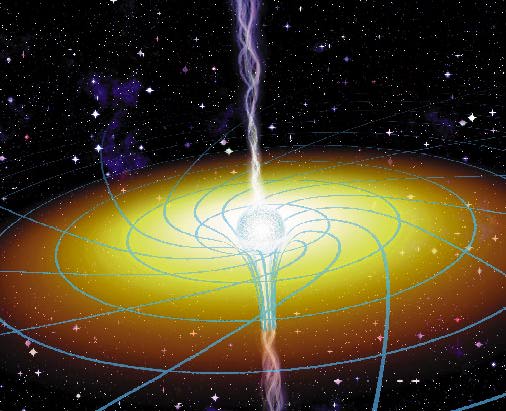
The twisting can become so strong that spacetime itself effectively whirls around the black hole.
The effect reaches levels unimaginable around ordinary stars or planets.
Here, Einstein’s theory reveals some of its most astonishing consequences.
The Ergosphere: A Region of No Escape from Rotation
One of the strangest features surrounding a rotating black hole is the ergosphere.
The ergosphere lies outside the event horizon.
Objects within this region are not trapped in the same way they are beyond the horizon.
In principle, they can still escape.
Yet something extraordinary happens there.
Frame dragging becomes so powerful that spacetime itself rotates faster than any object can resist.
No observer can remain stationary relative to distant space.
Everything must move in the direction of the black hole’s rotation.
Imagine standing in a river whose current becomes increasingly powerful.
Eventually, resisting the flow becomes impossible.
The ergosphere behaves somewhat similarly.
Spacetime itself becomes the flowing river.
Can Energy Be Extracted from a Black Hole?
Remarkably, frame dragging may allow energy extraction from rotating black holes.
Physicist Roger Penrose proposed a process in which objects entering the ergosphere could split apart.
Part of the material falls into the black hole.
Another part escapes with more energy than it originally possessed.
The additional energy comes from the black hole’s rotation.
In essence, rotational energy is extracted through frame-dragging effects.
Although difficult to achieve in practice, the Penrose process illustrates how deeply frame dragging influences black hole physics.
Even the most extreme objects in the universe obey Einstein’s geometric rules.
Frame Dragging and Accretion Disks
Many black holes are surrounded by disks of hot gas called accretion disks.
Material spirals inward, becoming compressed and heated to extraordinary temperatures.
Frame dragging affects these disks significantly.
The twisting of spacetime can alter the orientation of orbiting matter.
It can influence how gas moves and how energy is distributed.
In some cases, frame dragging may help explain the formation of enormous jets emerging from black holes.
These jets can extend thousands or even millions of light-years into space.
Understanding them requires understanding how rotating spacetime shapes their environment.
The Connection to Gravitational Waves
Frame dragging also relates to gravitational waves.
These waves are ripples in spacetime produced by accelerating masses.
When massive objects such as black holes merge, the resulting spacetime disturbances propagate outward at the speed of light.
The same dynamic view of spacetime that permits gravitational waves also permits frame dragging.
Both emerge naturally from Einstein’s theory.
Together, they demonstrate that spacetime is not static.
It behaves more like an active, evolving component of the universe.
Modern astronomy increasingly relies on studying these subtle effects.
Why Frame Dragging Matters
At first glance, frame dragging may seem like an obscure curiosity.
Its practical effects on everyday life are negligible.
Most people can live their entire lives without encountering it directly.
Yet its significance is enormous.
Frame dragging confirms a key prediction of general relativity.
It reveals that spacetime behaves in ways far beyond ordinary intuition.
It helps scientists understand neutron stars, black holes, and galaxy-scale phenomena.
It influences satellite navigation and precision measurements.
Most importantly, it deepens our understanding of reality itself.
The universe is not built from rigid, unchanging space and time.
Instead, spacetime responds dynamically to matter and motion.
Frame dragging is one of the clearest demonstrations of this truth.
A Universe More Strange Than Imagined
Before Einstein, few people would have considered the possibility that rotating objects could twist space and time.
The idea sounds almost like science fiction.
Yet nature often proves stranger than imagination.
Massive objects do not merely occupy spacetime.
They shape it.
They bend it.
They stretch it.
They ripple it.
And when they rotate, they twist it.
Frame dragging shows that reality operates according to principles far deeper than our everyday experience suggests.
What appears empty is not truly empty.
What appears fixed is not truly fixed.
The universe is a dynamic geometric structure constantly responding to the matter and energy within it.
The Future of Frame-Dragging Research
Scientists continue studying frame dragging with increasing precision.
New telescopes, improved satellites, and advanced gravitational-wave observatories provide opportunities to test Einstein’s predictions more rigorously than ever before.
Observations of black holes are especially exciting.
The ability to image regions near event horizons allows researchers to examine environments where frame dragging becomes extremely strong.
Future discoveries may reveal subtle deviations from current theories.
They may provide clues about quantum gravity, the unification of physics, or the nature of spacetime itself.
Every improvement in observational technology brings us closer to answering some of the deepest questions in science.
Conclusion
Frame dragging is one of the most remarkable predictions of Einstein’s general theory of relativity. It occurs when a rotating massive object twists the surrounding fabric of spacetime, pulling nearby space and time into motion. Though the effect is tiny around Earth, it becomes dramatic near neutron stars and especially rotating black holes, where spacetime itself can be dragged into powerful cosmic whirlpools.
The phenomenon was once a purely theoretical idea, but decades of careful experiments and observations have confirmed its reality. From the precise measurements of satellites and gyroscopes orbiting Earth to the extreme environments surrounding black holes, evidence continues to support Einstein’s vision of a dynamic universe.
More than a century after its prediction, frame dragging remains one of the most fascinating demonstrations that space and time are not passive backgrounds. They are active participants in the story of the cosmos. Massive objects bend them, rotating objects twist them, and together they create a universe far stranger, richer, and more beautiful than anyone could have imagined.