Every morning, the Sun rises with comforting predictability. It warms our planet, illuminates our skies, powers Earth’s climate, and fuels nearly every ecosystem through photosynthesis. To most people, it seems calm, constant, and dependable—a glowing disk that has watched over humanity since the dawn of civilization.
Yet beneath that familiar appearance lies one of the most violent and complex objects in the known universe.
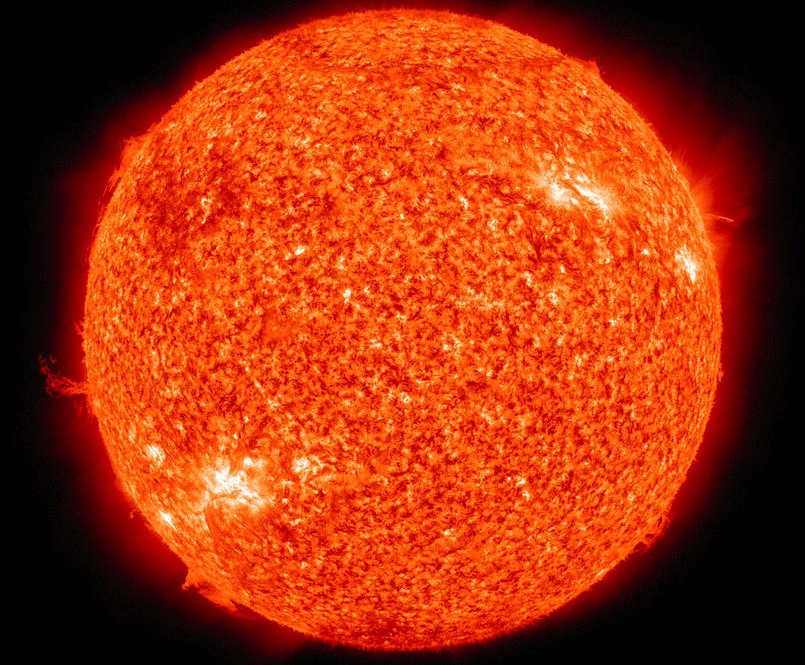
The Sun is not a quiet ball of burning gas. It is a gigantic sphere of superheated plasma, nearly 1.39 million kilometers (864,000 miles) across, containing about 99.8% of all the mass in our Solar System. Every second, its core converts roughly 600 million tons of hydrogen into helium through nuclear fusion, releasing an unimaginable amount of energy. Deep inside, temperatures exceed 15 million degrees Celsius (27 million degrees Fahrenheit). On its surface, magnetic fields twist, snap, and reconnect with explosive power.
For centuries, astronomers viewed the Sun as a relatively simple star. Today, after decades of observations from space telescopes, solar probes, and sophisticated computer simulations, they know something surprising.
The better we understand the Sun, the more mysteries we uncover.
Many of the Sun’s most important processes remain only partially understood. Some challenge modern plasma physics. Others raise concerns about Earth’s technological future. None suggest that the Sun is behaving unnaturally—it is an ordinary G-type main-sequence star by cosmic standards—but many of its behaviors remain extraordinarily difficult to predict.
These are eleven of the most unsettling aspects of our nearest star that continue to puzzle, surprise, and occasionally worry astronomers.
1. The Sun’s Corona Is Hundreds of Times Hotter Than Its Surface
At first glance, this seems impossible.
Anyone standing near a fire knows that temperatures decrease as you move away from the heat source. The hottest part should be closest to the center.
The Sun appears to violate that intuition.
Its visible surface, called the photosphere, has a temperature of approximately 5,500°C (9,900°F). Yet above this surface lies the corona, the Sun’s outer atmosphere, where temperatures soar to between one and several million degrees Celsius.
In other words, the atmosphere surrounding the Sun is vastly hotter than the surface beneath it.
This phenomenon is known as the coronal heating problem, and it remains one of solar physics’ greatest unsolved mysteries.
Astronomers have developed promising explanations.
One possibility involves countless tiny magnetic explosions called nanoflares. Another suggests that powerful magnetic waves known as Alfvén waves transport energy upward into the corona.
Observations from spacecraft such as NASA’s Parker Solar Probe and ESA’s Solar Orbiter continue providing valuable data.
Yet scientists still cannot fully explain how enough energy reaches the corona to produce such extraordinary temperatures.
The answer almost certainly lies in the Sun’s magnetic field—but the complete mechanism remains elusive.
2. We Still Can’t Reliably Predict Solar Flares
Solar flares are among the most energetic explosions in the Solar System.
When twisted magnetic fields suddenly release enormous amounts of stored energy, they accelerate particles, emit intense radiation, and produce bursts that can affect Earth within minutes.
Most flares are harmless to life on Earth’s surface because our atmosphere absorbs dangerous radiation.
Modern civilization, however, is another matter.
Large flares can disrupt radio communication, interfere with navigation systems, damage satellites, and endanger astronauts outside Earth’s protective magnetic field.
Despite decades of research, scientists still cannot predict precisely when major flares will occur.
Astronomers can identify regions where flares are more likely.
They can estimate probabilities based on magnetic complexity.
But predicting the exact timing, strength, and evolution of a major flare remains beyond current scientific capability.
This uncertainty makes space weather forecasting significantly more difficult than terrestrial weather prediction.
3. Coronal Mass Ejections Can Threaten Modern Civilization
Not every solar flare produces a coronal mass ejection, or CME, but when one does, the consequences can be dramatic.
A CME is an enormous eruption that launches billions of tons of solar plasma and magnetic field into space.
If Earth lies in its path, the effects can be profound.
Most CMEs produce beautiful auroras.
The largest, however, can disturb Earth’s magnetic field enough to induce electric currents in long conductors such as power lines and pipelines.
The most famous historical example occurred in 1859.
Known as the Carrington Event, this powerful solar storm disrupted telegraph systems around the world, with operators receiving electric shocks and equipment continuing to function even after power supplies were disconnected.
Today’s interconnected technological society would likely experience much greater disruption from an event of similar magnitude.
Scientists monitor the Sun continuously to provide early warning, but forecasting the exact magnetic orientation of an incoming CME remains a major challenge.
That orientation largely determines how strongly Earth’s magnetosphere will be affected.
4. The Sun’s Magnetic Field Completely Reverses Every Solar Cycle
Earth’s magnetic poles wander slowly over time.
The Sun does something far more dramatic.
Approximately every eleven years, its global magnetic field reverses polarity.
The magnetic north pole becomes south.
South becomes north.
This reversal is part of the Sun’s approximately 22-year magnetic cycle, consisting of two eleven-year solar cycles.
Although astronomers understand the broad outline of this process, the detailed physics remain extraordinarily complicated.
The Sun is not solid.
Its plasma rotates at different speeds depending on latitude and depth.
This differential rotation twists magnetic field lines into increasingly tangled configurations.
Eventually, the entire magnetic structure reorganizes.
Understanding this magnetic dynamo remains one of astrophysics’ greatest computational challenges.
5. Sunspots Are Cooler—but They Signal Extreme Activity
Sunspots appear dark because they are cooler than the surrounding photosphere.
Even so, they remain astonishingly hot, with temperatures around 3,500 to 4,500°C.
Their darker appearance is purely relative.
Sunspots form where intense magnetic fields suppress convection, reducing the upward transport of heat.
What makes them unsettling is not their appearance but what they represent.
Large, complex sunspot groups often indicate enormous concentrations of magnetic energy.
These regions are the most likely sources of powerful flares and coronal mass ejections.
Astronomers monitor sunspots daily because they serve as visible clues to otherwise invisible magnetic processes occurring deep within the Sun.
6. The Solar Wind Never Truly Stops
The Sun is constantly losing material.
Every second, streams of charged particles flow outward in all directions, forming the solar wind.
Unlike isolated eruptions, this outflow never ceases.
It extends far beyond Pluto, creating a vast bubble surrounding the Solar System known as the heliosphere.
The solar wind shapes planetary magnetospheres, influences comet tails, affects spacecraft electronics, and contributes to space weather throughout the Solar System.
Scientists understand its general origin.
Yet exactly how the solar wind is accelerated to such high speeds remains an active area of research.
Parker Solar Probe has provided unprecedented measurements by flying closer to the Sun than any previous spacecraft.
Its observations continue reshaping models of solar wind acceleration.
7. The Sun Doesn’t Rotate Like a Solid Object
Unlike Earth, the Sun has no rigid surface.
It consists almost entirely of plasma.
As a result, different regions rotate at different speeds.
Near the equator, the Sun completes one rotation in roughly 25 days.
Near the poles, the same process takes about 35 days.
Even more surprising, deeper internal layers rotate differently from outer layers.
This differential rotation stretches and twists magnetic field lines, playing a crucial role in generating solar activity.
Understanding these complex internal motions requires helioseismology—the study of sound waves traveling through the Sun’s interior.
By analyzing subtle vibrations on the solar surface, astronomers can infer structures hidden deep inside.
Even with these techniques, the Sun’s internal dynamics remain incompletely understood.
8. The Solar Cycle Doesn’t Behave Perfectly
The Sun follows an approximately eleven-year cycle of activity.
During solar maximum, sunspots, flares, and coronal mass ejections become more frequent.
During solar minimum, activity decreases substantially.
The word “approximately” is important.
No two cycles are identical.
Some are stronger.
Some are weaker.
Some begin earlier or later than expected.
One particularly intriguing period, known as the Maunder Minimum, occurred between roughly 1645 and 1715.
During this time, sunspots became extraordinarily rare.
Researchers continue investigating why this happened.
Although the Sun continued shining, its magnetic behavior changed dramatically.
Understanding why solar cycles vary remains essential for improving long-term space weather forecasting.
9. We Can’t See Inside the Solar Core Directly
Everything that powers the Solar System originates within the Sun’s core.
There, immense pressure and temperature allow hydrogen nuclei to fuse into helium.
This nuclear fusion releases energy that eventually reaches the surface as sunlight.
Yet the core itself remains hidden.
Visible light cannot travel directly from the core to space.
Instead, photons undergo countless interactions with particles inside the Sun.
On average, the energy released during fusion may require tens of thousands to hundreds of thousands of years—or even longer, depending on the model—to reach the surface through the radiative zone before moving more rapidly through the convective zone.
Astronomers therefore rely on indirect methods.
Helioseismology reveals internal structure through sound waves.
Solar neutrinos, nearly massless particles produced during fusion, escape almost immediately from the core.
Detecting these neutrinos has confirmed that nuclear fusion powers the Sun.
Even so, many details of the core’s dynamics remain inaccessible to direct observation.
10. The Sun Will Eventually Destroy Earth’s Habitability
This is not an immediate threat.
It will not happen tomorrow, next century, or even within millions of years.
But it will happen.
As the Sun ages, nuclear fusion gradually changes its internal composition.
Over billions of years, the Sun slowly becomes brighter.
This increase is measurable and expected from stellar evolution theory.
Long before the Sun becomes a red giant, Earth’s climate will likely become increasingly hostile to complex life.
Models suggest that within roughly one to two billion years, increasing solar luminosity may trigger a runaway greenhouse effect, making Earth’s surface increasingly inhospitable.
About five billion years from now, the Sun will exhaust hydrogen in its core and expand into a red giant.
Its outer layers may engulf Mercury and Venus.
Whether Earth itself will ultimately be engulfed remains an area of ongoing research, depending on competing effects involving solar mass loss and orbital expansion.
Regardless, Earth’s present environment cannot survive indefinitely.
The Sun that made life possible will eventually make life here impossible.
11. The Sun Still Surprises Us
Perhaps the most unsettling fact is not any single mystery.
It is that our nearest star continues producing unexpected discoveries.
Spacecraft repeatedly observe magnetic structures more complex than anticipated.
New forms of plasma behavior emerge.
Previously unknown features appear in high-resolution images.
Models require continual revision.
NASA’s Parker Solar Probe has flown through the Sun’s corona itself, revealing unexpected magnetic “switchbacks”—sudden reversals in magnetic field direction that challenge existing theories.
Solar Orbiter has detected previously unseen small-scale activity near the Sun’s poles.
Each mission answers old questions while creating entirely new ones.
The closer we look, the stranger the Sun becomes.
Why These Mysteries Matter
It might be tempting to view solar research as an abstract scientific pursuit.
In reality, understanding the Sun affects everyday life.
Modern civilization depends heavily on technologies vulnerable to space weather.
Communication satellites.
Global navigation systems.
Electrical power grids.
Aviation.
Human spaceflight.
Accurate forecasting of solar activity has become increasingly important as technological dependence grows.
Better understanding the Sun also improves knowledge of other stars.
Every insight into solar physics helps astronomers interpret stellar behavior throughout the Milky Way.
Because the Sun is the only star close enough to study in extraordinary detail, it serves as a natural laboratory for stellar astrophysics.
The Sun Is Ordinary—and Extraordinary
Astronomically speaking, the Sun is not unusual.
It is a middle-aged G-type main-sequence star with average size, average mass, and average brightness compared with many stars in our galaxy.
Yet from humanity’s perspective, it is utterly unique.
Every breath we take, every ocean current, every forest, every food chain, and every human civilization has depended on this single star.
Its light has shaped Earth’s history for more than four billion years.
Its gravity holds the Solar System together.
Its energy sustains nearly all life.
And despite centuries of scientific investigation, it still guards profound secrets.
A Star That Refuses to Become Ordinary
The Sun has been observed by ancient astronomers, medieval scholars, modern physicists, orbiting observatories, and spacecraft that have ventured closer to it than ever before.
It has been photographed across every region of the electromagnetic spectrum.
Its vibrations have been measured.
Its particles have been captured.
Its magnetic fields have been mapped.
Its atmosphere has been entered by robotic explorers.
Yet no scientist would claim we completely understand it.
That may be the most remarkable fact of all.
The brightest object in our sky remains one of the greatest laboratories of unsolved physics. Every sunrise reminds us not only of the energy that sustains life on Earth but also of the enduring mysteries that continue to challenge the world’s astronomers. The Sun is familiar enough to illuminate every day of our lives, yet mysterious enough to ensure that generations of scientists will continue looking upward, searching for answers hidden within its brilliant light.