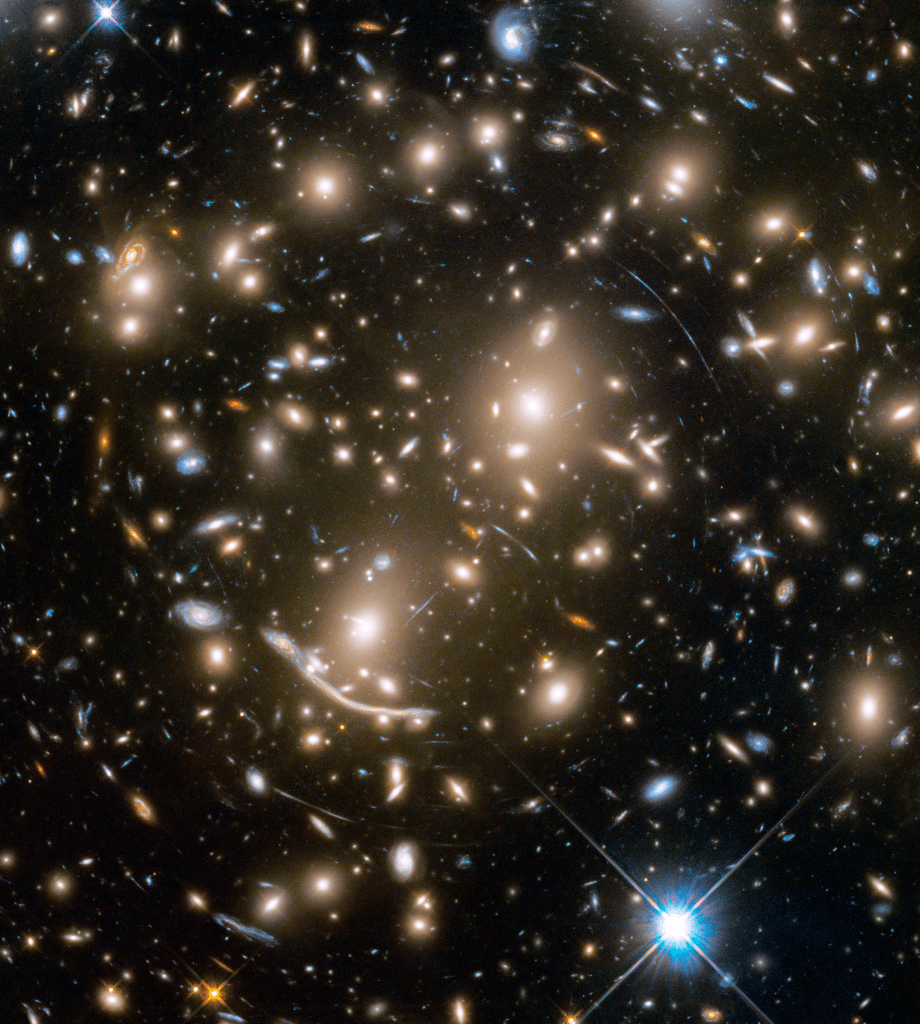
On a clear night, the stars seem calm and timeless. They appear fixed in the sky, quietly decorating the darkness with points of light. But beneath that peaceful appearance lies a universe that is astonishingly dynamic, violent, and deeply mysterious. Galaxies collide. Black holes consume stars. Invisible matter shapes the cosmos. Space itself stretches as the universe expands. Entire regions of the universe remain forever beyond our reach.
For centuries, astronomy transformed mysterious lights into planets, stars, and galaxies. Modern telescopes have revealed thousands of exoplanets, captured images of black holes, detected gravitational waves, and measured the faint afterglow of the Big Bang. Humanity has never understood the universe better than it does today.
And yet, paradoxically, every major discovery has revealed even deeper mysteries.
Scientists estimate that ordinary matter—the atoms that make up stars, planets, people, and everything visible—accounts for only about 5% of the universe. The remaining 95% consists of dark matter and dark energy, both of which remain largely unexplained. We can measure their effects with remarkable precision, but we still do not know what they are.
Astronomy is unique among sciences because it constantly reminds us how little we truly know. Every new telescope uncovers unexpected phenomena. Every spacecraft returns surprising data. Every breakthrough raises new questions.
The following twenty-five mysteries represent some of the greatest unanswered questions in modern astronomy and astrophysics. None of these mysteries require supernatural explanations. Instead, they represent active areas of scientific research where evidence continues to accumulate while definitive answers remain elusive.
1. What Is Dark Matter?
Perhaps no mystery has shaped modern astronomy more profoundly than dark matter.
When astronomers measure how galaxies rotate, they find something astonishing. Stars near the edges of galaxies move far faster than expected based on the visible matter alone. According to gravity, those galaxies should fly apart.
Yet they remain stable.
The simplest explanation is that galaxies contain enormous amounts of invisible matter whose gravity holds everything together.
Dark matter does not emit, absorb, or reflect light, making it invisible to telescopes. Scientists detect it only through its gravitational influence.
Observations of galaxy clusters, gravitational lensing, and the large-scale structure of the universe all independently support its existence.
Despite decades of experiments, however, scientists have never directly detected the particles that might compose dark matter.
Possible candidates include weakly interacting massive particles, axions, sterile neutrinos, and entirely new forms of matter beyond the Standard Model of particle physics.
Until dark matter is identified, one of the universe’s largest components remains completely mysterious.
2. What Is Dark Energy?
If dark matter is mysterious, dark energy is even stranger.
In 1998, astronomers studying distant exploding stars made a shocking discovery.
The expansion of the universe is accelerating.
Gravity should gradually slow cosmic expansion.
Instead, space is expanding faster and faster.
Something appears to be pushing galaxies apart.
Scientists call this unknown phenomenon dark energy.
Current observations suggest that dark energy accounts for roughly 68% of the total energy content of the universe.
Its nature remains unknown.
It may represent the energy of empty space itself.
It may arise from unknown quantum effects.
It may indicate that our understanding of gravity is incomplete.
At present, nobody knows.
3. What Happened Before the Big Bang?
The Big Bang theory successfully describes how the universe evolved from an extremely hot, dense early state approximately 13.8 billion years ago.
But it does not necessarily describe the absolute beginning of existence.
What happened before?
Did time itself begin with the Big Bang?
Was there an earlier universe?
Did our universe emerge from a quantum fluctuation?
Could multiple universes exist?
Current physics cannot answer these questions with confidence.
General relativity predicts conditions where known physics breaks down, while quantum mechanics has yet to merge successfully with gravity.
The earliest moments of cosmic history remain hidden behind one of science’s greatest frontiers.
4. What Caused Cosmic Inflation?
Shortly after the Big Bang, the universe appears to have undergone an incredibly rapid expansion known as cosmic inflation.
During an unimaginably brief interval, space expanded enormously.
Inflation explains several observed properties of the universe, including its remarkable uniformity and large-scale geometry.
Yet scientists still do not know what caused inflation.
The hypothetical field responsible has never been detected.
Understanding inflation may ultimately reveal how the universe itself emerged.
5. Why Does Matter Exist at All?
According to current physics, the Big Bang should have produced nearly equal amounts of matter and antimatter.
When matter meets antimatter, both annihilate into energy.
If equal amounts had formed, almost nothing should remain today.
Yet the observable universe consists overwhelmingly of ordinary matter.
Something created a tiny imbalance.
Scientists know this imbalance occurred.
They do not yet know exactly why.
Without it, galaxies, stars, planets, and life would never have existed.
6. What Lies Inside a Black Hole?
Black holes are among the most extreme objects in the universe.
Their gravity becomes so intense that nothing—not even light—can escape once it crosses the event horizon.
General relativity predicts that matter eventually reaches a singularity of infinite density.
Quantum physics suggests this picture cannot be complete.
Inside black holes, the laws of physics appear to conflict.
No current theory successfully describes their interiors.
Understanding them may require an entirely new framework for physics.
7. Where Does Information Go in a Black Hole?
This question has puzzled physicists for nearly fifty years.
Quantum mechanics states that information cannot be destroyed.
General relativity suggests information falling into a black hole may disappear forever.
These two principles cannot both be entirely correct.
Proposed solutions include Hawking radiation carrying information away, holographic descriptions of spacetime, or radical revisions of quantum theory.
No consensus exists.
8. What Creates Fast Radio Bursts?
Fast Radio Bursts (FRBs) are intense flashes of radio waves lasting only milliseconds.
They originate from distant galaxies.
Some repeat.
Others occur only once.
Scientists have linked certain FRBs to highly magnetized neutron stars called magnetars.
However, not all observed bursts fit existing models.
Their diversity suggests multiple origins may exist.
The full picture remains incomplete.
9. What Powers Ultra-High-Energy Cosmic Rays?
Earth is constantly bombarded by cosmic rays.
Some carry energies millions of times greater than particles produced in human accelerators.
Scientists still debate exactly which cosmic objects accelerate particles to such extraordinary energies.
Possible sources include supernova remnants, active galactic nuclei, gamma-ray bursts, and other extreme environments.
The highest-energy events remain difficult to explain.
10. How Do Supermassive Black Holes Grow So Quickly?
Nearly every large galaxy contains a supermassive black hole at its center.
Some formed astonishingly early in cosmic history.
Observations reveal billion-solar-mass black holes less than one billion years after the Big Bang.
Current growth models struggle to explain how they became so massive so rapidly.
11. What Is the Nature of Time?
Time appears fundamental.
Yet physics treats it differently across theories.
General relativity links time with space.
Quantum mechanics treats time as an external parameter.
Why time moves forward remains deeply mysterious.
The arrow of time appears connected to entropy, but many questions remain unresolved.
12. Are We Alone in the Universe?
Thousands of exoplanets have now been discovered.
Many orbit within regions where liquid water could potentially exist.
Yet no confirmed evidence of extraterrestrial life has been found.
Microbial life may be common.
Intelligent civilizations may be extraordinarily rare.
We simply do not know.
13. Why Is the Universe So Uniform?
Regions of the observable universe separated by enormous distances possess nearly identical temperatures.
According to ordinary expansion, these regions should never have exchanged information.
Inflation explains this remarkably well.
But why inflation itself occurred remains unknown.
14. What Are the True Origins of Gamma-Ray Bursts?
Gamma-ray bursts are among the brightest explosions in the universe.
Many originate from collapsing massive stars.
Others result from merging neutron stars.
Yet certain bursts remain difficult to classify.
Scientists continue investigating whether additional mechanisms also exist.
15. What Is the Ultimate Fate of the Universe?
Will cosmic expansion continue forever?
Will stars eventually burn out?
Will dark energy tear galaxies apart?
Could gravity someday reverse expansion?
Current observations favor endless expansion, but the long-term future depends upon dark energy’s true nature.
16. Why Do Galaxies Form the Way They Do?
Galaxies display remarkable diversity.
Some become graceful spirals.
Others evolve into giant ellipticals.
Many merge repeatedly over billions of years.
Scientists understand much of galaxy evolution, but important questions remain about how initial conditions shape final structures.
17. What Creates the Largest Cosmic Structures?
Galaxies cluster into enormous filaments surrounding vast cosmic voids.
These structures span hundreds of millions of light-years.
Dark matter plays a central role.
Yet researchers continue studying exactly how these immense patterns emerged.
18. What Is the True Nature of Neutron Stars?
Neutron stars compress more mass than the Sun into spheres only about twenty kilometers across.
Matter inside them exists under conditions impossible to recreate on Earth.
Scientists still debate their internal composition.
Some theories propose exotic particles or even quark matter deep within their cores.
19. Do Primordial Black Holes Exist?
Most black holes form when massive stars collapse.
However, some theories predict black holes may have formed shortly after the Big Bang.
If they exist, primordial black holes could help explain dark matter or early galaxy formation.
None have yet been confirmed.
20. Why Do Some Exoplanets Defy Expectations?
Astronomers continue discovering worlds unlike anything in our Solar System.
Hot Jupiters orbit incredibly close to their stars.
Some planets appear unusually dense.
Others possess bizarre atmospheric chemistry.
Planet formation proves far more diverse than scientists once imagined.
Many observed systems challenge existing models.
21. What Causes Magnetars to Become So Powerful?
Magnetars possess magnetic fields trillions of times stronger than Earth’s.
These fields are the strongest known in the universe.
Scientists understand that magnetars are neutron stars.
However, the precise processes producing such extraordinary magnetic strength remain under investigation.
22. What Are Cosmic Voids Really Telling Us?
Between galaxy clusters lie enormous empty regions called cosmic voids.
These vast expanses influence cosmic evolution.
Studying them may help reveal the properties of dark energy, gravity, and the universe’s large-scale structure.
Much remains to be learned.
23. Why Does the Hubble Constant Disagree?
Astronomers measure the universe’s expansion rate using different methods.
Surprisingly, those methods produce slightly different answers.
Measurements based on the early universe disagree with measurements based on nearby galaxies.
This discrepancy is known as the Hubble tension.
It may reflect hidden systematic errors.
Or it may signal entirely new physics.
Scientists are actively investigating.
24. Can Gravity Be Unified with Quantum Mechanics?
Modern physics rests upon two extraordinary theories.
General relativity describes gravity.
Quantum mechanics describes the microscopic world.
Each works remarkably well.
Together, however, they become mathematically incompatible under extreme conditions.
Finding a quantum theory of gravity remains one of theoretical physics’ greatest goals.
25. Why Does the Universe Exist in a Form That Allows Life?
The fundamental constants of nature appear remarkably well suited for the existence of stars, chemistry, and life.
Small changes in certain constants could prevent galaxies from forming or atoms from remaining stable.
Scientists debate whether this reflects chance, deeper physical laws, selection effects, or something not yet understood.
No definitive explanation exists.
Why Space Mysteries Matter
These mysteries are not failures of science.
They are evidence of science working exactly as it should.
Every mystery listed here emerged because scientists made precise observations that existing theories could not fully explain.
Rather than inventing unsupported answers, researchers continue collecting data, testing hypotheses, and refining models.
History repeatedly demonstrates that today’s mystery can become tomorrow’s textbook knowledge.
Gravitational waves were once theoretical.
Black holes were once mathematical curiosities.
Exoplanets were once speculative.
All are now established scientific realities.
The unanswered questions of today may one day seem equally familiar.
New Telescopes Are Opening New Frontiers
Humanity is entering a remarkable era of astronomical discovery.
The James Webb Space Telescope is revealing galaxies from the universe’s earliest epochs and analyzing the atmospheres of distant exoplanets.
The Vera C. Rubin Observatory is expected to transform our understanding of transient events and dark matter through an unprecedented survey of the night sky.
The Laser Interferometer Gravitational-Wave Observatory and its international partners continue detecting collisions between black holes and neutron stars, opening an entirely new way of observing the cosmos.
Future missions—including next-generation gravitational-wave detectors, giant ground-based telescopes, and ambitious space observatories—will probe the universe with sensitivities unimaginable only a few decades ago.
Every new instrument expands the boundaries of the observable universe.
Every improvement increases the possibility of unexpected discoveries.
The Greatest Mystery May Be What We Haven’t Yet Imagined
History teaches a humbling lesson.
Many of the universe’s greatest discoveries were completely unexpected.
No one anticipated pulsars before they were observed.
No one predicted that the universe’s expansion was accelerating.
No one imagined that nearly every star would host planets.
The universe has repeatedly surprised humanity.
That pattern will almost certainly continue.
Perhaps the most profound cosmic mystery is not one already listed, but one we have not yet discovered because we have not yet looked in the right place—or asked the right question.
A Universe That Invites Wonder
Every generation has believed it understood the universe better than the one before.
Every generation has also discovered how much remained unknown.
Today, humanity can observe galaxies billions of light-years away, detect ripples in spacetime, measure the afterglow of the Big Bang, and analyze the atmospheres of distant worlds. Yet we still do not know what most of the universe is made of, how gravity fits into quantum physics, why cosmic expansion is accelerating, or whether life exists elsewhere among the stars.
Far from diminishing the beauty of the cosmos, these mysteries deepen it.
They remind us that science is not merely a collection of answers. It is a continuing journey driven by curiosity, evidence, and the courage to admit what we do not yet know.
The night sky is not simply filled with stars. It is filled with questions—some ancient, some newly discovered, and many waiting for future generations to solve. Every unanswered mystery is an invitation to explore, to observe more carefully, and to keep searching for the hidden truths written across the vast expanse of the universe.