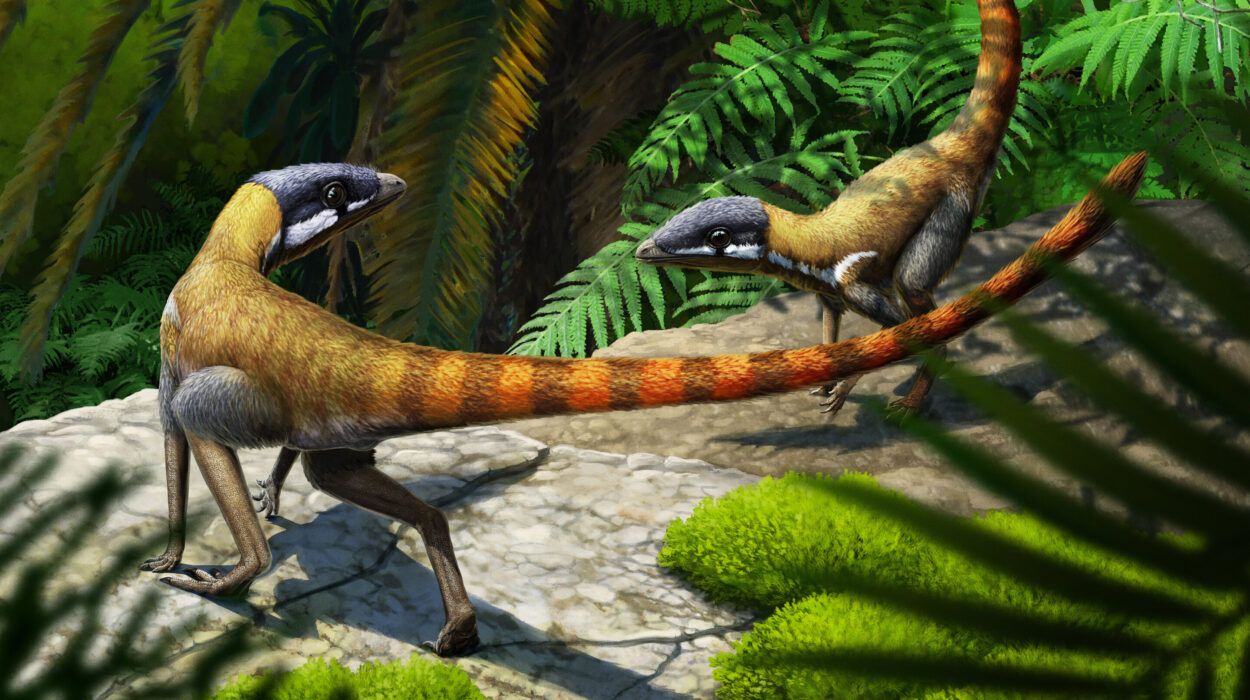
Millions of years before the first bird took to the skies, a creature roughly the size of a human teenager paced through the humid landscapes of what is now China. This was Heyuannia huangi, a member of the oviraptor family. With a body stretching 1.5 meters and weighing about 20 kg, it looked strikingly bird-like, yet it remained tethered to the earth. For decades, paleontologists have looked at the fossilized remains of these creatures—often found hunched over nests of elongated eggs—and wondered about the intimate mechanics of their parenthood. Did they sit on their eggs to keep them warm like a modern robin, or did they rely on the sweltering heat of the prehistoric sun like a crocodile?
A new investigation led by researchers in Taiwan has begun to peel back the layers of this ancient mystery. By blending the physical laws of heat transfer with the dusty evidence of the fossil record, the team, including senior author Dr. Tzu-Ruei Yang and lead author Chun-Yu Su, decided that to understand a dinosaur, they had to build one.
Bringing a Ghost Back to Life
The researchers faced a unique challenge: how do you measure the incubation efficiency of a creature that hasn’t breathed in 66 million years? The answer lay in a mix of high-tech simulation and craft-store ingenuity. The team constructed a life-sized oviraptor incubator. This wasn’t a sleek, robotic replica, but a carefully engineered model designed to mimic the thermal properties of a living animal.
The “skeleton” of the model was crafted from polystyrene foam and wood, providing the structure of the dinosaur’s frame. To simulate the soft tissue—the muscle and skin that would hold and radiate heat—they used a combination of cotton, bubble paper, and cloth. This reconstructed parent was then placed over a clutch of eggs that were just as carefully designed.
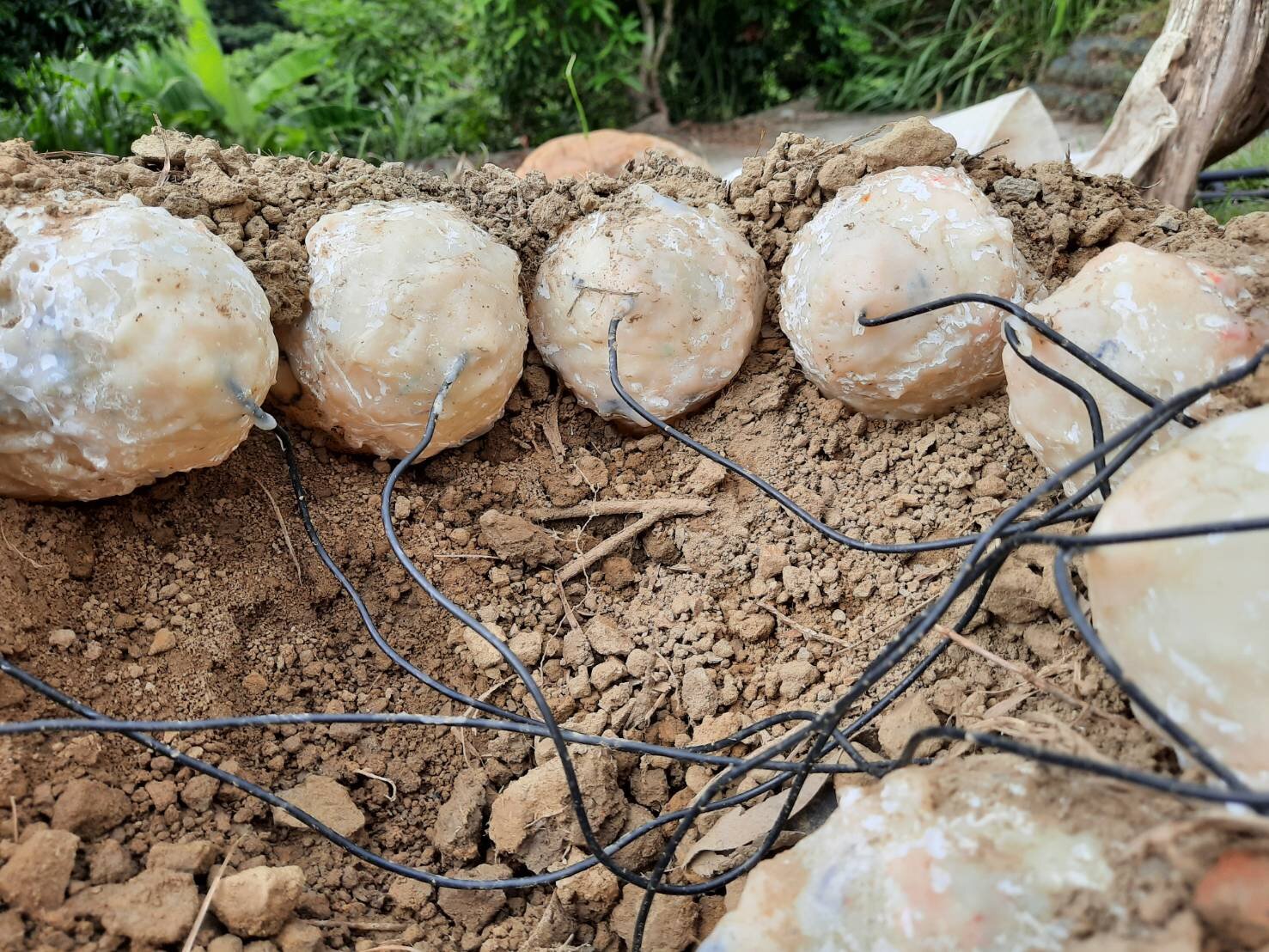
Because oviraptor eggs are unlike any produced by species alive today, the team had to invent casting resin eggs that approximated the size, shape, and thermal conductivity of the real thing. These eggs were arranged in double-rings, a specific semi-open pattern found in actual oviraptor fossil sites, creating a circular stadium of future dinosaurs.
The Secret Dance of Heat and Shadow
As the experiments began, the team discovered that the way an oviraptor sat mattered just as much as its body temperature. The relative position of the adult to the eggs created a complex map of heat. In the experiments, the researchers found that when the environment turned cold, the presence of the brooding adult caused a massive temperature disparity.
In these chilly conditions, the eggs in the outer ring of the nest could differ in temperature by as much as 6°C. This gap is significant; it suggests that oviraptors likely experienced asynchronous hatching. Instead of all the siblings popping out of their shells at once, the eggs in the warmer spots would develop faster, leading to a staggered arrival of hatchlings over several days or weeks.
However, the story changed when the sun came out. In warmer environmental conditions, the temperature difference across the outer ring plummeted to a mere 0.6°C. This suggests that oviraptors weren’t just parents; they were master opportunists. In the heat of the Late Cretaceous, the sun acted as a “co-incubator.” Because oviraptor nests were semi-open and exposed to the air, the sun provided a powerful, supplementary heat source that the soil could not match.
A Different Path to Life
When comparing these ancient parents to the birds in our backyards, the researchers found a striking gap in performance. Modern birds utilize a method called thermoregulatory contact incubation (TCI). To pull this off, a bird must meet three strict criteria: it must be in direct contact with every egg, it must be the primary heat source, and it must keep all eggs within a very tight temperature range.
The oviraptor failed on almost every count. Their specific egg arrangement—those beautiful double-rings—actually prevented the adult from making full physical contact with every egg in the clutch. Because they couldn’t cover the entire nest, their incubation efficiency was much lower than that of modern birds.
But Dr. Yang cautions against seeing this as an evolutionary failure. While modern birds might be “faster” or more focused heat sources, the oviraptors had a strategy perfectly tuned to their world. Their method was a bridge in time—a behavioral adaptation that moved away from the buried nests of reptiles toward the open nests of birds. They didn’t need to be the sole provider of warmth because they had a partnership with their environment.
Why This Ancient Nursery Matters
This research is more than a study of old bones; it is a bridge between the rigid world of physics-based simulations and the creative interpretations of paleontology. It proves that we can test the behavior of extinct animals by recreating their physical world, allowing us to ask questions about incubation periods and nesting strategies that were previously considered unknowable.
Furthermore, this study serves as a powerful message about the nature of scientific discovery. Despite the fact that Taiwan has no dinosaur fossils of its own, this team of researchers proved that curiosity is not limited by geography. By using innovative modeling and “inventing” the tools they lacked, they have contributed a vital chapter to the story of how life began in the shadow of the dinosaurs. It reminds us that evolution isn’t a ladder of “better” or “worse” techniques, but a shifting mosaic of survival, where a 20 kg dinosaur and the midday sun once worked together to bring the next generation into a prehistoric world.
Study Details
Heat transfer in a realistic clutch reveals a lower efficiency in incubation of oviraptorid dinosaurs than of modern birds, Frontiers in Ecology and Evolution (2026). DOI: 10.3389/fevo.2026.1351288