The Cretaceous Period was not a place for the faint of heart, especially within the churning depths of the Western Interior Sea. This ancient seaway, which once split North America in two, was a realm of giants where the line between hunter and hunted blurred in the silt-filled water. For millions of years, the stories of these encounters remained locked in stone, waiting for someone to notice a single, violent moment frozen in time. That moment finally came to light not in the field under a baking sun, but within the quiet, climate-controlled specimen drawers of Chicago’s Field Museum of Natural History.
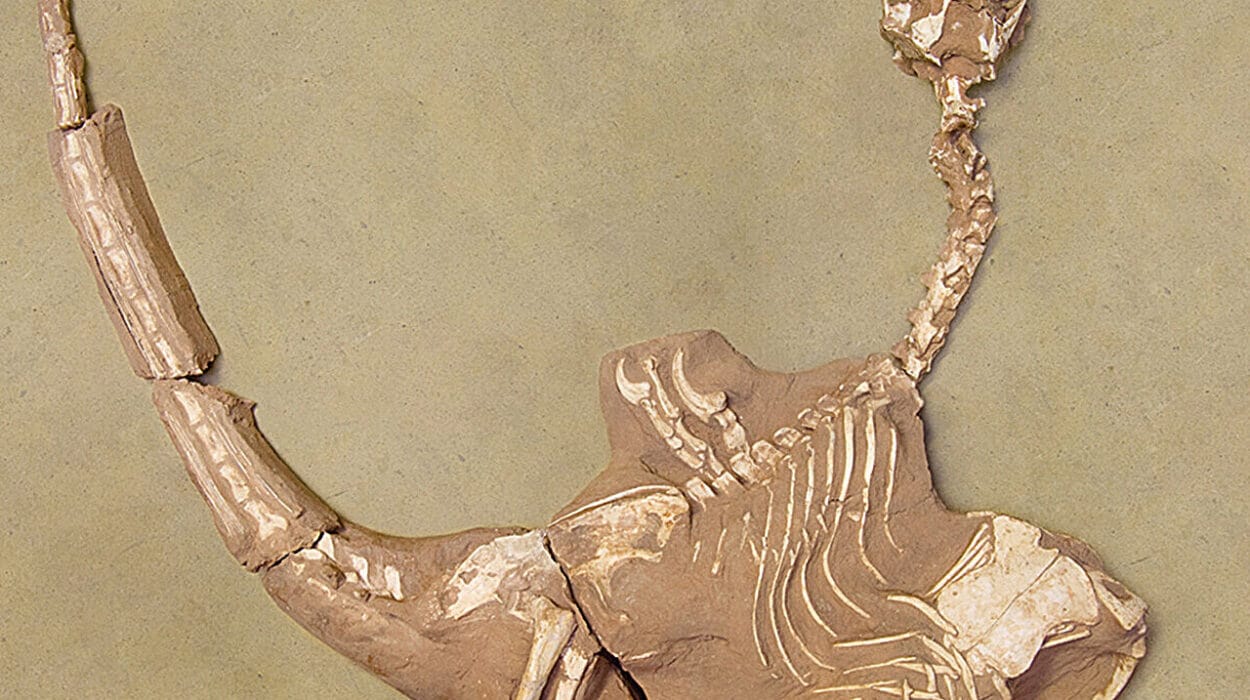
While most scientific breakthroughs are the result of targeted expeditions, this discovery began with a moment of curiosity. Professor Christopher Brochu of the University of Iowa was spending his day examining fossil crocodiles when he decided to look at other materials to find something interesting for his students. His eyes fell upon the remains of a Polycotylus, a type of plesiosaur that stretched four meters long. As he looked closer at the animal’s neck vertebrae, he realized he wasn’t looking at a pristine bone. There, embedded deep within the spinal column, was the jagged evidence of a prehistoric assault.
A Shadow in the Specimen Drawer
The fossil originated from the Mooreville Chalk of Alabama, a geological formation famous for preserving the inhabitants of a dynamic and dangerous ecosystem. This particular Polycotylus had carried a secret for 80 million years: a massive, broken tooth lodged firmly into its neck. The violence of the original strike, combined with the crushing weight of time and the process of fossilization, had left the tooth shattered at both its base and its tip. It was a riddle wrapped in stone, impossible to identify with the naked eye without risking damage to the precious vertebra.
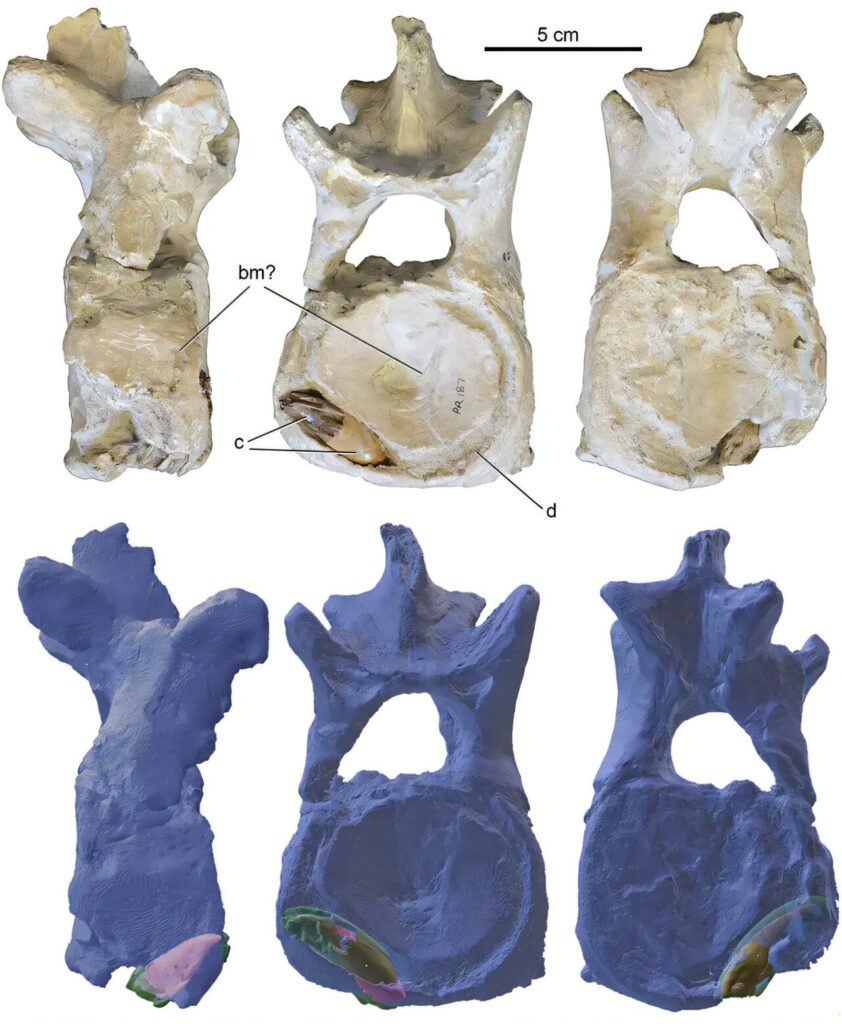
To solve the mystery of who had dared to bite a four-meter-long marine reptile, the research team turned to the digital world. They utilized computed tomography, or CT scanning, to peer inside the bone without ever touching a chisel to the surface. This high-tech visualization allowed a team from the University of Tennessee, Knoxville, including undergraduates Miles Mayhall and Emma Stalker, to virtually dissect the specimen. They meticulously built a three-dimensional model of the embedded tooth, mapped out its shape, and compared its structure to the known predators of the Cretaceous.
The Unexpected Titan of the Deep
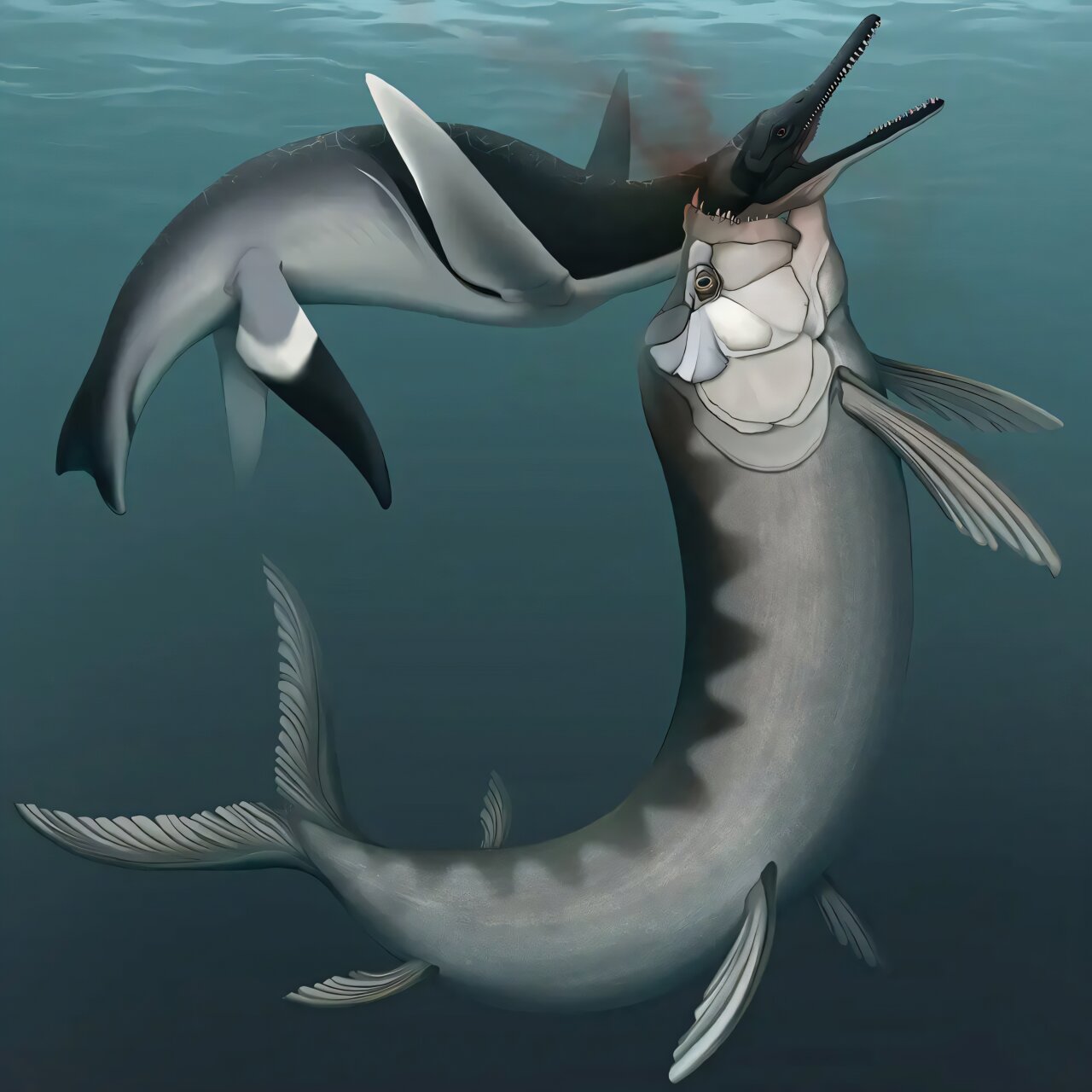
The results of the digital reconstruction shifted the team’s understanding of the ancient food chain. The culprit was not a fellow marine reptile or a shark, as one might expect, but a gargantuan bony fish known as Xiphactinus. Often reaching terrifying proportions, Xiphactinus was a torpedo-shaped predator built for speed and power. Finding its tooth buried in the neck of a Polycotylus challenged the traditional “fixed ideas” scientists often hold about which animals sit at the absolute top of the pyramid and which reside a rung or two lower.
Lead author Stephanie Drumheller noted that nature is rarely as organized as a textbook diagram. While the Polycotylus was a formidable animal, the Xiphactinus proved to be a chaotic and lethal contemporary. However, the motivation behind the bite remains a subject of scientific intrigue. Xiphactinus is famous among paleontologists for “fish-within-a-fish” fossils, which show the predator frequently swallowed smaller prey whole. Given the size of the Polycotylus, it is unlikely the fish was attempting to eat the reptile in a single gulp. Instead, the wound suggests a different kind of interaction—perhaps a territorial clash or a desperate struggle between two of the sea’s most dangerous inhabitants.
The High Price of a Long Neck
Regardless of whether the fish was hunting or simply defending its space, the impact of the bite was devastating. Professor Robin O’Keefe pointed out that the iconic long necks of plesiosaurs were a double-edged sword. While they offered advantages for movement and catching prey, they were also a significant anatomical “price.” Within that narrow column of bone and muscle lay the trachea, the esophagus, and the major arteries and veins, as well as vital nerves.
A strike to this specific area by an animal as powerful as a Xiphactinus would have been a “death blow.” If the Polycotylus was not already dead when the fish struck, the depth and location of the tooth penetration ensured it wouldn’t survive much longer. The fossil serves as a grim reminder that in the Mooreville Chalk ecosystem, even the largest predators were vulnerable. The rocks of Alabama have yielded a “host of other evidence” involving sharks, bony fish, and marine reptiles all bearing the marks of conflict. It was an environment where even a “hapless dinosaur” washed out to sea would find no safety.
Why This Discovery Matters
This research, published in the Journal of Vertebrate Paleontology, is significant because it provides rare, direct evidence of inter-species conflict that goes beyond simple predator-prey dynamics. It forces scientists to rethink the complexity of ancient ecosystems, moving away from a linear food chain and toward a more “dynamic” and chaotic web of life.
By identifying Xiphactinus as an animal capable of taking down or severely injuring a large plesiosaur, researchers gain a clearer picture of the energy and aggression required to survive in the Cretaceous oceans. It reminds us that the fossil record is not just a collection of bones, but a record of behaviors, risks, and the brutal reality of evolution. The discovery underscores that in the ancient seas, size was no guarantee of safety, and the “top predator” was often whoever struck first.
Study Details
Stephanie K. Drumheller et al, A bite to the throat: A probable Xiphactinus attack on a Polycotylus from the Cretaceous Mooreville Chalk of Alabama, U.S.A., Journal of Vertebrate Paleontology (2026). DOI: 10.1080/02724634.2026.2625732