Physics is often celebrated as the science that explains the universe. It has revealed why planets orbit stars, how electricity powers our world, why atoms hold together, and how light travels across billions of light-years. From Isaac Newton’s laws of motion to Albert Einstein’s theory of relativity and the astonishing predictions of quantum mechanics, physics has transformed humanity’s understanding of reality.
Yet for all its remarkable successes, physics remains unfinished.
Modern scientists can predict the behavior of subatomic particles with extraordinary precision. They can detect ripples in space-time from colliding black holes billions of light-years away. They can recreate conditions similar to those just after the Big Bang inside particle accelerators.
And still, they face mysteries so profound that no accepted theory can explain them.
These are not minor gaps in scientific knowledge. They are fundamental questions about the nature of reality itself. What is most of the universe actually made of? Why does time seem to move in only one direction? Why is gravity so astonishingly weak compared to the other fundamental forces? Do black holes destroy information? Why do the laws of physics have exactly the values they do?
Scientists have developed promising hypotheses for many of these puzzles, but none has yet been confirmed. Each mystery represents a frontier where today’s physics reaches its limits.
The following seventeen mysteries are among the deepest unanswered questions in modern physics. They remind us that even after centuries of discovery, the universe still guards many of its greatest secrets.
1. What Is Dark Matter?
Look up at the night sky and imagine every star, planet, nebula, black hole, and galaxy you can see.
Now imagine that all of them combined account for only a small fraction of the universe’s total matter.
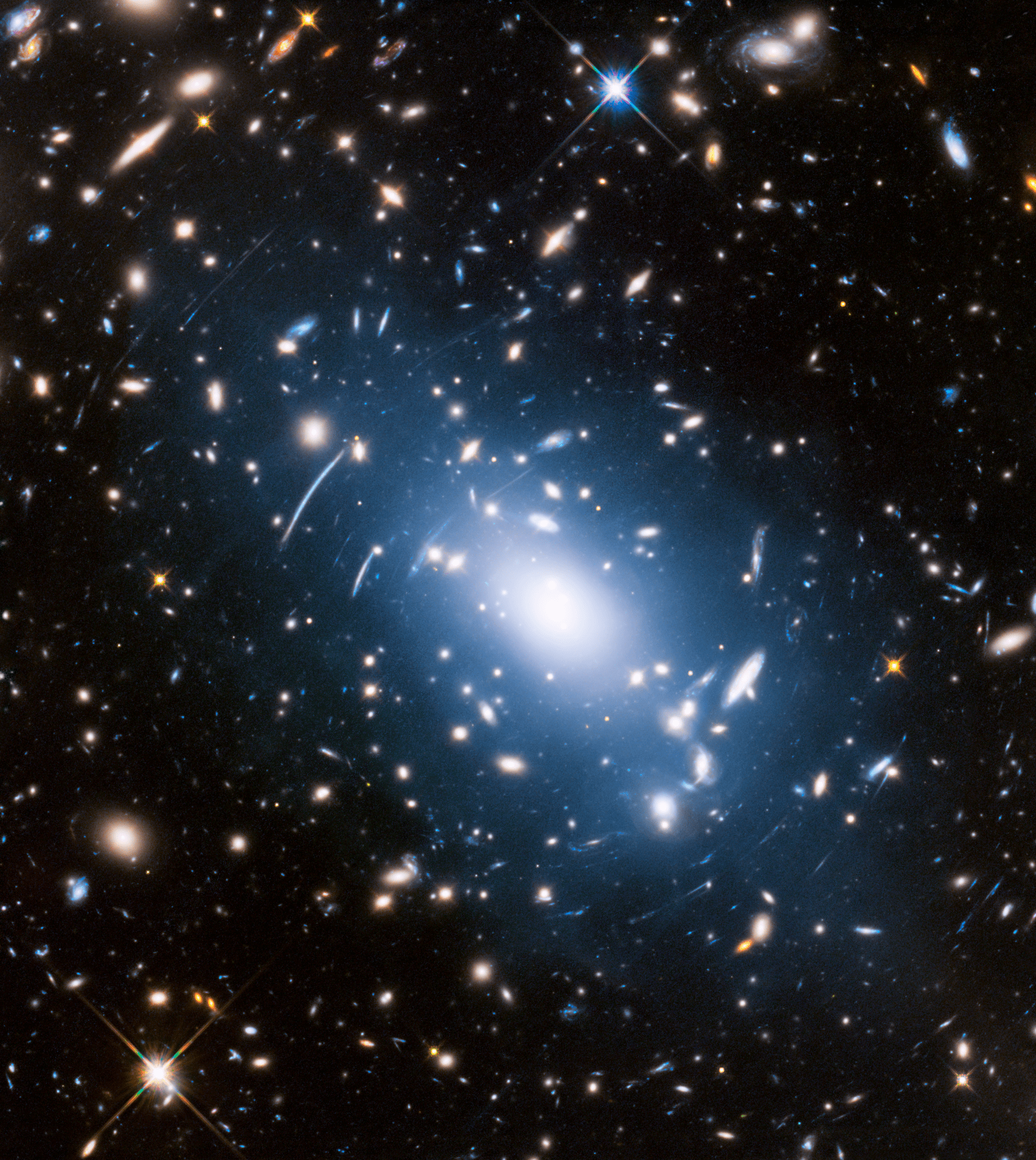
According to modern cosmology, ordinary matter—the atoms that make up everything visible—represents only about 5% of the universe’s total energy and matter content. Roughly 27% appears to consist of something entirely different: dark matter.
Dark matter neither emits nor absorbs light, making it invisible to telescopes.
Scientists know it exists because of gravity.
Galaxies rotate far too quickly to remain intact if only visible matter were present. Galaxy clusters bend light from distant objects more strongly than ordinary matter alone can explain. Measurements of the cosmic microwave background independently support the same conclusion.
All evidence points toward enormous quantities of unseen mass.
Yet despite decades of research, physicists have never directly detected a dark matter particle.
Numerous candidates have been proposed, including weakly interacting massive particles (WIMPs), axions, sterile neutrinos, and other hypothetical particles beyond the Standard Model.
Large underground detectors, particle accelerators, and astronomical observatories continue searching.
So far, dark matter remains invisible except through its gravitational influence.
2. What Is Dark Energy?
As mysterious as dark matter is, dark energy may be even stranger.
In 1998, astronomers studying distant supernovae made an astonishing discovery.
Instead of slowing down under gravity, the expansion of the universe is accelerating.
Something appears to be pushing galaxies apart.
This unknown phenomenon has been named dark energy.
Unlike ordinary energy, dark energy does not seem to cluster into stars or galaxies. Instead, it appears to fill space itself.
Current observations suggest that dark energy constitutes nearly 68% of the universe’s total energy content.
Despite dominating the cosmos, nobody knows what it actually is.
Some physicists associate it with vacuum energy—the energy of empty space predicted by quantum mechanics.
However, theoretical calculations exceed observed values by an astonishing factor of roughly 10¹²⁰, making this one of the largest discrepancies in physics.
Others propose entirely new fields or modifications to Einstein’s theory of gravity.
No explanation has yet achieved experimental confirmation.
3. Why Is Gravity So Weak?
Gravity governs planets, stars, galaxies, and the structure of the universe.
Yet at the particle level, gravity is astonishingly weak.
A small refrigerator magnet can overcome Earth’s entire gravitational pull on a paperclip.
Compared with electromagnetism, gravity is approximately 10³⁶ times weaker.
Physicists do not know why.
Some theories involving extra spatial dimensions suggest gravity spreads into dimensions beyond our perception.
Others argue that gravity’s apparent weakness reflects deeper symmetries not yet understood.
Despite centuries of study, one of nature’s most familiar forces remains among its greatest puzzles.
4. Why Can’t Quantum Mechanics and General Relativity Be Unified?
Modern physics rests upon two extraordinarily successful theories.
Quantum mechanics describes the microscopic world of atoms and elementary particles.
General relativity explains gravity and the large-scale structure of space-time.
Individually, both theories work remarkably well.
Together, they become mathematically incompatible under extreme conditions, such as inside black holes or during the earliest moments of the universe.
This incompatibility represents perhaps the greatest challenge in theoretical physics.
Scientists seek a theory of quantum gravity capable of describing both the quantum and gravitational realms simultaneously.
Candidates include string theory, loop quantum gravity, causal dynamical triangulations, and several other approaches.
None has yet received experimental confirmation.
5. What Happened Before the Big Bang?
According to modern cosmology, the observable universe evolved from an extremely hot, dense state approximately 13.8 billion years ago.
This event is commonly called the Big Bang.
A widespread misconception is that the Big Bang was an explosion in space.
Instead, it was the rapid expansion of space itself.
But what happened before it?
Current physics cannot provide a definitive answer.
General relativity predicts a singularity where known physical laws break down.
Many physicists suspect that this singularity signals the limits of the theory rather than physical reality.
Various hypotheses include bouncing universes, eternal inflation, cyclic cosmologies, and quantum origins of space-time.
At present, none has been verified.
6. Why Does Time Flow Forward?
The equations governing most fundamental physical processes are largely time-symmetric.
In principle, they work equally well whether time moves forward or backward.
Yet everyday experience tells a different story.
Broken cups never spontaneously reassemble.
Smoke does not return to a candle.
People remember yesterday but not tomorrow.
This directionality is called the arrow of time.
Thermodynamics connects it to increasing entropy—the tendency for isolated systems to become more disordered.
However, physicists still debate why the universe began in such an extraordinarily low-entropy state that allowed this arrow of time to emerge.
The origin of time’s direction remains one of physics’ deepest mysteries.
7. What Happens Inside a Black Hole?
Black holes are among the most extreme objects known.
Their gravity becomes so intense that beyond the event horizon, nothing—not even light—can escape.
General relativity predicts that matter falling inward eventually reaches a singularity.
Yet quantum physics suggests that singularities indicate incomplete understanding.
Because information from inside the event horizon cannot return to outside observers, direct observation is impossible.
The true internal structure of black holes remains unknown.
Some theories eliminate singularities entirely.
Others propose quantum states replacing classical geometry.
Until quantum gravity is understood, the interiors of black holes remain hidden.
8. The Black Hole Information Paradox
Quantum mechanics states that information cannot be destroyed.
Black holes appear to challenge this principle.
Stephen Hawking showed that black holes emit faint thermal radiation due to quantum effects.
Over immense timescales, they could eventually evaporate.
If they disappear completely, what happens to all the information about the matter that fell inside?
Does it vanish forever?
If so, quantum theory would require revision.
If not, how does the information escape?
This question has generated decades of intense debate.
Ideas involving holography, quantum entanglement, and subtle properties of Hawking radiation continue to be investigated.
No consensus has yet emerged.
9. Why Is There More Matter Than Antimatter?
The laws of physics predict that the Big Bang should have produced matter and antimatter in nearly equal amounts.
Whenever matter and antimatter meet, they annihilate each other into energy.
If equal amounts had existed, the universe would contain almost no atoms today.
Instead, matter overwhelmingly dominates.
Stars, planets, galaxies, and people all exist because of a tiny imbalance.
Why that imbalance occurred remains unknown.
Experiments studying CP violation—small differences between matter and antimatter behavior—have revealed partial asymmetries.
However, the observed effects appear too small to explain the universe’s overwhelming matter dominance.
10. Why Do the Fundamental Constants Have Their Values?
The speed of light.
Planck’s constant.
The gravitational constant.
The strengths of the fundamental forces.
Particle masses.
Modern physics relies on numerous constants measured experimentally.
But why do they possess exactly their observed values?
Even tiny changes would dramatically alter the universe.
Stars might never form.
Chemistry could become impossible.
Atoms might not remain stable.
Physicists do not know whether these values arise from deeper principles, random chance, or selection among multiple universes.
11. Is Space-Time Fundamental or Emergent?
We usually imagine space and time as the stage upon which the universe exists.
Some modern theories challenge this assumption.
Instead, space-time itself may emerge from deeper quantum structures.
Ideas involving quantum entanglement suggest that geometry may arise from underlying informational relationships.
If true, space would not be fundamental.
It would be a consequence of something even more basic.
This possibility remains one of theoretical physics’ most exciting frontiers.
12. Why Does Quantum Measurement Produce Definite Outcomes?
Quantum systems can exist in superpositions, representing multiple possible states simultaneously.
Yet measurements always produce one definite result.
Why?
This question is known as the quantum measurement problem.
Various interpretations attempt to explain it.
Some invoke wavefunction collapse.
Others propose branching universes, hidden variables, or decoherence.
Although these interpretations differ philosophically, they generally produce identical experimental predictions.
Physics currently lacks experimental evidence distinguishing among them.
13. Are There More Dimensions Than We Can See?
Everyday experience involves three dimensions of space and one of time.
Some advanced theories propose additional hidden dimensions.
String theory, for example, requires extra spatial dimensions for mathematical consistency.
These dimensions would be compactified at incredibly small scales.
Despite decades of searching, no experimental evidence confirms their existence.
If extra dimensions exist, they could reshape understanding of gravity, particle physics, and cosmology.
14. Why Does Quantum Entanglement Exist?
When particles become entangled, measurements performed on one instantly correlate with measurements on another, even across enormous distances.
Einstein famously called this phenomenon “spooky action at a distance.”
Experiments have repeatedly confirmed entanglement.
Importantly, it does not allow faster-than-light communication.
Instead, it reveals correlations stronger than classical physics permits.
Why nature behaves this way remains deeply mysterious.
Entanglement lies at the heart of quantum computing and quantum information science, yet its ultimate physical meaning continues to provoke debate.
15. What Is the True Nature of the Quantum Vacuum?
Empty space is not actually empty.
According to quantum field theory, the vacuum teems with fluctuating fields and transient virtual particles.
These fluctuations produce measurable effects, including the Casimir effect and subtle shifts in atomic energy levels.
Yet profound questions remain.
How should vacuum energy be calculated?
Why does theoretical vacuum energy differ so dramatically from cosmological observations?
What role does the vacuum play in the universe’s large-scale evolution?
The emptiest possible space may be far more complicated than anyone imagined.
16. Are We Missing Fundamental Particles or Forces?
The Standard Model of particle physics has been spectacularly successful.
It accurately predicts countless experimental results.
Yet it cannot explain dark matter, neutrino masses in its original formulation, gravity, or dark energy.
Many physicists suspect additional particles remain undiscovered.
Experiments at the CERN and elsewhere continue searching for evidence of new physics.
So far, results largely confirm the Standard Model with remarkable precision.
Whether new particles await discovery—or whether entirely different ideas are required—remains unknown.
17. Why Does the Universe Exist at All?
Perhaps the deepest mystery transcends every equation.
Why is there something rather than nothing?
Physics describes how the universe evolves.
It explains interactions, particles, fields, and forces.
Whether physics can ultimately explain why reality exists in the first place remains uncertain.
Some cosmological models suggest universes can emerge naturally from quantum processes.
Others argue that such explanations merely push the question deeper.
The existence of the universe itself remains the most profound unanswered question in science.
Why These Mysteries Matter
These puzzles are not signs that physics has failed.
They are evidence that science continues to advance.
Every major revolution in physics began with unexplained observations.
Mercury’s unusual orbit led to general relativity.
The photoelectric effect helped launch quantum mechanics.
Unexpected galaxy rotation curves revealed dark matter.
Mysteries drive scientific progress.
Each unanswered question inspires new experiments, more powerful telescopes, increasingly sensitive detectors, and deeper mathematical theories.
Some of today’s greatest mysteries may become tomorrow’s textbook knowledge.
Others may require entirely new ways of thinking about reality.
The Future of Physics
The coming decades promise extraordinary opportunities.
New observatories will map billions of galaxies to investigate dark energy.
Underground detectors will continue searching for dark matter particles.
Gravitational-wave observatories will probe the most violent events in the universe.
Quantum computers may simulate physical systems beyond the reach of classical computation.
Particle accelerators will continue testing the Standard Model with unprecedented precision.
Artificial intelligence is already helping physicists analyze enormous datasets and discover subtle patterns invisible to human researchers.
Each advance brings us closer to answers.
Yet history suggests that every solution will reveal even deeper questions.
The Endless Wonder of the Unknown
Physics has revealed that space bends, time slows, particles behave like waves, black holes evaporate, and empty space is alive with quantum activity. Ideas that once sounded impossible are now established scientific facts.
That history offers an important lesson.
Reality is under no obligation to match human intuition.
The seventeen mysteries explored here remind us that the universe remains far stranger than our current understanding. They represent the boundaries of human knowledge, where observation exceeds explanation and evidence points toward discoveries still waiting to be made.
Some of these mysteries may be solved within our lifetimes. Others may challenge generations of scientists yet to come. But every unanswered question carries the same promise: somewhere beyond the limits of today’s physics lies a deeper understanding of the cosmos.
And perhaps the most extraordinary truth is this—not that we still have mysteries, but that the universe is comprehensible enough for us to recognize them. Every unanswered question is an invitation to explore, to test, to imagine, and to continue humanity’s greatest scientific adventure: discovering how reality truly works.