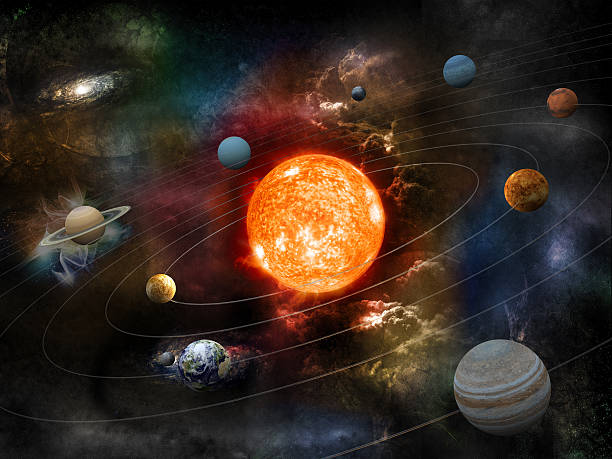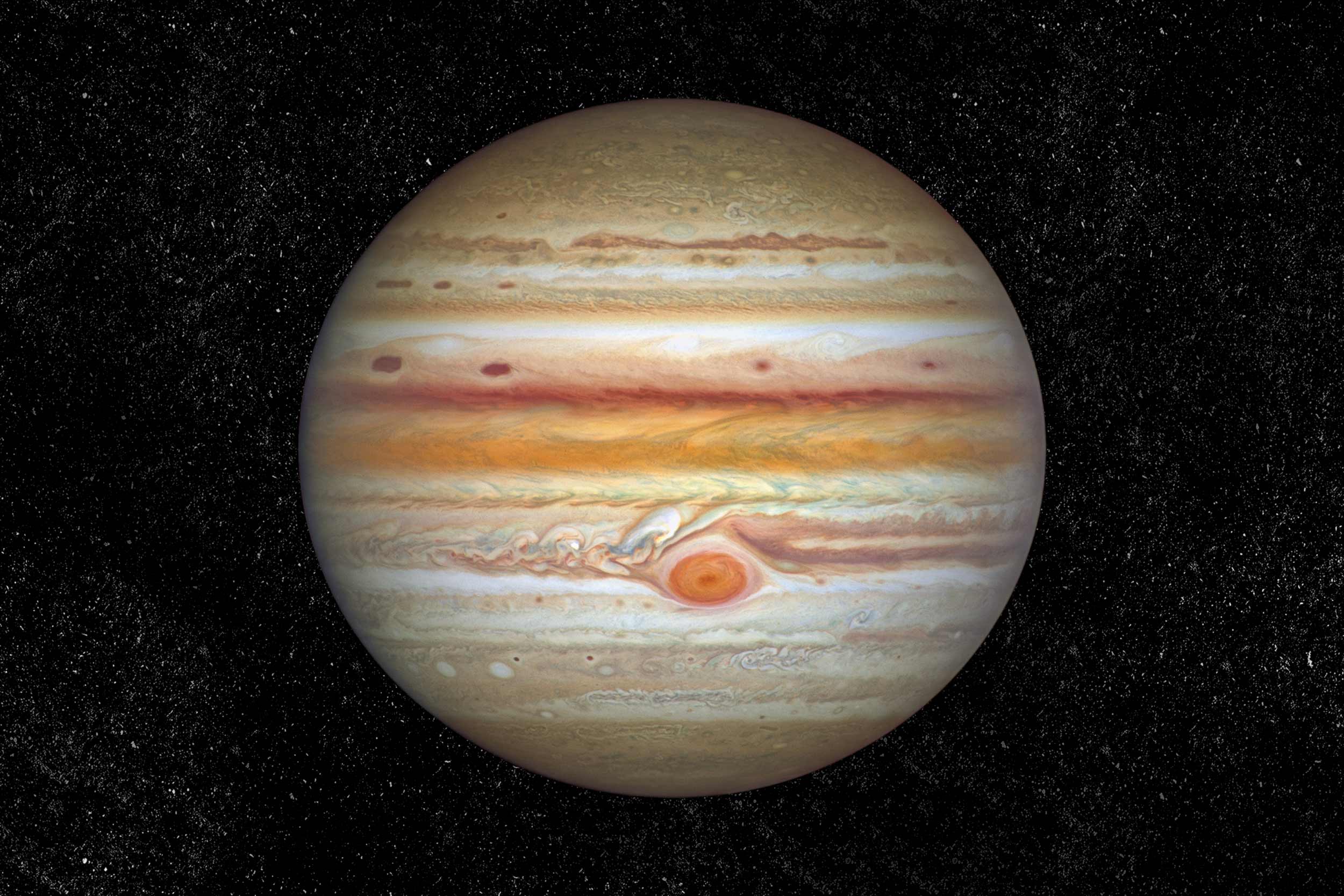
Far beyond Earth, beyond Mars, and past the asteroid belt lies Jupiter, the largest planet in our Solar System. Even through small telescopes, Jupiter appears extraordinary. Its surface is covered with colorful bands of clouds, swirling storms, and mysterious atmospheric features unlike anything seen on Earth.
Among all of Jupiter’s wonders, one feature stands above the rest: the Great Red Spot.
At first glance, it looks like a simple reddish oval embedded within the planet’s cloud bands. But this enormous mark is actually a gigantic storm, one so large that Earth itself could fit inside it. It is the largest known storm in the Solar System and one of the most fascinating mysteries in planetary science.
For centuries, astronomers have watched this enormous vortex spin through Jupiter’s atmosphere. It has survived generation after generation of human observers. Empires have risen and fallen, technologies have transformed civilization, and countless discoveries have reshaped our understanding of the universe. Yet throughout all that time, the Great Red Spot has continued to rage.
Why has it lasted so long?
Why is it red?
Why hasn’t it disappeared?
How deep does it extend into Jupiter?
And what can this giant storm teach us about the nature of planets?
These questions have driven scientific investigations for decades, and while researchers have uncovered many answers, the Great Red Spot still holds secrets that continue to challenge our understanding of planetary weather.
Meeting Jupiter: The King of the Planets
To understand the Great Red Spot, we must first understand Jupiter itself.
Jupiter is the largest planet orbiting the Sun. It contains more than twice the mass of all the other planets combined. If Jupiter were hollow, more than 1,300 Earths could fit inside it.
Unlike Earth, Jupiter is not a rocky world with mountains, oceans, and continents. It is a gas giant composed primarily of hydrogen and helium. These are the same elements that make up most of the Sun.
Because Jupiter lacks a solid surface, its atmosphere transitions gradually into deeper layers of increasingly compressed gases and liquids. Descending into Jupiter would not involve landing on the ground. Instead, a spacecraft would sink through thicker and thicker atmospheric layers until crushing pressures eventually destroyed it.
Jupiter’s atmosphere is one of the most dynamic environments in the Solar System. Powerful winds race around the planet at tremendous speeds. Massive cloud bands circle the globe. Storms form, merge, evolve, and disappear.
Within this chaotic environment exists the Great Red Spot—a storm unlike any other.
The Discovery of the Great Red Spot
The Great Red Spot has been observed for so long that its exact discovery remains uncertain.
Astronomers began studying Jupiter through telescopes shortly after the invention of the telescope in the early seventeenth century.
Some historical observations suggest that astronomers may have seen a large storm on Jupiter as early as the 1660s. However, scientists cannot be completely certain that the feature observed centuries ago is the same storm we see today.
The first reliable observations of the modern Great Red Spot date back to the nineteenth century.
Since then, astronomers have continuously monitored the giant storm, documenting changes in its size, color, shape, and behavior.
This means humanity has been observing the Great Red Spot for well over 150 years.
It may actually be much older.
If the earliest observations truly describe the same feature, the storm could have existed for more than 350 years.
No storm on Earth comes close to such longevity.
How Big Is the Great Red Spot?
One reason the Great Red Spot attracts so much attention is its incredible size.
When people first hear about the storm, they often assume it is merely larger than a hurricane.
The reality is far more astonishing.
At its largest recorded size during the nineteenth century, the Great Red Spot was wide enough to fit several Earths side by side.
Today, the storm has shrunk significantly, yet it remains enormous.
Its current width is still roughly 14,000 to 16,000 kilometers, depending on how it is measured.
Earth’s diameter is approximately 12,742 kilometers.
In other words, the entire Earth could still fit comfortably inside the Great Red Spot.
If a person could somehow stand above Jupiter and look down at the storm, it would dominate the view like a colossal crimson eye staring from the planet’s atmosphere.
Its scale is almost impossible to comprehend.
What Exactly Is the Great Red Spot?
The Great Red Spot is an anticyclonic storm.
On Earth, we often hear about cyclones and hurricanes. These storms rotate around areas of low pressure.
An anticyclone is different. It rotates around a region of high pressure.
The Great Red Spot is essentially a giant atmospheric vortex.
Clouds circulate around its perimeter in a continuous rotation. The storm spins counterclockwise because of Jupiter’s atmospheric dynamics and its location in the planet’s southern hemisphere.
The winds surrounding the Great Red Spot are extraordinarily powerful.
Some reach speeds exceeding 400 kilometers per hour.
These winds are significantly stronger than many of the most intense storms on Earth.
Yet despite their tremendous velocity, they are only part of what makes the Great Red Spot extraordinary.
Its true mystery lies in its persistence.
Why Has the Storm Lasted So Long?
On Earth, even the most powerful storms eventually die.
Hurricanes lose energy when they move over land or colder waters. Tornadoes usually survive only minutes or hours. Even large weather systems rarely persist for more than weeks.
The Great Red Spot has survived for centuries.
Why?
One major reason involves Jupiter’s lack of a solid surface.
Earth’s storms eventually encounter continents, mountains, forests, and other obstacles that disrupt their circulation.
Jupiter has no continents.
No mountain ranges.
No oceans in the familiar terrestrial sense.
Nothing rises into the atmosphere to weaken the storm.
The Great Red Spot can continue rotating without colliding with land.
Another important factor involves Jupiter’s enormous energy reserves.
The planet radiates more heat than it receives from the Sun. Internal heat rises from deep within Jupiter, helping drive atmospheric activity.
This continuous energy supply may help sustain long-lived storms.
Scientists also believe that neighboring jet streams contribute to the storm’s survival.
The Great Red Spot sits between powerful eastward and westward atmospheric currents.
These currents may effectively feed energy into the vortex, helping maintain its strength.
Even with these explanations, however, the storm’s extraordinary longevity remains one of planetary science’s greatest puzzles.
Why Is It Red?
The storm’s distinctive color is perhaps its most famous characteristic.
Yet surprisingly, scientists still do not know exactly why the Great Red Spot is red.
Several theories have been proposed.
One leading idea suggests that ultraviolet sunlight triggers chemical reactions within Jupiter’s atmosphere.
Jupiter contains compounds such as ammonia, methane, sulfur compounds, and other chemicals.
When sunlight interacts with these substances, complex molecules may form.
These newly created chemicals could produce the reddish coloration seen in the storm.
Another possibility involves materials rising from deeper atmospheric layers.
The Great Red Spot may transport chemicals upward from beneath Jupiter’s visible clouds.
Once exposed to sunlight and radiation, these materials could undergo chemical changes that generate reddish hues.
Laboratory experiments have shown that certain combinations of atmospheric chemicals can indeed create colors similar to those observed on Jupiter.
However, scientists have not yet identified the exact mechanism responsible.
The storm continues to guard one of its most visible secrets.
The Great Red Spot Is Shrinking
For much of modern history, the Great Red Spot was significantly larger than it is today.
Astronomers comparing historical observations with modern measurements have discovered a surprising trend.
The storm has been shrinking.
During the late nineteenth century, the Great Red Spot was approximately twice as wide as it is now.
Over the decades, its dimensions have steadily decreased.
This shrinking has raised an intriguing possibility.
Could the Great Red Spot eventually disappear?
Scientists are not sure.
Although the storm is becoming smaller, it remains extraordinarily powerful.
Recent observations suggest that its rate of shrinkage has varied over time.
Some periods show rapid changes, while others indicate greater stability.
Predicting the future evolution of such a complex atmospheric system is extremely difficult.
The Great Red Spot may continue shrinking.
It may stabilize.
Or it may transform into something entirely different.
For now, nobody knows.
A World of Storms
The Great Red Spot is not Jupiter’s only storm.
The planet hosts countless vortices of various sizes.
Some appear white.
Others are brown or reddish.
Many emerge, interact, and disappear over time.
Astronomers have observed smaller storms merging together to form larger structures.
They have also witnessed new vortices developing unexpectedly.
Jupiter’s atmosphere resembles a gigantic laboratory where atmospheric processes unfold on scales far beyond anything found on Earth.
The Great Red Spot is simply the most famous member of a vast family of Jovian storms.
Studying these other storms helps scientists understand why the Great Red Spot behaves as it does.
The Role of Jupiter’s Rapid Rotation
Jupiter rotates incredibly fast.
Despite being the largest planet in the Solar System, it completes one rotation in less than ten hours.
This rapid spinning has profound effects on its atmosphere.
The fast rotation creates powerful forces that organize clouds into distinct bands encircling the planet.
These bands move at different speeds and often in opposite directions.
The boundaries between them generate turbulence and instability.
Storms frequently emerge in these regions.
The Great Red Spot exists within this dynamic environment.
Jupiter’s rapid rotation helps maintain the atmospheric structure that allows such a giant vortex to survive.
Without the planet’s extraordinary spin, the storm might never have formed.
Looking at the Storm Through Spacecraft Eyes
For centuries, astronomers could only study the Great Red Spot from Earth.
The Space Age changed everything.
Spacecraft began providing close-up views that transformed scientific understanding.
The first detailed images arrived during the 1970s when the spacecraft Pioneer 10 and Pioneer 11 flew past Jupiter.
Soon afterward, Voyager 1 and Voyager 2 delivered spectacular photographs.
For the first time, scientists could see the storm in remarkable detail.
The images revealed swirling structures, turbulent edges, and complex cloud patterns.
What once appeared as a simple red oval suddenly became a dynamic and intricate atmospheric system.
Each new mission provided additional clues about the storm’s nature.
The Galileo Mission’s Contributions
A major leap forward came with the arrival of the Galileo spacecraft in the 1990s.
Unlike flyby missions, Galileo orbited Jupiter for years.
This allowed scientists to observe changes in the Great Red Spot over extended periods.
Galileo revealed that the storm was not static.
Its appearance evolved continuously.
Cloud formations shifted.
Colors varied.
Internal structures changed.
The mission demonstrated that the Great Red Spot was a living, dynamic system rather than a permanent atmospheric feature frozen in time.
These observations laid the foundation for modern studies of Jupiter’s atmosphere.
Juno and a New Era of Discovery
The most detailed investigations of the Great Red Spot have come from the Juno spacecraft.
Arriving at Jupiter in 2016, Juno carries sophisticated instruments designed to probe beneath the planet’s clouds.
One of the mission’s most important discoveries concerns the depth of the Great Red Spot.
For many years, scientists debated whether the storm was a shallow surface feature or a deep atmospheric structure.
Juno provided the answer.
The storm extends hundreds of kilometers below the visible cloud tops.
Measurements indicate that it reaches at least around 300 kilometers into Jupiter’s atmosphere.
This depth is enormous compared with many terrestrial weather systems.
The finding suggests that the Great Red Spot is deeply rooted within Jupiter’s atmospheric layers.
Its visible clouds are merely the uppermost expression of a much larger structure hidden below.
The Strange Dynamics Inside the Storm
The interior of the Great Red Spot is surprisingly complex.
Rather than behaving like a simple spinning disk, the storm contains multiple layers and flow patterns.
Clouds move at different speeds depending on their location.
The strongest winds often occur near the outer edges.
The center can be comparatively calmer.
Researchers have identified intricate interactions between rising and sinking atmospheric currents.
Some regions transport material upward.
Others move gases downward.
These processes influence temperature, chemistry, and cloud formation.
The storm resembles a giant atmospheric engine continuously recycling energy and material.
Understanding these dynamics remains an active area of research.
Lightning, Clouds, and Weather on Jupiter
Jupiter’s atmosphere experiences weather phenomena that would seem familiar in some ways and utterly alien in others.
Massive cloud systems drift through the atmosphere.
Powerful lightning flashes illuminate storms.
Towering cloud formations rise high above surrounding regions.
Yet the scale dwarfs anything on Earth.
Lightning storms on Jupiter can be larger than entire countries.
Cloud layers contain substances rarely encountered in Earth’s atmosphere.
Instead of water clouds alone, Jupiter hosts clouds composed of ammonia crystals and other exotic materials.
The Great Red Spot exists within this strange meteorological landscape.
It is part of a planetary weather system operating on scales that challenge human imagination.
Could Humans Survive Inside the Great Red Spot?
This question often arises because the storm is so famous.
The answer is no.
Even reaching the Great Red Spot would be extraordinarily difficult.
Jupiter’s environment is hostile to life as we know it.
There is no solid surface on which to stand.
Atmospheric pressures increase dramatically with depth.
Temperatures vary widely.
Powerful winds would create dangerous conditions.
Additionally, Jupiter possesses intense radiation belts that can damage both humans and spacecraft.
A person descending into the Great Red Spot would encounter increasingly severe conditions until survival became impossible.
The storm may be beautiful from afar, but it is one of the most extreme environments in the Solar System.
What the Great Red Spot Teaches Us About Other Planets
Studying Jupiter’s giant storm has applications far beyond Jupiter itself.
Scientists use knowledge gained from the Great Red Spot to improve understanding of atmospheric physics throughout the universe.
Many exoplanets discovered around distant stars are gas giants similar to Jupiter.
Some may host enormous storms of their own.
By understanding how Jupiter’s atmosphere behaves, researchers gain insight into weather patterns on worlds light-years away.
The Great Red Spot serves as a natural laboratory for studying fluid dynamics, turbulence, atmospheric chemistry, and planetary climate systems.
Lessons learned from Jupiter often influence broader planetary science.
Could Similar Storms Exist Elsewhere?
Jupiter is not the only planet with giant storms.
Saturn, Neptune, and Uranus also host powerful atmospheric systems.
Neptune’s famous Dark Spot, observed by the Voyager 2, resembled Jupiter’s Great Red Spot in some ways.
However, Neptune’s storm eventually disappeared.
This contrast makes Jupiter’s storm even more remarkable.
Why has one giant vortex survived for centuries while others vanish?
The answer may reveal fundamental differences in atmospheric dynamics among giant planets.
Researchers continue comparing these worlds in search of clues.
The Human Fascination with Cosmic Storms
There is something deeply captivating about the Great Red Spot.
Perhaps it is the sheer scale.
Perhaps it is the mystery.
Or perhaps it is the realization that nature can create structures far beyond human experience.
On Earth, storms inspire awe and respect.
The Great Red Spot takes those emotions and magnifies them enormously.
It reminds us that the Solar System is not a quiet collection of planets drifting peacefully through space.
It is a dynamic place filled with powerful forces, violent weather, and ongoing change.
The giant storm has become one of astronomy’s most recognizable symbols because it captures this sense of cosmic drama.
Mysteries That Remain Unsolved
Despite centuries of observation and decades of spacecraft exploration, major questions remain unanswered.
Scientists still do not know precisely how the storm formed.
Its exact age remains uncertain.
The reason for its color remains debated.
Its long-term future remains unclear.
Researchers continue developing computer models to simulate its behavior.
New observations regularly reveal unexpected details.
Every answer seems to generate new questions.
This is one reason the Great Red Spot remains such an exciting subject of scientific investigation.
The mystery is far from solved.
Conclusion
Jupiter’s Great Red Spot is far more than a colorful mark on a distant planet. It is the largest and longest-lasting storm known in the Solar System, a colossal atmospheric vortex that has fascinated humanity for centuries. Large enough to swallow Earth and powerful enough to sustain winds hundreds of kilometers per hour, it stands as one of nature’s most extraordinary creations.
Scientists have learned much about the storm. They know it is a massive high-pressure system. They know it extends deep into Jupiter’s atmosphere. They understand that the planet’s rapid rotation, internal heat, and atmospheric currents all contribute to its survival.
Yet many mysteries remain. The storm’s exact origin is unknown. Its reddish color continues to puzzle researchers. Its gradual shrinking raises questions about its future.
Perhaps that uncertainty is part of its appeal.
The Great Red Spot is a reminder that even within our own Solar System, there are wonders we do not fully understand. It challenges scientists, inspires curiosity, and demonstrates the astonishing power of planetary weather.
As spacecraft continue exploring Jupiter and future missions uncover new details, the giant storm will undoubtedly reveal more of its secrets. Until then, the Great Red Spot remains one of the most magnificent mysteries in the cosmos—a swirling crimson giant that has watched over Jupiter for centuries and may continue doing so for many years to come.