For more than seventy years, schoolchildren around the world learned that our Solar System contained nine planets. Mercury, Venus, Earth, Mars, Jupiter, Saturn, Uranus, Neptune, and Pluto formed a familiar cosmic family. Pluto was always the smallest and most distant member, a tiny world orbiting in the darkness beyond Neptune. Despite its size, it captured imaginations like few other celestial bodies. It was mysterious, remote, and oddly lovable.
Then, in 2006, something happened that sparked one of the most famous scientific debates in modern astronomy.
Pluto lost its status as a planet.
The decision shocked the public. Newspapers around the world reported the news. Teachers had to revise textbooks. Students wondered why scientists would suddenly change something that seemed settled. Many people felt that Pluto had been unfairly demoted. Others argued that science had simply corrected a classification based on new evidence.
Nearly two decades later, the debate continues.
Why was Pluto removed from the list of planets? Was the decision justified? What new discoveries forced astronomers to rethink the Solar System? And could Pluto someday regain its planetary status?
The story is far more fascinating than a simple change in terminology. It is a tale of discovery, scientific progress, disagreement, and humanity’s evolving understanding of the cosmos.
The Discovery of Pluto
The story begins in the early twentieth century.
Astronomers had long suspected that another large object might exist beyond Neptune. Tiny irregularities in the motions of Uranus and Neptune led some scientists to believe an undiscovered planet was exerting gravitational influence.
This hypothetical object became known as Planet X.
The search for Planet X was led by American astronomer Percival Lowell, who spent years trying to locate it. Although he died before finding the object, his observatory continued the search.
In 1930, a young astronomer named Clyde Tombaugh made a remarkable discovery at the Lowell Observatory.
By comparing photographic plates taken days apart, Tombaugh noticed a tiny point of light moving against the background stars.
He had found Pluto.
The discovery generated enormous excitement.
At a time when astronomy was rapidly expanding humanity’s view of the universe, finding a new planet felt like a historic achievement. Newspapers celebrated the event, and Pluto quickly became the ninth planet of the Solar System.
Its name came from the Roman god of the underworld, fitting for a dark and distant world residing at the edge of the known planetary system.
Why Pluto Seemed Like a Planet
When Pluto was discovered, classifying it as a planet seemed reasonable.
After all, it orbited the Sun, just like the other planets.
At the time, astronomers knew relatively little about it. Because of its great distance, Pluto appeared only as a tiny point of light through telescopes.
Many scientists initially assumed it might be comparable in size to Earth.
As better observations became available, however, a problem emerged.
Pluto was much smaller than expected.
Over the decades, estimates of its size continued shrinking.
Eventually astronomers realized that Pluto was dramatically different from the eight major planets.
It was tiny, icy, and unlike anything previously classified as a planet.
Yet because it had already spent decades in textbooks and public consciousness as the ninth planet, its status remained unchanged.
For many years, nobody seriously challenged the classification.
A Strange World at the Solar System’s Edge
As scientists learned more about Pluto, they discovered a surprisingly unusual world.
Pluto follows a highly elliptical orbit. Unlike the nearly circular paths of most planets, Pluto’s orbit is stretched and tilted.
For part of its journey around the Sun, Pluto actually travels closer to the Sun than Neptune.
This unusual orbit raised questions.
Why did Pluto behave so differently from the other planets?
Its physical characteristics were also distinctive.
Pluto is only about 2,377 kilometers (1,477 miles) across. Earth’s diameter exceeds 12,700 kilometers.
Pluto’s mass is less than one percent of Earth’s.
If Earth were the size of a basketball, Pluto would be roughly the size of a marble.
Despite its small size, Pluto possesses fascinating features.
Its surface contains mountains made of water ice, frozen plains of nitrogen ice, and a thin atmosphere that expands and contracts as it moves around the Sun.
Far from being an insignificant rock, Pluto turned out to be a complex and dynamic world.
The problem was not that Pluto lacked interesting qualities.
The problem was whether those qualities made it a planet.
The Discovery of the Kuiper Belt
The biggest challenge to Pluto’s planetary status came from discoveries beyond its orbit.
For much of the twentieth century, Pluto appeared unique.
Astronomers believed it was the lone major object occupying the distant reaches of the Solar System.
That assumption began to collapse in the 1990s.
Scientists discovered numerous icy bodies orbiting beyond Neptune in a region known as the Kuiper Belt.
The Kuiper Belt is somewhat similar to the asteroid belt, although much larger and composed primarily of icy objects.
Suddenly Pluto no longer looked unique.
Instead, it appeared to be one member of a vast population of distant icy worlds.
As more objects were discovered, astronomers realized that Pluto might simply be the largest known example of a completely different category of celestial body.
This raised a profound question.
If Pluto was a planet, should all these newly discovered objects also be considered planets?
The Growing Population of Pluto-Like Objects
The number of known Kuiper Belt objects increased rapidly.
Advances in telescope technology allowed astronomers to detect increasingly faint and distant bodies.
Many of these objects shared characteristics with Pluto.
They were icy.
They followed unusual orbits.
They occupied the same general region of space.
Some were surprisingly large.
Each new discovery complicated Pluto’s status.
If scientists continued calling Pluto a planet, consistency demanded that they consider whether these similar objects deserved the same label.
The Solar System’s planetary count might soon rise dramatically.
Some astronomers welcomed this possibility.
Others worried it would make the term “planet” increasingly meaningless.
The issue was no longer about Pluto alone.
It had become a question of scientific classification.
The Discovery of Eris
The turning point arrived in 2005.
Astronomers announced the discovery of an object later named Eris.
Initially, Eris appeared even larger than Pluto.
This discovery created an immediate crisis.
If Pluto was a planet, then Eris seemingly had to be a planet as well.
Yet Eris was only one of many large objects likely waiting to be discovered.
Astronomers realized they faced two options.
They could continue expanding the list of planets indefinitely.
Or they could develop a clearer definition of what qualifies as a planet.
The debate intensified.
Scientific meetings became battlegrounds for competing ideas.
The future of Pluto hung in the balance.
The Need for a Definition
One surprising aspect of the controversy was that astronomers had never formally defined the word “planet.”
For centuries, the term had evolved naturally.
When only a handful of obvious planets were known, a strict definition seemed unnecessary.
But scientific progress had changed the situation.
New discoveries demanded greater precision.
Scientists needed a definition capable of distinguishing planets from other objects.
The challenge proved difficult.
Nature rarely fits neatly into human categories.
Some objects possessed planetary characteristics but not all of them.
Others occupied gray areas between established classifications.
Finding a definition acceptable to astronomers worldwide would require extensive debate.
The 2006 International Astronomical Union Meeting
The decisive moment came in August 2006.
Astronomers gathered in Prague for a meeting of the International Astronomical Union, commonly known as the IAU.
The organization serves as the international authority responsible for naming and classifying astronomical objects.
Among the topics under discussion was the definition of a planet.
Numerous proposals were considered.
Some would have retained Pluto’s planetary status.
Others would have expanded the list of planets significantly.
After intense discussion, voting, and revisions, the IAU adopted a new definition.
The consequences would reshape astronomy education worldwide.
The New Definition of a Planet
According to the IAU, a planet must satisfy three criteria.
First, it must orbit the Sun.
Second, it must possess enough mass for its gravity to pull it into a nearly round shape.
Third, it must have “cleared the neighborhood” around its orbit.
The first two conditions posed no problem for Pluto.
It clearly orbits the Sun.
Its gravity has pulled it into a spherical shape.
The controversy centered on the third requirement.
What exactly does it mean to clear an orbital neighborhood?
Understanding Orbital Clearing
The concept of orbital clearing refers to gravitational dominance.
A true planet becomes the dominant object in its region of space.
Over time, its gravity either absorbs, ejects, or controls smaller objects near its orbit.
Earth, for example, overwhelmingly dominates its orbital zone.
Jupiter exerts even greater control over its region.
Pluto, however, shares its neighborhood with many Kuiper Belt objects.
It does not gravitationally dominate its surroundings in the same way the eight major planets do.
This distinction became crucial.
Because Pluto failed the third criterion, it no longer qualified as a planet under the new definition.
Instead, it entered a newly created category.
The Birth of the Dwarf Planet
The IAU introduced a new classification called “dwarf planet.”
A dwarf planet orbits the Sun.
It possesses sufficient gravity to become nearly round.
However, it has not cleared its orbital neighborhood.
Pluto fit this category perfectly.
So did Eris and several other objects.
Under this system, Pluto remained an important member of the Solar System.
It simply belonged to a different category.
Scientifically, the change reflected growing knowledge about the outer Solar System.
Emotionally, however, many people viewed it as a demotion.
The public reaction was immediate and passionate.
Why People Were Upset
The backlash surprised many astronomers.
From a scientific perspective, reclassification was a routine process.
Science constantly updates categories when new evidence emerges.
Yet Pluto occupied a special place in public imagination.
Generations had grown up learning about nine planets.
Many people felt an emotional connection to Pluto.
It was the underdog of the Solar System.
Small, distant, and mysterious, it inspired affection in a way few astronomical objects could.
Teachers, students, and space enthusiasts protested the decision.
Some newspapers framed the event as a cosmic injustice.
Humorous campaigns demanded Pluto’s reinstatement.
The debate extended far beyond scientific circles.
Scientists Who Disagreed
Not all astronomers supported the IAU decision.
Some argued that the definition was flawed.
Critics pointed out that the phrase “cleared the neighborhood” can be ambiguous.
No orbit is completely empty.
Even Earth shares space with numerous asteroids.
Others argued that physical characteristics should matter more than orbital dynamics.
From this perspective, Pluto’s geology, atmosphere, and complexity make it more planet-like than many people realize.
Some researchers continue advocating alternative definitions.
The debate remains active within parts of the scientific community.
Science thrives on disagreement and evidence-based discussion.
The Pluto controversy reflects that reality.
What New Horizons Revealed
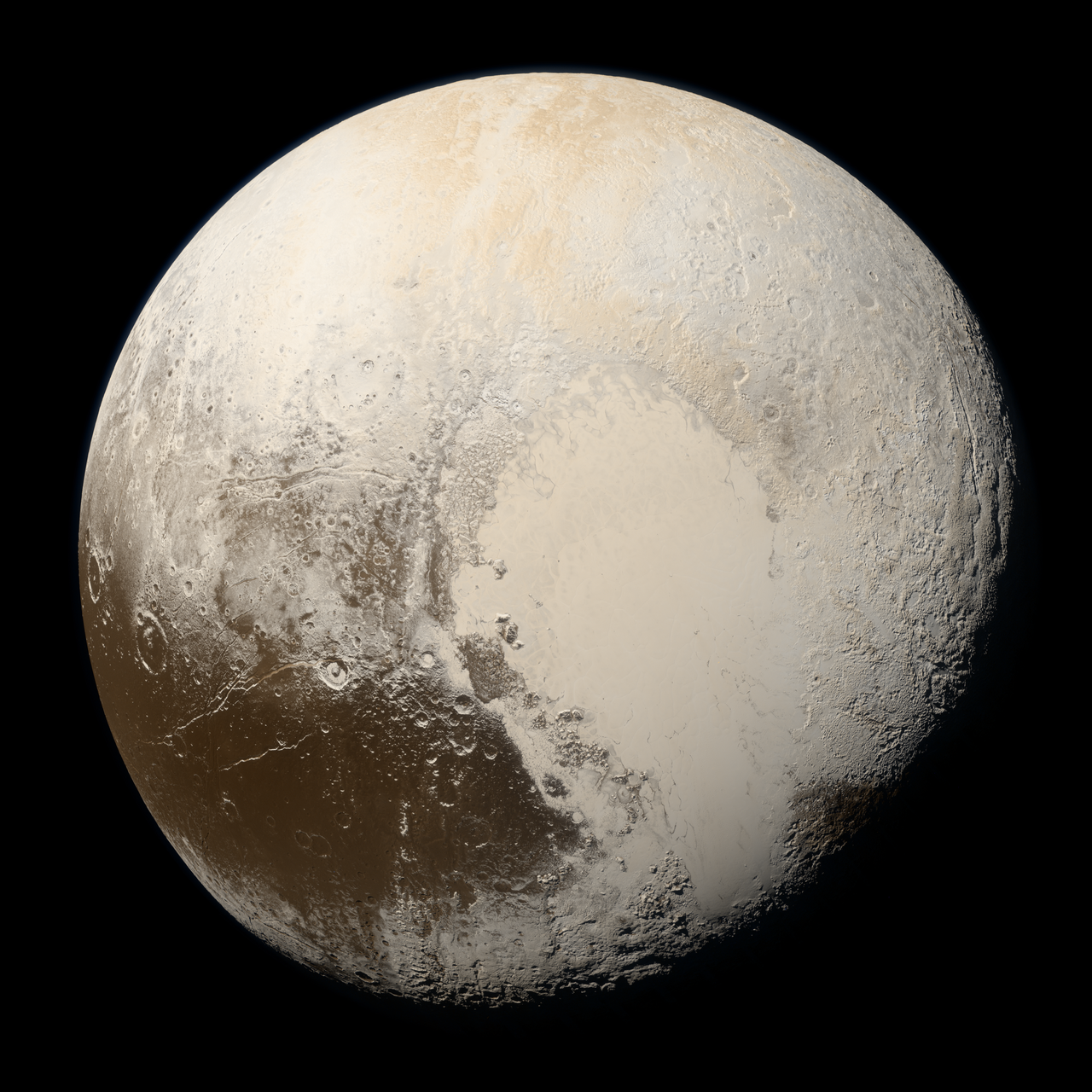
In 2015, Pluto experienced a remarkable comeback.
NASA’s New Horizons spacecraft flew past Pluto after a journey lasting nearly a decade.
For the first time, humanity saw Pluto up close.
The images stunned scientists.
Instead of a frozen, inactive world, Pluto displayed extraordinary complexity.
Towering mountains rose above icy plains.
Vast glaciers flowed across the surface.
Atmospheric hazes stretched high into the sky.
Signs of active geological processes appeared everywhere.
One enormous region, known as Sputnik Planitia, became particularly famous.
Its heart-shaped appearance captured public attention around the world.
The flyby transformed Pluto from a distant dot into a real world.
Ironically, the mission strengthened emotional arguments for restoring planetary status.
Many people wondered how such a fascinating place could be anything other than a planet.
Why Geological Complexity Matters
Some planetary scientists argue that classification should depend primarily on intrinsic characteristics.
If an object is round, geologically active, and possesses a complex internal structure, they believe it should qualify as a planet.
Under this approach, Pluto would easily make the cut.
So would numerous moons, including some larger than Mercury.
This definition emphasizes what an object is rather than where it happens to orbit.
Supporters argue that geology tells us more about planetary nature than orbital relationships.
Opponents counter that such a definition would create hundreds of planets in the Solar System.
The disagreement illustrates how classification often depends on priorities and perspective.
Pluto and the Evolution of Science
The Pluto story provides an excellent example of how science works.
Many people mistakenly assume scientific knowledge remains fixed forever.
In reality, science evolves.
New evidence leads to revised conclusions.
Improved observations force researchers to reconsider old assumptions.
When Pluto was discovered in 1930, astronomers lacked the information available today.
At that time, classifying Pluto as a planet was reasonable.
Later discoveries changed the context.
The Kuiper Belt revealed that Pluto belonged to a much larger population of similar objects.
Scientists adapted their classification system accordingly.
This process represents scientific progress, not failure.
Changing conclusions in response to evidence is one of science’s greatest strengths.
Is Pluto Less Important Now?
One common misconception is that Pluto became less significant after losing planetary status.
In reality, the opposite may be true.
Pluto remains one of the most scientifically interesting objects in the Solar System.
Researchers continue studying its atmosphere, geology, climate, and interior.
The New Horizons mission generated years of valuable scientific data.
Pluto serves as a window into the early Solar System.
Because it formed in a cold, distant environment, it preserves clues about planetary formation billions of years ago.
Its scientific importance has never depended on its label.
Whether classified as a planet or dwarf planet, Pluto remains a fascinating world.
Could Pluto Become a Planet Again?
Technically, yes.
Scientific classifications can change.
If astronomers eventually adopt a different definition of “planet,” Pluto could regain its status.
However, such a change would require widespread agreement within the scientific community.
At present, the IAU definition remains the official standard used by most astronomers and educational institutions.
That said, the debate is not entirely settled.
Many researchers continue discussing alternative approaches.
Future discoveries may reshape the conversation.
Science remains open to revision when compelling evidence emerges.
The Broader Question of Classification
The Pluto debate highlights a larger issue in science.
Nature does not always fit neatly into categories.
Human beings create classifications to organize knowledge.
Sometimes those categories work well.
Sometimes new discoveries reveal their limitations.
Biologists face similar challenges when classifying species.
Geologists encounter them when categorizing rocks.
Astronomers experience them when defining planets.
The universe often proves more complicated than our labels.
Pluto reminds us that scientific categories are tools, not absolute truths.
Their purpose is to improve understanding, not restrict it.
Why Pluto’s Story Matters
At first glance, the debate may seem trivial.
After all, Pluto itself did not change in 2006.
Its orbit remained the same.
Its mountains remained the same.
Its icy surface remained the same.
Only the label changed.
Yet the controversy matters because it reveals how knowledge advances.
It demonstrates that science is not merely a collection of facts.
It is a process of discovery.
Scientists continually refine ideas as new evidence appears.
The Pluto debate also reminds us that emotional attachment can influence how people respond to scientific change.
Humans are storytellers.
We form connections with ideas, symbols, and traditions.
Pluto’s removal from the planetary roster felt personal to many people because it challenged a familiar narrative.
A World That Refused to Be Forgotten
Ironically, losing planetary status may have made Pluto more famous than ever.
Countless scientific articles, documentaries, books, and public debates have focused attention on this tiny world.
Millions of people who previously knew little about Pluto suddenly became interested in astronomy.
The controversy sparked curiosity.
It encouraged discussions about science and classification.
And when New Horizons revealed Pluto’s stunning landscapes, public fascination grew even stronger.
Far from fading into obscurity, Pluto became a symbol of exploration and discovery.
Conclusion
Pluto is no longer classified as a planet because of a decision made by the International Astronomical Union in 2006. Under the current definition, a planet must orbit the Sun, be nearly round due to its own gravity, and gravitationally dominate its orbital neighborhood. Pluto satisfies the first two criteria but not the third, leading to its reclassification as a dwarf planet.
The decision emerged from decades of new discoveries, particularly the identification of the Kuiper Belt and large Pluto-like objects such as Eris. These findings forced astronomers to confront a fundamental question: what exactly is a planet?
The answer remains surprisingly complex.
For some scientists, Pluto’s orbital environment justifies its reclassification. For others, Pluto’s geological richness and planetary characteristics make the current definition unsatisfactory. The debate continues because both sides raise important points.
What is certain is that Pluto remains one of the most fascinating worlds in the Solar System. It possesses mountains, glaciers, an atmosphere, and a rich geological history. It continues to challenge assumptions and inspire exploration.
Whether we call Pluto a planet or a dwarf planet, its significance has not diminished. If anything, the controversy has highlighted a deeper truth about science: our understanding of the universe is always evolving. As new discoveries emerge, even the most familiar ideas may be reconsidered.
And perhaps that is Pluto’s greatest lesson. The universe is far more complex, surprising, and wonderful than any classification system can fully capture.