The Solar System often feels familiar. Most people can name the planets, recognize Saturn’s rings, and picture the red deserts of Mars. Yet beyond the orbit of Neptune lies a vast, mysterious region that remains one of the least understood parts of our cosmic neighborhood. It is a place filled with ancient icy worlds, frozen remnants from the birth of the Solar System, and clues to mysteries that astronomers are still trying to solve. This distant realm is known as the Kuiper Belt.
For centuries, humanity’s view of the Solar System ended with the known planets. Even after the discovery of Neptune in 1846 and Pluto in 1930, few people imagined that a massive population of icy bodies existed beyond them. Today, however, scientists know that Pluto is only one member of an enormous family of objects occupying a vast ring around the Sun.
The Kuiper Belt is more than just a collection of frozen rocks. It is a time capsule from the earliest days of the Solar System. Hidden within it are some of the oldest and most primitive objects that have survived since the formation of the planets over 4.5 billion years ago. Every icy world in this distant region carries valuable information about the processes that shaped our cosmic home.
Exploring the Kuiper Belt is like opening a forgotten chapter of the Solar System’s history. The farther scientists look into this icy frontier, the more surprises they discover.
Understanding the Kuiper Belt
The Kuiper Belt is a large region of space located beyond Neptune’s orbit. It stretches from approximately 30 astronomical units from the Sun to about 50 astronomical units. An astronomical unit, often abbreviated as AU, is the average distance between Earth and the Sun, which is about 150 million kilometers or 93 million miles.
This means that the Kuiper Belt begins roughly 4.5 billion kilometers from the Sun and extends much farther outward.
Unlike the asteroid belt between Mars and Jupiter, which consists mainly of rocky bodies, the Kuiper Belt is dominated by icy objects. These objects contain frozen water, methane, ammonia, nitrogen, and other volatile compounds that can remain solid in the extreme cold of the outer Solar System.
Temperatures in the Kuiper Belt can plunge below minus 220 degrees Celsius. In this frigid environment, even substances that are gases on Earth become frozen solids.
The Kuiper Belt is often described as a doughnut-shaped region surrounding the Solar System. It contains millions of icy bodies, ranging from small fragments to dwarf planets hundreds or even thousands of kilometers across.
A Hidden World Beyond Neptune
For much of human history, nobody knew the Kuiper Belt existed.
Even after Pluto was discovered in 1930, astronomers assumed it might simply be an isolated planet orbiting far beyond Neptune. However, Pluto’s relatively small size puzzled researchers. It seemed different from the giant planets and even from the rocky inner planets.
As telescopes improved, scientists began detecting additional objects beyond Neptune. These discoveries suggested that Pluto was not alone.
In 1992, astronomers discovered a small object known as 1992 QB1. This became the first Kuiper Belt Object found after Pluto and its moon Charon.
The discovery changed astronomy forever.
Suddenly, scientists realized they were looking at an entirely new region of the Solar System populated by countless icy bodies.
Since then, thousands of Kuiper Belt Objects have been identified, and researchers estimate that many more remain undiscovered.
The Scientist Behind the Name
The Kuiper Belt is named after the Dutch-American astronomer Gerard Kuiper.
Interestingly, Kuiper did not actually predict the modern Kuiper Belt exactly as we understand it today. In the 1950s, he suggested that leftover material from the Solar System’s formation may once have existed beyond Neptune, though he believed much of it had likely disappeared.
Later astronomers developed the concept further and proposed that a large population of icy bodies should still exist in the outer Solar System.
When discoveries confirmed these predictions, the region eventually became known as the Kuiper Belt in honor of Kuiper’s contributions to planetary science.
Today, his name is permanently associated with one of the Solar System’s most fascinating regions.
How the Solar System Formed
To understand the Kuiper Belt, it helps to understand how the Solar System itself formed.
About 4.6 billion years ago, a giant cloud of gas and dust collapsed under its own gravity. As it contracted, it formed a spinning disk surrounding the young Sun.
Within this disk, particles collided and stuck together. Over time, they grew into larger and larger bodies.
Some became planets.
Others became moons.
Many never fully developed.
The Kuiper Belt contains some of these leftover building blocks.
Unlike objects closer to the Sun, which often experienced intense heating and dramatic geological changes, many Kuiper Belt Objects remained relatively unchanged for billions of years.
As a result, they preserve valuable information about conditions that existed during the Solar System’s infancy.
Studying them is like examining ancient fossils from the dawn of planetary history.
What Lives in the Kuiper Belt?
The Kuiper Belt is home to an astonishing variety of objects.
Some are small icy fragments only a few kilometers across. Others rival major moons in size.
These objects are collectively known as Kuiper Belt Objects, often abbreviated as KBOs.
Many KBOs have unusual shapes. Some are reddish in color due to complex organic molecules on their surfaces. Others appear brighter because of exposed ice.
Because they orbit so far from the Sun, most remain extremely cold and dark.
Many scientists believe the Kuiper Belt contains hundreds of thousands of objects larger than 100 kilometers across and millions of smaller bodies.
The sheer scale of this population makes the Kuiper Belt one of the largest structures in the Solar System.
Pluto and the Kuiper Belt Revolution
No object is more closely associated with the Kuiper Belt than Pluto.
For decades, Pluto was considered the ninth planet.
However, as astronomers discovered more Kuiper Belt Objects, they realized Pluto was not unique.
Many newly discovered objects shared similar characteristics.
Some followed comparable orbits.
Others approached Pluto’s size.
This raised an important question.
If Pluto was a planet, should all these similar objects also be considered planets?
The debate eventually led to Pluto’s reclassification as a dwarf planet in 2006.
Although controversial, this decision reflected a growing understanding that Pluto belongs to a much larger population of Kuiper Belt Objects.
Rather than diminishing Pluto’s importance, the discovery of the Kuiper Belt transformed it into the most famous member of a vast and fascinating family.
The Discovery of Eris
The debate over Pluto intensified after the discovery of Eris in 2005.
Eris appeared comparable to Pluto in size and mass.
Its discovery challenged traditional definitions of a planet.
If Pluto was a planet, many astronomers argued, Eris should also qualify.
The resulting discussions led the International Astronomical Union to create a new category: dwarf planets.
Pluto and Eris became members of this category alongside several other distant worlds.
The discovery highlighted just how diverse and complex the outer Solar System really is.
Other Dwarf Planets in the Kuiper Belt
Pluto and Eris are not the only dwarf planets associated with the Kuiper Belt.
Objects such as Haumea and Makemake also inhabit this distant region.
Each has unique characteristics.
Haumea rotates extraordinarily fast, giving it an elongated shape unlike most known worlds.
Makemake possesses a bright icy surface and a thin atmosphere under certain conditions.
These dwarf planets demonstrate that the Kuiper Belt is not a monotonous collection of frozen rocks.
Instead, it is a diverse ecosystem of worlds with distinct histories and physical properties.
Strange and Exotic Landscapes
Although the Kuiper Belt is incredibly cold, its objects are far from boring.
Scientists have discovered evidence of surprisingly complex geology on some of these distant worlds.
Pluto, for example, contains vast plains of nitrogen ice, towering mountains made of water ice, and signs of ancient geological activity.
Some Kuiper Belt Objects may contain subsurface oceans hidden beneath thick layers of ice.
Others exhibit evidence of collisions, cryovolcanism, or unusual surface chemistry.
These findings have forced scientists to rethink assumptions about the outer Solar System.
Even in extreme cold and darkness, fascinating processes can occur.
The New Horizons Mission
Humanity’s understanding of the Kuiper Belt changed dramatically thanks to the New Horizons spacecraft.
Launched in 2006, New Horizons embarked on a journey spanning billions of kilometers.
In 2015, it performed the first close flyby of Pluto.
The images stunned scientists.
Instead of a frozen, inactive world, Pluto revealed remarkable complexity.
Its landscapes included mountains, glaciers, plains, and atmospheric layers.
The mission transformed Pluto from a blurry point of light into a real world.
But New Horizons did not stop there.
After leaving Pluto, the spacecraft continued deeper into the Kuiper Belt.
In 2019, it flew past a small object known as Arrokoth.
This encounter provided humanity’s first close-up look at a primitive Kuiper Belt Object.
Arrokoth and a Window into the Past
Arrokoth may be one of the most important objects ever explored.
Before the flyby, it appeared as a tiny distant target.
When New Horizons arrived, scientists discovered a remarkably unusual shape.
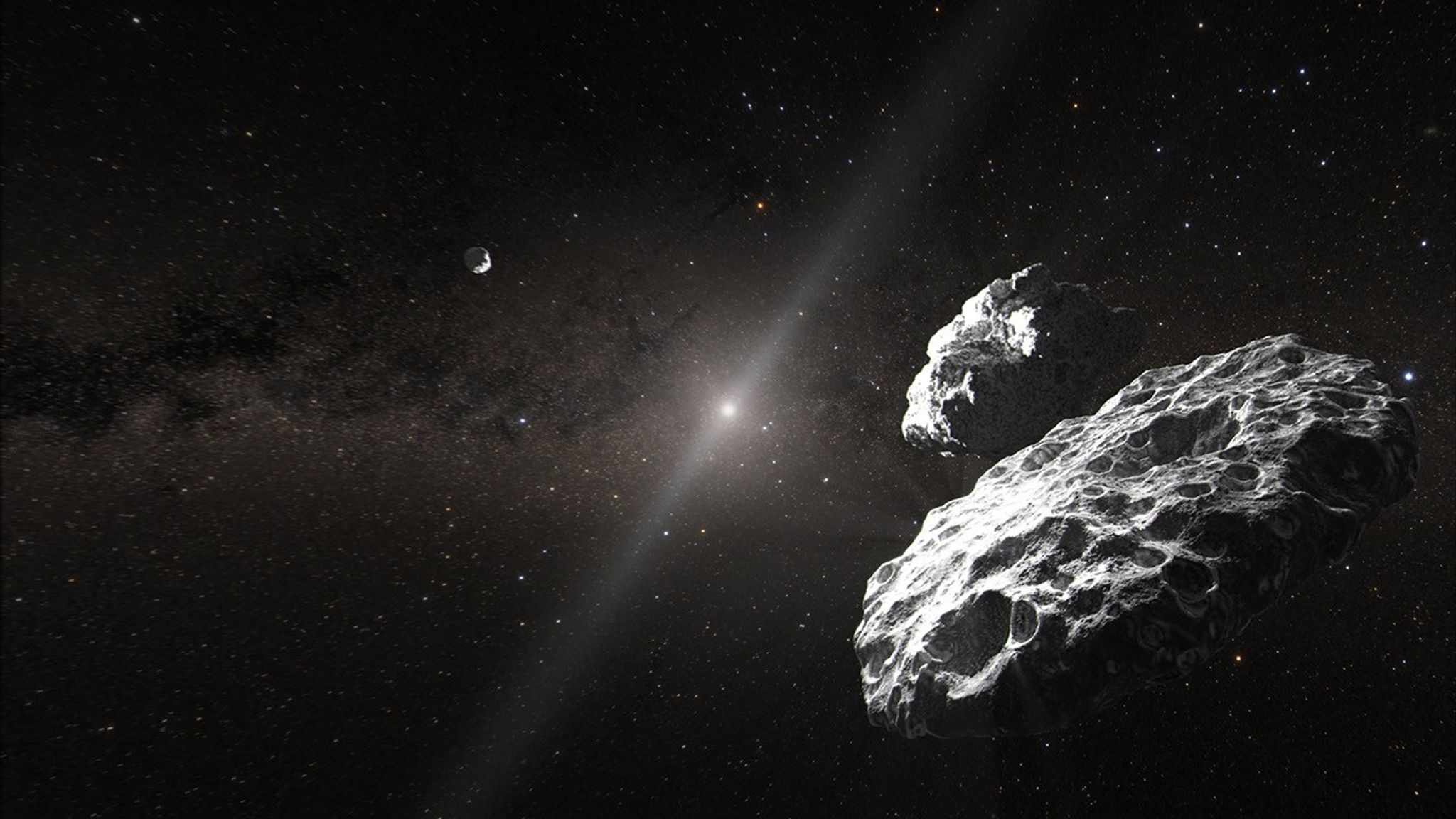
Arrokoth resembles two connected lobes gently fused together.
This structure provides clues about how planets formed.
Evidence suggests that Arrokoth formed through a slow and gentle process in which small bodies gradually merged rather than violently colliding.
Because it has remained largely unchanged for billions of years, Arrokoth serves as a pristine relic from the Solar System’s earliest era.
Studying it is like examining a fossil preserved since the birth of the planets.
Why the Kuiper Belt Matters
The Kuiper Belt matters because it preserves ancient history.
Most planets have undergone major changes over billions of years.
Volcanism, impacts, tectonic activity, atmospheric evolution, and other processes have altered their surfaces.
Many Kuiper Belt Objects experienced far fewer changes.
As a result, they provide a direct glimpse into the conditions that existed during the Solar System’s formation.
Researchers study these objects to answer fundamental questions.
How did planets form?
How did giant planets migrate?
What materials existed in the early Solar System?
How common are organic compounds in distant regions?
The Kuiper Belt helps scientists investigate all these mysteries.
The Connection to Comets
The Kuiper Belt is closely linked to comets.
Many short-period comets originate there.
These comets occasionally experience gravitational disturbances that send them toward the inner Solar System.
When they approach the Sun, their icy materials begin to vaporize.
This creates the glowing coma and tail that make comets so beautiful.
In a sense, some of the comets visible from Earth are visitors from the Kuiper Belt.
They carry ancient material from one of the Solar System’s most remote regions.
Each comet provides scientists with a sample of primordial matter preserved since planetary formation.
Neptune’s Powerful Influence
The Kuiper Belt does not exist in isolation.
Its structure is heavily influenced by Neptune.
The giant planet’s gravity shapes the orbits of many Kuiper Belt Objects.
Some objects orbit in special patterns known as resonances.
Pluto is one example.
Although its orbit crosses Neptune’s orbital distance, gravitational resonance prevents collisions.
The relationship between Neptune and the Kuiper Belt offers valuable insights into the Solar System’s history.
Many scientists believe Neptune migrated outward early in its existence.
As it moved, it reshaped the Kuiper Belt and scattered objects throughout the outer Solar System.
The Scattered Disk
Beyond the main Kuiper Belt lies an even more distant region known as the scattered disk.
Objects in the scattered disk often have highly elongated orbits.
Some travel extremely far from the Sun before returning.
These bodies likely experienced powerful gravitational interactions with Neptune long ago.
The scattered disk blurs the boundary between the Kuiper Belt and more distant regions of the Solar System.
It represents another piece of the complex architecture surrounding our planetary neighborhood.
The Oort Cloud Connection
Far beyond the Kuiper Belt lies a hypothetical region known as the Oort Cloud.
The Oort Cloud may contain trillions of icy objects extending nearly a quarter of the distance to the nearest stars.
Although it has never been directly observed, strong evidence suggests it exists.
Scientists believe some Kuiper Belt Objects may have contributed material to the formation of the Oort Cloud.
Together, these distant populations create a vast outer realm surrounding the Solar System.
Compared to Earth’s orbit, the scale is almost unimaginable.
The Colors of the Kuiper Belt
One surprising aspect of Kuiper Belt research involves color.
Different objects display a wide range of shades.
Some appear gray.
Others are reddish.
A few show complex mixtures of colors.
These variations likely result from differences in composition, radiation exposure, and geological history.
Over billions of years, cosmic radiation can alter surface materials and produce complex organic compounds.
The resulting colors provide clues about an object’s past.
By studying color patterns, astronomers gain valuable information about the evolution of distant worlds.
Organic Molecules in the Outer Solar System
The Kuiper Belt is especially interesting because it may contain significant quantities of organic compounds.
Organic molecules are carbon-based substances that serve as building blocks for life.
Finding them does not mean life exists in the Kuiper Belt.
However, it demonstrates that important chemical ingredients are widespread throughout the Solar System.
Some scientists believe icy bodies may have delivered organic compounds to the early Earth.
If true, objects from regions like the Kuiper Belt could have contributed to conditions that eventually allowed life to emerge.
This possibility adds another layer of importance to studying these distant worlds.
The Search for Planet Nine
One of the most intriguing mysteries connected to the outer Solar System involves the hypothetical Planet Nine.
Some astronomers have noticed unusual patterns in the orbits of certain distant objects.
One possible explanation is the gravitational influence of an undiscovered planet.
If Planet Nine exists, it could be several times more massive than Earth and orbit far beyond Neptune.
So far, no direct evidence has confirmed its existence.
Nevertheless, the search continues.
Many researchers believe that studying distant Kuiper Belt Objects may eventually reveal whether such a planet is hiding in the darkness.
Challenges of Exploring the Kuiper Belt
Exploring the Kuiper Belt is extraordinarily difficult.
The distances involved are immense.
Sunlight is weak.
Objects are small and faint.
Even powerful telescopes struggle to detect many Kuiper Belt Objects.
Spacecraft require years or even decades to reach them.
Communication delays can exceed several hours.
Despite these challenges, advances in technology continue to improve our ability to investigate this distant frontier.
Each new discovery expands humanity’s understanding of the Solar System.
What Future Missions May Discover
Future missions could revolutionize our knowledge of the Kuiper Belt.
More powerful telescopes are expected to identify thousands of new objects.
Improved instruments may reveal details about surface composition, atmospheres, and internal structures.
Spacecraft missions could explore additional dwarf planets and primitive bodies.
Scientists hope to study how these objects formed, evolved, and interacted over billions of years.
Every new observation has the potential to reshape existing theories.
The Kuiper Belt remains one of the least explored regions of our cosmic neighborhood.
Many surprises almost certainly await discovery.
The Kuiper Belt and Our Place in the Universe
The study of the Kuiper Belt does more than expand scientific knowledge.
It changes how we view our place in the universe.
For centuries, people imagined the Solar System as a relatively simple collection of planets orbiting the Sun.
Modern discoveries reveal something far richer.
The Solar System contains vast populations of icy worlds, hidden structures, and ancient remnants stretching far beyond the traditional planetary boundary.
The Kuiper Belt reminds us that exploration is far from complete.
Even in our own cosmic backyard, entire regions remained unknown until recently.
What other discoveries await beyond the limits of current knowledge?
The Kuiper Belt encourages us to keep asking questions.
Conclusion
The Kuiper Belt is one of the most remarkable regions in the Solar System. Located beyond Neptune, it contains millions of icy objects that have preserved clues from the dawn of planetary history. Once completely unknown, this distant realm has transformed our understanding of how the Solar System formed and evolved.
Home to Pluto, Eris, Haumea, Makemake, and countless smaller worlds, the Kuiper Belt is far more than a frozen wasteland. It is a dynamic, diverse, and scientifically priceless region filled with ancient relics from a time when the planets themselves were still taking shape.
Missions such as New Horizons have revealed that even the most distant worlds can be surprisingly complex and beautiful. Meanwhile, ongoing research continues to uncover new mysteries involving planetary migration, comet origins, organic chemistry, and the possible existence of undiscovered planets.
In many ways, the Kuiper Belt represents the Solar System’s final frontier. It is a vast archive of cosmic history waiting to be explored. Every new object discovered there adds another piece to the story of how our planetary system came to exist.
As telescopes become more powerful and future missions venture deeper into the darkness, the Kuiper Belt will continue to reveal its secrets. And with every revelation, humanity moves one step closer to understanding not only the outer reaches of the Solar System, but also the extraordinary journey that led to our own existence.