Look at your hands for a moment.
The calcium in your bones, the iron in your blood, the oxygen you breathe, and the carbon that forms the framework of every cell in your body all have an extraordinary history. These atoms are far older than Earth. They are older than the Solar System. Some were created billions of years before our planet even existed.
In fact, many of the atoms inside you were born in stars.
This remarkable idea is one of the most profound discoveries in modern science. It reveals that human beings are not merely inhabitants of the universe—we are products of it. The matter that makes up our bodies was forged deep inside stellar furnaces, scattered across space by cosmic explosions, and eventually assembled into planets, oceans, trees, animals, and people.
The process responsible for creating these elements is called stellar nucleosynthesis.
At first glance, the term sounds complex and intimidating. Yet the concept behind it is breathtakingly simple. Stellar nucleosynthesis is the process by which stars create new atomic elements through nuclear reactions occurring in their incredibly hot and dense interiors.
Without stellar nucleosynthesis, the universe would be a very different place. There would be no rocky planets, no oceans, no mountains, no living organisms, and no humans wondering about their origins.
Understanding stellar nucleosynthesis means understanding where the ingredients of life came from. It is the story of how stars became cosmic factories that transformed simple matter into the rich chemical diversity that fills the universe today.
Most importantly, it is the story of how the atoms inside you began their journey among the stars.
The Universe Before Stars Existed
To appreciate stellar nucleosynthesis, we must travel back to the earliest moments of cosmic history.
About 13.8 billion years ago, the universe began with the event known as the Big Bang.
Contrary to popular imagery, the Big Bang was not an explosion occurring within space. Instead, it was the rapid expansion of space itself from an extremely hot and dense state.
In the first moments after the Big Bang, temperatures were unimaginably high. Matter existed in forms very different from those we see today. As the universe expanded, it cooled.
During the first few minutes, a process called Big Bang nucleosynthesis occurred.
This process created the first atomic nuclei.
However, there was a limitation.
The young universe produced mostly hydrogen and helium, along with tiny amounts of lithium and a few other light elements. It did not create significant quantities of carbon, oxygen, iron, gold, or most other elements familiar to us.
In other words, the early universe contained the raw materials for stars but lacked most of the elements necessary for planets and life.
Something else would need to create them.
That something was stars.
What Exactly Is Stellar Nucleosynthesis?
The word “nucleosynthesis” literally means the creation of atomic nuclei.
Stellar nucleosynthesis refers to the formation of new atomic nuclei inside stars through nuclear fusion and other nuclear processes.
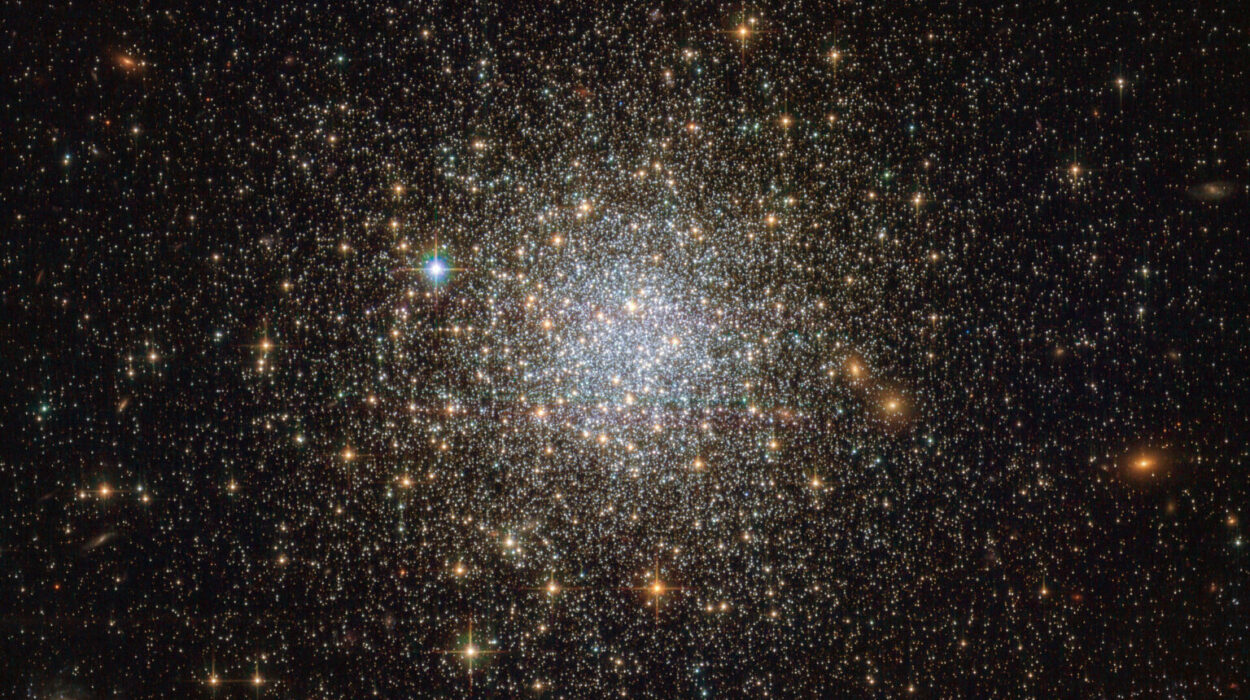
Stars are gigantic spheres of gas held together by gravity. Most of their mass consists of hydrogen.
Gravity continuously pulls stellar material inward. This compression creates enormous temperatures and pressures within the star’s core.
Eventually, conditions become extreme enough for hydrogen nuclei to fuse together.
This fusion releases tremendous amounts of energy.
That energy is what makes stars shine.
At the same time, fusion transforms one element into another.
Hydrogen becomes helium.
Later, helium can become carbon.
Carbon can help produce oxygen.
In massive stars, increasingly heavier elements are created.
Over millions or billions of years, stars act as cosmic furnaces, manufacturing much of the periodic table.
This process is stellar nucleosynthesis.
The Birth of a Star
Every story of stellar nucleosynthesis begins with the birth of a star.
Stars form within enormous clouds of gas and dust known as nebulae.
These clouds drift through galaxies for millions of years. Eventually, gravity causes regions within them to collapse.
As material falls inward, it becomes denser and hotter.
A growing concentration of matter forms at the center.
This developing object is called a protostar.
The protostar continues gathering mass while its core temperature rises.
Eventually, the temperature reaches approximately ten million degrees Celsius.
At that point, hydrogen fusion begins.
A star is born.
From this moment onward, stellar nucleosynthesis becomes one of the star’s defining activities.
The Power of Nuclear Fusion
The engine driving stellar nucleosynthesis is nuclear fusion.
Fusion occurs when atomic nuclei combine to form heavier nuclei.
Under ordinary conditions on Earth, positively charged nuclei repel each other.
But inside stellar cores, temperatures are so extreme that particles move at incredible speeds.
These conditions allow nuclei to overcome their mutual repulsion and collide.
When fusion occurs, some mass is converted into energy according to Einstein’s famous equation:
E = mc²
Even tiny amounts of mass produce enormous quantities of energy.
This energy supports the star against gravitational collapse.
Without fusion, stars could not shine.
Without fusion, stellar nucleosynthesis would not exist.
Without stellar nucleosynthesis, life itself would likely be impossible.
How Hydrogen Becomes Helium
The first stage of stellar nucleosynthesis involves converting hydrogen into helium.
Hydrogen is the simplest element in the universe.
Each hydrogen nucleus consists of a single proton.
Inside stars, hydrogen nuclei collide and eventually fuse through a series of reactions.
The exact process varies depending on the star’s mass.
In stars similar to the Sun, the dominant mechanism is known as the proton-proton chain.
Through multiple steps, four hydrogen nuclei ultimately combine to form one helium nucleus.
This transformation releases vast amounts of energy.
Our Sun performs this process continuously.
Every second, it converts roughly 600 million tons of hydrogen into helium.
The sunlight warming Earth today originates from these fusion reactions occurring deep within the Sun’s core.
The Long Life of Main-Sequence Stars
Most stars spend the majority of their lives fusing hydrogen into helium.
Astronomers call this stage the main sequence.
During this period, stars achieve a balance.
Gravity pulls inward.
Fusion-generated pressure pushes outward.
These opposing forces create stability.
The duration of this phase depends largely on stellar mass.
Massive stars burn fuel rapidly and may survive only millions of years.
Smaller stars consume fuel much more slowly and can persist for trillions of years.
Our Sun is currently a main-sequence star.
It has been generating energy through hydrogen fusion for approximately 4.6 billion years and is expected to continue doing so for another five billion years.
Throughout this period, stellar nucleosynthesis steadily transforms hydrogen into helium.
When Hydrogen Runs Out
Eventually, hydrogen in the stellar core becomes depleted.
This creates a crisis for the star.
Fusion slows.
Without sufficient outward pressure, gravity begins compressing the core.
As compression increases, temperatures rise dramatically.
For many stars, this temperature increase triggers a new phase of nucleosynthesis.
Helium fusion begins.
The star enters a new chapter in its life.
The Creation of Carbon
Carbon is one of the most important elements in the universe.
All known life depends upon it.
Yet carbon was not produced in significant amounts during the Big Bang.
Instead, it was created inside stars.
When helium fusion begins, three helium nuclei can combine through a process known as the triple-alpha process.
The result is carbon.
This achievement represents one of the most important moments in cosmic history.
Without carbon formation inside stars, life as we know it would almost certainly never have emerged.
Every carbon atom in your body was once forged through stellar nucleosynthesis.
The carbon in your muscles, skin, brain, and DNA originated inside stars that lived and died long before Earth existed.
The Formation of Oxygen
Carbon production is only the beginning.
As helium fusion continues, carbon nuclei can capture additional helium nuclei.
This process produces oxygen.
Oxygen is the third most abundant element in the universe and one of the most important ingredients for life on Earth.
It fills our atmosphere, forms water molecules, and plays a critical role in biological processes.
Like carbon, oxygen owes its existence largely to stellar nucleosynthesis.
Every breath you take contains atoms that were created in ancient stars.
Every molecule of water contains oxygen forged in stellar interiors billions of years ago.
Massive Stars: Nature’s Element Factories
While stars like the Sun create carbon and oxygen, truly massive stars go much further.
These stellar giants possess much greater mass and achieve much higher internal temperatures.
As each fuel source becomes exhausted, the core contracts and heats up.
New fusion reactions begin.
Carbon fusion creates neon, sodium, and magnesium.
Neon fusion produces oxygen and magnesium.
Oxygen fusion generates silicon, sulfur, phosphorus, and other elements.
Silicon fusion ultimately creates iron.
Massive stars resemble cosmic onions, with multiple layers undergoing different fusion processes simultaneously.
Near the center, heavy elements form.
Toward the outside, lighter fusion reactions continue.
This layered structure allows massive stars to manufacture a wide variety of elements.
Why Iron Changes Everything
Iron occupies a unique position in stellar nucleosynthesis.
Fusion reactions involving lighter elements release energy.
This energy powers stars.
However, iron behaves differently.
Fusing iron does not release energy.
Instead, it requires energy.
This creates a problem.
Once a massive star develops an iron core, its energy-producing fusion processes effectively end.
The star loses its primary source of support against gravity.
Catastrophe becomes inevitable.
The Death of Massive Stars
When fusion can no longer sustain the star, gravity wins.
The iron core collapses with astonishing speed.
Within seconds, the core contracts dramatically.
Temperatures soar.
Densities become extraordinary.
The collapse triggers one of the most powerful events in the universe: a supernova.
A supernova releases more energy in a brief period than the Sun will emit during its entire lifetime.
For a short time, a single exploding star can outshine an entire galaxy.
Yet the explosion’s importance extends beyond its brilliance.
Supernovae play a crucial role in creating many of the universe’s heavier elements.
Creating Elements Heavier Than Iron
Iron marks the end of ordinary fusion-based element production.
But the periodic table continues far beyond iron.
Elements such as gold, silver, platinum, uranium, lead, and iodine require different mechanisms.
These elements form through processes involving neutron capture.
Supernova explosions create conditions extreme enough for these reactions to occur.
Enormous numbers of neutrons bombard atomic nuclei.
The nuclei absorb neutrons and transform into heavier elements.
In a matter of seconds, elements heavier than iron are produced.
These newly created atoms are then blasted into space.
The gold in jewelry, the silver in electronics, and the uranium inside Earth’s crust all trace their origins to these violent cosmic events.
The Role of Neutron Star Collisions
In recent years, scientists have discovered that supernovae are not the only sources of heavy elements.
Neutron star collisions also play a major role.
Neutron stars are the collapsed remnants of massive stars.
They are among the densest objects in the universe.
When two neutron stars spiral together and collide, extraordinary conditions arise.
These collisions generate enormous quantities of heavy elements.
Observations suggest that significant amounts of gold, platinum, and other precious metals may originate from such events.
This discovery has transformed our understanding of stellar nucleosynthesis.
The universe possesses multiple pathways for creating its richest chemical treasures.
How Elements Escape from Stars
Creating elements inside stars is only part of the story.
Those elements must somehow reach the wider universe.
Fortunately, stars are not perfectly closed systems.
Throughout their lives, many stars lose material through stellar winds.
As stars age, these winds become stronger.
Eventually, dying stars shed their outer layers into space.
Massive stars release enormous quantities of material during supernova explosions.
This ejected matter enriches surrounding regions of the galaxy.
Astronomers call this process chemical enrichment.
Over billions of years, generations of stars gradually increase the abundance of heavy elements throughout the cosmos.
The universe becomes chemically richer with each stellar generation.
The Recycling of Cosmic Matter
One of the most beautiful aspects of stellar nucleosynthesis is that it creates a cosmic cycle.
Stars are born from interstellar clouds.
They manufacture new elements.
They release those elements back into space.
New stars then form from the enriched material.
Planets emerge around these newer stars.
Eventually, life may appear.
The atoms created by one generation of stars become the building blocks of future generations.
Nothing is wasted.
Matter is continuously recycled across cosmic timescales.
The universe resembles a vast ecosystem operating on billions of years rather than seasons.
The Birth of the Solar System
Our own Solar System formed approximately 4.6 billion years ago.
By that time, the Milky Way had already experienced countless generations of stars.
Many of those stars had lived, produced heavy elements, and died.
The cloud that formed the Sun contained material enriched by ancient stellar nucleosynthesis.
Carbon, oxygen, silicon, iron, calcium, magnesium, and countless other elements were already present.
As the Solar System formed, these elements became incorporated into planets, asteroids, moons, and comets.
Earth inherited this stellar legacy.
Everything on our planet originated from matter shaped by previous generations of stars.
The Atoms Inside Your Body
Consider the human body.
Hydrogen atoms within you likely originated during the Big Bang.
Many of the other atoms came from stars.
The carbon in your cells formed through helium fusion.
The oxygen you breathe was produced in stellar interiors.
The calcium in your bones emerged from ancient stars.
The iron carrying oxygen through your bloodstream originated during stellar nucleosynthesis.
Even trace elements essential for life have stellar origins.
Every atom carries a cosmic history stretching back billions of years.
You are not separate from the universe.
You are one of its products.
Carl Sagan’s Famous Insight
The astronomer Carl Sagan famously popularized the idea that humans are “star stuff.”
Although poetic, the statement is scientifically accurate.
The atoms composing our bodies were indeed created through cosmic processes occurring in stars.
Sagan’s phrase resonates because it connects scientific knowledge with human experience.
We often think of ourselves as small and isolated.
Yet stellar nucleosynthesis reveals a profound connection between people and the cosmos.
The same processes shaping distant stars also helped create every living organism on Earth.
Evidence for Stellar Nucleosynthesis
How do scientists know stellar nucleosynthesis is real?
The evidence is overwhelming.
Astronomers analyze starlight using spectroscopy.
Different elements leave unique signatures in light.
These signatures reveal which elements exist within stars.
Observations show exactly the kinds of elements predicted by nucleosynthesis theories.
Scientists also study meteorites, ancient rocks, and cosmic dust.
These materials contain isotopic patterns matching stellar nucleosynthesis models.
Supernova remnants reveal freshly created elements expanding into space.
Modern computer simulations reproduce observed abundances with remarkable accuracy.
Together, these observations provide strong confirmation that stars truly are element factories.
The Legacy of Burbidge, Burbidge, Fowler, and Hoyle
A major breakthrough in understanding stellar nucleosynthesis came during the twentieth century.
In 1957, researchers Margaret Burbidge, Geoffrey Burbidge, William Fowler, and Fred Hoyle published a landmark scientific paper explaining how stars create elements.
Their work became one of the most influential contributions in astrophysics.
It provided a comprehensive framework connecting nuclear physics with stellar evolution.
Much of modern understanding of stellar nucleosynthesis rests upon foundations they helped establish.
Their research transformed humanity’s view of its cosmic origins.
Stellar Nucleosynthesis and the Search for Life
The study of stellar nucleosynthesis extends beyond understanding our own origins.
It also influences the search for life elsewhere.
Life requires specific elements.
Carbon, oxygen, nitrogen, phosphorus, sulfur, and others play essential roles in biology.
These elements become available only after generations of stars enrich their surroundings.
This means life is more likely to emerge in regions where stellar nucleosynthesis has already occurred extensively.
In a sense, stars prepare the universe for life.
Before life can appear, stars must first create the necessary ingredients.
A Universe That Learns to Build Complexity
One of the most remarkable consequences of stellar nucleosynthesis is the gradual increase in complexity throughout cosmic history.
The early universe contained mostly hydrogen and helium.
Stars transformed those simple ingredients into heavier elements.
These elements enabled planets.
Planets enabled chemistry.
Chemistry enabled biology.
Biology eventually produced conscious beings capable of studying the stars themselves.
Through stellar nucleosynthesis, the universe developed the chemical diversity needed for increasing complexity.
The story of life is therefore inseparable from the story of stars.
Conclusion
Stellar nucleosynthesis is one of the most extraordinary processes in the universe. It is the mechanism through which stars create new elements, transforming simple hydrogen and helium into the rich assortment of atoms that make planets, oceans, mountains, living organisms, and human beings possible.
From the moment the first stars ignited, stellar nucleosynthesis began reshaping the cosmos. Deep within stellar cores, fusion reactions forged carbon, oxygen, calcium, iron, and many other elements essential for life. Massive stars created even heavier elements, while supernova explosions and neutron star collisions scattered these materials across space.
Over billions of years, this cosmic recycling enriched galaxies and prepared the conditions necessary for worlds like Earth to form.
Every atom in your body carries a story older than humanity itself. The carbon in your DNA, the calcium in your bones, the oxygen in your lungs, and the iron in your blood were all forged in ancient stars that lived and died long before the Solar System existed.
When we look up at the night sky, we are not merely observing distant points of light. We are looking at the cosmic furnaces that created the very matter from which we are made.
The universe is not something separate from us.
Through stellar nucleosynthesis, it became us.