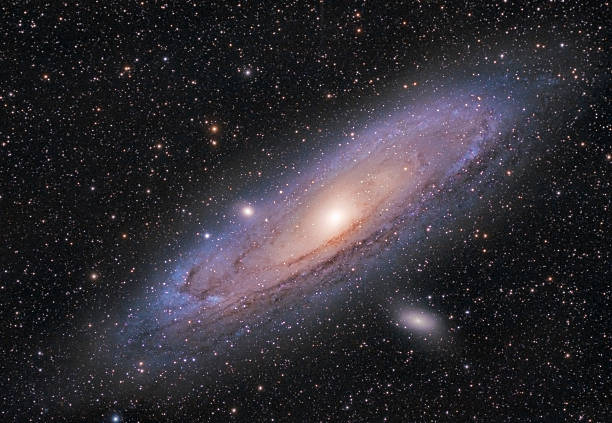
On a clear, dark night far from city lights, there is a faint smudge in the sky that most people would never notice. To the naked eye, it appears as a small, hazy patch among countless stars. Yet that dim blur is one of the most extraordinary objects visible from Earth. It is the Andromeda Galaxy, a vast island of stars located more than 2.5 million light-years away.
What makes Andromeda truly fascinating is not just its beauty or size. It is the fact that it is moving toward us.
Right now, as you read these words, the Andromeda Galaxy is racing through space in the direction of our own galaxy, the Milky Way. The two giant galaxies have been approaching each other for billions of years. Their meeting is inevitable. One day, far in the future, they will collide and merge into a completely new galaxy.
The thought sounds terrifying at first. After all, galaxy collisions seem like cosmic disasters on an unimaginable scale. Yet the reality is far more fascinating than frightening. This future encounter will be one of the greatest events in the history of our cosmic neighborhood, reshaping the night sky forever.
To understand why Andromeda matters so much, we must first explore what this galaxy is, where it came from, how it compares to our own galaxy, and what its eventual collision with the Milky Way means for the future of the universe.
Meeting Our Closest Giant Neighbor
The Andromeda Galaxy is the nearest large galaxy to the Milky Way.
Astronomers officially designate it as Messier 31, often shortened to M31. It is named after the constellation Andromeda, where it appears in Earth’s sky.
Although Andromeda is incredibly distant by human standards, it is actually quite close in cosmic terms. The galaxy lies approximately 2.5 million light-years away. This means the light reaching our eyes today began its journey long before humans existed. In fact, when the light now arriving from Andromeda first left the galaxy, our early human ancestors were only beginning to walk across Africa.
Looking at Andromeda is therefore a journey into the past.
Every telescope image shows the galaxy not as it is today, but as it existed millions of years ago.
This simple fact reveals one of astronomy’s most astonishing truths: when we observe distant objects in space, we are also looking back in time.
The Largest Galaxy in the Local Group
Our galaxy is not alone in space.
The Milky Way belongs to a collection of galaxies known as the Local Group. This group contains more than fifty galaxies of various sizes, all connected through gravity.
Most of these galaxies are relatively small dwarf galaxies. The true giants of the Local Group are the Milky Way and Andromeda.
For many years, astronomers believed Andromeda was significantly larger than our galaxy. Modern measurements suggest the two galaxies are more similar in size than previously thought, although Andromeda may still contain slightly more stars.
The Andromeda Galaxy is estimated to contain roughly one trillion stars, compared to the Milky Way’s estimated 100 to 400 billion stars.
That means Andromeda may hold several times more stars than our own galaxy.
Trying to imagine a trillion stars is nearly impossible. Even if someone counted one star every second without stopping, it would take over 31,000 years to reach a trillion.
Andromeda is truly enormous.
How We First Discovered Andromeda
Humans have observed Andromeda for centuries.
Ancient skywatchers noticed the faint fuzzy object long before telescopes existed. Persian astronomer Abd al-Rahman al-Sufi described it around the year 964, calling it a “little cloud.”
For hundreds of years, nobody knew what it really was.
Even after telescopes improved, astronomers remained uncertain. Some believed Andromeda was a cloud of gas within the Milky Way. Others suspected it might be something much larger.
The true nature of Andromeda became one of astronomy’s greatest mysteries.
Everything changed during the early twentieth century.
Using powerful telescopes, astronomer Edwin Hubble identified special stars known as Cepheid variables inside Andromeda. These stars allowed him to calculate the galaxy’s distance.
The result shocked the scientific world.
Andromeda was far beyond the Milky Way.
It was not a cloud within our galaxy at all. It was an entirely separate galaxy containing billions of stars.
This discovery dramatically expanded humanity’s understanding of the universe.
Suddenly, astronomers realized that the cosmos was far larger than anyone had imagined.
What Does Andromeda Look Like?
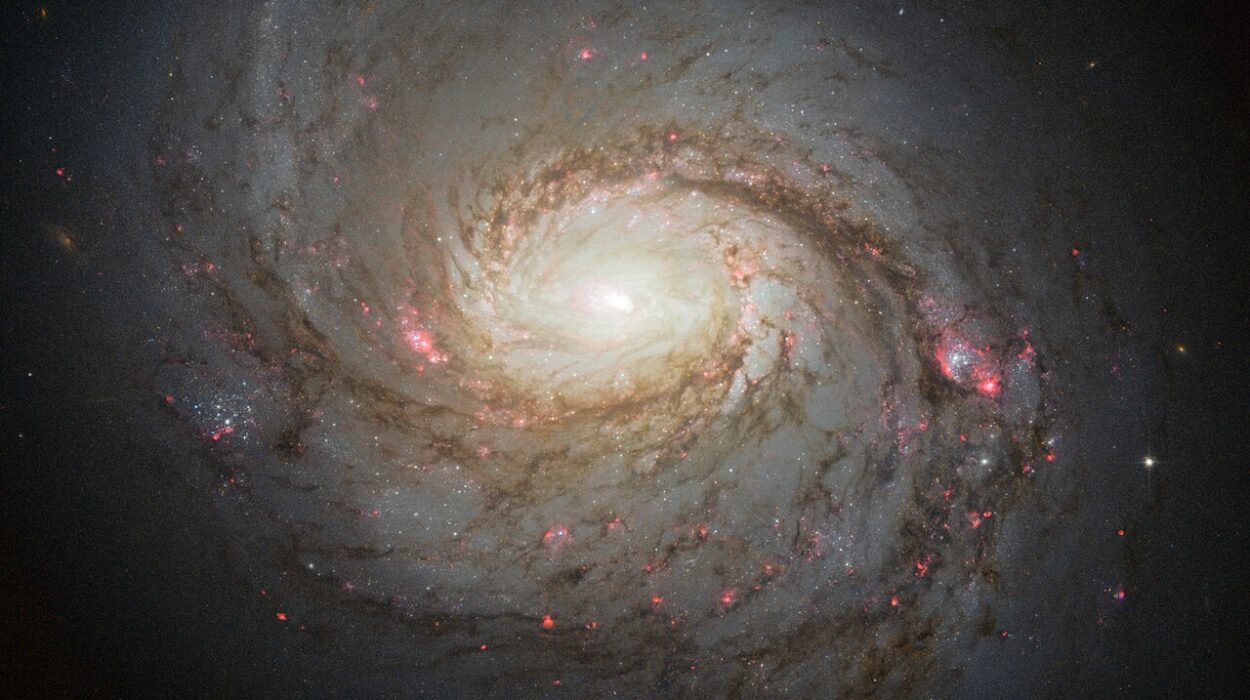
The Andromeda Galaxy is a spiral galaxy.
Like the Milky Way, it consists of a bright central bulge surrounded by enormous spiral arms filled with stars, gas, and dust.
From above, Andromeda would resemble a giant cosmic pinwheel.
Its disk stretches across approximately 220,000 light-years, making it somewhat larger than the visible disk of the Milky Way.
Within its spiral arms, new stars continue to form from massive clouds of gas and dust.
The galaxy’s central region glows brightly because it contains countless densely packed stars.
Astronomers studying Andromeda often describe it as a cosmic cousin to our own galaxy.
The similarities between the two are remarkable.
Both are spiral galaxies.
Both contain hundreds of billions of stars.
Both host supermassive black holes at their centers.
Both are surrounded by smaller satellite galaxies.
Yet despite these similarities, each galaxy has followed its own unique evolutionary path.
Seeing Andromeda with Your Own Eyes
One of the most amazing facts about Andromeda is that it can be seen without a telescope.
Under dark skies, observers can spot the galaxy as a faint oval patch.
This makes it the most distant object visible to the unaided human eye.
When people look at Andromeda, they are seeing light that traveled approximately 2.5 million years to reach them.
No other naked-eye object commonly observed in the night sky lies anywhere near that far away.
The experience can be deeply moving.
That tiny fuzzy patch contains roughly a trillion stars.
Entire planetary systems exist within it.
Perhaps countless civilizations have arisen and vanished there throughout cosmic history.
All of that is compressed into a faint smudge barely visible against the darkness.
A Galaxy Filled with Stellar Cities
Every star in Andromeda can be thought of as a distant sun.
Many likely possess planets.
Some may host entire planetary systems far more complex than our own.
When viewed from Earth, Andromeda appears peaceful and uniform. In reality, it is an extraordinarily dynamic environment.
Stars are constantly being born.
Others are reaching the ends of their lives.
Massive stars explode as supernovae.
Gas clouds collapse into new generations of suns.
Black holes consume matter.
Gravity shapes the movement of billions of objects simultaneously.
Across Andromeda, countless cosmic stories unfold every moment.
The Supermassive Black Hole at Its Heart
At the center of Andromeda lies a supermassive black hole.
Like the one found in the Milky Way, this object contains millions of times the mass of the Sun.
The black hole itself is invisible.
Its gravity is so powerful that even light cannot escape once it crosses a boundary called the event horizon.
Astronomers detect its presence by observing how nearby stars move.
The motions reveal that an immense concentration of mass exists at the galaxy’s center.
Supermassive black holes are among the most mysterious objects in the universe.
Almost every large galaxy appears to contain one.
Understanding how they form and evolve remains one of astronomy’s biggest challenges.
Andromeda’s Family of Satellite Galaxies
Just as Earth has a Moon, large galaxies often possess smaller companions.
Andromeda is surrounded by numerous dwarf galaxies.
These tiny galaxies orbit their giant parent much like moons orbit planets.
Some contain only a few million stars.
Others contain billions.
Over billions of years, Andromeda has likely absorbed many smaller galaxies through gravitational interactions.
Evidence of these ancient mergers remains visible today in streams of stars stretching across space.
Astronomers often compare galaxies to living organisms because they grow by consuming smaller systems.
Andromeda’s history is filled with such cosmic encounters.
How Galaxies Grow Over Time
Galaxies are not static structures.
They evolve continuously.
Billions of years ago, Andromeda was much smaller than it is today.
Through repeated mergers and interactions, it gradually increased in size.
This process continues across the universe.
Small galaxies combine to form larger ones.
Large galaxies absorb their neighbors.
The cosmos is constantly reshaping itself.
Modern observations suggest that Andromeda experienced a particularly significant merger several billion years ago.
This event may have dramatically altered its structure and triggered widespread star formation.
Galactic evolution is often violent on cosmic scales, yet it unfolds so slowly that individual stars rarely collide.
Measuring the Distance to Andromeda
Determining distances in space is one of astronomy’s greatest challenges.
Unlike measuring a road or building, astronomers cannot simply stretch a tape measure across millions of light-years.
Instead, they rely on special techniques.
Cepheid variable stars played a crucial role in measuring Andromeda’s distance.
These stars brighten and dim at predictable rates.
By comparing their observed brightness to their true brightness, astronomers can calculate how far away they are.
This method allowed Edwin Hubble to prove that Andromeda was an external galaxy.
Today, astronomers use multiple independent techniques to refine distance estimates.
Modern measurements place Andromeda approximately 2.5 million light-years away.
The Surprising Discovery That It Is Moving Toward Us
Most galaxies in the universe are moving away from us because space itself is expanding.
This expansion was one of the greatest discoveries in modern science.
Yet Andromeda behaves differently.
Instead of moving away, it is approaching.
Astronomers discovered this by studying the galaxy’s light.
When an object moves toward an observer, its light becomes slightly shifted toward shorter wavelengths. This effect is known as blueshift.
Andromeda exhibits a clear blueshift.
This tells scientists that it is traveling toward the Milky Way at roughly 110 kilometers per second, or about 250,000 miles per hour.
Although that speed sounds enormous, the distance between the galaxies is so vast that the collision will not occur for billions of years.
The Future Collision with the Milky Way
The eventual meeting between Andromeda and the Milky Way is one of the most dramatic events predicted in our cosmic future.
Current models suggest the first close encounter will occur roughly 4 to 5 billion years from now.
At that time, the night sky will look dramatically different.
Andromeda will gradually grow larger and brighter.
Over millions of years, it will stretch across the heavens.
Eventually, the two galaxies will begin passing through one another.
Enormous tidal forces will distort their shapes.
Long streams of stars will be pulled into space.
Gas clouds will collide and trigger intense waves of star formation.
The spectacle would be breathtaking beyond imagination.
Will Stars Actually Crash Into Each Other?
Many people picture galaxy collisions as catastrophic pileups involving countless stellar impacts.
The reality is surprisingly different.
Stars are separated by immense distances.
Even when galaxies overlap, the chances of individual stars colliding directly are extremely small.
Imagine two swarms of bees passing through each other in a vast open field.
Most bees would never touch.
The same principle applies to stars.
Although gravitational interactions will alter many stellar orbits, direct collisions remain unlikely.
The galaxies themselves will merge, but most stars will continue their journeys through space largely unharmed.
What Might Happen to the Solar System?
The fate of our Solar System during the collision remains uncertain.
Fortunately, Earth and the Sun are unlikely to experience direct impacts.
However, gravitational forces could alter the Solar System’s position within the merged galaxy.
Our star might be thrown into a different orbit.
It could move farther from the galactic center.
Some simulations even suggest a small possibility that the Solar System could be ejected into intergalactic space.
The exact outcome depends on countless complex interactions occurring over billions of years.
By then, however, the Sun itself will be nearing the end of its life.
Earth’s habitability may already have disappeared long before the galaxies complete their merger.
The Birth of a New Galaxy
After repeated interactions, the Milky Way and Andromeda will eventually combine into a single giant galaxy.
Astronomers sometimes nickname this future galaxy “Milkomeda.”
The merger process will likely take several billion years.
When complete, the new galaxy may resemble a giant elliptical galaxy rather than a spiral one.
Its stars will orbit in more random directions.
The elegant spiral structures of both parent galaxies may disappear.
A completely new galactic identity will emerge.
In a sense, the Milky Way and Andromeda will cease to exist as separate entities.
Their stars will become part of something entirely new.
The Role of Dark Matter
Much of Andromeda’s mass is invisible.
Like the Milky Way, the galaxy appears to be surrounded by a vast halo of dark matter.
Dark matter does not emit, absorb, or reflect light.
Scientists cannot see it directly.
Yet its gravitational influence is unmistakable.
Without dark matter, galaxies would rotate differently than they do.
Stars on the outer edges would move too quickly and escape.
Instead, dark matter’s gravity helps hold galaxies together.
The collision between Andromeda and the Milky Way will therefore involve not only visible stars and gas but also enormous halos of dark matter interacting on colossal scales.
What Andromeda Teaches Us About the Universe
Studying Andromeda provides a unique opportunity for astronomers.
Because it is relatively close, scientists can observe details impossible to see in more distant galaxies.
Andromeda serves as a laboratory for understanding galactic evolution.
Researchers study its stars, gas clouds, black hole, and structure to learn how galaxies form and change over time.
Every discovery helps answer larger questions about the universe.
How do galaxies grow?
How do stars form?
How do black holes evolve?
How common are planetary systems?
Andromeda offers valuable clues.
Could Life Exist in Andromeda?
There is no reason to believe life is impossible in Andromeda.
The galaxy contains hundreds of billions, perhaps a trillion, stars.
Many likely possess planets.
Some may orbit within habitable zones where liquid water can exist.
If life emerged in our galaxy, it could potentially arise elsewhere.
The distances involved make direct investigation extremely difficult.
Even traveling at the speed of today’s fastest spacecraft, reaching Andromeda would require millions of years.
For now, the possibility remains purely speculative.
Yet the sheer number of stars suggests that Andromeda may host countless worlds waiting to be discovered.
The Emotional Power of Looking at Andromeda
Few astronomical objects inspire wonder quite like Andromeda.
When people look at it through binoculars or a telescope, they often experience a profound sense of perspective.
That faint glow represents an entire galaxy.
Its light began traveling toward Earth before modern humans existed.
Within it are trillions of stars.
Possibly trillions of planets.
Potentially countless untold stories.
The realization can feel both humbling and uplifting.
We live in a universe far larger than our everyday concerns.
And yet we possess the ability to understand it.
The Future Written Across the Sky
The Andromeda Galaxy is more than a distant object.
It is part of our future.
Its approach has already begun.
The collision course is set.
Over billions of years, gravity will draw our two galaxies together until they become one.
Long after human civilization is gone, long after continents have shifted beyond recognition, long after the Sun has changed dramatically, the cosmic dance between Andromeda and the Milky Way will continue.
The stars themselves will participate in a transformation on a scale almost impossible to comprehend.
Conclusion
The Andromeda Galaxy is one of the most remarkable objects in the known universe. Located approximately 2.5 million light-years from Earth, it is the nearest major galaxy to the Milky Way and one of our most important cosmic neighbors. Containing perhaps a trillion stars, a supermassive black hole, countless planetary systems, and vast clouds of gas and dust, Andromeda is a magnificent example of a spiral galaxy.
Yet its significance extends beyond its size and beauty. Unlike most distant galaxies that are moving away from us, Andromeda is approaching. In roughly 4 to 5 billion years, it will begin an extraordinary gravitational encounter with the Milky Way. The two galaxies will eventually merge, creating a completely new galactic structure and forever changing the appearance of the night sky.
Far from being merely a distant collection of stars, Andromeda is connected to our own story. It helps astronomers understand galaxy formation, stellar evolution, dark matter, and the future of our cosmic environment. It reminds us that the universe is not static but constantly evolving across immense stretches of time.
When we gaze at Andromeda, we are not simply looking at another galaxy. We are looking at a neighbor, a time capsule from the distant past, and a glimpse of the far future. In that faint patch of light lies a trillion stars and one of the greatest cosmic events yet to come—a meeting that has been billions of years in the making and is still unfolding across the vast darkness of space.