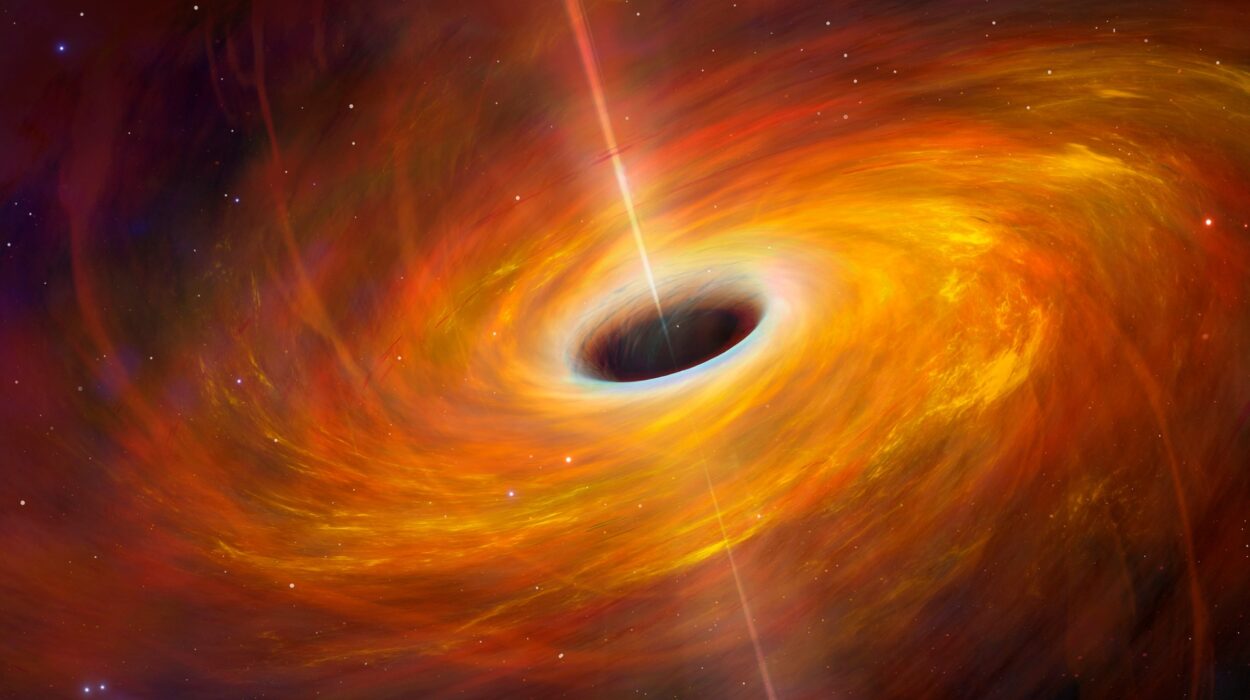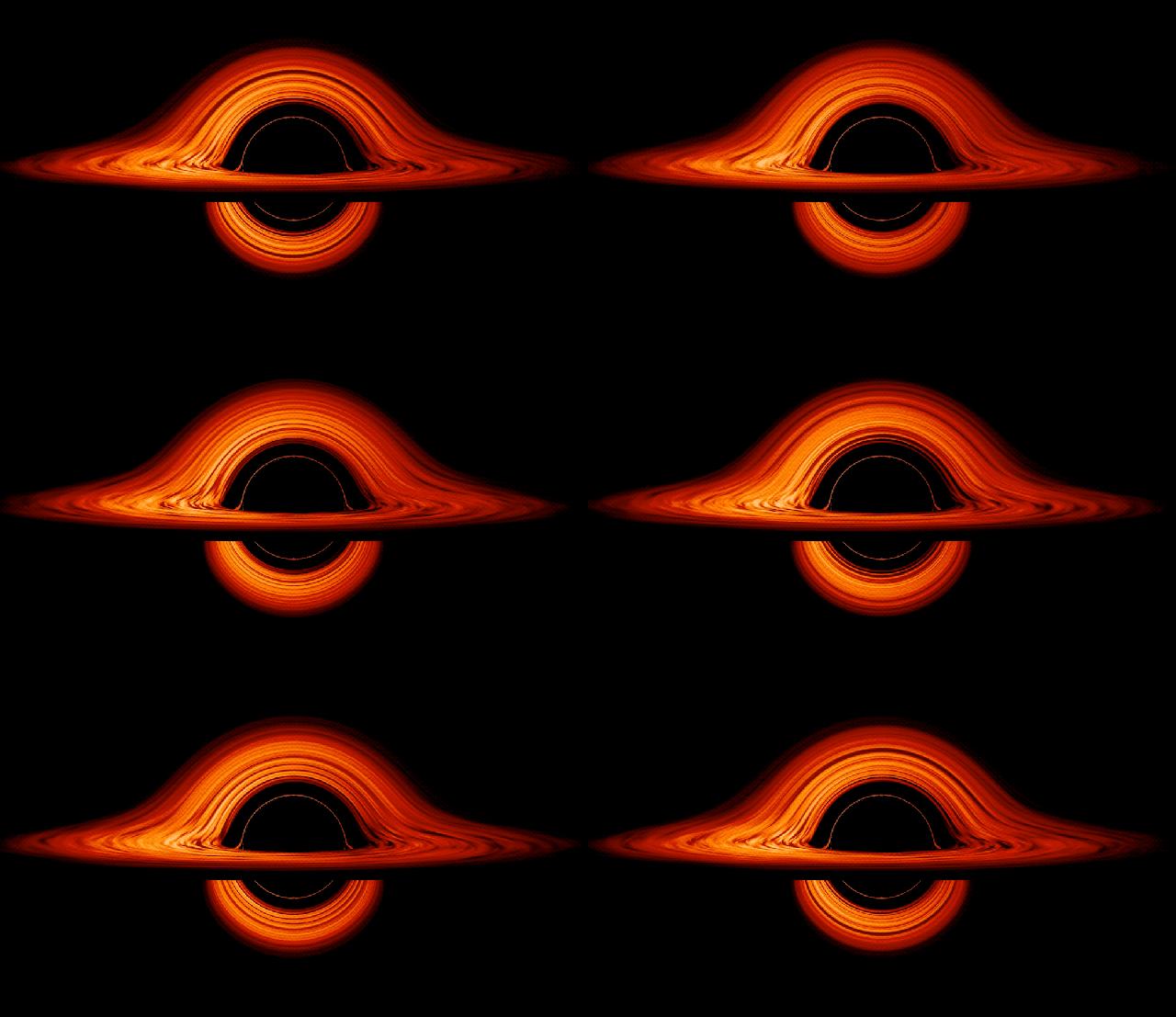
Imagine standing at the edge of one of the most extreme places in the universe. Ahead of you lies a black hole, a region of space where gravity is so powerful that nothing—not even light—can escape once it crosses a certain boundary. The black hole itself is invisible, hidden behind a veil of darkness. Yet surprisingly, the area around it may be among the brightest places in the cosmos.
A brilliant whirlpool of glowing gas circles the darkness. The material races around at incredible speeds, heating to millions of degrees as it spirals inward. It shines with the energy of countless stars. It can outshine entire galaxies. It produces powerful radiation that can travel across billions of light-years.
This spectacular structure is known as an accretion disk.
Accretion disks are among the most fascinating objects in astronomy. They form around black holes, young stars, neutron stars, and other massive celestial objects. They play a crucial role in the growth of cosmic structures and help scientists understand some of the universe’s greatest mysteries.
Although black holes often receive the most attention, it is frequently the accretion disk that astronomers actually observe. These glowing disks reveal the presence of otherwise invisible objects and allow scientists to study environments where gravity, temperature, and motion reach extraordinary extremes.
Understanding accretion disks means understanding how matter behaves under some of the most intense conditions nature can create. It is a story of gravity, motion, energy, and cosmic transformation.
Understanding the Basics of an Accretion Disk
An accretion disk is a rotating disk of gas, dust, plasma, or other matter that gradually spirals inward toward a central object.
The central object can be a black hole, a neutron star, a white dwarf, or even a young star that is still forming.
The word “accretion” refers to the process by which matter accumulates onto an object through gravity.
Imagine water flowing down a drain. Instead of plunging directly inward, the water often forms a swirling vortex. Similarly, matter falling toward a massive object in space usually does not travel straight inward. Instead, it forms a rotating disk.
This happens because the infalling material possesses angular momentum, the tendency of an object in motion to continue rotating.
As gravity pulls matter inward, angular momentum causes it to spread into a flattened, spinning structure.
Over time, the material gradually loses energy and moves closer to the central object.
The result is an accretion disk—a vast cosmic whirlpool glowing with enormous energy.
Why Matter Does Not Fall Straight Into a Black Hole
Many people imagine a black hole acting like a cosmic vacuum cleaner, instantly sucking in everything nearby.
Reality is far more interesting.
Most matter near a black hole is already moving. It possesses velocity and angular momentum.
Imagine throwing a ball toward Earth from space. Rather than falling straight down, the ball may enter orbit if it has enough sideways motion.
Gas and dust around black holes behave similarly.
Instead of plunging directly inward, the material enters orbit around the black hole.
Different regions of the disk move at different speeds. Material closer to the center travels faster than material farther away.
This difference in speed creates friction and turbulence within the disk.
As the matter rubs against itself, it loses energy.
Gradually, it spirals inward.
The process can continue for thousands, millions, or even billions of years depending on the system.
The Role of Gravity
Gravity is the driving force behind every accretion disk.
Without gravity, the disk would not exist.
Massive objects warp space and attract surrounding matter.
The stronger the gravitational field, the more powerful the effects.
Black holes represent the ultimate example because their gravity is stronger than that of any ordinary star.
As matter falls deeper into a gravitational well, it gains kinetic energy.
This energy must go somewhere.
In accretion disks, much of it becomes heat.
The closer matter moves toward the central object, the more energy it releases.
This conversion of gravitational energy into heat is one of the reasons accretion disks become so bright.
In fact, accretion can be one of the most efficient energy-producing processes in the universe.
How an Accretion Disk Forms
The birth of an accretion disk begins when material becomes trapped by gravity.
This material may originate from a nearby star, a cloud of interstellar gas, or leftover matter from a stellar explosion.
As the gas falls inward, conservation of angular momentum causes it to rotate faster.
A useful analogy is a figure skater spinning on ice.
When the skater pulls their arms inward, they spin faster.
Similarly, as matter moves closer to a massive object, its rotational speed increases.
The increasing speed flattens the material into a disk.
Collisions between particles help distribute energy and smooth the structure.
Eventually, a stable rotating disk emerges.
Although it may appear calm from a distance, the interior is an incredibly dynamic environment filled with turbulence, magnetic fields, and extreme temperatures.
Why Accretion Disks Glow
One of the most striking features of accretion disks is their brightness.
Black holes themselves emit no light.
Yet the disks surrounding them can shine more brightly than entire galaxies.
The reason lies in friction and gravitational energy.
As matter spirals inward, neighboring layers move at different speeds.
This creates friction-like effects.
Particles collide.
Gas becomes compressed.
Turbulence develops.
These processes generate enormous amounts of heat.
Temperatures can rise from thousands of degrees to millions of degrees depending on the location within the disk.
Hot matter emits radiation.
The hotter the material becomes, the more energetic the radiation.
Outer regions may glow in visible light.
Inner regions often emit ultraviolet radiation, X-rays, and even gamma rays.
The result is a luminous beacon visible across vast cosmic distances.
The Extreme Temperatures of Accretion Disks
Conditions inside an accretion disk can be astonishingly intense.
Near a supermassive black hole, temperatures may reach millions of degrees Celsius.
At such temperatures, ordinary matter no longer exists in familiar forms.
Atoms become ionized.
Electrons separate from nuclei.
The gas transforms into plasma, a highly energetic state of matter.
Plasma behaves differently from ordinary gas because it responds strongly to magnetic fields.
These magnetic interactions contribute to the complexity of accretion disk dynamics.
The extreme heat also makes accretion disks valuable sources of high-energy radiation, allowing astronomers to detect and study them even when the central object remains invisible.
Black Holes and Their Accretion Disks
Accretion disks are most famous for their association with black holes.
A black hole forms when enough mass becomes concentrated into an extremely small region of space.
The gravitational pull becomes so strong that an event horizon forms.
Beyond this boundary, escape becomes impossible.
The accretion disk exists outside the event horizon.
Matter can orbit there for long periods before eventually crossing the point of no return.
Interestingly, much of the radiation associated with black holes comes not from the black hole itself but from its accretion disk.
When astronomers detect intense X-rays from a black hole system, they are often observing the hot inner regions of the surrounding disk.
In many cases, the disk provides the only evidence that a black hole is present.
The Event Horizon and the Inner Edge of the Disk
The event horizon represents the ultimate boundary around a black hole.
Anything crossing this threshold cannot escape.
However, the accretion disk does not extend all the way to the event horizon.
Instead, there is an innermost stable orbit where matter can circle the black hole safely.
Inside this region, stable orbits become impossible.
Matter rapidly plunges inward.
The exact location depends on factors such as the black hole’s mass and rotation.
This inner region is particularly important because it produces some of the highest-energy radiation in the disk.
By studying this radiation, astronomers can estimate black hole properties and test predictions of Einstein’s theory of relativity.
Einstein’s Relativity and Accretion Disks
Accretion disks provide natural laboratories for studying extreme gravity.
According to the theory of general relativity, massive objects warp space and time.
Near a black hole, these effects become dramatic.
Time passes more slowly close to the black hole than it does farther away.
Light follows curved paths through warped spacetime.
The motion of matter becomes influenced by relativistic effects.
Accretion disks allow astronomers to observe these phenomena indirectly.
By analyzing emitted radiation, scientists can test whether observations match theoretical predictions.
So far, relativity has passed these tests remarkably well.
Supermassive Black Holes and Galactic Powerhouses
At the centers of most large galaxies reside supermassive black holes.
These giants can contain millions or billions of times the mass of the Sun.
When large amounts of matter fall toward a supermassive black hole, an enormous accretion disk forms.
The energy released can be staggering.
Such systems are known as active galactic nuclei.
In some cases, they become so luminous that they outshine every star in their host galaxy combined.
These intensely bright objects can be observed across much of the observable universe.
Their power comes primarily from accretion.
Gravity transforms falling matter into radiant energy with astonishing efficiency.
Quasars and the Brightest Objects in the Universe
Among the most spectacular examples of accretion-powered systems are quasars.
Quasars are active galactic nuclei fueled by supermassive black holes consuming enormous amounts of matter.
Their accretion disks radiate extraordinary energy.
A single quasar may emit more light than hundreds of billions of stars.
Some quasars are visible from over 12 billion light-years away.
The light reaching Earth today began its journey when the universe was very young.
By studying quasars, astronomers gain insights into the growth of black holes and the evolution of galaxies across cosmic history.
Accretion Disks Around Young Stars
Accretion disks are not limited to black holes.
They also play a crucial role in star formation.
When giant clouds of gas collapse under gravity, they often form rotating disks around newborn stars.
These structures are called protoplanetary disks.
Material from the disk gradually falls onto the growing star.
At the same time, dust grains within the disk collide and stick together.
Over millions of years, these particles can form planets, moons, asteroids, and comets.
In a very real sense, Earth itself originated within an accretion disk around the young Sun.
The process that creates planets is closely linked to the same physical principles that govern black holes.
The Birthplace of Planets
A young star’s accretion disk represents a cosmic construction site.
Tiny dust particles begin colliding.
Some collisions result in sticking rather than bouncing apart.
Gradually, larger clumps form.
These grow into planetesimals.
Eventually, planets emerge.
Astronomers have observed numerous protoplanetary disks throughout the Milky Way.
Some reveal gaps and rings that likely indicate forming planets.
These observations provide direct glimpses into the processes that shaped planetary systems across the galaxy.
Accretion disks are therefore not merely environments of destruction around black holes.
They are also places of creation.
Accretion Disks Around Neutron Stars
Neutron stars are among the densest objects in the universe.
They form when massive stars explode as supernovae.
A neutron star packs more mass than the Sun into a sphere only about twenty kilometers wide.
When matter falls toward a neutron star, an accretion disk may form.
Because neutron stars possess solid surfaces, infalling material eventually crashes onto the star itself.
This impact releases tremendous energy.
Many neutron star systems become powerful X-ray sources.
Studying these systems helps astronomers understand the behavior of matter under extreme density and gravity.
White Dwarfs and Accretion
White dwarfs can also host accretion disks.
A white dwarf represents the remnant core of a Sun-like star.
If it has a companion star nearby, gravity may pull material away from its partner.
This material forms an accretion disk before eventually reaching the white dwarf.
In some cases, accumulated material triggers powerful thermonuclear explosions known as novae.
These events can temporarily cause a star system to become thousands of times brighter.
Again, the accretion disk serves as the mechanism that transfers matter and energy throughout the system.
Magnetic Fields Inside Accretion Disks
Magnetic fields play a crucial role in accretion disk behavior.
Without them, matter might have difficulty losing enough angular momentum to spiral inward efficiently.
Magnetic forces help transport angular momentum outward.
This allows material closer to the center to move inward.
Magnetic fields also contribute to turbulence.
They influence plasma motion and can generate powerful jets extending far beyond the disk.
Modern simulations reveal that magnetic processes are among the most important factors governing disk evolution.
They transform what might otherwise be a relatively simple structure into a highly dynamic environment.
The Mystery of Relativistic Jets
One of the most spectacular phenomena associated with accretion disks is the formation of relativistic jets.
These narrow beams of matter shoot outward from the regions surrounding black holes and other compact objects.
Jets can extend for thousands, millions, or even millions of light-years.
Their particles travel at speeds approaching the speed of light.
Remarkably, the jets emerge perpendicular to the accretion disk.
Scientists believe magnetic fields play a major role in launching and guiding them.
Although researchers have made significant progress in understanding jet formation, many details remain mysterious.
The connection between black holes, accretion disks, and jets continues to be an active area of research.
How Astronomers Observe Accretion Disks
Accretion disks cannot usually be visited or examined directly.
Instead, astronomers rely on the light they emit.
Different wavelengths reveal different aspects of disk structure.
Visible light provides information about cooler regions.
Ultraviolet observations probe hotter material.
X-rays reveal the extreme inner zones near compact objects.
Radio telescopes can detect jets and surrounding gas.
By combining data from multiple instruments, scientists create comprehensive models of accretion disk behavior.
Modern observatories have transformed our understanding of these remarkable structures.
The First Image of a Black Hole’s Environment
In 2019, the world was captivated by the first image of a black hole’s shadow.
The image showed the supermassive black hole at the center of the galaxy known as Messier 87.
The bright ring surrounding the dark center was produced by hot material associated with the black hole’s accretion flow.
Although the black hole itself remained invisible, the surrounding glowing matter revealed its presence.
This achievement represented a milestone in astronomy.
It provided direct evidence of phenomena predicted by relativity and highlighted the importance of accretion structures in studying black holes.
The Efficiency of Accretion
One reason accretion disks fascinate physicists is their extraordinary efficiency.
Nuclear fusion powers stars by converting a small fraction of mass into energy.
Accretion around black holes can be even more efficient.
A significant percentage of the infalling matter’s mass-energy may be released as radiation before crossing the event horizon.
This makes accretion one of the most powerful energy-generation mechanisms known.
It explains how relatively compact regions can produce immense luminosities visible across the universe.
Accretion Disks and Cosmic Evolution
Accretion disks influence the evolution of galaxies, stars, and planetary systems.
They regulate black hole growth.
They help determine how stars accumulate mass.
They provide environments where planets form.
They distribute energy throughout galaxies.
The effects of accretion can shape cosmic structures over billions of years.
Without accretion disks, the universe would look very different.
Many of the objects we observe today owe their existence to these rotating reservoirs of matter.
The Beauty of a Cosmic Whirlpool
There is something profoundly captivating about an accretion disk.
It represents a balance between order and chaos.
Gravity pulls inward.
Motion pushes sideways.
Heat, magnetism, turbulence, and radiation interact continuously.
The result is a glowing cosmic whirlpool unlike anything found on Earth.
These structures reveal nature operating at its most extreme.
They demonstrate how simple physical laws can create extraordinary phenomena.
From the birth of planets to the feeding of supermassive black holes, accretion disks connect some of the universe’s most dramatic events.
Conclusion
An accretion disk is a rotating structure of gas, dust, and plasma that forms around a massive central object such as a black hole, neutron star, white dwarf, or young star. Created by gravity and shaped by angular momentum, the disk acts as a cosmic engine where matter spirals inward while releasing enormous amounts of energy. Through friction, turbulence, and magnetic interactions, the material heats to extraordinary temperatures and emits powerful radiation.
Around black holes, accretion disks can become some of the brightest objects in the universe, powering quasars and active galaxies visible across billions of light-years. Around young stars, they serve as the birthplaces of planets and entire solar systems. Their influence extends across nearly every scale of cosmic evolution.
Far more than simple rings of matter, accretion disks are dynamic laboratories where the laws of physics reveal themselves in spectacular fashion. They illuminate invisible black holes, nurture newborn worlds, and help shape the structure of the universe itself. In the darkness surrounding some of nature’s most mysterious objects, accretion disks provide a brilliant and unforgettable glow.