Few objects in the universe inspire as much wonder as black holes. They are places where gravity becomes so powerful that nothing—not even light—can escape once it crosses a critical boundary. Black holes challenge our intuition, stretch the limits of physics, and force us to confront some of the deepest mysteries of space and time.
For many people, the phrase “black hole” evokes a simple image: a dark sphere silently swallowing everything around it. Yet the reality is far more fascinating. Most black holes in the universe are not motionless cosmic traps. They spin.
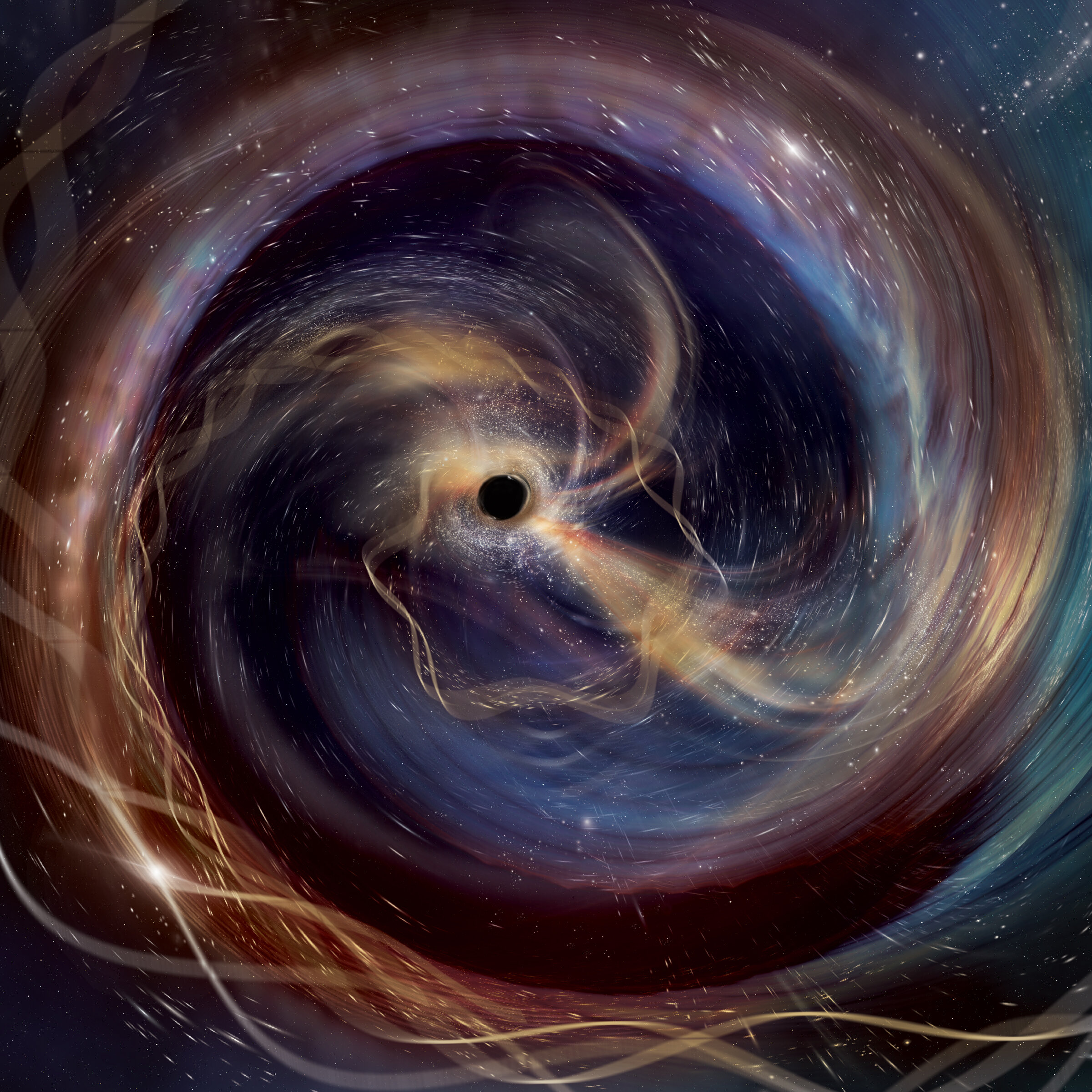
In fact, astronomers believe that nearly every astrophysical black hole rotates, some at incredible speeds approaching the ultimate limits allowed by physics. When a black hole spins, its behavior changes dramatically. Space itself becomes twisted. Time behaves differently. Matter follows strange paths. Entire regions of spacetime can be dragged around like water caught in a cosmic whirlpool.
The mathematical description of a rotating black hole is known as a Kerr black hole.
Named after the New Zealand mathematician and physicist who discovered its solution, the Kerr black hole represents one of the most extraordinary predictions of Einstein’s theory of general relativity. It is not merely a black hole that spins. It is a completely different kind of spacetime, filled with exotic features such as frame dragging, ergospheres, multiple horizons, and ring-shaped singularities.
Understanding Kerr black holes takes us into one of the most beautiful and mind-bending regions of modern physics, where gravity, motion, space, and time become inseparably linked.
The Birth of the Black Hole Concept
The story of Kerr black holes begins long before anyone knew they existed.
The idea that gravity could become overwhelmingly strong dates back centuries. In the eighteenth century, some scientists speculated about hypothetical “dark stars” whose gravity might prevent light from escaping. However, these ideas remained largely philosophical because nobody understood gravity well enough to determine whether such objects could truly exist.
Everything changed in 1915 when Albert Einstein introduced the theory of general relativity.
Einstein’s revolutionary theory described gravity not as a force pulling objects together but as the curvature of spacetime itself. Massive objects bend the fabric of space and time, and other objects move along paths shaped by that curvature.
Almost immediately, physicists began exploring the consequences of Einstein’s equations.
One year later, German physicist Karl Schwarzschild found the first exact solution describing a black hole. His solution represented an idealized black hole that possessed mass but no rotation.
For decades, Schwarzschild black holes dominated theoretical discussions.
Yet there was a problem.
Real stars rotate.
Planets rotate.
Galaxies rotate.
If black holes form from collapsing stars, they should rotate too.
Physicists needed a solution describing spinning black holes.
Roy Kerr and a Revolutionary Discovery
The breakthrough arrived in 1963.
New Zealand mathematician Roy Kerr discovered an exact solution to Einstein’s equations that described a rotating black hole.
The achievement stunned the scientific community.
Einstein’s field equations are notoriously difficult to solve. Finding an exact solution that incorporated rotation seemed almost impossible.
Yet Kerr succeeded.
His solution revealed that rotating black holes were not merely Schwarzschild black holes set into motion. Rotation fundamentally transformed the geometry of spacetime.
The resulting object became known as a Kerr black hole.
Today, the Kerr solution is regarded as one of the most elegant achievements in theoretical physics.
Even more remarkably, observations suggest that real black holes closely resemble Kerr black holes, making Kerr’s work not merely a mathematical curiosity but a description of actual objects scattered throughout the universe.
Why Rotation Changes Everything
To understand why Kerr black holes are so different, imagine spinning a spoon through honey.
As the spoon rotates, nearby honey begins moving with it. The faster the spoon spins, the stronger this dragging effect becomes.
A rotating black hole does something similar.
Except instead of dragging honey, it drags spacetime itself.
This phenomenon is known as frame dragging.
According to general relativity, space and time are not passive backgrounds. They are dynamic entities that respond to matter and energy.
When an extremely massive object rotates, it twists the surrounding spacetime.
Near a rapidly spinning black hole, spacetime becomes so distorted that nothing can remain completely stationary.
Everything must rotate along with the black hole to some degree.
This extraordinary effect has no counterpart in Newtonian gravity.
It exists only because spacetime itself is an active participant in the universe.
What Exactly Is a Kerr Black Hole?
A Kerr black hole is a rotating black hole characterized by two fundamental properties: mass and angular momentum.
Mass determines the black hole’s gravitational strength.
Angular momentum describes its rotation.
According to the famous “no-hair theorem,” these two quantities, along with electric charge, contain essentially all the information needed to describe a black hole.
Most astrophysical black holes are expected to have negligible electric charge because surrounding matter quickly neutralizes any imbalance.
As a result, real black holes are generally described by mass and spin.
This means most black holes in nature are likely Kerr black holes.
From stellar-mass black holes formed by dying stars to supermassive monsters lurking in galactic centers, rotation appears to be the norm rather than the exception.
The Event Horizon Revisited
Every black hole possesses an event horizon.
The event horizon marks the boundary beyond which escape becomes impossible.
For a non-rotating Schwarzschild black hole, this boundary is relatively straightforward.
For a Kerr black hole, the situation becomes more complex.
Rotation alters the horizon’s structure.
The event horizon still exists, but its geometry changes because spacetime itself is being twisted.
The faster the black hole spins, the more pronounced these effects become.
To an outside observer, the horizon remains the point of no return.
Yet hidden beneath that simple description lies an astonishingly intricate spacetime geometry.
The Ergosphere: A Region Found Only Around Rotating Black Holes
One of the most fascinating features of a Kerr black hole is the ergosphere.
This region exists outside the event horizon and owes its existence entirely to rotation.
Within the ergosphere, frame dragging becomes so extreme that no object can remain stationary relative to distant stars.
Even light is forced to move in the direction of the black hole’s spin.
Imagine standing on a moving walkway that becomes increasingly fast.
Eventually, the walkway moves so rapidly that standing still becomes impossible.
The ergosphere functions in a somewhat similar way.
Spacetime itself is moving.
Everything inside must move with it.
This peculiar region creates opportunities for processes that cannot occur around non-rotating black holes.
Most notably, it allows energy to be extracted from the black hole’s rotation.
Extracting Energy from a Black Hole
At first glance, the idea sounds impossible.
How can energy be extracted from an object famous for trapping everything?
The answer lies in the ergosphere.
Physicist Roger Penrose proposed a mechanism known as the Penrose process.
In this scenario, an object enters the ergosphere and splits into two pieces.
One fragment falls into the black hole.
The other escapes carrying more energy than the original object possessed.
The extra energy comes from the black hole’s rotational energy.
In effect, the black hole slows down slightly while transferring energy to the escaping fragment.
Although the Penrose process is difficult to realize practically, it demonstrates an extraordinary fact:
Rotating black holes contain enormous stores of usable energy.
Some astrophysical phenomena may exploit similar principles on a much larger scale.
Frame Dragging and Twisted Spacetime
Frame dragging represents one of the strangest predictions of general relativity.
Near Earth, frame dragging exists but is incredibly weak.
Sensitive experiments have measured Earth’s tiny twisting influence on spacetime.
Near a Kerr black hole, however, frame dragging becomes overwhelming.
Spacetime is dragged around the black hole at tremendous speeds.
Objects attempting to resist this motion are carried along regardless.
The effect grows stronger closer to the black hole.
Near the event horizon of a rapidly rotating Kerr black hole, spacetime may be dragged at nearly the speed of light.
This twisting profoundly influences the motion of matter, light, and energy.
Accretion disks, jets, and particle orbits all reflect the influence of frame dragging.
The Ring Singularity
Perhaps the most famous feature of a Kerr black hole is its singularity.
In a Schwarzschild black hole, the singularity is often described as a point of infinite density.
In a Kerr black hole, the singularity takes a different form.
Rotation transforms the singularity into a ring.
This ring singularity lies in the black hole’s equatorial plane.
The mathematics describing it are extraordinarily complex and remain the subject of ongoing research.
At the singularity, known physical laws break down.
General relativity predicts infinite curvature and infinite density.
Such infinities usually signal that our current theories are incomplete.
Many physicists believe a future theory of quantum gravity will eventually provide a more complete description.
For now, the true nature of the Kerr singularity remains unknown.
Could Kerr Black Holes Contain Gateways?
The ring singularity has inspired some of the most imaginative speculation in theoretical physics.
Certain mathematical interpretations suggest that spacetime inside a Kerr black hole may possess unusual pathways connecting different regions.
These ideas have occasionally been linked to concepts such as wormholes and alternate universes.
However, most physicists remain cautious.
The internal structure predicted by idealized Kerr solutions likely differs from the interiors of real astrophysical black holes.
Small perturbations, quantum effects, and realistic conditions may eliminate many of these exotic possibilities.
Nevertheless, Kerr black holes continue to inspire fascinating discussions about the ultimate structure of spacetime.
Accretion Disks Around Kerr Black Holes
Black holes themselves emit no light.
Yet many of the brightest objects in the universe involve black holes.
The reason lies in accretion disks.
Gas and dust falling toward a black hole rarely plunge directly inward. Instead, they form rapidly rotating disks.
As material spirals inward, friction heats it to enormous temperatures.
The resulting radiation can outshine entire galaxies.
Kerr black holes influence these disks in unique ways.
Rotation allows matter to orbit closer to the event horizon before becoming unstable.
This means infalling material can release more gravitational energy.
As a result, rapidly spinning black holes are often associated with exceptionally luminous accretion disks.
The spin of a black hole therefore affects how efficiently it converts matter into energy.
Relativistic Jets and Black Hole Spin
Some black holes launch colossal jets of particles extending thousands or even millions of light-years into space.
These jets rank among the most energetic structures in the universe.
Their exact origins remain an active area of research, but black hole spin appears to play a crucial role.
Magnetic fields threading the accretion disk and ergosphere may tap into rotational energy.
The extracted energy powers powerful streams of particles moving at nearly the speed of light.
Supermassive Kerr black holes at galactic centers are particularly effective at generating such jets.
These structures can influence the evolution of entire galaxies.
In this sense, black hole spin affects not only the immediate surroundings but cosmic environments on vast scales.
How Fast Can a Kerr Black Hole Spin?
Physics imposes limits on black hole rotation.
A Kerr black hole cannot spin arbitrarily fast.
There exists a maximum spin rate beyond which the event horizon would disappear.
Such an object would expose its singularity directly to the universe.
This hypothetical situation is known as a naked singularity.
Most physicists suspect that nature prevents naked singularities from forming through a principle called cosmic censorship.
As matter falls into a black hole, various processes limit its spin.
Nevertheless, some observed black holes appear to rotate at astonishing speeds, approaching the theoretical maximum.
These extreme objects provide valuable opportunities to test general relativity under extraordinary conditions.
Measuring Black Hole Spin
How can astronomers determine whether a black hole is spinning?
After all, black holes themselves cannot be seen directly.
Scientists infer spin by studying nearby matter.
The behavior of accretion disks offers important clues.
The closer matter can orbit before plunging inward, the faster the black hole is likely spinning.
X-ray observations provide additional information.
Radiation emitted by hot gas near the event horizon carries signatures of relativistic effects.
By analyzing these signals, astronomers can estimate spin rates.
Modern observations suggest many black holes rotate rapidly, lending strong support to the Kerr model.
Supermassive Kerr Black Holes
At the centers of most large galaxies reside supermassive black holes.
These giants contain millions or billions of times the Sun’s mass.
Evidence indicates that many are rotating Kerr black holes.
Their spin histories reflect billions of years of growth.
Mergers with other black holes can alter rotation rates.
Accretion of gas can spin black holes up or slow them down.
The resulting rotational properties provide clues about galactic evolution.
Studying supermassive Kerr black holes therefore helps astronomers reconstruct the histories of galaxies themselves.
Gravitational Waves and Rotating Black Holes
The detection of gravitational waves opened a new window into the universe.
These ripples in spacetime occur when massive objects accelerate.
Merging black holes generate especially powerful gravitational waves.
By analyzing the waveforms, scientists can infer the masses and spins of the colliding black holes.
Many detected mergers involve rotating black holes consistent with Kerr solutions.
The final black hole produced by a merger is typically another Kerr black hole.
These observations provide some of the strongest evidence that Kerr’s mathematical description accurately reflects reality.
The Event Horizon Telescope and Kerr Black Holes
A major milestone occurred in 2019 when the Event Horizon Telescope Collaboration released the first image of a black hole’s shadow.
The target was the supermassive black hole in the galaxy Messier 87.
Later observations also produced images of the black hole at the center of the Milky Way.
These images do not directly reveal the event horizon itself. Instead, they show the surrounding environment shaped by extreme gravity.
Comparisons between observations and theoretical models indicate strong agreement with Kerr black hole predictions.
Once again, theory and observation converged.
A mathematical solution discovered in 1963 continues to describe real objects observed across the universe.
Kerr Black Holes and the Limits of Physics
Kerr black holes occupy a unique position in modern science.
They represent one of the most successful applications of general relativity.
Yet they also highlight the theory’s limitations.
Near singularities, quantum effects become impossible to ignore.
General relativity excels at describing large-scale gravity.
Quantum mechanics governs the microscopic world.
Inside black holes, these two frameworks collide.
Physicists continue searching for a unified theory capable of describing both.
Whether through quantum gravity, string theory, loop quantum gravity, or another approach, solving this puzzle remains one of science’s greatest challenges.
Kerr black holes stand at the frontier where known physics begins to fail.
Why Kerr Black Holes Matter
At first glance, rotating black holes may seem like exotic curiosities relevant only to specialists.
In reality, they occupy a central role in modern astrophysics.
Most black holes in nature likely rotate.
Their spin influences accretion disks, jet formation, gravitational waves, and galactic evolution.
They provide laboratories for testing general relativity under extreme conditions.
They offer clues about the relationship between gravity and quantum mechanics.
They challenge our deepest assumptions about space and time.
Every new observation of a rotating black hole expands our understanding of the universe.
The Beauty of a Rotating Universe
There is something profoundly elegant about Kerr black holes.
A collapsing star spins.
Its rotation survives.
The surrounding spacetime twists and swirls.
Gravity becomes geometry.
Motion becomes curvature.
Energy becomes extractable from the fabric of spacetime itself.
What began as a simple question—what happens if a black hole rotates?—led to one of the most remarkable discoveries in theoretical physics.
The Kerr solution reveals a universe more dynamic, complex, and beautiful than anyone previously imagined.
Conclusion
A Kerr black hole is a rotating black hole described by Roy Kerr’s groundbreaking solution to Einstein’s equations of general relativity. Unlike non-rotating black holes, Kerr black holes twist spacetime around them through frame dragging, possess unique regions known as ergospheres, and contain ring-shaped singularities rather than point-like ones. Their rotation profoundly influences the behavior of matter, light, energy, and time itself.
Modern observations strongly suggest that most real black holes are Kerr black holes. From stellar remnants to supermassive giants at galactic centers, rotation appears to be a defining feature of black holes throughout the cosmos. These extraordinary objects power luminous accretion disks, launch relativistic jets, generate gravitational waves, and provide invaluable laboratories for testing the limits of physics.
More than six decades after its discovery, the Kerr solution remains one of the greatest triumphs of theoretical science. It transforms black holes from simple gravitational traps into rich and dynamic structures where spacetime itself is dragged into motion. In the strange and beautiful world of Kerr black holes, the universe reveals some of its deepest secrets, reminding us that reality is often far more astonishing than imagination.