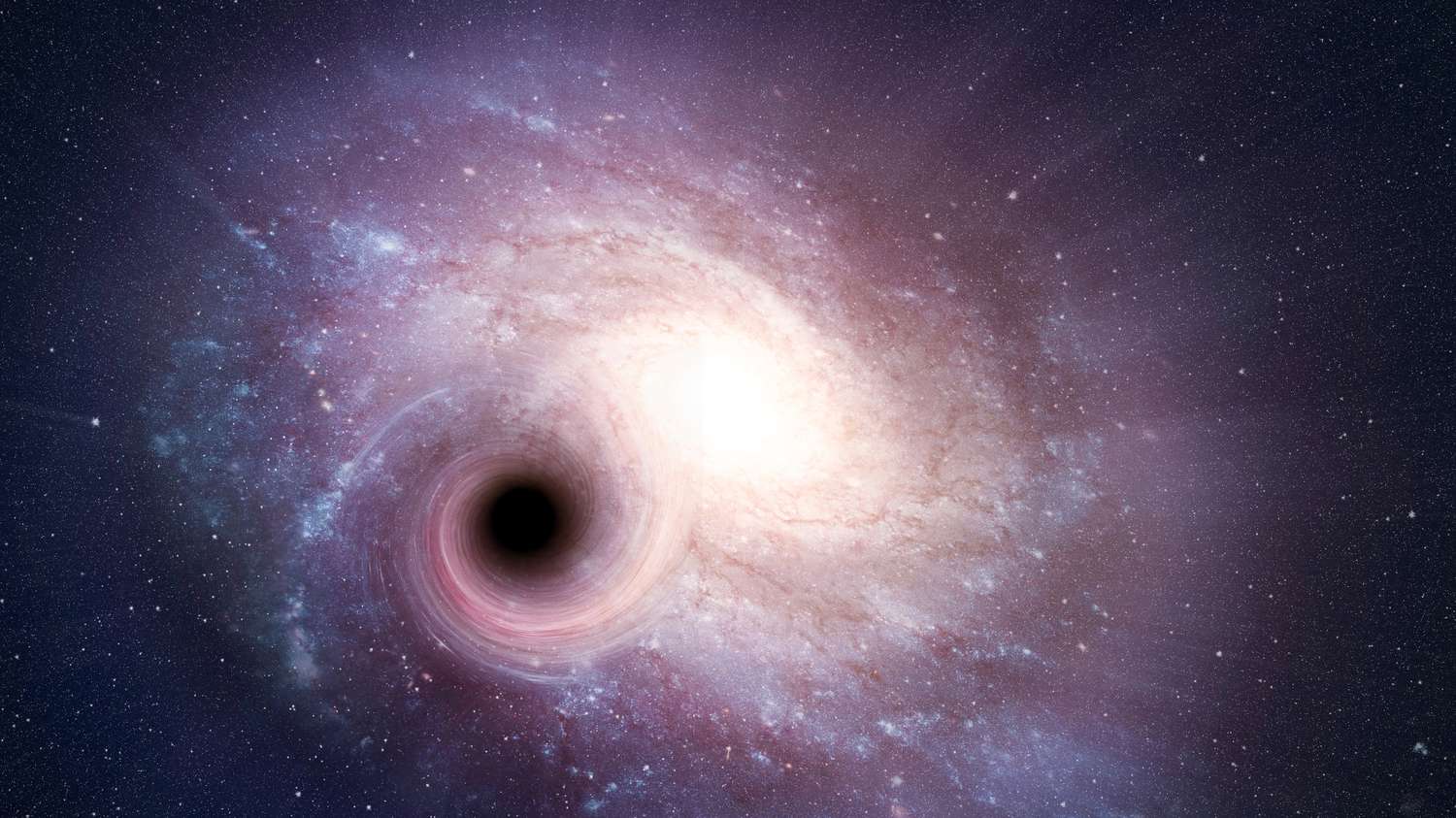
For much of human history, black holes have been imagined as the ultimate cosmic prisons. They are regions of space where gravity is so powerful that nothing—not planets, not stars, not light itself—can escape once it crosses a certain boundary. To many people, a black hole seems like the end of the story. Matter falls in, disappears forever, and nothing comes back out.
This image is dramatic, mysterious, and partly correct.
Yet in the 1970s, a young physicist made a discovery that completely transformed how scientists think about black holes. His idea was so surprising that it challenged decades of assumptions. According to his calculations, black holes are not entirely black after all.
Instead, they can slowly emit energy.
Over unimaginable spans of time, they can gradually lose mass.
And if enough time passes, they may eventually disappear completely.
This astonishing phenomenon is known as Hawking radiation.
Named after the renowned physicist Stephen Hawking, Hawking radiation represents one of the most profound ideas in modern physics. It connects gravity, quantum mechanics, thermodynamics, and the nature of reality itself. It suggests that black holes are not eternal objects but temporary features of the universe.
The concept is so revolutionary because it emerges from two of physics’ greatest theories—quantum mechanics and general relativity—which often seem incompatible with one another. Hawking radiation sits at the crossroads between them, offering a glimpse into a deeper understanding of nature.
To appreciate why Hawking radiation is so important, we must first understand what black holes are, why scientists once believed they could never emit anything, and how quantum physics completely changed that picture.
Understanding Black Holes
A black hole forms when an enormous amount of mass becomes concentrated into a very small region of space.
The most common black holes originate from massive stars. When such a star exhausts its nuclear fuel, it can no longer support itself against gravity. The star’s core collapses inward, compressing matter to extraordinary densities.
If enough mass remains after the collapse, gravity becomes so intense that a black hole forms.
At the center lies a region known as a singularity, where current theories suggest matter becomes infinitely dense. Surrounding this is the event horizon, often described as the point of no return.
The event horizon is not a physical surface like the surface of a planet. Instead, it is a boundary in spacetime.
Once anything crosses this boundary, escape becomes impossible according to classical physics.
Light itself cannot move outward fast enough to overcome the black hole’s gravitational pull.
Because no light escapes, black holes appear completely dark.
For decades, this understanding led scientists to believe black holes could only grow larger. They could absorb matter and energy, but they could never lose them.
Then quantum mechanics entered the story.
The Strange World of Quantum Physics
Quantum mechanics governs the behavior of nature at the smallest scales.
Unlike the predictable world of everyday experience, the quantum world is filled with uncertainty, probabilities, and surprising phenomena.
Particles can behave like waves.
Energy can fluctuate unexpectedly.
Empty space is not truly empty.
This last idea is particularly important for understanding Hawking radiation.
To human intuition, a vacuum seems like nothingness.
Imagine removing all matter, all air, all dust, and all radiation from a region of space. It would appear completely empty.
According to quantum physics, however, even perfect emptiness contains activity.
Space itself is alive with tiny fluctuations.
Particles and antiparticles can briefly appear and disappear in accordance with quantum laws.
These fleeting events occur constantly throughout the universe.
Although they usually vanish almost immediately, their existence has measurable consequences.
This quantum activity forms the foundation of Hawking radiation.
Empty Space Is Never Truly Empty
One of the most surprising discoveries in modern physics is that a vacuum is not a featureless void.
Instead, it possesses what physicists call quantum fields.
Every type of particle in nature is associated with a field that fills all of space.
Even when no particles are present, these fields continue to exist.
Quantum uncertainty allows temporary fluctuations within these fields.
As a result, pairs of particles and antiparticles can spontaneously emerge.
An antiparticle resembles an ordinary particle but possesses opposite properties such as electric charge.
For example, an electron has a positively charged counterpart called a positron.
When a particle and its antiparticle meet, they typically annihilate each other, converting their mass into energy.
In ordinary empty space, these pairs appear and disappear so quickly that they leave no lasting trace.
Near a black hole, however, something extraordinary can happen.
Stephen Hawking’s Revolutionary Insight
In the early 1970s, Stephen Hawking began investigating how quantum mechanics behaves in the intense gravitational environment surrounding black holes.
At the time, black holes were generally regarded as perfect absorbers.
They could swallow matter and energy but emit nothing.
Hawking combined principles from quantum theory with Einstein’s theory of gravity.
His calculations revealed an unexpected result.
Black holes should not be completely black.
Instead, they should emit a faint form of thermal radiation.
This radiation would cause the black hole to lose energy.
Because energy and mass are equivalent according to Einstein’s famous equation E = mc², losing energy means losing mass.
Over time, the black hole would gradually shrink.
The implications were astonishing.
Objects once believed to be eternal could eventually evaporate away.
The Popular Particle-Pair Explanation
The most commonly used explanation for Hawking radiation involves virtual particle pairs near the event horizon.
Although this picture is somewhat simplified, it provides an intuitive way to understand the basic idea.
Imagine a particle-antiparticle pair appearing near the event horizon.
Normally, the pair would quickly annihilate each other and disappear.
But suppose the black hole’s gravity separates them before annihilation can occur.
One particle falls into the black hole.
The other escapes into space.
To an outside observer, it appears as though the black hole has emitted a particle.
The escaping particle carries energy away from the black hole.
As this process repeats over vast periods of time, the black hole gradually loses mass.
This simplified picture captures the essence of Hawking radiation, although the actual mathematics is more complex and involves quantum fields in curved spacetime.
Why the Escaping Particle Matters
The particle that escapes the black hole becomes real and detectable.
It is no longer merely a temporary fluctuation.
From the perspective of distant observers, radiation is emerging from the vicinity of the black hole.
This radiation can include photons, neutrinos, and other particles.
Importantly, the radiation does not originate from deep inside the black hole.
Instead, it arises from quantum effects occurring near the event horizon.
This distinction is crucial.
Nothing escapes from within the event horizon itself.
The laws of general relativity remain intact.
Rather, quantum mechanics alters what happens just outside that boundary.
The result is radiation that appears to come from the black hole.
Black Holes Have Temperature
Before Hawking’s work, black holes seemed strangely disconnected from thermodynamics.
Thermodynamics studies heat, temperature, and energy.
Everything with a temperature emits some form of radiation.
Hot objects glow brightly.
Cooler objects emit infrared radiation.
If black holes emitted nothing, how could they fit into thermodynamic theory?
Hawking’s discovery solved this puzzle.
His calculations showed that black holes possess a temperature.
This temperature depends on their mass.
The larger the black hole, the lower its temperature.
The smaller the black hole, the higher its temperature.
This relationship is unusual.
Most everyday objects cool as they lose energy.
Black holes do the opposite.
As they lose mass, they become hotter.
This strange behavior plays a key role in their eventual evaporation.
The Connection to Black Hole Entropy
Hawking’s discovery built upon earlier work by physicists who noticed surprising similarities between black holes and thermodynamic systems.
One important concept is entropy.
Entropy measures the number of possible microscopic arrangements corresponding to a system’s overall state.
In simple terms, it is often associated with disorder or information content.
Physicists realized that black holes appear to possess entropy proportional to the area of their event horizons.
This idea was initially controversial because entropy usually applies to physical systems containing particles.
Black holes seemed too simple.
Hawking radiation confirmed that black holes genuinely behave like thermodynamic objects.
They possess temperature.
They possess entropy.
They exchange energy with their surroundings.
This realization transformed black hole physics forever.
How Fast Do Black Holes Evaporate?
One of the most fascinating aspects of Hawking radiation is its incredible slowness.
For large black holes, the effect is extremely weak.
A stellar-mass black hole formed from a collapsed star emits only a tiny amount of Hawking radiation.
In fact, such a black hole absorbs far more energy from the cosmic environment than it loses through evaporation.
Its temperature is extraordinarily low—far colder than the surrounding universe.
As a result, evaporation proceeds at an almost unimaginably slow rate.
A black hole with the mass of the Sun would require roughly 10⁶⁷ years to evaporate completely.
For comparison, the universe is currently about 13.8 billion years old.
That is approximately 10¹⁰ years.
The evaporation timescale exceeds the current age of the universe by an almost incomprehensible margin.
Supermassive Black Holes and Immense Lifetimes
At the centers of most large galaxies reside supermassive black holes.
These giants contain millions or billions of times the Sun’s mass.
Because Hawking temperature decreases as mass increases, supermassive black holes are even colder than stellar-mass black holes.
Their evaporation rates are correspondingly smaller.
Some may survive for around 10¹⁰⁰ years or more before disappearing.
Such timescales dwarf every familiar measure of time.
Entire galaxies will evolve.
Stars will burn out.
New cosmic eras will come and go.
Yet many supermassive black holes will still remain.
They may become among the last surviving structures in the distant future of the universe.
What Happens as a Black Hole Shrinks?
As a black hole loses mass through Hawking radiation, something unusual occurs.
Its temperature rises.
Higher temperature leads to stronger radiation.
Stronger radiation increases the rate of mass loss.
This creates a feedback loop.
The smaller the black hole becomes, the faster it evaporates.
For most of its existence, evaporation proceeds incredibly slowly.
Near the end, however, the process accelerates dramatically.
The final stages remain uncertain because current theories may become inadequate under such extreme conditions.
Many physicists suspect that quantum gravity effects become important.
Exactly what happens during a black hole’s final moments remains one of the great unanswered questions in theoretical physics.
The Black Hole Information Paradox
Hawking radiation led directly to one of the deepest problems in modern science.
This problem is known as the black hole information paradox.
Quantum mechanics states that information cannot be destroyed.
If the complete state of a system is known, its evolution should preserve information.
Black holes complicate this principle.
Imagine throwing books, computers, photographs, and countless other objects into a black hole.
These objects contain information.
If the black hole eventually evaporates completely through Hawking radiation, what happens to that information?
Hawking’s original calculations suggested the radiation contains no detailed information about what fell into the black hole.
If true, information would effectively disappear from the universe.
This outcome conflicts with fundamental principles of quantum mechanics.
The paradox has inspired decades of research and remains one of the most important unresolved questions in theoretical physics.
Searching for a Solution
Many proposed solutions have emerged over the years.
Some physicists argue that information is subtly encoded within Hawking radiation.
Others suggest information may be stored on the event horizon itself.
Certain theories propose that tiny remnants survive after evaporation.
Still others invoke new principles involving quantum gravity.
Although significant progress has been made, no universally accepted solution exists.
The information paradox remains an active area of research.
Its resolution may reveal profound truths about the nature of space, time, and reality.
Hawking Radiation and Quantum Gravity
One reason Hawking radiation is so important is that it sits at the intersection of two great theories.
General relativity describes gravity and the large-scale structure of the universe.
Quantum mechanics governs the microscopic world.
Each theory works extraordinarily well within its domain.
Yet combining them into a single framework has proven remarkably difficult.
Hawking radiation arises precisely where both theories matter.
Gravity shapes the black hole.
Quantum effects generate the radiation.
Because of this, Hawking radiation provides valuable clues for developing a future theory of quantum gravity.
Many physicists believe understanding black holes may ultimately help unify the fundamental laws of nature.
Has Hawking Radiation Been Observed?
Despite its importance, Hawking radiation has not yet been directly detected from an astrophysical black hole.
The main reason is that the effect is extremely weak.
Large black holes emit radiation far too faint for current instruments to measure.
Their temperatures are lower than the cosmic microwave background radiation filling the universe.
Any Hawking radiation would be overwhelmed by other sources of energy.
This makes direct observation extraordinarily challenging.
Nevertheless, most physicists consider Hawking radiation a robust theoretical prediction because it emerges naturally from well-established principles.
Laboratory Analogues
Although actual Hawking radiation remains undetected, scientists have created experimental systems that mimic certain aspects of black hole behavior.
These laboratory analogues include specially designed fluids, optical systems, and ultra-cold atomic gases.
In some cases, researchers have observed effects resembling Hawking radiation.
These experiments do not create genuine black holes.
Instead, they simulate mathematical conditions similar to those near an event horizon.
Such studies provide valuable insights into how Hawking-like processes may occur.
They also help test theoretical predictions in controlled environments.
Primordial Black Holes and Hawking Radiation
Some theories suggest that tiny black holes may have formed shortly after the Big Bang.
These hypothetical objects are known as primordial black holes.
Because Hawking radiation becomes stronger for smaller black holes, primordial black holes would evaporate much more rapidly than stellar or supermassive black holes.
A sufficiently small primordial black hole could potentially evaporate within the current age of the universe.
Astronomers have searched for evidence of such evaporation events.
So far, no definitive detections have been made.
However, these searches continue because they could provide indirect evidence supporting Hawking’s theory.
The Fate of the Universe and Black Hole Evaporation
Hawking radiation profoundly influences predictions about the universe’s distant future.
Current cosmological models suggest stars will eventually exhaust their fuel.
Galaxies will evolve.
Many celestial structures will disappear.
For an extraordinarily long period, black holes may dominate the cosmic landscape.
Yet Hawking radiation implies even these seemingly eternal objects are temporary.
Over unimaginable spans of time, black holes will gradually evaporate.
Eventually, the universe may become a vast, dark expanse containing little more than dilute radiation and elementary particles.
In this picture, Hawking radiation plays a central role in shaping the ultimate destiny of the cosmos.
Why Hawking Radiation Is So Remarkable
Many scientific discoveries reveal unexpected details about nature.
Hawking radiation goes further.
It overturns an entire way of thinking about black holes.
Objects once believed to trap everything forever are revealed to possess temperature, entropy, and finite lifetimes.
The discovery links gravity with quantum mechanics.
It raises deep questions about information and reality.
It influences our understanding of the universe’s future.
Most importantly, it demonstrates that even the darkest objects in existence are not completely isolated from the rest of the cosmos.
Quantum physics finds a way to connect them.
Stephen Hawking’s Legacy
Stephen Hawking became one of the world’s most famous scientists not merely because of his remarkable personal story, but because of the profound impact of his ideas.
Hawking radiation stands among the most important theoretical discoveries of the twentieth century.
It transformed black holes from simple gravitational curiosities into rich laboratories for exploring fundamental physics.
The concept continues to inspire new research decades after its introduction.
Scientists studying quantum gravity, cosmology, information theory, and black hole thermodynamics all build upon foundations Hawking helped establish.
His work demonstrated how a bold theoretical insight can reshape humanity’s understanding of the universe.
Conclusion
Hawking radiation is the theoretical process through which black holes slowly lose energy and mass due to quantum effects occurring near their event horizons. Proposed by Stephen Hawking in 1974, the idea revealed that black holes are not completely black but emit faint thermal radiation. Over immense periods of time, this radiation causes black holes to shrink and eventually evaporate.
The discovery united concepts from quantum mechanics, general relativity, and thermodynamics in a way that revolutionized modern physics. It showed that black holes possess temperature and entropy, raised profound questions about information and reality, and suggested that even the most extreme objects in the universe are not eternal.
Although Hawking radiation has not yet been directly observed, it remains one of the most influential and compelling predictions in theoretical science. It reminds us that the universe often behaves in ways far stranger and more beautiful than intuition suggests. Even in the darkest regions of space, where gravity seems absolute and escape appears impossible, quantum physics whispers a remarkable truth: nothing lasts forever—not even a black hole.