The universe is filled with mysteries, but few are as captivating as black holes. These strange objects possess gravity so powerful that nothing—not even light—can escape once it crosses a boundary known as the event horizon. Black holes have fascinated scientists and the public alike for decades, inspiring countless books, documentaries, and scientific investigations.
Most black holes we know about have a dramatic origin story. They are born when massive stars exhaust their nuclear fuel and collapse under their own gravity. Others form through mergers between smaller black holes or through the growth of supermassive black holes at the centers of galaxies.
But what if some black holes are far older than the first stars?
What if certain black holes were not created by dying stars at all?
What if they formed during the first fraction of a second after the birth of the universe itself?
This remarkable possibility leads us to one of the most fascinating ideas in modern cosmology: primordial black holes.
Primordial black holes are hypothetical black holes that may have formed shortly after the Big Bang, long before stars, galaxies, planets, or even atoms existed. If they are real, they would be ancient relics from the earliest moments of cosmic history—tiny fossils from an era that remains largely hidden from direct observation.
The search for primordial black holes is more than a quest to find unusual objects. It is an attempt to uncover clues about the birth of the universe, the nature of dark matter, and the physics that governed reality when the cosmos was unimaginably young.
Understanding Black Holes
To appreciate why primordial black holes are so extraordinary, it helps to first understand what a black hole actually is.
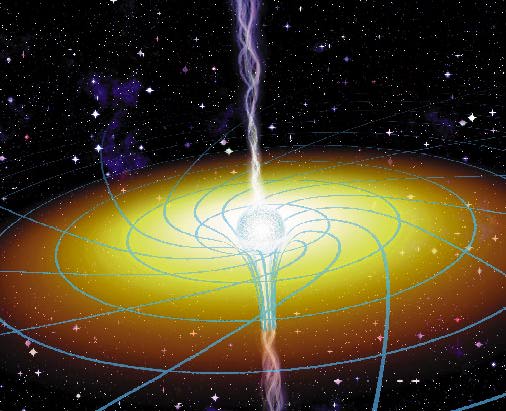
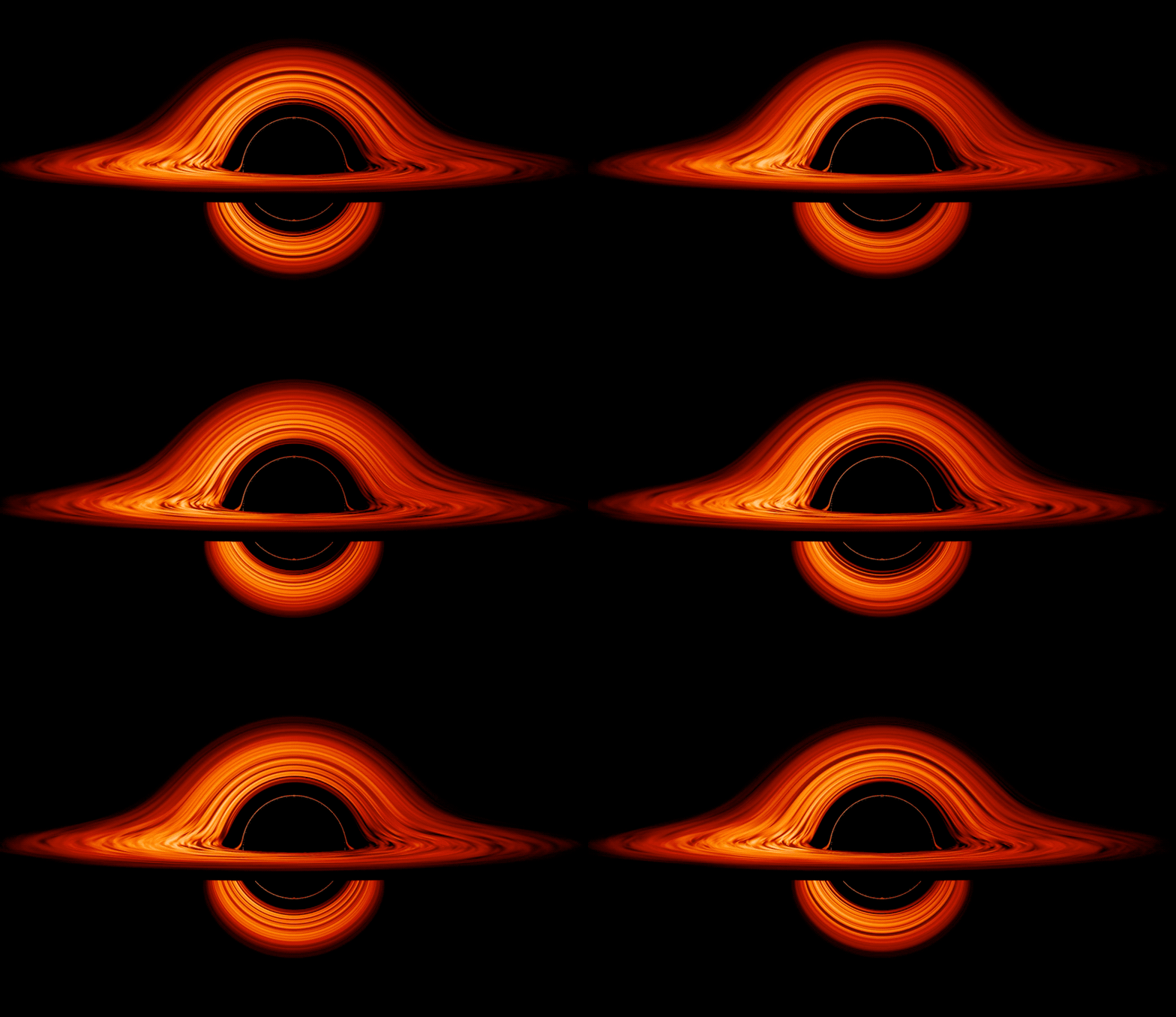
A black hole forms when matter becomes compressed into an extremely small volume. The resulting concentration of mass creates a gravitational field so intense that escape becomes impossible within a certain boundary.
This boundary is called the event horizon.
Anything crossing the event horizon can never return to the outside universe.
Contrary to popular imagination, black holes are not cosmic vacuum cleaners endlessly sucking everything around them into oblivion. Objects can orbit black holes just as planets orbit stars. A black hole only becomes dangerous when something ventures too close.
Most known black holes originate from stellar collapse. When a massive star reaches the end of its life, gravity overwhelms the pressure supporting the star. The core collapses, and if enough mass remains, a black hole forms.
Primordial black holes would be fundamentally different.
They would not need stars.
They would not require galaxies.
They could have appeared before either existed.
The Universe Immediately After the Big Bang
To understand primordial black holes, we must travel back to the beginning.
According to modern cosmology, the universe began approximately 13.8 billion years ago in an event known as the Big Bang.
The Big Bang was not an explosion in space. Rather, it marked the rapid expansion of space itself from an incredibly hot, dense state.
In its earliest moments, the universe was almost unimaginably extreme.
Temperatures reached trillions upon trillions of degrees.
Matter as we know it did not exist.
Atoms had not yet formed.
Stars and galaxies were still far in the future.
The cosmos consisted of a dense sea of energy and elementary particles interacting under conditions far beyond anything we can reproduce on Earth.
During this chaotic infancy, tiny fluctuations in density may have existed throughout space.
Most of these fluctuations were small.
But under certain circumstances, some regions might have become exceptionally dense.
And that is where the story of primordial black holes begins.
What Is a Primordial Black Hole?
A primordial black hole is a hypothetical black hole that formed from extremely dense regions in the early universe rather than from collapsing stars.
The key idea is surprisingly simple.
If a region of the newborn universe became dense enough, gravity could overwhelm all other forces and cause that region to collapse directly into a black hole.
No star would be necessary.
No supernova explosion would be required.
The black hole would emerge directly from the conditions present shortly after the Big Bang.
Because these objects would form during the earliest stages of cosmic history, they would be among the oldest structures in existence.
Some primordial black holes, if they exist, could be nearly as old as the universe itself.
Why Scientists Proposed Primordial Black Holes
The concept of primordial black holes emerged during the twentieth century as cosmologists explored the consequences of the Big Bang.
Researchers realized that the early universe was not perfectly uniform.
Tiny density variations existed.
In fact, those small fluctuations eventually grew into the galaxies and galaxy clusters we observe today.
Scientists began asking an intriguing question.
What if some fluctuations were unusually large?
Could gravity have caused them to collapse into black holes before stars ever formed?
The possibility seemed plausible.
Over time, theoretical studies showed that certain conditions in the early universe could indeed produce black holes of various sizes.
This idea transformed primordial black holes from science fiction into a legitimate scientific hypothesis.
Today, they remain an active area of research.
The Role of Density Fluctuations
The early universe was remarkably smooth, but not perfectly smooth.
Tiny differences in density existed from place to place.
These fluctuations are visible today in the cosmic microwave background, the faint afterglow left behind by the Big Bang.
Most density variations were extremely small.
However, in some theoretical models, rare regions could have become significantly denser than average.
Imagine a calm ocean with tiny ripples covering its surface.
Most ripples remain harmless.
But occasionally, unusual circumstances might produce a much larger wave.
Similarly, most density fluctuations in the early universe remained modest.
Yet some may have been large enough to trigger gravitational collapse.
If a region contained enough mass within a sufficiently small volume, a primordial black hole could form.
The entire process could occur within fractions of a second after the Big Bang.
A Wide Range of Possible Sizes
One of the most fascinating aspects of primordial black holes is the enormous range of sizes they might possess.
Stellar black holes typically have masses several times greater than the Sun.
Supermassive black holes contain millions or billions of solar masses.
Primordial black holes, however, could theoretically span a much wider range.
Some might have been incredibly tiny.
Others could rival stellar black holes.
A few models even allow for primordial black holes with masses much greater than those produced by stars.
The size of a primordial black hole would depend largely on when it formed.
The earlier its formation, the smaller the amount of matter available within the collapsing region.
As the universe expanded, larger regions could collapse, producing more massive black holes.
This diversity makes primordial black holes particularly intriguing.
Tiny Black Holes from the Dawn of Time
Perhaps the strangest possibility involves microscopic primordial black holes.
Some theoretical models predict black holes with masses far smaller than mountains, planets, or stars.
Such objects would possess incredibly tiny event horizons.
A black hole with the mass of a mountain might be smaller than an atom.
This seems almost impossible to imagine.
We often associate black holes with gigantic cosmic monsters.
Yet according to general relativity, a black hole’s size depends entirely on how much mass is compressed into a sufficiently small space.
A tiny primordial black hole could contain enormous mass within an incredibly small region.
If such objects ever existed, they would represent some of the most extreme entities in the universe.
Stephen Hawking and Black Hole Evaporation
The story of primordial black holes changed dramatically in the 1970s thanks to the work of Stephen Hawking.
Hawking made a groundbreaking discovery that challenged conventional ideas about black holes.
According to classical physics, nothing can escape from a black hole.
However, when quantum mechanics is considered, the situation becomes more complicated.
Hawking showed that black holes should emit a faint form of radiation, now known as Hawking radiation.
This radiation causes black holes to gradually lose mass.
Over extremely long periods, black holes can slowly evaporate.
For large black holes, the process is extraordinarily slow.
A stellar black hole would survive far longer than the current age of the universe.
Tiny primordial black holes are different.
Because smaller black holes emit Hawking radiation more intensely, they evaporate much faster.
Some primordial black holes may have completely disappeared billions of years ago.
The Final Explosion
As a black hole loses mass through Hawking radiation, the process accelerates.
The smaller the black hole becomes, the faster it evaporates.
Near the end of its life, a tiny primordial black hole could release a burst of energy.
This final phase might resemble a powerful explosion.
Astronomers have searched for evidence of such events.
Detecting one would provide strong support for the existence of primordial black holes and Hawking radiation.
So far, no definitive observations have been made.
Nevertheless, these searches continue because the scientific rewards would be enormous.
Confirming Hawking radiation would unite key ideas from quantum mechanics and gravity.
Could Primordial Black Holes Explain Dark Matter?
One of the biggest mysteries in modern science is dark matter.
Galaxies rotate too quickly to be held together by visible matter alone.
Galaxy clusters contain more mass than astronomers can directly observe.
The universe appears filled with an invisible substance that interacts primarily through gravity.
Scientists call this mysterious component dark matter.
Despite decades of research, its true nature remains unknown.
Primordial black holes have emerged as one possible explanation.
Because black holes exert gravity while emitting little or no light, they naturally share some characteristics expected of dark matter.
If enough primordial black holes formed in the early universe, they could potentially account for a significant fraction of the missing mass.
This idea has generated enormous interest.
A universe filled with ancient black holes would be dramatically different from one dominated by unknown particles.
The possibility remains one of the most exciting aspects of primordial black hole research.
The Search for Dark Matter Clues
Scientists have developed numerous methods to test whether primordial black holes could be dark matter.
Researchers study gravitational lensing, a phenomenon in which massive objects bend light from distant sources.
If primordial black holes are abundant, they should occasionally pass between Earth and distant stars, temporarily magnifying the starlight.
Astronomers have conducted extensive surveys looking for such events.
Other searches examine the cosmic microwave background, gravitational waves, and galactic structures.
Each observation helps narrow the range of possible primordial black hole populations.
Although many possibilities have been ruled out, some mass ranges remain viable candidates.
The mystery is far from solved.
Gravitational Waves and New Possibilities
The discovery of gravitational waves opened a new chapter in black hole research.
Predicted by Albert Einstein more than a century ago, gravitational waves are ripples in spacetime produced by accelerating massive objects.
In 2015, scientists detected gravitational waves directly for the first time.
The signals came from merging black holes.
Some researchers noticed something intriguing.
Certain observed black holes appeared more massive than expected from ordinary stellar evolution.
This led to speculation that some mergers might involve primordial black holes.
Although alternative explanations exist, gravitational-wave observations have renewed interest in primordial black hole scenarios.
Every new detection provides additional opportunities to test these ideas.
Seeds of Supermassive Black Holes
Another cosmic mystery involves supermassive black holes.
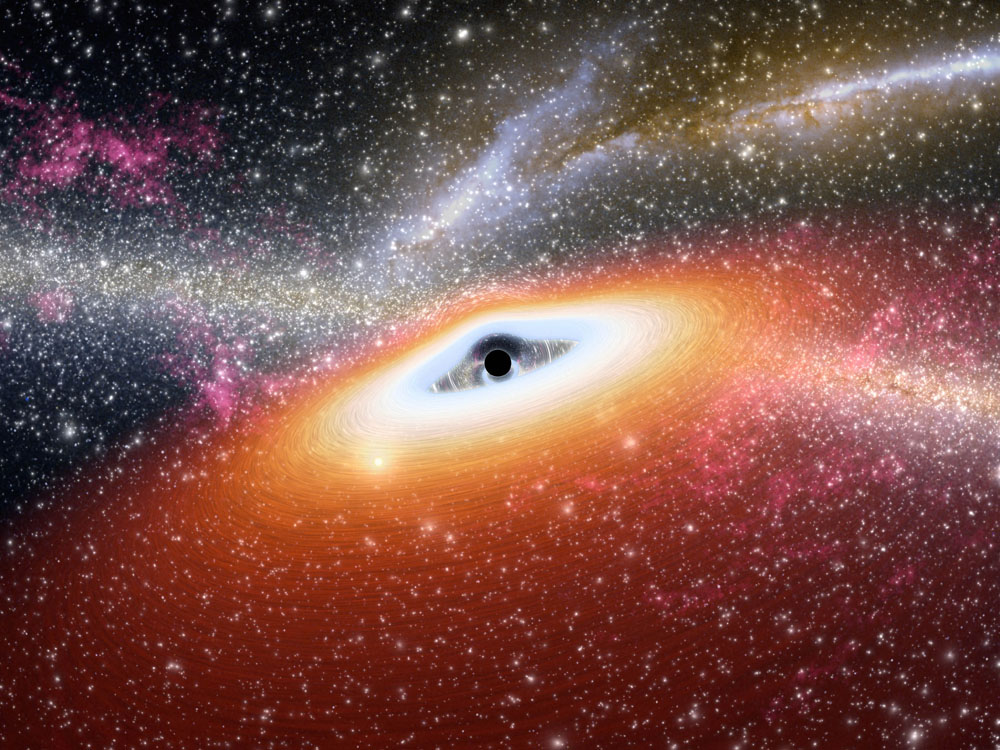
These giants reside at the centers of most large galaxies.
Some contain billions of solar masses.
Astronomers have discovered supermassive black holes existing surprisingly early in cosmic history.
This presents a challenge.
Growing a black hole to such enormous sizes requires time.
Yet some seem to have formed astonishingly quickly after the Big Bang.
Primordial black holes may offer a solution.
If large primordial black holes existed from the beginning, they could serve as seeds for later growth.
Starting with a substantial initial mass would make it easier to explain the rapid appearance of supermassive black holes.
Although not proven, this possibility continues to attract scientific attention.
How Astronomers Search for Primordial Black Holes
Detecting primordial black holes is difficult because black holes emit little or no light.
Scientists therefore rely on indirect evidence.
One approach involves observing gravitational lensing events.
Another examines distortions in the cosmic microwave background.
Researchers also analyze gamma-ray data, gravitational-wave signals, and the motions of stars.
Each method targets different possible black hole masses.
Because primordial black holes could exist across such a broad range, no single technique can search all possibilities.
The hunt resembles assembling a giant puzzle.
Every observation removes some pieces while revealing new possibilities.
Primordial Black Holes and the Early Universe
Even if primordial black holes are rare, they could still provide extraordinary insights into the early universe.
The conditions required for their formation depend on physical processes occurring fractions of a second after the Big Bang.
Finding evidence for primordial black holes would therefore reveal information about an era otherwise inaccessible to direct observation.
It would offer a glimpse into energies far beyond those achievable in modern particle accelerators.
In many ways, primordial black holes function as cosmic fossils.
Like ancient bones preserving clues about extinct creatures, these hypothetical objects could preserve evidence about the infancy of the universe.
Their existence would tell us something profound about how the cosmos began.
The Connection to Inflation
Many cosmological theories include a period called inflation.
According to this idea, the universe experienced an extremely rapid expansion shortly after the Big Bang.
Inflation helps explain why the universe appears remarkably uniform on large scales.
It also provides a mechanism for generating the tiny density fluctuations observed today.
Certain inflation models predict enhanced fluctuations at specific scales.
These enhanced fluctuations could collapse into primordial black holes.
As a result, the abundance of primordial black holes may offer clues about inflation itself.
Studying these objects could therefore help scientists investigate one of cosmology’s most important theories.
Challenges and Skepticism
Science advances through evidence, not wishful thinking.
Although primordial black holes are fascinating, they remain hypothetical.
No confirmed primordial black hole has ever been discovered.
Many proposed scenarios face significant observational constraints.
Astronomers have ruled out large portions of the possible mass range.
Some theories once considered promising now appear unlikely.
This skepticism is healthy.
Extraordinary claims require extraordinary evidence.
Researchers continue testing the idea because it remains scientifically plausible and potentially transformative.
The absence of confirmation does not mean primordial black holes do not exist.
It simply means the search continues.
What If They Are Found?
Imagine the consequences of discovering definitive evidence for primordial black holes.
Such a finding would represent one of the most important scientific breakthroughs of the century.
It would confirm that black holes can form without stars.
It would provide direct evidence about conditions in the infant universe.
It might solve the dark matter mystery.
It could reveal new physics operating at extreme energies.
It would deepen our understanding of gravity, cosmology, and the origins of cosmic structure.
Few scientific discoveries would have broader implications.
The excitement surrounding primordial black holes reflects this enormous potential.
Why the Idea Captures Human Imagination
There is something deeply compelling about primordial black holes.
Perhaps it is their age.
These objects, if real, would be survivors from the universe’s first moments.
Long before Earth formed.
Long before the Sun ignited.
Long before galaxies matured.
They may have existed when the cosmos was less than a second old.
That concept stretches the imagination.
Primordial black holes connect us to a time so remote that ordinary experience offers no comparison.
They are potential messengers from the beginning of everything.
The Future of Primordial Black Hole Research
The coming decades may bring answers.
New telescopes, gravitational-wave observatories, and space missions will provide increasingly sensitive data.
Researchers will continue searching for lensing events, evaporation signatures, and gravitational-wave patterns.
Improved cosmological observations will place tighter constraints on theoretical models.
Advances in computing will allow more realistic simulations of the early universe.
Each step will help determine whether primordial black holes are real cosmic objects or merely intriguing theoretical possibilities.
Either outcome will teach us something important about nature.
Conclusion
Primordial black holes are among the most fascinating ideas in modern cosmology. Unlike ordinary black holes formed by dying stars, these hypothetical objects may have emerged directly from dense regions in the infant universe shortly after the Big Bang. If they exist, they would be ancient relics from the dawn of time, preserving clues about conditions that prevailed when the cosmos was only fractions of a second old.
Their potential significance is extraordinary. Primordial black holes could help explain dark matter, illuminate the physics of inflation, reveal the origins of supermassive black holes, and provide rare insights into the earliest moments of cosmic history. Theoretical studies suggest they may have existed in a vast range of sizes, from microscopic objects that evaporated long ago to larger survivors that may still roam the universe today.
Although no primordial black hole has yet been confirmed, the search continues with growing intensity. Every new observation, every gravitational-wave detection, and every cosmological survey brings scientists closer to answering one of the universe’s most intriguing questions.
If primordial black holes are eventually discovered, they will not merely be another type of black hole. They will be ancient witnesses to creation itself—dark, silent relics from the first heartbeat of the cosmos, carrying secrets from a time when the universe was just beginning its long and extraordinary story.