Few ideas in modern science are as mysterious, unsettling, and fascinating as a singularity.
Imagine a place where all known laws of physics seem to break down. A location where matter is crushed beyond imagination, where gravity becomes infinitely strong, and where our best scientific theories can no longer tell us what happens next. A place so extreme that space and time themselves lose their familiar meaning.
According to our current understanding of black holes, such a place may exist at their very centers.
This hypothetical region is known as a singularity.
The singularity is not merely another strange object in space. It represents one of the deepest mysteries in all of science. It sits at the boundary between what we know and what we do not know. It challenges the theories that have successfully explained planets, stars, galaxies, and even the expansion of the universe.
For decades, physicists have wrestled with the idea of singularities. Some believe they are real physical entities hidden within black holes. Others think they are signs that our current theories are incomplete. Either way, singularities point toward a deeper understanding of reality that humanity has not yet reached.
To understand a singularity, we must first take a journey into the strange world of gravity, black holes, space, and time.
Understanding Gravity Beyond Everyday Experience
Gravity seems simple in everyday life.
Drop a book, and it falls.
Throw a ball upward, and it eventually returns to the ground.
The Moon orbits Earth, and Earth orbits the Sun.
These familiar experiences create the impression that gravity is straightforward.
For centuries, the explanation developed by Isaac Newton worked remarkably well. Newton described gravity as an attractive force between masses.
His theory explained the motion of planets, falling objects, and countless other phenomena.
Yet gravity turned out to be stranger than anyone imagined.
In the early twentieth century, Albert Einstein introduced a revolutionary new perspective.
According to Einstein’s theory of general relativity, gravity is not simply a force pulling objects together.
Instead, mass and energy warp the fabric of space and time.
Objects move along paths determined by this curvature.
A useful analogy is to imagine placing a heavy bowling ball on a stretched rubber sheet. The ball creates a depression in the sheet. Smaller objects placed nearby roll toward the bowling ball because the surface itself is curved.
Although imperfect, this analogy captures an essential idea: gravity arises from the geometry of spacetime.
The more mass concentrated in one place, the more extreme the curvature becomes.
And if enough mass is compressed into a sufficiently small region, something extraordinary happens.
The Birth of a Black Hole
Stars spend most of their lives balancing two opposing forces.
Gravity constantly tries to pull matter inward.
At the same time, nuclear fusion inside the star’s core generates pressure pushing outward.
For millions or billions of years, these forces remain in equilibrium.
Eventually, however, stars run out of fuel.
Without enough outward pressure, gravity gains the upper hand.
For stars like the Sun, this process ends relatively gently.
But for extremely massive stars, the collapse can become catastrophic.
The star’s core implodes under its own immense gravity.
Matter is compressed to astonishing densities.
If the remaining core contains enough mass, no known force can stop the collapse.
A black hole forms.
A black hole is not simply a dense object.
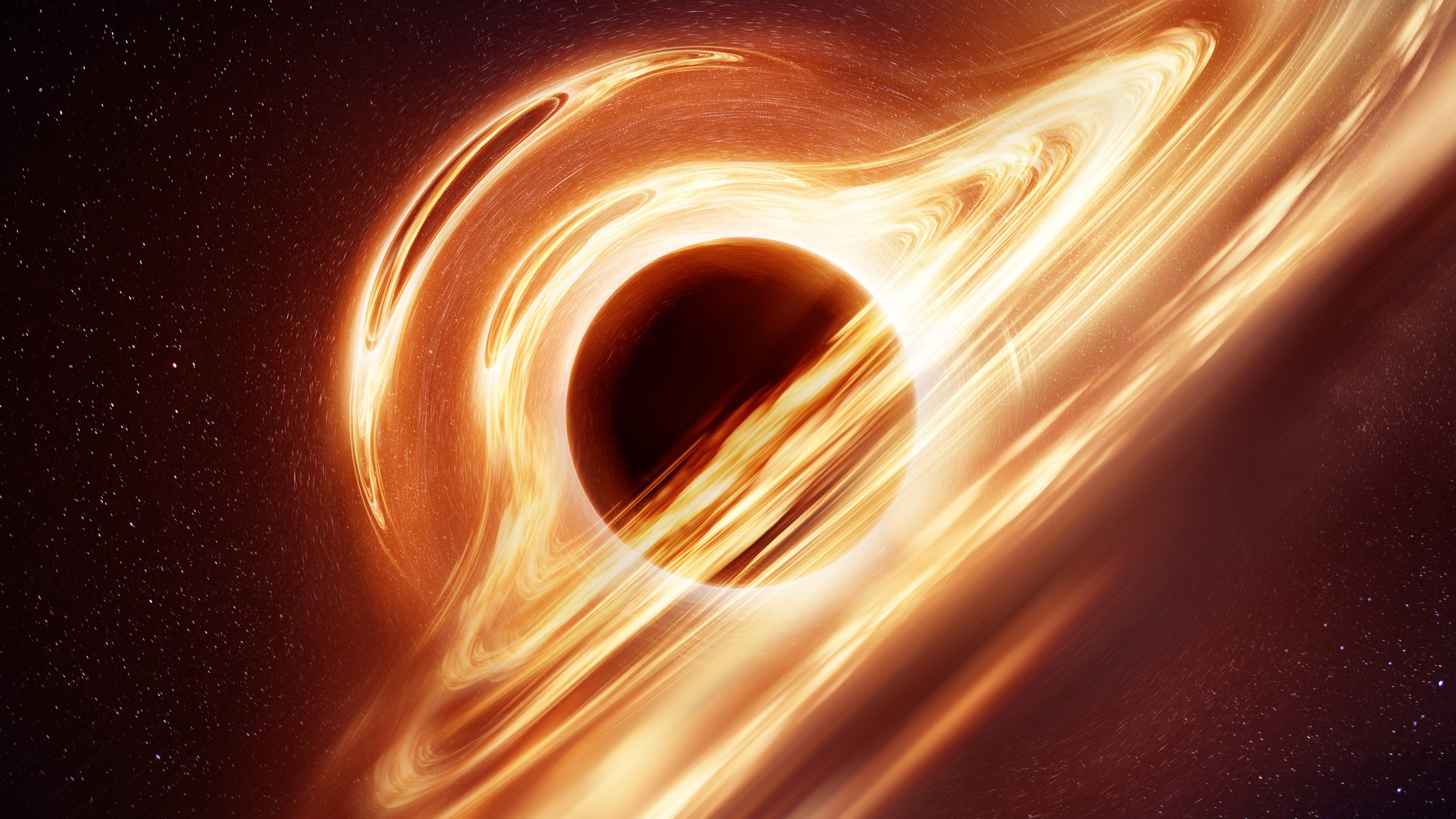
It is a region where gravity becomes so intense that nothing—not even light—can escape once it crosses a certain boundary.
That boundary is called the event horizon.
Beyond it lies one of the most mysterious regions in the universe.
And according to general relativity, at the very center lies a singularity.
What Exactly Is a Singularity?
In simple terms, a singularity is a point where certain physical quantities become infinite.
Within black hole physics, the singularity is often described as a location where matter is compressed into zero volume while maintaining finite mass.
If finite mass occupies zero volume, density becomes infinite.
Gravity also becomes infinitely strong.
Curvature of spacetime becomes infinite as well.
These infinities create profound problems.
Physics relies on equations to describe reality.
When equations produce infinities, they often signal that something has gone wrong.
It does not necessarily mean nature contains literal infinities.
Instead, it may indicate that the theory being used has reached its limits.
This is why singularities remain controversial.
They emerge naturally from Einstein’s equations.
Yet many physicists suspect that a more complete theory would eliminate these infinities and reveal what truly exists at the center of a black hole.
Why Infinite Density Is Difficult to Imagine
Human intuition struggles with the concept of infinite density.
Everything we encounter occupies space.
A grain of sand occupies space.
A mountain occupies space.
A star occupies space.
Even atoms, despite being incredibly small, occupy volume.
The idea that an entire star could collapse into a point with no size at all seems impossible.
Imagine compressing Earth into a smaller and smaller sphere.
Shrink it to the size of a city.
Then to the size of a house.
Then to the size of a marble.
Then smaller than a grain of dust.
Continue compressing forever.
Eventually, according to classical general relativity, the process leads to zero volume.
Yet all of Earth’s mass remains present.
The resulting density becomes infinite.
This outcome feels absurd because our everyday experiences provide no parallel.
Nevertheless, mathematics suggests such a result may occur under extreme gravitational collapse.
The Event Horizon and the Hidden Center
When discussing singularities, it is important to understand that they are hidden behind the event horizon.
The event horizon is not a physical surface.
It is a boundary in spacetime.
Once an object crosses it, escape becomes impossible.
Even light cannot return.
Because information cannot travel outward from within the event horizon, scientists cannot directly observe a singularity.
Everything we know about singularities comes from theoretical calculations.
This creates a unique challenge.
Normally, scientific theories can be tested through observation and experiment.
Singularities remain hidden from direct view.
As a result, researchers must rely heavily on mathematical reasoning and indirect evidence.
The center of a black hole is therefore one of the least accessible places in the universe.
How Einstein’s Equations Predict Singularities
One of the most remarkable aspects of singularities is that Einstein did not initially expect them.
When he developed general relativity in 1915, his goal was to describe gravity more accurately than Newton’s theory.
The equations proved extraordinarily successful.
They explained the orbit of Mercury.
They predicted gravitational lensing.
They forecast the existence of gravitational waves.
Yet these same equations contained surprising implications.
In 1916, Karl Schwarzschild found a solution describing a black hole.
At first, many scientists viewed such objects as mathematical curiosities rather than real astronomical entities.
As decades passed, however, evidence accumulated.
Theoretical work showed that under certain conditions gravitational collapse appeared unavoidable.
Even more surprisingly, the equations suggested that collapse continued all the way to a singularity.
The mathematics seemed clear.
The physical interpretation was far less certain.
The Singularity Theorems
During the 1960s, groundbreaking work by Roger Penrose and Stephen Hawking strengthened the case for singularities.
They developed what became known as the singularity theorems.
These theorems demonstrated that under broad and realistic conditions, general relativity predicts the formation of singularities.
The significance of this work cannot be overstated.
It showed that singularities were not rare mathematical accidents.
They appeared to be an inevitable consequence of gravitational collapse.
If general relativity remains valid under extreme conditions, singularities seem unavoidable.
This realization transformed singularities from speculative ideas into central problems in theoretical physics.
Are Singularities Real?
This question remains one of the greatest mysteries in science.
Mathematically, singularities emerge naturally from Einstein’s equations.
Physically, however, many researchers doubt that infinite density truly exists.
Nature often avoids infinities.
For example, early theories predicted infinite energies in certain situations, only for later discoveries to reveal deeper mechanisms preventing them.
Many physicists suspect the same may be true for black hole singularities.
The infinities may indicate that general relativity is incomplete rather than literally correct.
Just as Newton’s theory eventually gave way to Einstein’s, general relativity itself may eventually be replaced or expanded by a deeper framework.
In that future theory, the singularity might disappear and be replaced by something entirely different.
The Clash Between Relativity and Quantum Mechanics
The singularity problem highlights a major conflict in modern physics.
The two most successful theories ever developed are general relativity and quantum mechanics.
General relativity describes gravity and large-scale structures.
Quantum mechanics describes atoms, particles, and microscopic phenomena.
Both theories work extraordinarily well within their respective domains.
Yet they do not fit together smoothly.
Near a singularity, matter becomes incredibly compressed.
Both gravity and quantum effects become enormously important.
Unfortunately, the two theories make incompatible assumptions.
General relativity treats spacetime as smooth and continuous.
Quantum mechanics suggests that reality may be fundamentally granular and probabilistic.
At a singularity, both theories should apply simultaneously.
Yet current physics cannot fully combine them.
This conflict suggests that singularities may mark the boundary where a new theory becomes necessary.
The Search for Quantum Gravity
One of the biggest goals in modern physics is developing a theory of quantum gravity.
Such a theory would unify general relativity and quantum mechanics into a single framework.
Many researchers believe quantum gravity would resolve the singularity problem.
Instead of infinite density, a quantum theory might reveal a finite but extraordinarily dense state.
Several approaches have been proposed.
String theory suggests that fundamental particles are actually tiny vibrating strings.
Loop quantum gravity proposes that spacetime itself consists of discrete units.
Other models explore entirely different possibilities.
Although none has yet been confirmed experimentally, all share a common motivation: explaining what truly happens where classical physics predicts a singularity.
The Difference Between Mathematical and Physical Singularities
Not all singularities are created equal.
In mathematics, a singularity refers to a point where equations become undefined or infinite.
This does not automatically imply that physical reality contains an actual singularity.
A useful analogy comes from cartography.
Suppose a map shows the North Pole.
Certain coordinate systems become problematic there.
Lines of longitude converge, causing mathematical difficulties.
Yet the North Pole itself is perfectly real and well-behaved.
The problem lies in the coordinate system, not in nature.
Similarly, some physicists wonder whether black hole singularities reflect limitations in our mathematical descriptions rather than actual infinities in the universe.
Determining which interpretation is correct remains an active area of research.
What Would Happen Near a Singularity?
Because singularities are hidden behind event horizons, no one can observe them directly.
Nevertheless, theoretical calculations provide clues.
As an object approaches the center of a black hole, gravitational forces become increasingly extreme.
Differences in gravitational pull between different parts of the object grow larger and larger.
This phenomenon is known as tidal force.
Eventually, tidal forces become so strong that they stretch objects dramatically.
Scientists sometimes call this process “spaghettification.”
An astronaut falling toward a stellar-mass black hole would be stretched lengthwise and compressed sideways.
Closer to the singularity, the distortion would become catastrophic.
According to classical relativity, all matter would ultimately be crushed into the singularity itself.
Whether this description remains accurate under quantum gravity remains unknown.
Time Near a Black Hole
Black holes produce some of the most extraordinary effects on time.
General relativity predicts that time flows more slowly in stronger gravitational fields.
Near a black hole, this effect becomes dramatic.
To a distant observer, a clock near the event horizon appears to tick increasingly slowly.
An astronaut falling toward the black hole would experience time normally from their own perspective.
Yet observers far away would perceive the astronaut’s clock slowing dramatically.
Near the singularity, spacetime becomes so severely distorted that familiar notions of time may cease to apply.
Some equations suggest that all future paths lead inevitably toward the singularity.
In a sense, moving toward the singularity becomes as unavoidable as moving toward tomorrow.
These strange implications reveal how profoundly black holes challenge ordinary intuition.
Supermassive Black Holes and Their Singularities
Not all black holes are the same size.
Some form from collapsing stars.
Others contain millions or billions of times the Sun’s mass.
These enormous objects are known as supermassive black holes.
They reside at the centers of many galaxies, including our own.
At the heart of the Milky Way lies the supermassive black hole Sagittarius A*.
If general relativity is correct, supermassive black holes also contain singularities.
The key difference lies not in the singularity itself but in the surrounding spacetime.
A supermassive black hole has a much larger event horizon.
An astronaut crossing it might initially experience little discomfort.
The journey toward the center would take longer.
Eventually, however, the same fundamental mystery awaits.
What truly exists at the center?
No one knows.
Rotating Black Holes and Ring Singularities
Real black holes are expected to rotate.
Rotation changes the structure predicted by general relativity.
Instead of a point-like singularity, a rotating black hole may contain a ring-shaped singularity.
This solution, known as the Kerr black hole, introduces astonishing possibilities.
The mathematics suggests complicated spacetime structures with unusual properties.
Some interpretations even imply theoretical pathways to other regions of spacetime.
Most physicists remain skeptical of these more exotic possibilities because quantum effects are likely to alter the picture dramatically.
Nevertheless, rotating black holes demonstrate that singularities may be more complex than simple points.
The geometry of spacetime near extreme gravity remains one of the most fascinating topics in theoretical physics.
Singularities and the Beginning of the Universe
Black holes are not the only place where singularities appear.
The standard Big Bang model also leads to a singularity when extrapolated backward in time.
According to classical general relativity, the universe began from an infinitely dense state approximately 13.8 billion years ago.
This idea presents challenges similar to those found in black holes.
Infinite density appears once again.
Known physics breaks down.
Quantum effects become unavoidable.
Many researchers suspect that a future theory of quantum gravity will eliminate the Big Bang singularity just as it may eliminate black hole singularities.
If so, understanding one mystery may help solve the other.
The beginning of the universe and the centers of black holes could be deeply connected problems.
Hawking Radiation and the Fate of Black Holes
In the 1970s, Stephen Hawking made a remarkable discovery.
By combining ideas from quantum mechanics and general relativity, he showed that black holes are not entirely black.
They emit tiny amounts of radiation, now known as Hawking radiation.
Over immense timescales, this radiation causes black holes to lose mass.
Eventually, they may evaporate completely.
This raises profound questions.
What happens to the singularity if the black hole disappears?
What happens to the information that fell inside?
These puzzles remain unresolved.
The information paradox is one of the most famous problems in modern physics.
Its solution may ultimately reveal the true nature of singularities.
Why Singularities Fascinate Scientists
Singularities are not merely strange mathematical objects.
They represent the limits of human knowledge.
Every major advance in science has occurred when researchers confronted the boundaries of existing theories.
The orbit of Mercury helped reveal general relativity.
Atomic mysteries led to quantum mechanics.
Today, singularities occupy a similar position.
They signal that something important remains undiscovered.
They tell us that our understanding of space, time, matter, and gravity is incomplete.
For scientists, singularities are not dead ends.
They are signposts pointing toward deeper truths.
The Emotional Power of the Singularity
Beyond science, singularities possess a unique emotional impact.
They confront us with the immense scale and mystery of the universe.
Human beings evolved to navigate forests, rivers, and mountains.
Our intuition was never designed to comprehend infinite density or warped spacetime.
Yet our curiosity drives us to explore these ideas anyway.
There is something profoundly humbling about realizing that nature contains realms so extreme that our best theories struggle to describe them.
The singularity stands as a reminder that the universe remains far stranger than everyday experience suggests.
It invites awe, wonder, and a sense of mystery.
The Future of Singularity Research
The coming decades may transform our understanding of singularities.
New gravitational-wave observatories will provide unprecedented information about black holes.
Advanced telescopes will reveal their environments in greater detail.
Theoretical breakthroughs may lead to a successful theory of quantum gravity.
Future discoveries could show that singularities are real physical entities.
Alternatively, they may reveal entirely new structures replacing them.
Either outcome would revolutionize our understanding of reality.
The mystery remains open.
And that uncertainty is part of what makes the subject so compelling.
Conclusion
A singularity is the hypothetical region at the center of a black hole where matter is compressed to infinite density and spacetime curvature becomes infinite according to classical general relativity. It represents one of the most extreme predictions ever produced by science and marks the point where our current understanding of physics breaks down.
Although singularities emerge naturally from Einstein’s equations, many physicists believe they signal the need for a deeper theory that combines gravity and quantum mechanics. Hidden behind event horizons and inaccessible to direct observation, singularities remain among the greatest unsolved mysteries in the universe.
Far from being merely abstract mathematical curiosities, singularities lie at the crossroads of black hole physics, cosmology, quantum theory, and the search for a unified understanding of nature. They challenge our assumptions about space, time, matter, and reality itself.
Whether singularities truly exist or are placeholders for an even deeper truth, they continue to inspire some of humanity’s most ambitious scientific investigations. At the center of every black hole may lie not only a mystery of gravity, but a doorway to a new understanding of the cosmos.