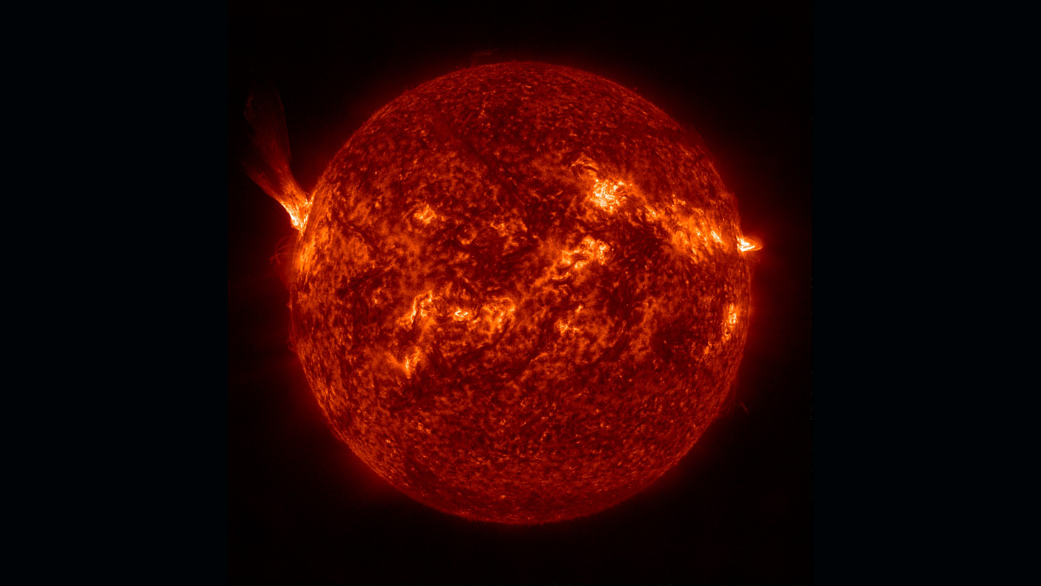
Every morning, the Sun rises without fail, filling the sky with light and warmth. It powers Earth’s climate, allows plants to grow, and makes life possible. But like every star in the universe, the Sun is not immortal. It was born, it is changing, and one day it will die.
This raises a fascinating question that has captured the imagination of countless people: Will the Sun eventually become a black hole?
Black holes are among the most mysterious objects in the universe. They are so dense that not even light can escape their gravity. Movies, books, and science fiction often portray stars collapsing into black holes, making it seem like every dying star meets the same dramatic fate.
The truth, however, is very different—and even more fascinating. The Sun’s future has been studied in remarkable detail, and scientists are confident that our star will never become a black hole.
The Short Answer
No. The Sun will not become a black hole.
Instead, billions of years from now, it will expand into a giant star called a red giant, shed its outer layers into space, and leave behind a small, extremely dense object known as a white dwarf.
A black hole requires far more mass than the Sun possesses. Simply put, our star is nowhere near massive enough to collapse into one.
Why Stars Don’t All Die the Same Way
Not all stars are created equal.
Some stars are only a fraction of the Sun’s mass, while others are hundreds of times more massive. Their mass determines almost everything about their lives, including how they shine, how long they live, and how they die.
Small stars burn their fuel slowly and can survive for trillions of years.
Stars like the Sun enjoy long, stable lives lasting about 10 billion years.
Extremely massive stars burn through their nuclear fuel much faster. Although they contain far more material, they often survive for only a few million years before ending in spectacular explosions.
Because the Sun belongs to the middle category, its destiny is completely different from that of the massive stars that create black holes.
How the Sun Shines
At the Sun’s core, temperatures reach about 15 million degrees Celsius (27 million degrees Fahrenheit).
Under these incredible conditions, hydrogen atoms collide with enough force to fuse together and form helium. This process, called nuclear fusion, releases enormous amounts of energy.
That energy slowly travels outward before finally escaping as sunlight.
Every second, the Sun converts roughly 600 million tons of hydrogen into helium, releasing energy that spreads throughout the Solar System.
This steady fusion has powered the Sun for about 4.6 billion years.
The Sun Is Already Middle-Aged
Although the Sun feels timeless from a human perspective, it is actually about halfway through its life.
Astronomers estimate that the Sun has enough hydrogen fuel to continue shining for roughly another 5 billion years.
During this time, it will gradually become slightly brighter.
In fact, scientists estimate that the Sun today is about 30% brighter than it was when life first appeared on Earth billions of years ago.
Its slow brightening will eventually make Earth too hot for oceans to survive long before the Sun itself reaches the end of its life.
What Happens When the Sun Runs Out of Hydrogen?
Eventually, the hydrogen in the Sun’s core will become depleted.
Without enough hydrogen fusion in the core, gravity will begin compressing the center.
As the core contracts, temperatures rise dramatically.
Ironically, this causes the outer layers of the Sun to expand enormously.
Instead of shrinking, the Sun will grow.
It will become a red giant.
The Red Giant Phase
During the red giant stage, the Sun will become vastly larger than it is today.
Its diameter could expand more than 200 times its current size.
Mercury will almost certainly disappear.
Venus is expected to be swallowed.
Earth’s ultimate fate is still an active area of research. Many models indicate our planet will likely be engulfed as the Sun expands, while others suggest changing orbital dynamics might temporarily move Earth outward before tidal interactions pull it inward. Regardless of the exact outcome, Earth will no longer be a habitable world.
The once-familiar Sun will appear as a gigantic reddish-orange star dominating the sky.
Its outer atmosphere will become much cooler than it is today, giving it its characteristic red color.
Why Doesn’t the Sun Collapse into a Black Hole?
To understand why, we need to understand what creates a black hole.
Gravity constantly tries to pull a star inward.
Nuclear fusion pushes outward.
During most of a star’s life, these two forces remain balanced.
When fusion ends, gravity wins.
But what happens next depends entirely on the star’s mass.
The Sun simply doesn’t have enough mass for gravity to crush it into a black hole.
Instead, another force comes to the rescue.
As the Sun’s core shrinks, electrons become packed incredibly tightly together.
Quantum mechanics predicts that electrons cannot all occupy the same quantum state. This creates a pressure called electron degeneracy pressure, which resists further compression.
This remarkable quantum effect stops the collapse.
The result is a white dwarf—not a black hole.
How Massive Must a Star Be to Become a Black Hole?
Stars that form black holes begin life much more massive than the Sun.
While the exact threshold depends on factors such as chemical composition and mass lost through stellar winds, stars born with roughly 20 or more times the Sun’s mass are among those that can ultimately leave behind black holes after their violent deaths.
These enormous stars live fast and die young.
After exhausting their nuclear fuel, they undergo catastrophic core collapse.
The outer layers explode in a supernova, one of the most energetic events in the universe.
If the remaining core is sufficiently massive, gravity overwhelms every known force.
The core continues collapsing until it forms a black hole.
The Sun will never experience this kind of explosion.
Could the Sun Ever Explode as a Supernova?
No.
The Sun is far too small.
Only much more massive stars undergo the type of core-collapse supernova that produces many black holes.
Instead, the Sun’s death will be comparatively gentle.
It will gradually lose its outer layers rather than exploding.
This process will unfold over hundreds of thousands of years.
The Beautiful Ending: A Planetary Nebula
As the Sun nears the end of the red giant phase, its outer gases will drift away into space.
Ultraviolet radiation from the hot core will illuminate these expanding clouds, creating glowing shells of colorful gas.
Astronomers call this a planetary nebula.
Despite the name, planetary nebulae have nothing to do with planets. Early astronomers gave them this name because they looked somewhat like small planets through old telescopes.
Planetary nebulae are among the most beautiful objects in the night sky.
Their glowing clouds enrich interstellar space with elements like carbon, nitrogen, and oxygen—materials that future generations of stars and planets can inherit.
The Sun’s Final Form
After the planetary nebula fades away, only the Sun’s core will remain.
This tiny object will become a white dwarf.
Although about the size of Earth, it will contain roughly half the Sun’s original mass.
A teaspoon of white dwarf material would weigh many tons on Earth because of its extraordinary density.
At first, the white dwarf will be incredibly hot, with surface temperatures exceeding 100,000 degrees Celsius.
However, it will no longer generate energy through fusion.
Instead, it will slowly cool over billions and eventually trillions of years.
Will the White Dwarf Become a Black Hole Later?
No.
Once a white dwarf forms, its fate is essentially sealed.
Without gaining additional mass from a nearby companion star, it cannot collapse further.
Over immense spans of time, it simply cools and becomes dimmer.
Far in the future, it is expected to become a theoretical object called a black dwarf—a cold, dark stellar remnant. However, the universe is currently only about 13.8 billion years old, which is far too young for any black dwarfs to exist yet. White dwarfs need much longer than the current age of the universe to cool that much.
Could the Sun Somehow Turn into a Black Hole?
Only under impossible circumstances.
The Sun would need to suddenly gain many times its current mass.
There is no known natural process capable of adding enough material to the Sun to make this happen.
Our Solar System simply does not contain nearly enough matter.
The Sun’s future is therefore one of the best-understood predictions in astronomy.
What Happens to the Solar System?
The inner Solar System will change dramatically.
Mercury and Venus are expected to disappear inside the expanding Sun.
Earth will almost certainly become a lifeless world long before then because increasing solar brightness will evaporate the oceans and destroy the conditions needed for life.
Mars may become temporarily warmer.
The giant planets—Jupiter, Saturn, Uranus, and Neptune—will survive, although their orbits will slowly expand as the Sun loses mass.
Many moons, asteroids, and comets will continue orbiting the white dwarf that remains.
The Solar System will become quieter, darker, and colder than it is today.
Why Black Holes Are So Different
Black holes represent one of gravity’s most extreme triumphs.
Their gravitational pull becomes so intense that the escape velocity exceeds the speed of light.
The boundary around a black hole is called the event horizon.
Once anything crosses this boundary, it cannot return.
White dwarfs are incredibly dense, but they are fundamentally different.
They have solid surfaces, emit light because they remain hot, and their gravity is strong but not overwhelming.
A spacecraft could, in principle, orbit a white dwarf safely.
Crossing an event horizon of a black hole is an entirely different experience.
What the Sun’s Future Teaches Us
The Sun’s story reminds us that the universe follows understandable physical laws.
A star’s mass largely determines its destiny.
Massive stars become neutron stars or black holes.
Medium-sized stars like our Sun become white dwarfs.
Small red dwarfs fade away over unimaginably long timescales.
Every star contributes to the cosmic cycle of creation by producing elements that later become new stars, planets, and perhaps even life.
A Gentle Ending for Our Star
The Sun will never become a black hole. Despite its immense size and power, it simply lacks the mass needed for such an extraordinary transformation.
Instead, its final journey will be quieter but no less magnificent. It will swell into a red giant, cast beautiful glowing clouds into space as a planetary nebula, and leave behind a brilliant white dwarf that slowly cools over billions of years.
Long after humanity is gone and Earth’s familiar landscapes have vanished, the tiny white dwarf that was once our Sun will continue drifting through the Milky Way—a silent reminder of the star that made life on our planet possible.