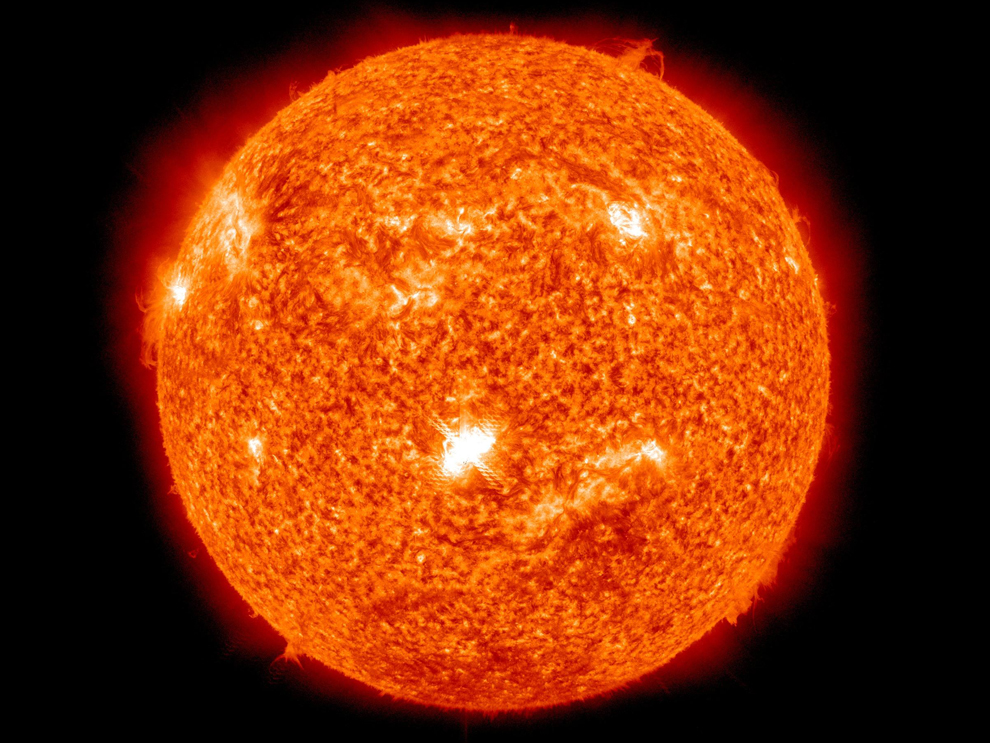
The Sun is so familiar that it’s easy to forget just how extraordinary it truly is. Every sunrise feels ordinary because it happens every day, yet the glowing star that illuminates our world is one of the most remarkable objects in the universe. Without it, Earth would be a frozen, lifeless rock drifting through space. Every breath you take, every plant that grows, every ocean current, and nearly every form of life ultimately depends on the immense energy produced deep inside the Sun.
Despite being studied for centuries, the Sun continues to surprise scientists. Powerful space telescopes, sophisticated satellites, and solar probes have revealed a star far more dynamic, violent, and fascinating than anyone once imagined. It constantly changes, unleashes enormous eruptions, bends space with its gravity, and shapes the entire solar system with its magnetic influence.
The following fifteen facts reveal why the Sun is not just another star—it is one of the greatest natural wonders humanity will ever know.
1. The Sun Contains More Than 99% of the Solar System’s Mass
When people picture the solar system, they often imagine a collection of planets orbiting a large star. But the true scale of the Sun’s dominance is astonishing.
The Sun contains about 99.86% of all the mass in the entire solar system. Everything else—every planet, moon, asteroid, comet, dwarf planet, and grain of cosmic dust—accounts for less than one-fifth of one percent.
Jupiter, the largest planet, contains most of the remaining planetary mass, yet it is still tiny compared to the Sun. Roughly 1,000 Jupiters would be needed to equal the Sun’s mass.
This overwhelming mass is why the Sun’s gravity controls the motions of all the planets. Every orbit, from Mercury to Neptune, is shaped by the Sun’s immense gravitational pull.
Without such a massive central star, the solar system as we know it simply could not exist.
2. The Sun Is Actually an Ordinary Star
Considering its importance to us, it’s tempting to think the Sun must be something exceptionally rare.
In reality, it isn’t.
The Sun is classified as a G-type main-sequence star, often called a “yellow dwarf.” Although the term “dwarf” may sound small, the Sun is anything but tiny. The classification simply distinguishes it from giant and supergiant stars.
Across the Milky Way, there are hundreds of billions of stars. Some are much smaller than the Sun, particularly red dwarfs, which are the most common type. Others are far larger, brighter, and more massive.
In terms of size, temperature, and luminosity, the Sun falls comfortably within the normal range for stars of its type.
Ironically, its ordinary nature is precisely what makes life on Earth possible. A much larger star would burn through its fuel rapidly, while a much smaller one might not provide the stable conditions necessary for complex life to evolve.
3. Every Second, the Sun Converts About 600 Million Tons of Hydrogen Into Helium
Deep within the Sun’s core lies one of nature’s greatest power plants.
The core reaches temperatures of approximately 15 million degrees Celsius (27 million degrees Fahrenheit). Under such enormous pressure and heat, hydrogen nuclei collide with enough force to overcome their natural electrical repulsion.
They fuse together.
This process, called nuclear fusion, transforms hydrogen into helium while releasing enormous amounts of energy.
Every single second, the Sun fuses roughly 600 million metric tons of hydrogen.
Not all of that mass remains.
About 4 million metric tons of matter disappear every second, converted directly into energy according to Albert Einstein’s famous equation:
E = mc²
This tiny fraction of lost mass generates the immense energy that powers the Sun.
That energy eventually escapes into space as light, heat, ultraviolet radiation, X-rays, and other forms of electromagnetic radiation.
4. Sunlight Takes About Eight Minutes to Reach Earth
When you look at the Sun, you’re actually seeing the past.
Light travels incredibly fast—about 299,792 kilometers (186,282 miles) per second—yet the distance between Earth and the Sun is so vast that sunlight still requires approximately 8 minutes and 20 seconds to arrive.
This means every sunrise is slightly delayed.
If the Sun somehow disappeared instantaneously—a purely hypothetical scenario—Earth would continue receiving sunlight for another eight minutes before darkness arrived.
Likewise, the Sun’s gravitational influence would continue for the same amount of time because changes in gravity also propagate at the speed of light according to general relativity.
Every glance toward the Sun is literally a glimpse into the recent past.
5. The Energy Created in the Sun’s Core Takes Thousands to Hundreds of Thousands of Years to Reach the Surface
The eight-minute journey to Earth sounds fast.
But that’s only the final stage.
The energy produced through nuclear fusion begins deep within the Sun’s core. From there, it must work its way outward through incredibly dense layers of hot plasma.
Instead of traveling in a straight line, photons are constantly absorbed and re-emitted by particles inside the Sun.
This creates an extraordinarily slow “random walk.”
Scientists estimate that a photon may require anywhere from tens of thousands to hundreds of thousands of years—depending on the model used—to finally reach the Sun’s visible surface, known as the photosphere.
Only then does it begin the rapid eight-minute journey across space to Earth.
The sunlight warming your face today may have begun its journey before modern humans even existed.
6. The Sun Doesn’t Burn Like Fire
People often say the Sun is “burning.”
Scientifically, that description is incorrect.
Fire requires oxygen and chemical reactions.
Space contains almost no oxygen, and the Sun’s energy is not produced through combustion.
Instead, it shines because of nuclear fusion, an entirely different process.
Inside the core, hydrogen nuclei merge into helium, releasing energy because the combined helium nucleus has slightly less mass than the original hydrogen nuclei.
That missing mass becomes energy.
This distinction is important because nuclear fusion is vastly more efficient than ordinary chemical burning.
If the Sun relied on combustion instead of fusion, it would exhaust its fuel in only a few thousand years.
Fusion allows it to shine steadily for billions of years.
7. The Sun Is Constantly Losing Mass
Every second, part of the Sun literally disappears.
Most of this loss occurs because some mass is converted into energy during nuclear fusion.
Additionally, the Sun continuously releases charged particles into space through the solar wind.
Combined, these processes cause the Sun to lose about 4.3 million metric tons of mass every second.
That number sounds enormous.
Yet compared with the Sun’s total mass of approximately 2 × 10³⁰ kilograms, it is almost insignificant.
Even after billions of years, the Sun remains overwhelmingly massive.
8. The Sun Rotates—but Not Like a Solid Object
Unlike Earth, the Sun has no solid surface.
It consists almost entirely of hot plasma.
Because plasma behaves like a fluid, different parts of the Sun rotate at different speeds.
This phenomenon is known as differential rotation.
Near the equator, the Sun completes one rotation in about 25 Earth days.
Near the poles, rotation takes roughly 35 Earth days.
This uneven motion twists and stretches the Sun’s magnetic field over time.
Scientists believe differential rotation plays a major role in generating the Sun’s powerful magnetic activity, including sunspots, solar flares, and coronal mass ejections.
9. The Sun Has an Extremely Powerful Magnetic Field
The Sun is not simply a giant ball of glowing gas.
It is also an enormous magnetic machine.
Complex flows of electrically charged plasma generate powerful magnetic fields that constantly evolve.
Sometimes these magnetic fields become tangled and twisted.
When they suddenly reconnect, enormous amounts of energy are released.
This process produces spectacular events including:
- Solar flares
- Coronal mass ejections
- High-energy particle storms
These events can affect satellites, astronauts, radio communication, navigation systems, and even electrical power grids on Earth.
Modern space weather forecasting has become increasingly important because society now depends heavily on technologies vulnerable to solar activity.
10. Sunspots Are Cooler Than Their Surroundings
Sunspots appear dark.
Many people assume they are holes in the Sun.
They are not.
Sunspots are regions where intense magnetic fields reduce the upward flow of hot plasma.
As a result, they become cooler than surrounding areas.
Typical surface temperatures around the photosphere reach about 5,500°C (9,900°F).
Sunspots are often around 3,500–4,500°C (6,300–8,100°F).
Although they appear dark by comparison, they are still incredibly hot.
If a sunspot could somehow be placed alone in the night sky, it would shine brighter than the full Moon.
11. The Sun’s Atmosphere Is Hotter Than Its Surface
One of solar physics’ greatest mysteries involves temperature.
Normally, temperatures decrease farther from a heat source.
The Sun behaves differently.
Its visible surface—the photosphere—is approximately 5,500°C.
Above it lies the corona, the Sun’s outer atmosphere.
The corona reaches temperatures of over one million degrees Celsius.
Some regions become several million degrees.
Why should the atmosphere be hundreds of times hotter than the surface beneath it?
Scientists are still investigating this “coronal heating problem.”
Leading explanations involve magnetic waves and tiny magnetic reconnection events called nanoflares, but no single theory has completely solved the puzzle.
12. The Sun Has an Eleven-Year Activity Cycle
The Sun is not equally active all the time.
Instead, it follows an approximately 11-year solar cycle.
During solar minimum:
- Few sunspots appear.
- Solar flares are relatively rare.
- Magnetic activity decreases.
During solar maximum:
- Sunspots become numerous.
- Solar flares increase dramatically.
- Coronal mass ejections become more frequent.
- Auroras become more spectacular on Earth.
The magnetic polarity of the Sun actually reverses during each cycle.
After two eleven-year cycles, the magnetic field returns to its original orientation, creating a full magnetic cycle lasting about twenty-two years.
13. The Solar Wind Extends Far Beyond Pluto
The Sun constantly releases streams of charged particles known as the solar wind.
These particles flow outward in every direction, carrying the Sun’s magnetic field across the solar system.
The region dominated by the solar wind forms a giant bubble called the heliosphere.
This protective bubble extends well beyond Pluto.
Its outer boundary marks the point where the solar wind begins to give way to particles from interstellar space.
NASA’s Voyager 1 and Voyager 2 crossed this boundary, becoming the first human-made objects to directly explore interstellar space.
Even at those enormous distances, the Sun’s influence can still be detected.
14. The Sun Will Not Last Forever
Although the Sun appears permanent, stars have life cycles.
The Sun formed approximately 4.6 billion years ago from a collapsing cloud of gas and dust.
It is currently about halfway through its stable main-sequence lifetime.
Scientists estimate it has enough hydrogen fuel to continue shining for roughly another 5 billion years.
Eventually, the core will exhaust its hydrogen supply.
The Sun will then expand into a red giant, growing so large that it will likely engulf Mercury and Venus. Whether Earth survives physically remains uncertain, but it would certainly become completely uninhabitable long before then.
After shedding its outer layers, the Sun will leave behind a dense white dwarf surrounded by a glowing planetary nebula.
It will gradually cool over billions of years.
15. Nearly Every Living Thing on Earth Depends on the Sun
The most amazing fact about the Sun may also be the simplest.
Almost everything alive ultimately owes its existence to this star.
Plants capture sunlight through photosynthesis, converting solar energy into chemical energy.
Animals obtain that energy by eating plants or other animals.
The oxygen filling Earth’s atmosphere is continually replenished through photosynthesis powered by sunlight.
The Sun also drives:
- Earth’s climate
- Ocean circulation
- Weather systems
- The water cycle
- Seasonal changes
Even fossil fuels are ancient sunlight.
Coal, oil, and natural gas formed from organisms that originally captured solar energy millions of years ago.
Without the Sun, Earth’s average surface temperature would rapidly plunge far below freezing, photosynthesis would cease, ecosystems would collapse, and nearly all known forms of life would disappear.
In the deepest sense, every meal, every forest, every breath, and every heartbeat are connected to the energy continuously flowing from our nearest star.
Why Scientists Continue Studying the Sun
Although the Sun is the most closely observed star in the universe, it still holds countless mysteries.
Researchers continue investigating the origin of the solar magnetic field, the heating of the corona, the mechanisms behind solar eruptions, and the detailed physics of nuclear fusion. Spacecraft such as Parker Solar Probe and Solar Orbiter are flying closer to the Sun than any previous missions, collecting data that were unimaginable only a few decades ago.
Understanding the Sun is about far more than satisfying curiosity. Solar activity influences satellites, astronauts, communication networks, navigation systems, aviation, and electrical infrastructure. Accurate knowledge of our star helps scientists improve space weather forecasts and better protect the technologies on which modern civilization depends.
A Star That Makes Life Possible
The Sun is both ordinary and extraordinary. It is one of hundreds of billions of stars in the Milky Way, yet for Earth it is irreplaceable. Its gravity built the solar system, its light transformed a barren planet into a living world, and its energy continues to sustain every ecosystem on Earth.
Every sunrise is more than the beginning of another day. It is a reminder that, 150 million kilometers away, a vast sphere of glowing plasma has been steadily converting hydrogen into energy for billions of years. That continuous process has illuminated Earth’s oceans, forests, mountains, and skies since long before humans appeared—and if nature follows its course, it will continue to do so for billions of years to come.
The next time you feel sunlight on your skin, remember that you are experiencing the power of a star whose story stretches across cosmic time—a story that science continues to uncover, one remarkable discovery at a time.