Look up at the night sky, and most stars appear calm and eternal. They twinkle softly above us, giving the impression that they will remain unchanged for countless ages. In reality, every star is living a dramatic life. Stars are born, they grow, they age, and eventually they die. Some do so quietly, fading into darkness over billions of years. Others live fast, burn furiously, and end in spectacular explosions that can briefly outshine entire galaxies.
Among the most extreme stars in the universe are Wolf-Rayet stars.
These stellar giants are not ordinary stars. They are cosmic powerhouses pushing themselves to their physical limits. They shine with incredible brightness, generate fierce stellar winds, and lose enormous amounts of material into space. They live dangerous, unstable lives and race toward destruction far faster than most stars ever will.
Astronomers often describe Wolf-Rayet stars as some of the most evolved and violent stars known. They represent a brief but crucial stage in the life of the universe’s most massive stars. Although they are relatively rare, their influence extends far beyond their numbers. They help shape galaxies, enrich space with heavy elements, and often end their lives in some of the most powerful explosions ever witnessed.
In many ways, Wolf-Rayet stars are the cosmic equivalent of brilliant but short-lived giants—stars that burn with extraordinary intensity before disappearing forever.
The Discovery of Wolf-Rayet Stars
The story of Wolf-Rayet stars began in the nineteenth century.
In 1867, two French astronomers, Charles Wolf and Georges Rayet, were studying stellar spectra at the Paris Observatory. Spectroscopy was still a relatively new scientific technique. By spreading starlight into its component colors, astronomers could uncover clues about a star’s composition and physical properties.
Most stars displayed dark absorption lines in their spectra. These lines occur when certain wavelengths of light are absorbed by elements in a star’s atmosphere.
However, Wolf and Rayet discovered several stars that behaved differently.
Instead of showing dark absorption lines, these stars exhibited bright emission lines.
The observation was highly unusual.
At the time, nobody fully understood what these strange stars were. Yet it was clear they represented something fundamentally different from ordinary stars.
The stars eventually became known as Wolf-Rayet stars, honoring the astronomers who first recognized their unique nature.
More than a century later, scientists continue studying these remarkable objects because they reveal some of the most extreme processes occurring in stellar evolution.
What Exactly Is a Wolf-Rayet Star?
A Wolf-Rayet star is an extremely hot, massive, evolved star that has lost much of its outer hydrogen layer through powerful stellar winds.
To understand this definition, it helps to break it into pieces.
These stars begin life with enormous masses. Many start with more than twenty times the mass of the Sun, and some may exceed one hundred solar masses.
Massive stars burn their nuclear fuel much faster than smaller stars. While the Sun will survive for roughly ten billion years, very massive stars may live only a few million years.
That may sound like a long time, but on cosmic timescales it is remarkably brief.
As these stars age, they generate intense radiation. The outward pressure from this radiation becomes so powerful that it literally blows away the star’s outer layers.
Over time, much of the hydrogen-rich surface disappears.
The deeper layers become exposed.
Astronomers can then directly observe material that is normally hidden inside stars.
This is what makes Wolf-Rayet stars so extraordinary.
They allow us to glimpse the inner workings of stellar giants.
Why Wolf-Rayet Stars Are So Rare
Wolf-Rayet stars are among the rarest stars in the universe.
The main reason is simple: the Wolf-Rayet phase is very short.
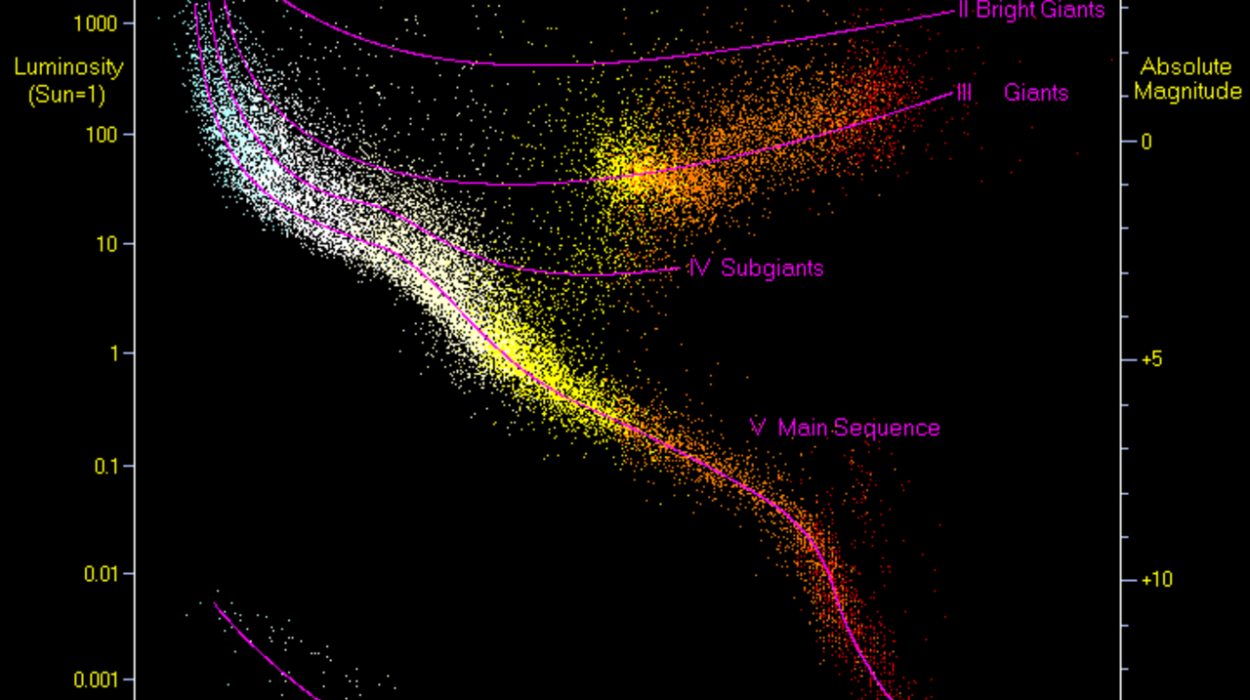
Stars spend most of their lives fusing hydrogen into helium in their cores. This stable period, known as the main sequence stage, lasts far longer than later phases of stellar evolution.
The Wolf-Rayet stage occurs near the end of a massive star’s life.
It is a transitional period lasting only a few hundred thousand years or perhaps a few million years in some cases.
Compared with the total lifetime of a star, this stage is remarkably brief.
Imagine taking a person’s entire life and compressing it into a single day. The Wolf-Rayet phase would occupy only a few minutes before death.
Because the stage is so short, astronomers observe relatively few Wolf-Rayet stars at any given time.
Even in a galaxy containing hundreds of billions of stars, only a tiny fraction qualify as Wolf-Rayet stars.
The Extreme Temperatures of Wolf-Rayet Stars
If the Sun feels hot from 150 million kilometers away, imagine standing near a Wolf-Rayet star.
Fortunately, that is impossible.
These stars are among the hottest known.
The Sun’s surface temperature is about 5,500 degrees Celsius.
Wolf-Rayet stars often exceed 30,000 degrees Celsius and may reach temperatures above 200,000 degrees Celsius in extreme cases.
At such temperatures, atoms become highly energized.
The intense heat strips electrons from atoms, creating ionized gases.
These conditions produce the unusual spectral signatures that first caught the attention of Wolf and Rayet in the nineteenth century.
The extraordinary temperatures also contribute to the immense luminosity of these stars.
They shine with incredible brilliance, often hundreds of thousands or even millions of times brighter than the Sun.
Stellar Winds Unlike Anything in the Solar System
One of the defining features of Wolf-Rayet stars is their powerful stellar winds.
The Sun continuously emits particles into space through the solar wind. Although this flow influences planets and creates phenomena such as auroras, it is relatively gentle by Wolf-Rayet standards.
Wolf-Rayet stars unleash winds of astonishing strength.
Material streams away from their surfaces at speeds reaching thousands of kilometers per second.
Every second, enormous quantities of matter are blasted into space.
Over time, these winds strip away entire layers of the star.
Imagine a hurricane so powerful that it gradually tears apart the object generating it.
That comparison still falls far short of the reality.
Wolf-Rayet stellar winds rank among the strongest known in astronomy.
They dramatically influence both the stars themselves and the surrounding interstellar environment.
Peering Into a Star’s Interior
Most stars hide their internal layers beneath thick hydrogen atmospheres.
Wolf-Rayet stars are different.
Their powerful winds remove much of this outer material.
As a result, astronomers can observe deeper regions that are normally concealed.
The exposed layers reveal products of nuclear fusion occurring within the star.
Depending on the evolutionary stage, scientists may detect large amounts of helium, carbon, nitrogen, or oxygen.
These elements were forged inside the star through nuclear reactions.
In a sense, Wolf-Rayet stars allow astronomers to look beneath the surface and witness stellar evolution in action.
Few other stars provide such direct access to their internal chemistry.
The Life of a Massive Star
To appreciate Wolf-Rayet stars, we need to understand how massive stars evolve.
A massive star begins life inside a giant cloud of gas and dust.
Gravity causes material to collapse inward.
As pressure and temperature increase, nuclear fusion begins.
The newborn star enters the main sequence stage.
During this period, hydrogen nuclei fuse into helium within the core.
For massive stars, this process occurs at an extraordinary rate.
The star shines intensely but consumes fuel rapidly.
Eventually, hydrogen in the core becomes depleted.
The star then begins fusing heavier elements.
Its structure changes dramatically.
The outer layers expand.
The core contracts.
Powerful radiation drives increasingly intense stellar winds.
At some point, the outer hydrogen envelope may be stripped away, exposing deeper layers.
The star enters the Wolf-Rayet phase.
It has reached one of the final chapters of its life story.
The Different Types of Wolf-Rayet Stars
Not all Wolf-Rayet stars are identical.
Astronomers classify them according to the elements visible in their spectra.
Some display strong nitrogen signatures.
Others reveal carbon-rich material.
Still others exhibit oxygen-rich compositions.
These differences reflect the star’s evolutionary stage.
As nuclear fusion progresses, different elements become dominant within the exposed layers.
A nitrogen-rich Wolf-Rayet star generally represents an earlier stage.
Carbon-rich stars often indicate more advanced evolution.
Oxygen-rich examples are among the most evolved and rarest.
These classifications provide valuable clues about what is happening deep inside the star.
Each spectral type tells part of the story of stellar aging.
Living Fast and Dying Young
Massive stars are often described as living fast and dying young.
Wolf-Rayet stars embody this principle perfectly.
The Sun carefully conserves its fuel and will survive for billions of years.
Wolf-Rayet stars behave differently.
Their immense masses create enormous pressures and temperatures in their cores.
Fusion reactions proceed at breathtaking rates.
The stars burn through fuel much faster than smaller stars.
Although they begin life with far more fuel than the Sun, they consume it so rapidly that their overall lifetimes are much shorter.
This imbalance creates a fascinating paradox.
The largest stars possess the greatest fuel reserves yet die the quickest.
Wolf-Rayet stars are among the clearest examples of this cosmic rule.
The Road to a Supernova
For most Wolf-Rayet stars, the final destination is a supernova.
As fusion continues, progressively heavier elements form in the core.
Helium becomes carbon.
Carbon becomes oxygen.
Additional reactions produce neon, magnesium, silicon, and eventually iron.
Iron creates a problem.
Fusion involving iron does not generate energy.
Instead, it consumes energy.
Once a massive iron core forms, the star loses its ability to support itself against gravity.
The core collapses.
In a fraction of a second, enormous forces trigger a catastrophic explosion.
The resulting supernova can briefly outshine billions of stars.
The Wolf-Rayet star is destroyed.
Yet its death creates opportunities for new beginnings throughout the galaxy.
Birthplaces of Heavy Elements
Everything around us contains elements forged inside stars.
The carbon in our bodies.
The oxygen we breathe.
The calcium in our bones.
The iron in our blood.
Much of this material originated within ancient stars that died long before the Sun formed.
Wolf-Rayet stars play an important role in this cosmic recycling process.
Their stellar winds continuously eject enriched material into space.
When they eventually explode as supernovae, even more elements are released.
These elements become part of interstellar clouds.
Future generations of stars, planets, and potentially living organisms form from this enriched material.
In a very real sense, Wolf-Rayet stars help build the chemical foundations of life.
Creating Cosmic Bubbles
The intense winds produced by Wolf-Rayet stars dramatically affect their surroundings.
As material rushes outward, it collides with surrounding gas.
These interactions carve enormous cavities into the interstellar medium.
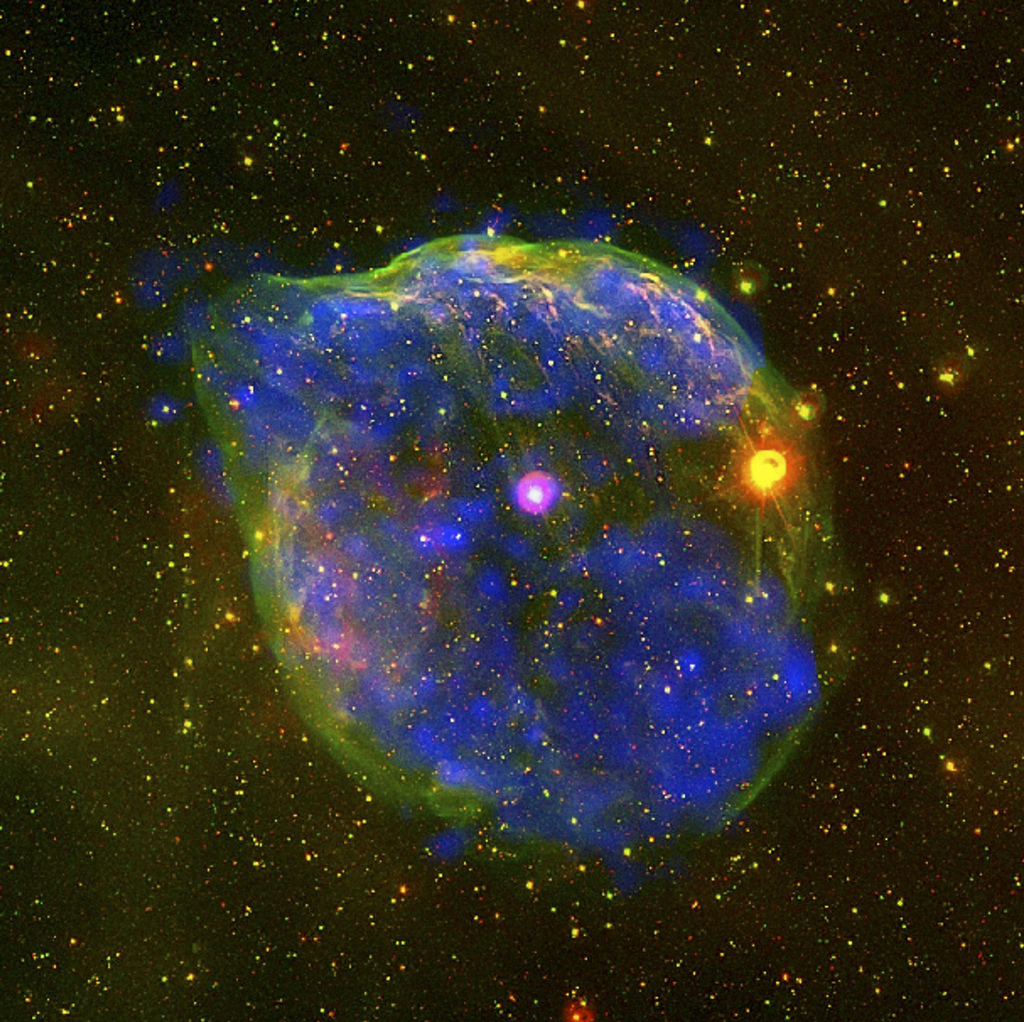
Astronomers often observe vast bubble-like structures surrounding Wolf-Rayet stars.
These cosmic bubbles can span dozens or even hundreds of light-years.
Their glowing shells reveal the immense power of stellar winds.
Inside these regions, gas becomes compressed and heated.
Such processes may trigger the formation of new stars.
Thus, a Wolf-Rayet star can influence stellar birth even as it approaches its own death.
Wolf-Rayet Stars and Gamma-Ray Bursts
Some Wolf-Rayet stars may produce one of the most powerful phenomena in the universe: gamma-ray bursts.
Gamma-ray bursts release staggering amounts of energy.
In just seconds, a single burst may emit more energy than the Sun will produce during its entire lifetime.
Astronomers believe certain long-duration gamma-ray bursts occur when rapidly rotating Wolf-Rayet stars collapse.
As the core implodes, powerful jets of matter and radiation shoot outward at nearly the speed of light.
If one of these jets points toward Earth, telescopes detect an intense flash of gamma rays.
These events rank among the most energetic explosions ever observed.
Famous Wolf-Rayet Stars
Several Wolf-Rayet stars have become famous among astronomers.
One remarkable example is WR 124.
This star is surrounded by a spectacular nebula created by material ejected through stellar winds.
Images from modern space telescopes reveal intricate clouds glowing around the star like a cosmic firework frozen in time.
Another famous object is Gamma Velorum, one of the closest known Wolf-Rayet systems to Earth.
Because of its relative proximity, it provides scientists with valuable opportunities to study these stars in detail.
Each Wolf-Rayet star offers unique insights into stellar evolution and the physics of extreme environments.
Binary Companions and Stellar Interactions
Many Wolf-Rayet stars do not live alone.
They belong to binary systems containing two stars orbiting a common center.
These stellar partnerships can dramatically influence evolution.
Material may flow from one star to another.
Gravitational interactions can strip away outer layers.
Some stars become Wolf-Rayet objects primarily because a companion star removes their hydrogen envelope.
In such cases, binary interactions help create conditions that would not arise through stellar winds alone.
Studying these systems reveals that stellar evolution is often more complex than the life story of a single isolated star.
Dust Factories in Space
Despite their intense radiation, some Wolf-Rayet stars surprisingly help create dust.
This might seem contradictory.
Extreme heat usually destroys dust particles.
Yet in certain binary systems, colliding stellar winds generate conditions that allow dust formation.
Astronomers have observed beautiful spiral patterns of dust around some Wolf-Rayet binaries.
These structures resemble giant cosmic pinwheels.
As the stars orbit each other, newly formed dust streams outward in graceful spirals.
Such observations demonstrate how even the most violent stellar environments can give rise to unexpected beauty.
Observing Wolf-Rayet Stars
Studying Wolf-Rayet stars requires sophisticated instruments.
Many emit strongly in ultraviolet wavelengths that Earth’s atmosphere absorbs.
Space-based observatories provide crucial observations.
Infrared telescopes reveal surrounding dust.
X-ray observatories detect high-energy interactions within stellar winds.
Spectroscopy remains one of the most important tools.
By analyzing light from these stars, astronomers can determine temperatures, compositions, wind speeds, and evolutionary stages.
Each spectrum acts like a fingerprint, revealing details hidden within the star’s brilliant glow.
Wolf-Rayet Stars in Other Galaxies
Wolf-Rayet stars are not confined to the Milky Way.
Astronomers have identified them in many other galaxies.
Studying these distant populations helps scientists understand how environmental conditions influence stellar evolution.
Different galaxies contain varying amounts of heavy elements.
These differences affect stellar winds and mass loss rates.
As a result, Wolf-Rayet stars may evolve somewhat differently depending on where they form.
By comparing stars across multiple galaxies, researchers gain a broader understanding of how the universe creates and transforms massive stars.
The Connection to Black Holes
Many Wolf-Rayet stars are destined to leave behind black holes.
After a supernova explosion, the remaining core may be so massive that gravity overwhelms all other forces.
The core collapses into an object so dense that not even light can escape.
A black hole is born.
Thus, some of the black holes detected today may be the remnants of ancient Wolf-Rayet stars.
This connection links these luminous giants to some of the darkest objects in existence.
Their brilliant lives eventually give way to invisible gravitational monsters.
What Wolf-Rayet Stars Teach Us
Wolf-Rayet stars serve as natural laboratories for studying extreme physics.
They allow scientists to investigate powerful stellar winds, nuclear fusion, supernova precursors, gamma-ray bursts, and black hole formation.
They reveal how massive stars lose material.
They show how elements are distributed throughout galaxies.
They help explain the origins of cosmic dust and the evolution of stellar populations.
Without Wolf-Rayet stars, our understanding of the universe would be far less complete.
Although rare, their influence reaches across enormous distances and spans billions of years of cosmic history.
The Emotional Story of a Wolf-Rayet Star
There is something deeply moving about the life of a Wolf-Rayet star.
These stars are born with tremendous potential.
They shine brighter than almost anything around them.
They dominate their surroundings with extraordinary energy.
Yet their brilliance comes at a price.
They consume themselves rapidly.
Every moment of their existence brings them closer to destruction.
Unlike smaller stars that enjoy long, stable lives, Wolf-Rayet stars race toward their fate.
Their lives are short, intense, and unforgettable.
In their final moments, they often transform the surrounding universe, scattering the ingredients needed for future generations of stars and planets.
Their deaths become acts of creation.
The story is both tragic and beautiful.
The Future of Wolf-Rayet Research
Modern astronomy continues uncovering new mysteries surrounding Wolf-Rayet stars.
Powerful observatories such as the James Webb Space Telescope are providing unprecedented views of stellar environments.
Researchers are refining models of stellar winds, supernova explosions, and black hole formation.
Questions remain.
Exactly how do the most massive stars evolve?
Which Wolf-Rayet stars produce gamma-ray bursts?
How much material do they eject during their lifetimes?
What determines whether a collapsing core becomes a neutron star or a black hole?
Future discoveries will help answer these questions and reveal even more about these extraordinary stars.
Conclusion
Wolf-Rayet stars are among the most remarkable objects in the universe. Born as extremely massive stars, they enter a rare and short-lived phase during which powerful stellar winds strip away their outer layers, exposing their hot, fusion-powered interiors. These stars shine with immense brightness, generate some of the strongest stellar winds known, and lose mass at extraordinary rates.
Though rare, Wolf-Rayet stars play an outsized role in cosmic evolution. They enrich space with heavy elements, shape surrounding nebulae, trigger star formation, and often end their lives as spectacular supernovae. Some may even produce gamma-ray bursts or leave behind black holes.
Their story is one of intensity. They live fast, burn fiercely, and die young. Yet in doing so, they help create the materials that build future stars, planets, and perhaps life itself. Far from being mere astronomical curiosities, Wolf-Rayet stars are among the universe’s greatest engines of transformation—rare giants whose brief but powerful lives leave permanent marks on the cosmos.