On a clear night, when we look up at the stars, the universe appears clean and empty. The blackness between the stars seems like a vast vacuum containing almost nothing at all. Galaxies shine like distant islands of light, nebulae glow with vibrant colors, and planets travel silently around their stars.
Yet hidden within that darkness is something surprisingly important.
Tiny particles drift through space in enormous numbers. Individually, they are so small that they seem insignificant. Many are smaller than grains of smoke. Some are thinner than a human hair by hundreds of times. If you could hold a single particle in your hand, it would appear almost meaningless.
But together, these microscopic particles have helped shape the universe.
They have influenced the birth of stars, the formation of planets, and perhaps even the emergence of life itself. Without them, the Solar System might never have formed. Earth might not exist. The atoms that make up our bodies might never have assembled into the world we know today.
These particles are known as cosmic dust.
Despite its humble name, cosmic dust is one of the most important substances in astronomy. It is not simply debris floating aimlessly through space. It is a fundamental ingredient in the ongoing story of cosmic creation.
In many ways, cosmic dust is the universe’s construction material—a raw ingredient from which worlds are built.
Understanding Cosmic Dust
When people hear the word “dust,” they often think of the gray particles collecting on shelves, furniture, or forgotten corners of a room.
Cosmic dust is very different.
It consists of tiny solid particles that exist throughout space. These particles are usually composed of elements such as carbon, silicon, oxygen, iron, magnesium, and other materials created inside stars.
Most cosmic dust grains are incredibly small. Many are only a fraction of a micrometer across. A micrometer is one-millionth of a meter.
To appreciate how tiny this is, consider that a typical human hair is roughly fifty to one hundred micrometers wide. Many cosmic dust particles are far smaller.
Yet despite their size, these particles collectively have enormous influence.
They shape galaxies, affect the light we see from distant stars, participate in chemical reactions, and serve as the seeds from which planets eventually emerge.
Why Cosmic Dust Matters
At first glance, dust seems unimportant.
When compared with stars, black holes, galaxies, and planets, dust hardly sounds exciting.
But astronomy has repeatedly shown that small things can have enormous consequences.
Cosmic dust influences how stars form.
It helps cool clouds of gas.
It contributes to the creation of molecules.
It participates in the formation of planets, moons, asteroids, and comets.
It alters the appearance of galaxies.
It even preserves clues about events that occurred billions of years ago.
Astronomers often describe cosmic dust as a key ingredient in the universe’s recycling system.
Stars create many of the elements that become dust.
When stars die, they release those materials into space.
The dust then becomes part of new stars and planets.
The cycle continues across cosmic time.
The Origins of Cosmic Dust
Cosmic dust does not simply appear from nowhere.
Like nearly everything in the universe, it has a history.
Most cosmic dust originates in stars.
Stars are giant nuclear furnaces where lighter elements fuse into heavier ones. Over millions or billions of years, stars manufacture many of the elements found throughout the universe.
When certain stars approach the ends of their lives, they begin releasing material into space.
Some stars gently shed their outer layers.
Others die in spectacular explosions known as supernovae.
Both processes inject enormous quantities of gas and dust into the surrounding environment.
Within these expanding clouds, atoms cool and combine to form tiny solid particles.
These particles become cosmic dust grains.
In a very real sense, cosmic dust is stardust.
The calcium in your bones, the iron in your blood, and the carbon in your cells were once forged inside ancient stars. Many of those same stellar processes also created the dust that helped form Earth itself.
Dust from Dying Stars
Some of the most important dust producers are aging stars.
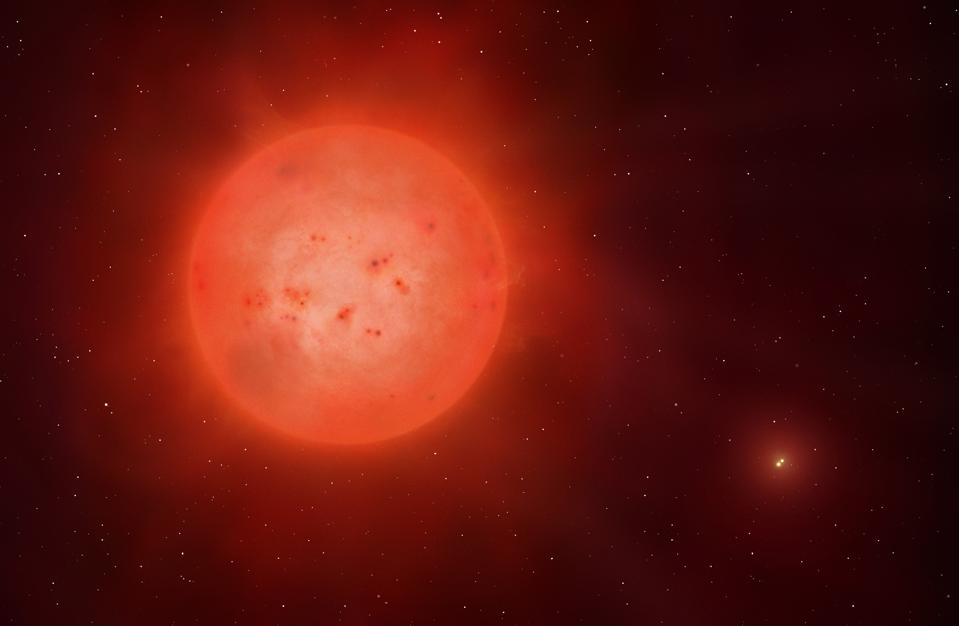
As stars similar to the Sun approach the final stages of their evolution, they expand into red giants.
These swollen stars lose material through powerful stellar winds.
Atoms flowing away from the star gradually cool.
As temperatures drop, atoms begin sticking together.
Tiny particles form.
Over time, enormous amounts of dust accumulate around the star.
Astronomers have observed thick shells of dust surrounding many dying stars.
These dusty envelopes eventually disperse into interstellar space, enriching the galaxy with fresh material.
The death of one generation of stars helps create the raw ingredients for future generations.
Supernova Explosions and Dust Creation
Some stars experience far more dramatic endings.
Massive stars eventually exhaust their nuclear fuel and collapse under their own gravity.
The resulting explosion, known as a supernova, can briefly outshine entire galaxies.
These events release vast quantities of matter into space.
Supernovae are among the most powerful explosions in the universe.
For years, scientists debated whether such violent events could create significant amounts of dust.
Modern observations have provided a clear answer.
The answer is yes.
Astronomers have discovered large amounts of newly formed dust inside supernova remnants.
These explosions not only distribute elements throughout galaxies but also help create the dust that future stars and planets will inherit.
Dust in the Space Between Stars
The space separating stars is not truly empty.
Instead, it contains a mixture of gas and dust known as the interstellar medium.
This material fills the gaps between stellar systems.
Although the interstellar medium is extraordinarily thin compared to Earth’s atmosphere, it contains enough matter to influence galactic evolution.
Dust particles drift through these regions alongside hydrogen gas, helium, and other elements.
Over time, gravity can cause parts of the interstellar medium to gather into dense clouds.
These clouds become some of the most important structures in astronomy.
They are the birthplaces of stars.
Without interstellar dust, the process of star formation would be dramatically different.
The Role of Dust in Star Formation
Stars are born inside enormous clouds of gas and dust called molecular clouds.
These clouds can span dozens or even hundreds of light-years.
At first, gravity slowly pulls material together.
As the cloud contracts, its density increases.
However, star formation faces an important challenge.
As gas compresses, it heats up.
Hot gas resists further collapse.
This is where dust becomes essential.
Dust grains help radiate heat away from the cloud.
By allowing energy to escape, dust enables the cloud to continue collapsing.
Eventually, dense regions form.
These regions become protostars—the earliest stages of stellar development.
Without dust helping to cool these clouds, many stars might never form.
The next time you look at a star in the night sky, remember that cosmic dust likely played a crucial role in its birth.
How Dust Helps Build Planets
Perhaps the most remarkable role of cosmic dust is its involvement in planet formation.
Every planet begins as dust.
When a new star forms, leftover gas and dust often remain in a rotating disk surrounding the young star.
Astronomers call this structure a protoplanetary disk.
Within the disk, tiny dust grains collide.
Some collisions break particles apart.
Others allow particles to stick together.
Gradually, dust grains become larger.
They grow from microscopic particles into pebbles.
Pebbles become rocks.
Rocks become planetesimals.
Planetesimals merge into protoplanets.
Eventually, full-sized planets emerge.
This process requires millions of years.
The Earth itself began as countless tiny dust grains orbiting the young Sun more than 4.5 billion years ago.
Every mountain, ocean, forest, and living creature on our planet can trace its origins back to cosmic dust.
The Dusty Birth of Earth
Imagine traveling back in time to the earliest days of the Solar System.
There would be no Earth.
No Moon.
No oceans.
No life.
Instead, a young Sun would sit at the center of a vast disk filled with swirling gas and dust.
Within that disk, countless particles collided and merged.
Tiny grains stuck together through electrostatic forces.
Gravity gradually took over as larger bodies formed.
The process was chaotic.
Collisions were common.
Some objects shattered.
Others grew.
Over millions of years, one growing world eventually became Earth.
Every rock beneath our feet began as dust floating through space.
In that sense, our planet is a monument built from ancient cosmic particles.
Cosmic Dust and the Birth of Life
The connection between cosmic dust and life may run even deeper.
Dust grains provide surfaces where chemical reactions can occur.
Inside cold interstellar clouds, atoms and molecules collect on dust particles.
These surfaces allow increasingly complex molecules to form.
Astronomers have detected water, alcohols, and various organic compounds in dusty regions of space.
Some of these molecules are considered important ingredients for life.
Although scientists do not yet fully understand how life originated, many researchers believe cosmic dust may have played an important role.
By helping create complex chemistry long before planets formed, dust may have contributed to the conditions necessary for life to emerge.
In this way, cosmic dust could represent one of the earliest chapters in the story of biology.
Why Dust Makes Nebulae Beautiful
Many of the most stunning images in astronomy feature enormous clouds known as nebulae.
Their vibrant colors and intricate shapes captivate people around the world.
Dust is often responsible for much of their beauty.
In some nebulae, dust blocks light from stars behind it, creating dark silhouettes against glowing backgrounds.
These structures are known as dark nebulae.
In other cases, dust reflects starlight.
These are called reflection nebulae.
Dust can also interact with energetic radiation, contributing to the glowing appearance of emission nebulae.
The spectacular cosmic landscapes photographed by modern telescopes often owe their appearance to vast quantities of dust suspended in space.
Dark Nebulae: Shadows in the Cosmos
Some dust clouds are so dense that they block visible light almost completely.
Against a rich background of stars, these clouds appear as dark patches.
At first glance, they may seem like holes in space.
In reality, they are enormous concentrations of dust and gas.
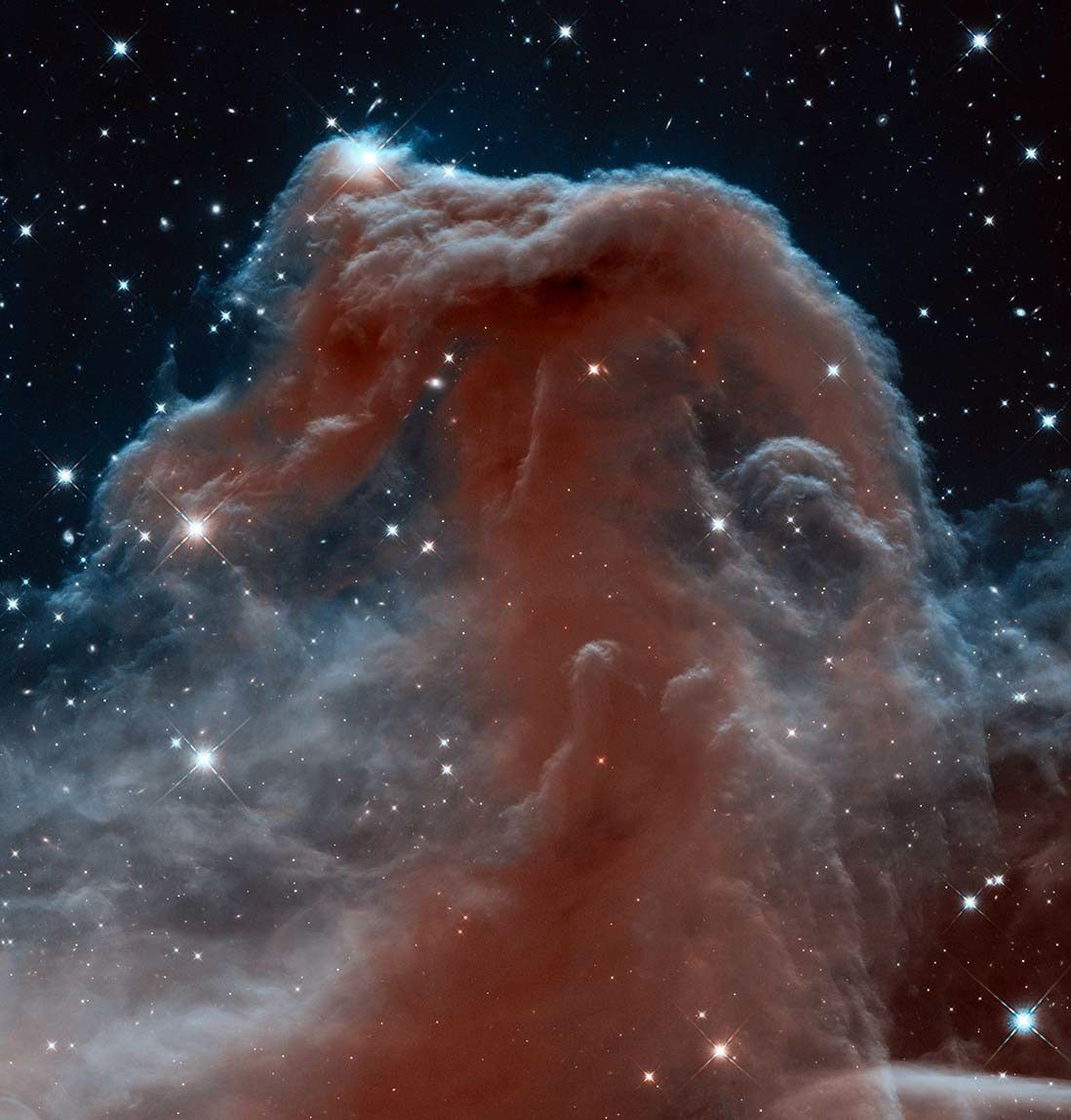
One famous example is the Horsehead Nebula.
Its distinctive shape resembles a horse’s head rising from a glowing cloud.
What appears dark is actually dust obscuring the bright material behind it.
These dark nebulae often contain regions where new stars are forming.
The darkness hides creation in progress.
Reflection Nebulae and Scattered Starlight
Not all dust blocks light.
Some dust reflects it.
When starlight encounters certain dust clouds, shorter wavelengths of light scatter more efficiently than longer wavelengths.
As a result, these clouds often appear blue.
This effect is similar to why Earth’s sky appears blue.
Reflection nebulae reveal the presence of dust through scattered starlight.
They create some of the most delicate and beautiful scenes in astronomy, glowing softly against the darkness of space.
Dust and the Colors of Galaxies
Cosmic dust affects how galaxies appear to observers.
Dust absorbs and scatters light.
As light travels through dusty regions, shorter wavelengths are removed more effectively than longer wavelengths.
This process causes objects to appear redder than they actually are.
Astronomers call this effect interstellar reddening.
Understanding dust is therefore essential for accurate observations.
Without accounting for dust, scientists could misjudge a star’s brightness, distance, temperature, or composition.
In some cases, dust hides entire regions of galaxies from view.
Infrared telescopes allow astronomers to see through much of this obscuring material.
These observations often reveal hidden structures invisible in ordinary light.
The Milky Way’s Dust Lanes
Our own galaxy contains enormous quantities of cosmic dust.
The Milky Way’s spiral arms are filled with clouds of gas and dust.
From Earth, some of these clouds appear as dark bands stretching across the sky.
These dust lanes block light from stars behind them.
They create dramatic patterns visible in photographs of the Milky Way.
Although dust can frustrate astronomers by obscuring objects, it also reveals where star formation is occurring.
Many of the galaxy’s most active stellar nurseries are located within dusty regions.
Seeing the Invisible with Infrared Light
One challenge of studying dust is that it often hides important objects.
Fortunately, dust behaves differently at infrared wavelengths.
Visible light may be blocked, but infrared radiation can often pass through.
This capability revolutionized astronomy.
Infrared telescopes can peer inside dusty clouds and observe young stars still embedded within their birth environments.
The powerful James Webb Space Telescope has provided extraordinary views of dusty cosmic regions.
By observing infrared light, it reveals structures previously hidden from human eyes.
Entire populations of stars have been discovered behind curtains of dust.
Cosmic Dust Is Not Uniform
Not all dust grains are identical.
They vary in size, composition, shape, and origin.
Some consist primarily of silicates, materials related to rock and sand.
Others contain large amounts of carbon.
Some grains are coated with icy layers of water, ammonia, methane, or carbon dioxide.
The exact composition depends on the environment in which the dust formed.
Studying these differences helps astronomers reconstruct the histories of stars, nebulae, and planetary systems.
Each grain carries information about the conditions that produced it.
In a sense, cosmic dust serves as a microscopic archive of cosmic history.
Dust in Comets and Asteroids
Much of the original dust from the Solar System still exists today.
Comets and certain asteroids preserve ancient material dating back billions of years.
These objects act as cosmic time capsules.
When scientists analyze samples from comets or asteroids, they gain insights into conditions present during the Solar System’s formation.
Space missions have collected and studied such material directly.
The results show remarkable similarities between modern cosmic dust and the ingredients believed to have existed when planets first formed.
These findings strengthen our understanding of planetary origins.
Dust Falling on Earth
Cosmic dust is not confined to distant regions of space.
Earth constantly encounters it.
Every day, tons of microscopic extraterrestrial material enter our atmosphere.
Most particles are tiny.
They burn up harmlessly or drift slowly downward.
Some eventually settle on Earth’s surface.
A small amount of cosmic dust may even be resting on rooftops, sidewalks, oceans, and forests right now.
Although invisible to most people, these particles represent a direct connection between our world and the wider universe.
The cosmos literally leaves traces on Earth every day.
The Challenges of Studying Dust
Studying cosmic dust is surprisingly difficult.
Individual grains are extraordinarily small.
Many are located immense distances away.
Their effects are often indirect.
Astronomers frequently detect dust by observing how it alters light rather than seeing the grains themselves.
Advanced instruments are required to analyze dust properties.
Computer simulations help scientists understand how dust behaves under different conditions.
Laboratory experiments attempt to recreate environments found in space.
Despite these challenges, research continues revealing new details about dust and its role in cosmic evolution.
Dust and the Future of Astronomy
Cosmic dust remains one of the most active areas of astronomical research.
Scientists are investigating how dust forms around different types of stars.
They seek to understand how dust evolves over time.
Researchers study how dust contributes to planet formation and complex chemistry.
Future telescopes will provide even more detailed observations.
These instruments may reveal the earliest dust produced in the young universe.
They may uncover new insights into how galaxies evolved.
They may even help answer questions about the origins of life.
Every new discovery reinforces the importance of these tiny particles.
Why Cosmic Dust Is More Important Than It Appears
One of the most remarkable aspects of cosmic dust is the contrast between its size and its significance.
Each grain is microscopic.
Individually, they seem trivial.
Yet collectively, they influence some of the largest and most important processes in the universe.
They help stars form.
They help planets grow.
They support complex chemistry.
They shape galaxies.
They preserve records of cosmic history.
The universe repeatedly demonstrates that greatness often emerges from humble beginnings.
Cosmic dust is perhaps one of the clearest examples of that truth.
Conclusion
Cosmic dust is far more than simple debris drifting through space. These microscopic particles, forged largely in the deaths of stars and distributed throughout galaxies, serve as essential ingredients in the ongoing evolution of the cosmos. They help cool star-forming clouds, provide surfaces for chemical reactions, shape the appearance of nebulae and galaxies, and ultimately become the building blocks of planets, moons, asteroids, and comets.
The Earth itself began as countless grains of cosmic dust orbiting the young Sun. Every living thing on this planet is connected to those ancient particles through a chain of cosmic events stretching back billions of years. From the birth of stars to the emergence of planetary systems, dust participates in nearly every major stage of celestial evolution.
Though often overlooked because of its tiny size, cosmic dust is one of the most important substances in the universe. It links the life cycles of stars, the formation of worlds, and perhaps even the origins of life itself. In the grand story of the cosmos, these microscopic grains are not merely passengers drifting through space—they are among the primary architects of everything we see around us.