Black holes are among the most extraordinary objects ever discovered. They are places where gravity becomes so intense that nothing—not even light—can escape once it crosses a boundary known as the event horizon. For decades, black holes existed only as mathematical predictions derived from Albert Einstein’s theory of general relativity. Today, astronomers have observed thousands of them indirectly, captured the first images of their shadows, and measured their masses with remarkable precision.
Most black holes form when massive stars exhaust their nuclear fuel and collapse under their own gravity. These stellar-mass black holes typically contain a few to several dozen times the mass of our Sun. But nature has created something far more astonishing.
At the centers of most large galaxies lie supermassive black holes, containing millions or even billions of solar masses. A few have grown to truly unimaginable proportions. These cosmic giants outweigh entire clusters of stars and possess event horizons larger than the orbit of Pluto—or even larger than our entire Solar System.
How these monsters became so enormous remains one of the greatest mysteries in modern astrophysics. Did they grow gradually by swallowing gas and stars? Did they merge repeatedly with other black holes during galaxy collisions? Or were some already enormous shortly after the Big Bang?
Astronomers continue searching for answers using ground-based observatories, space telescopes, radio interferometers, and sophisticated computer simulations.
The following ten black holes rank among the biggest ever reliably measured or estimated. Their masses are so immense that they challenge our understanding of how black holes evolve and how galaxies themselves are built.
1. TON 618
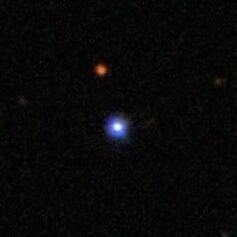
At the very top of the known cosmic giants stands the supermassive black hole powering the distant quasar TON 618.
Located more than 10 billion light-years from Earth, TON 618 shines so brilliantly that its host galaxy is almost impossible to observe directly. The enormous brightness comes from an accretion disk—a swirling disk of gas heated to millions of degrees as it spirals toward the black hole.
Astronomers estimate that TON 618 contains approximately 66 billion times the mass of the Sun.
This number is almost impossible to comprehend.
If our Sun were replaced by TON 618’s black hole, the entire Solar System would disappear deep inside its gravitational influence. The event horizon itself would extend far beyond the orbit of Neptune.
Scientists estimate its mass by analyzing the motion of gas within the quasar’s broad emission-line region. Faster-moving gas indicates stronger gravity, allowing astronomers to infer the black hole’s enormous mass.
TON 618 represents one of the largest reliably estimated black holes ever identified.
Its existence raises fundamental questions about cosmic history. Because we observe it as it existed billions of years ago, it had already become extraordinarily massive while the universe was still relatively young.
Understanding how such rapid growth occurred remains an active area of research.
2. Holmberg 15A*
At the center of the enormous elliptical galaxy Holmberg 15A lies another extraordinary gravitational giant.
This galaxy occupies the heart of the Abell 85 galaxy cluster, one of the most massive collections of galaxies in the nearby universe.
The central black hole is estimated to contain roughly 40 billion solar masses.
Unlike distant quasars, Holmberg 15A itself is relatively nearby on cosmological scales, allowing astronomers to study its host galaxy in greater detail.
Researchers determined the black hole’s mass by examining the motions of stars near the galactic center. These stellar orbits reveal the strength of the gravitational field surrounding the invisible object.
The galaxy itself possesses an unusually large central core where relatively few stars remain. Some astronomers believe this depleted region resulted from repeated mergers between giant galaxies, each bringing its own central black hole.
Such mergers may explain how Holmberg 15A* became one of the largest black holes known today.
3. IC 1101*
The giant elliptical galaxy IC 1101 is itself among the largest galaxies ever observed.
Stretching more than a million light-years across, it dwarfs our Milky Way in both size and stellar population.
Although the central black hole’s exact mass remains uncertain, estimates generally place it between 40 and 50 billion solar masses, making it one of the strongest candidates for inclusion among the most massive black holes known.
Astronomers continue refining these estimates because measuring black holes at such enormous distances remains challenging.
The galaxy’s exceptional size suggests an extensive history of mergers with other galaxies over billions of years.
Each merger may have contributed additional stars, gas, dark matter, and possibly another supermassive black hole.
If these black holes eventually merged, the central object would continue growing into one of the universe’s greatest gravitational giants.
4. S5 0014+81
Far beyond the Milky Way lies one of the brightest quasars ever discovered.
Known as S5 0014+81, this active galaxy hosts a black hole estimated at approximately 40 billion solar masses.
The quasar is so luminous that it emits thousands of times more energy than the entire Milky Way galaxy.
This incredible brightness comes not from the black hole itself but from matter falling inward.
As gas spirals toward the event horizon, gravitational energy converts into heat and radiation with remarkable efficiency.
The resulting accretion disk becomes one of the brightest objects in the universe.
Scientists continue debating whether the black hole’s estimated mass may be somewhat lower than early calculations suggested.
Nevertheless, even conservative estimates place it firmly among the largest black holes known.
5. H1821+643
Galaxy clusters often host enormous central galaxies, and these galaxies frequently contain equally enormous black holes.
The quasar H1821+643 contains one such monster.
Current estimates suggest a mass of approximately 30 billion Suns.
Unlike many quasars, H1821+643 sits within a massive galaxy cluster surrounded by extremely hot gas observable in X-rays.
The interaction between the black hole and this surrounding gas provides valuable insight into how supermassive black holes influence entire galaxy clusters.
Jets powered by the black hole inject enormous amounts of energy into the surrounding environment, affecting star formation across vast regions of space.
In this way, black holes do not merely consume matter.
They also regulate the evolution of galaxies on cosmic scales.
6. NGC 4889*
Within the Coma Cluster lies the enormous elliptical galaxy NGC 4889.
Its central black hole contains an estimated 21 billion solar masses.
This measurement emerged from careful observation of stellar motions near the galaxy’s center.
Interestingly, the black hole appears surprisingly quiet.
Unlike bright quasars actively consuming large amounts of gas, NGC 4889’s black hole currently accretes relatively little material.
This demonstrates an important fact about supermassive black holes.
Size alone does not determine brightness.
Some of the largest black holes in the universe remain comparatively inactive because little matter currently falls into them.
7. APM 08279+5255
One of the most fascinating giant black holes powers the quasar APM 08279+5255.
This distant object is also gravitationally lensed, meaning its light has been magnified by massive galaxies lying between it and Earth.
Current estimates place the black hole’s mass at roughly 23 billion solar masses, although uncertainties remain because gravitational lensing complicates precise measurement.
The quasar’s spectrum reveals enormous quantities of gas flowing outward at tremendous speeds.
These powerful outflows likely influence star formation within the host galaxy by removing gas that would otherwise collapse into new stars.
Modern astrophysics increasingly recognizes that black holes and galaxies evolve together rather than independently.
8. Phoenix A*
At the center of the Phoenix Cluster, one of the most massive galaxy clusters known, lies another enormous supermassive black hole.
Astronomers estimate its mass to be around 20 billion times that of the Sun.
The surrounding galaxy cluster contains vast quantities of extremely hot gas observed by X-ray telescopes.
Normally this gas would cool rapidly and produce enormous numbers of new stars.
Instead, energy released by the central black hole reheats much of the gas, slowing star formation dramatically.
This process, known as active galactic nucleus feedback, has become one of the central concepts in modern galaxy evolution.
Without these giant black holes regulating gas flow, many massive galaxies might appear very different from those observed today.
9. Messier 87*
Among all giant black holes, none is more famous than Messier 87*, often abbreviated M87*.
Located about 55 million light-years away, this supermassive black hole became the first ever directly imaged.
In 2019, the Event Horizon Telescope collaboration released the historic image showing a bright ring surrounding a dark central shadow.
This shadow represents the region where light disappears into the event horizon.
M87* contains approximately 6.5 billion solar masses.
Although several other black holes are considerably larger, M87* occupies a special place in scientific history because it provided humanity’s first direct visual evidence of a black hole’s immediate environment.
Its enormous jet extends thousands of light-years into intergalactic space.
The jet forms as magnetic fields channel particles outward at nearly the speed of light.
Understanding exactly how black holes launch such jets remains an important research question.
10. Sagittarius A*
Compared with the other giants on this list, the Milky Way’s central black hole appears almost modest.
Known as Sagittarius A*, it contains about 4.3 million solar masses.
Yet its importance far exceeds its ranking.
Because it lies only about 26,000 light-years away, astronomers can observe individual stars orbiting extremely close to it.
For decades, scientists carefully tracked these stellar motions.
Their observations provided compelling evidence that a compact object containing millions of solar masses occupied the galactic center.
This work earned the 2020 Nobel Prize in Physics for pioneering studies of black holes.
In 2022, the Event Horizon Telescope released humanity’s first image of Sagittarius A*, revealing another bright ring surrounding a central shadow.
Although far smaller than giants like TON 618, Sagittarius A* offers scientists their best opportunity to study supermassive black holes in extraordinary detail.
How Do Black Holes Become So Massive?
The existence of black holes containing tens of billions of solar masses presents one of astrophysics’ greatest challenges.
Scientists believe several processes contribute to their growth.
Gas falling into a black hole provides one mechanism. As galaxies contain abundant gas during their early history, central black holes may experience rapid accretion, growing millions of times larger over billions of years.
Galaxy mergers provide another pathway.
When two galaxies collide, their central black holes eventually spiral together through gravitational interactions.
After millions of years, they merge into a single larger black hole.
Repeated mergers over cosmic history could gradually produce the enormous masses observed today.
Some researchers also investigate the possibility that the first black hole “seeds” formed much larger than previously believed, allowing them to reach gigantic sizes surprisingly early in cosmic history.
Exactly which process dominates remains uncertain.
The answer likely involves all three mechanisms working together.
Measuring the Invisible
One might wonder how scientists can measure something that emits no light.
Astronomers use several complementary techniques.
In nearby galaxies, they observe the motions of stars orbiting the galactic center. Faster stellar motion indicates stronger gravity and therefore a more massive central object.
In active galaxies and quasars, researchers examine rapidly moving gas surrounding the black hole.
The speed of this gas reveals the gravitational pull responsible for its motion.
In rare cases, astronomers can directly image the black hole’s shadow using networks of radio telescopes spread across Earth, as demonstrated by the Event Horizon Telescope.
Each method carries uncertainties, but together they provide increasingly reliable estimates of black hole masses.
Why Giant Black Holes Matter
Supermassive black holes are no longer viewed as passive objects sitting quietly inside galaxies.
Modern astronomy shows that they profoundly influence galaxy evolution.
As matter falls inward, enormous amounts of energy are released.
This energy powers radiation, winds, and jets capable of heating or expelling gas across entire galaxies.
By regulating gas availability, black holes help determine when galaxies form stars and when star formation ends.
The largest black holes therefore shape not only their immediate surroundings but the long-term evolution of some of the universe’s biggest structures.
The Search Continues
Astronomers expect even larger black holes may still await discovery.
Future observatories, including more powerful space telescopes, next-generation radio arrays, and gravitational-wave detectors, will extend our ability to detect and measure supermassive black holes across cosmic history.
Some theoretical models even suggest that black holes exceeding 100 billion solar masses could exist under exceptional circumstances, although none has yet been confirmed.
Every new observation helps scientists understand how these extraordinary objects formed, evolved, and interacted with the galaxies around them.
The biggest black holes are more than astronomical curiosities. They are fundamental components of the universe itself—silent gravitational titans that have shaped galaxies for billions of years. Though invisible, their influence stretches across immense distances, reminding us that some of the most powerful forces in nature can never be seen directly, only understood through the light and motion of everything around them.