On a clear night, the stars scattered across the sky seem countless. Yet every star visible to the naked eye belongs to just one galaxy—our home, the Milky Way. Beyond its spiral arms lie hundreds of billions of other galaxies, each containing millions to trillions of stars, enormous clouds of gas and dust, mysterious dark matter, and often a supermassive black hole at its center.
For centuries, galaxies appeared as faint smudges through telescopes. Today, thanks to observatories such as the Hubble Space Telescope, the James Webb Space Telescope, and powerful ground-based observatories, astronomers have captured breathtaking images that reveal galaxies in astonishing detail. Delicate spiral arms, glowing stellar nurseries, immense dust lanes, cosmic collisions, and brilliant star clusters transform these distant systems into some of the most beautiful objects ever photographed.
Beauty, however, is only part of their story. Every galaxy records billions of years of cosmic evolution. Their shapes reveal the influence of gravity, dark matter, star formation, and interactions with neighboring galaxies. Some are peaceful stellar cities. Others are locked in violent mergers that reshape their structures over hundreds of millions of years.
The following fifteen galaxies are among the most spectacular ever photographed. Each is visually stunning, scientifically fascinating, and uniquely important in helping astronomers understand the universe.
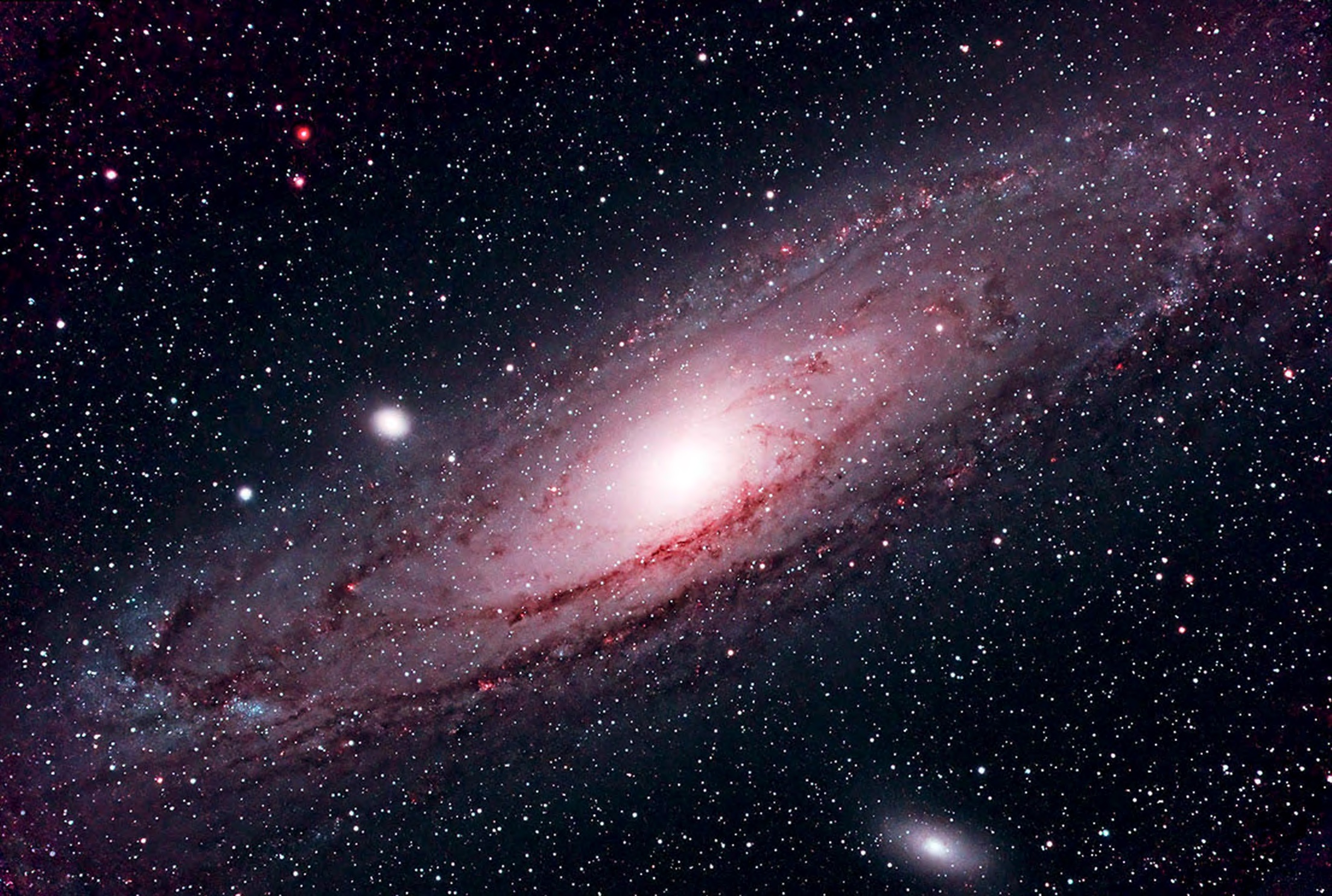
1. The Andromeda Galaxy (Messier 31)
The Andromeda Galaxy is the largest galaxy in the Local Group and the nearest giant spiral galaxy to the Milky Way. Located approximately 2.5 million light-years from Earth, it is also the most distant object that many people can see without optical aid under dark skies.
Photographs reveal an immense spiral disk stretching more than 220,000 light-years across, making it considerably larger than our own galaxy. Its graceful spiral arms are filled with blue star clusters, glowing pink regions where new stars are forming, and dark lanes of interstellar dust that wind toward its bright central bulge.
Modern observations have revealed that Andromeda contains roughly one trillion stars, significantly more than the Milky Way. At its center lies a supermassive black hole with a mass estimated to be around 100 million times that of the Sun.
One of the most fascinating aspects of Andromeda is its future relationship with our own galaxy. Precise measurements show that the Milky Way and Andromeda are moving toward one another at roughly 110 kilometers per second. In about 4 to 5 billion years, the two galaxies are expected to begin merging in a slow gravitational dance that will eventually create a much larger elliptical or lenticular galaxy.
Every detailed photograph of Andromeda offers a glimpse not only of a neighboring galaxy but also of the distant future of our cosmic home.
2. The Whirlpool Galaxy (Messier 51)
The Whirlpool Galaxy is often considered the textbook example of a grand-design spiral galaxy.
Located about 31 million light-years away, it displays two remarkably symmetrical spiral arms that wrap elegantly around a luminous central core. Bright blue star clusters outline the spiral pattern, while intricate dust lanes weave dark ribbons through the glowing disk.
One reason the Whirlpool Galaxy appears so spectacular is its ongoing interaction with a smaller companion galaxy. Gravitational forces generated during repeated close encounters compress enormous clouds of gas, triggering intense episodes of star formation throughout the spiral arms.
The Hubble Space Telescope has photographed this galaxy in extraordinary detail, revealing individual star clusters, delicate dust structures, and glowing hydrogen clouds where massive young stars illuminate surrounding gas.
The Whirlpool Galaxy demonstrates how gravity acts as both a destructive and creative force, reshaping galaxies while simultaneously stimulating the birth of countless new stars.
3. The Sombrero Galaxy (Messier 104)
Few galaxies possess a more distinctive appearance than the Sombrero Galaxy.
Viewed nearly edge-on, it resembles the broad-brimmed Mexican hat from which it takes its popular name. A brilliant central bulge shines above and below an exceptionally dark dust lane that cuts dramatically across the galaxy’s disk.
Located approximately 31 million light-years away, the Sombrero Galaxy contains hundreds of billions of stars and hosts an enormous supermassive black hole estimated to have a mass of roughly one billion Suns.
Its unusually large central bulge has long intrigued astronomers. Some evidence suggests the galaxy may have experienced significant mergers during its history, helping build its prominent spherical component.
High-resolution images reveal thousands of ancient globular clusters surrounding the galaxy like a vast halo of stellar jewels.
The contrast between its brilliant nucleus and razor-sharp dust lane makes the Sombrero Galaxy one of the most recognizable objects in the universe.
4. The Pinwheel Galaxy (Messier 101)
The Pinwheel Galaxy is among the largest spiral galaxies known in the nearby universe.
Stretching approximately 170,000 light-years across, it exceeds the diameter of the Milky Way and displays magnificent spiral arms filled with giant regions of star formation.
Unlike many spiral galaxies, the Pinwheel Galaxy possesses relatively small central bulge, allowing its intricate spiral structure to dominate photographs.
Its enormous arms contain numerous bright hydrogen clouds, where ultraviolet radiation from newly formed stars excites surrounding gas into vivid emission.
The galaxy has also hosted several observed supernovae during the past century, making it an important laboratory for studying stellar explosions and galactic evolution.
Every detailed image of the Pinwheel Galaxy reveals the remarkable complexity of star birth on a galactic scale.
5. The Cartwheel Galaxy
The Cartwheel Galaxy looks unlike almost any other galaxy ever photographed.
Its appearance resembles a giant wagon wheel suspended in space.
Astronomers believe this unusual structure formed when a smaller galaxy passed directly through the center of a much larger spiral galaxy hundreds of millions of years ago.
The collision generated powerful density waves that expanded outward like ripples on a pond after a stone is thrown into water.
These waves compressed interstellar gas, triggering intense star formation around the expanding outer ring.
Photographs from Hubble and James Webb reveal brilliant blue stars outlining the expanding ring while older yellow stars remain concentrated nearer the center.
The Cartwheel Galaxy beautifully illustrates how even catastrophic collisions can produce extraordinary cosmic beauty.
6. The Black Eye Galaxy (Messier 64)
The Black Eye Galaxy owes its memorable nickname to a dramatic dark dust band surrounding its bright nucleus.
This striking feature resembles a black eye beneath a glowing face.
The dust absorbs visible light from stars behind it, creating one of the most recognizable appearances among nearby galaxies.
Even more fascinating, astronomers have discovered that gas in the galaxy’s outer regions rotates in the opposite direction from gas nearer the center.
This unusual motion likely resulted from the long-ago merger with a smaller companion galaxy.
The Black Eye Galaxy reminds us that beautiful structures often preserve evidence of ancient cosmic encounters.
7. The Sunflower Galaxy (Messier 63)
The Sunflower Galaxy displays countless short spiral segments radiating outward from its center, giving it the appearance of a giant sunflower.
Located roughly 27 million light-years away, it belongs to a class known as flocculent spiral galaxies.
Unlike grand-design spirals with two clearly defined arms, flocculent galaxies contain numerous fragmented spiral features produced by localized star formation.
Photographs reveal rich yellow central regions surrounded by blue stellar populations and intricate dust lanes.
The galaxy demonstrates that spiral structure can emerge through multiple physical processes, not solely through large-scale density waves.
8. Centaurus A
The Centaurus A is one of the strangest galaxies in the nearby universe.
At first glance, it appears to consist of a giant elliptical galaxy sliced across its middle by an immense dark band of dust.
This dramatic appearance reflects a violent past.
Astronomers believe Centaurus A formed after a large elliptical galaxy merged with a spiral galaxy.
Its central supermassive black hole actively consumes surrounding material, producing enormous jets of energetic particles extending hundreds of thousands of light-years into space.
Photographs across visible light, radio waves, infrared, and X-rays reveal entirely different aspects of this remarkable galaxy.
Centaurus A combines elegance, violence, and extraordinary scientific importance within a single object.
9. The Antennae Galaxies
The Antennae Galaxies are not one galaxy but two spiral galaxies caught in the process of merging.
Long tidal tails stretching outward resemble the antennae of an insect, giving the system its familiar name.
The collision has compressed enormous gas clouds, producing one of the most spectacular starburst regions in the nearby universe.
Thousands of massive young star clusters appear throughout the interacting galaxies.
Eventually, the two spirals will merge completely into a much larger elliptical galaxy.
The Antennae provide astronomers with a preview of what may eventually happen when the Milky Way collides with Andromeda.
10. The Cigar Galaxy (Messier 82)
The Messier 82 is famous for its extraordinary rate of star formation.
Its elongated appearance gives it the nickname “Cigar Galaxy.”
Gravitational interactions with the neighboring Bode’s Galaxy triggered an enormous burst of star formation that continues today.
Powerful stellar winds and supernova explosions drive vast streams of gas outward from the galaxy’s center.
These spectacular outflows are visible in photographs as glowing red filaments extending thousands of light-years above and below the disk.
The Cigar Galaxy demonstrates how rapidly galaxies can transform under the influence of gravitational encounters.
11. The Sculptor Galaxy (NGC 253)
The Sculptor Galaxy is among the brightest spiral galaxies visible from the Southern Hemisphere.
Viewed at a moderate angle, it reveals magnificent dust lanes, countless young stars, and extensive regions of active star formation.
Infrared observations penetrate the dust, revealing hidden stellar nurseries that optical telescopes cannot easily detect.
The Sculptor Galaxy serves as one of astronomy’s most important laboratories for understanding starburst activity in relatively nearby galaxies.
12. The Needle Galaxy (NGC 4565)
The Needle Galaxy presents one of the finest edge-on views of a spiral galaxy.
Its thin disk stretches across space like a luminous blade.
A dark dust lane bisects the galaxy with astonishing precision, while its central bulge rises prominently above the flattened disk.
Because of its orientation, astronomers can study the vertical structure of spiral galaxies in exceptional detail.
The Needle Galaxy offers one of the clearest demonstrations that spiral galaxies are remarkably thin compared with their enormous diameters.
13. Bode’s Galaxy (Messier 81)
The Messier 81 is another magnificent grand-design spiral.
Its beautifully defined arms contain countless young stars, while its luminous central bulge dominates the galaxy’s appearance.
Located only about 12 million light-years away, it is one of the closest large spiral galaxies beyond the Local Group.
Interactions with neighboring galaxies have subtly influenced its structure, helping astronomers study the long-term effects of galactic gravity.
14. The Tadpole Galaxy
The Tadpole Galaxy possesses one of the longest tidal tails ever observed.
Stretching hundreds of thousands of light-years into space, this immense stream of stars formed after a close encounter with another galaxy.
The interaction triggered widespread star formation throughout the system.
The resulting appearance resembles a giant cosmic tadpole swimming through intergalactic space.
Its extraordinary tail illustrates the tremendous power of gravitational forces acting over enormous distances.
15. The Southern Pinwheel Galaxy (Messier 83)
The Messier 83 is among the brightest and most photogenic spiral galaxies visible from Earth.
Its tightly wound spiral arms glow with clusters of hot blue stars, pink hydrogen clouds, and dark dust lanes.
Astronomers have observed numerous supernovae within this galaxy, providing valuable opportunities to study stellar evolution and the life cycles of massive stars.
High-resolution photographs reveal remarkable complexity, from tiny star clusters to enormous molecular clouds where future generations of stars are still forming.
The Southern Pinwheel Galaxy beautifully illustrates the ongoing cycle of stellar birth, evolution, and death that shapes galaxies throughout cosmic history.
Why Galaxies Are So Beautiful
The breathtaking appearance of galaxies is not accidental. Their beauty emerges naturally from physical processes operating over billions of years.
Gravity gathers stars into rotating disks, spiral arms, and elliptical structures. Giant molecular clouds collapse to form brilliant young stars whose intense radiation illuminates surrounding hydrogen gas. Dust absorbs and scatters light, creating dramatic dark lanes that contrast with glowing stellar populations.
Collisions between galaxies stretch stars into graceful tidal streams while compressing gas into spectacular starburst regions. Supermassive black holes influence galactic centers, sometimes producing enormous jets visible across multiple wavelengths.
Even the colors seen in astronomical photographs tell scientific stories. Blue regions indicate young, massive stars. Yellow and red regions generally contain older stellar populations. Pink emission clouds mark active star formation, while dark bands reveal dense concentrations of interstellar dust.
Modern observatories often combine images taken through different filters or wavelengths—including visible light, infrared, ultraviolet, radio, and X-rays—to reveal structures invisible to the human eye. These scientifically processed images preserve real astronomical data while allowing us to appreciate the extraordinary complexity of the universe.
The Cosmic Cities of the Universe
Every galaxy is a vast cosmic city, home to billions or even trillions of stars, countless planets, immense nebulae, and mysterious dark matter halos that extend far beyond what telescopes can directly observe.
Some galaxies have lived relatively peaceful lives for billions of years. Others have been reshaped repeatedly by collisions and mergers. Some continue producing stars at astonishing rates, while others have nearly exhausted the gas needed for future star formation.
Yet despite their differences, they all share a common origin in the evolution of the universe after the Big Bang nearly 13.8 billion years ago.
When we admire photographs of these galaxies, we are not simply looking at beautiful images. We are looking across millions—or even hundreds of millions—of years of time. Their light began its journey long before human civilization existed, traveling unimaginable distances before finally reaching our telescopes.
Each photograph is therefore both a portrait and a time machine, preserving ancient moments in the life of the cosmos.
These magnificent galaxies remind us that beauty exists on every scale of nature—from the symmetry of a snowflake to the graceful sweep of spiral arms stretching hundreds of thousands of light-years across space. Together they reveal a universe that is not only governed by the elegant laws of physics but also filled with scenes of astonishing grandeur, inviting us to continue exploring the endless wonders beyond our own Milky Way.