Imagine a place where gravity becomes so powerful that nothing—not planets, not stars, not light itself—can escape. A place where time slows almost to a halt, where space is stretched beyond imagination, and where the known laws of physics are pushed to their limits. It sounds like science fiction, yet it is one of the most extraordinary realities in our universe.
Black holes are among the most fascinating discoveries in modern astronomy. For decades, they existed only as mathematical predictions. Today, astronomers have observed their effects on nearby stars, detected the ripples they create in space-time, photographed the glowing material surrounding them, and even recorded the echoes of colossal black hole collisions through gravitational waves.
Far from being simple “cosmic vacuum cleaners,” black holes are incredibly complex objects that challenge our understanding of gravity, quantum mechanics, and the very nature of reality. They are laboratories where the universe performs experiments impossible to recreate on Earth.
The more scientists study black holes, the stranger they become.
Here are fifteen scientifically accurate facts that reveal why black holes are among the most mind-blowing objects in the cosmos.
1. Black Holes Are Not Actually Holes
Despite their name, black holes are not empty holes or tunnels in space.
A black hole is an incredibly compact object containing an enormous amount of mass compressed into a very small region. Its gravity becomes so strong that there exists a boundary called the event horizon. Once anything crosses this boundary, escape becomes impossible because the required escape velocity exceeds the speed of light.
The word “hole” can therefore be misleading. Black holes are more accurately described as regions of space where gravity has become overwhelmingly intense.
Their interiors remain one of the greatest mysteries in physics because current theories cannot fully describe conditions beyond the event horizon.
2. Even Light Cannot Escape
Light travels at approximately 299,792 kilometers per second (186,282 miles per second), the fastest speed allowed by the laws of physics.
Yet inside the event horizon of a black hole, even light cannot escape.
This is not because black holes “pull” harder than light can move. Rather, the geometry of space-time becomes so severely curved that every possible path leads inward.
If light itself cannot escape, the black hole appears completely dark against the surrounding universe.
Ironically, astronomers often detect black holes not by observing the black hole itself, but by studying the intensely bright material orbiting just outside the event horizon.
3. Black Holes Can Be Tiny—or Larger Than Entire Solar Systems
Black holes come in a remarkable range of sizes.
Some stellar-mass black holes contain only a few times the mass of our Sun. They form when massive stars exhaust their nuclear fuel and collapse under their own gravity.
Intermediate-mass black holes appear to occupy the range between hundreds and hundreds of thousands of solar masses, although they remain relatively rare and difficult to study.
At the opposite extreme are supermassive black holes.
These cosmic giants contain millions—or even billions—of times the Sun’s mass. Their event horizons can be larger than the orbit of Pluto.
The largest known supermassive black holes are so enormous that multiple solar systems could fit comfortably inside their event horizons.
4. Nearly Every Large Galaxy Appears to Have a Supermassive Black Hole
One of the greatest discoveries in modern astronomy is that supermassive black holes are surprisingly common.
At the center of nearly every large galaxy studied, astronomers have found evidence for one.
Our own galaxy, the Milky Way, contains a supermassive black hole called Sagittarius A*.
Although it contains roughly four million times the Sun’s mass, it occupies a surprisingly compact region.
Scientists believe these enormous black holes play important roles in galaxy evolution, influencing star formation and the distribution of gas over vast distances.
5. Falling Into a Black Hole Would Stretch You Like Spaghetti
One of the strangest predicted effects near certain black holes is known as spaghettification.
Gravity weakens with distance.
Near a black hole, however, gravity changes so rapidly over short distances that your feet could experience significantly stronger gravity than your head.
This difference is called a tidal force.
As a result, an object falling toward a sufficiently small black hole would be stretched lengthwise while simultaneously compressed sideways.
The effect becomes so extreme that the object would eventually be torn apart atom by atom.
Fortunately—or unfortunately, depending on perspective—you would never survive long enough to report the experience.
6. Time Really Slows Down Near a Black Hole
According to Einstein’s theory of general relativity, gravity affects time itself.
The stronger the gravitational field, the more slowly time passes relative to observers farther away.
Near a black hole, this effect becomes extraordinary.
Imagine two identical clocks.
One remains safely distant from a black hole.
The other approaches the event horizon.
To the distant observer, the second clock appears to tick increasingly slowly.
Near the event horizon, it seems almost frozen.
For the traveler carrying the clock, however, time feels perfectly normal.
This phenomenon, called gravitational time dilation, has been experimentally confirmed in weaker gravitational fields and is one of the most astonishing predictions of modern physics.
7. Black Holes Can Create the Brightest Objects in the Universe
It seems contradictory that something incapable of emitting light can create extraordinary brightness.
The explanation lies outside the event horizon.
Gas and dust falling toward a black hole form an accretion disk, spinning at enormous speeds.
Friction and compression heat this material to millions of degrees.
Before crossing the event horizon, the gas can emit tremendous amounts of X-rays, ultraviolet radiation, and visible light.
In fact, actively feeding supermassive black holes power quasars, among the brightest known objects in the observable universe.
A single quasar can outshine an entire galaxy containing hundreds of billions of stars.
8. Black Holes Are Surprisingly Simple
Stars vary enormously in composition, temperature, magnetic fields, and internal structure.
Black holes, by contrast, are remarkably simple.
According to the no-hair theorem, an isolated black hole can be completely described by only three measurable properties.
Its mass.
Its electric charge.
Its angular momentum, or spin.
Everything else about the matter that formed the black hole is effectively lost from external observation.
Whether the original material came from iron, hydrogen, rock, or living organisms makes no observable difference once the black hole has formed.
9. They Can Spin at Incredible Speeds
Black holes do not merely sit motionless in space.
Many rotate.
Some spin so rapidly that space-time itself becomes twisted around them through an effect called frame dragging.
Near a rapidly rotating black hole, space is literally dragged along with the spinning object.
This remarkable prediction of general relativity has observational support around massive rotating bodies and plays an important role in black hole astrophysics.
Rapid rotation also influences the shape of the event horizon and the behavior of surrounding matter.
10. Black Holes Can Launch Enormous Jets Across Space
One of the greatest paradoxes in astronomy is that black holes, famous for trapping matter, can also power gigantic streams of material extending for thousands—or even millions—of light-years.
These structures are called relativistic jets.
They do not emerge from inside the event horizon.
Instead, magnetic fields surrounding the spinning black hole accelerate charged particles to speeds approaching the speed of light.
The resulting jets shoot outward in opposite directions.
Some extend far beyond the galaxies that contain them.
Although scientists understand many aspects of jet formation, important details remain active areas of research.
11. Two Black Holes Can Collide
For much of scientific history, black hole mergers existed only in theoretical calculations.
That changed dramatically in 2015.
The LIGO Scientific Collaboration made the first direct detection of gravitational waves generated by two merging black holes.
These waves were tiny ripples in space-time itself.
The signal matched predictions made by Einstein nearly a century earlier.
During the merger, several solar masses were converted directly into gravitational-wave energy within a fraction of a second.
For an instant, the collision released more power than all the stars in the observable universe combined.
12. Black Holes Slowly Evaporate
Black holes seem eternal.
Surprisingly, quantum physics predicts otherwise.
In the 1970s, physicist Stephen Hawking showed that black holes should emit an extremely faint form of thermal radiation, now called Hawking radiation.
This process causes black holes to lose tiny amounts of mass.
Over unimaginably long periods, they should gradually evaporate.
For stellar-mass black holes, the evaporation time vastly exceeds the current age of the universe.
No black hole has yet been observed evaporating.
Nevertheless, Hawking radiation remains one of the most profound theoretical connections between quantum mechanics and gravity.
13. Scientists Have Photographed a Black Hole
For decades, black holes remained invisible.
That changed in 2019.
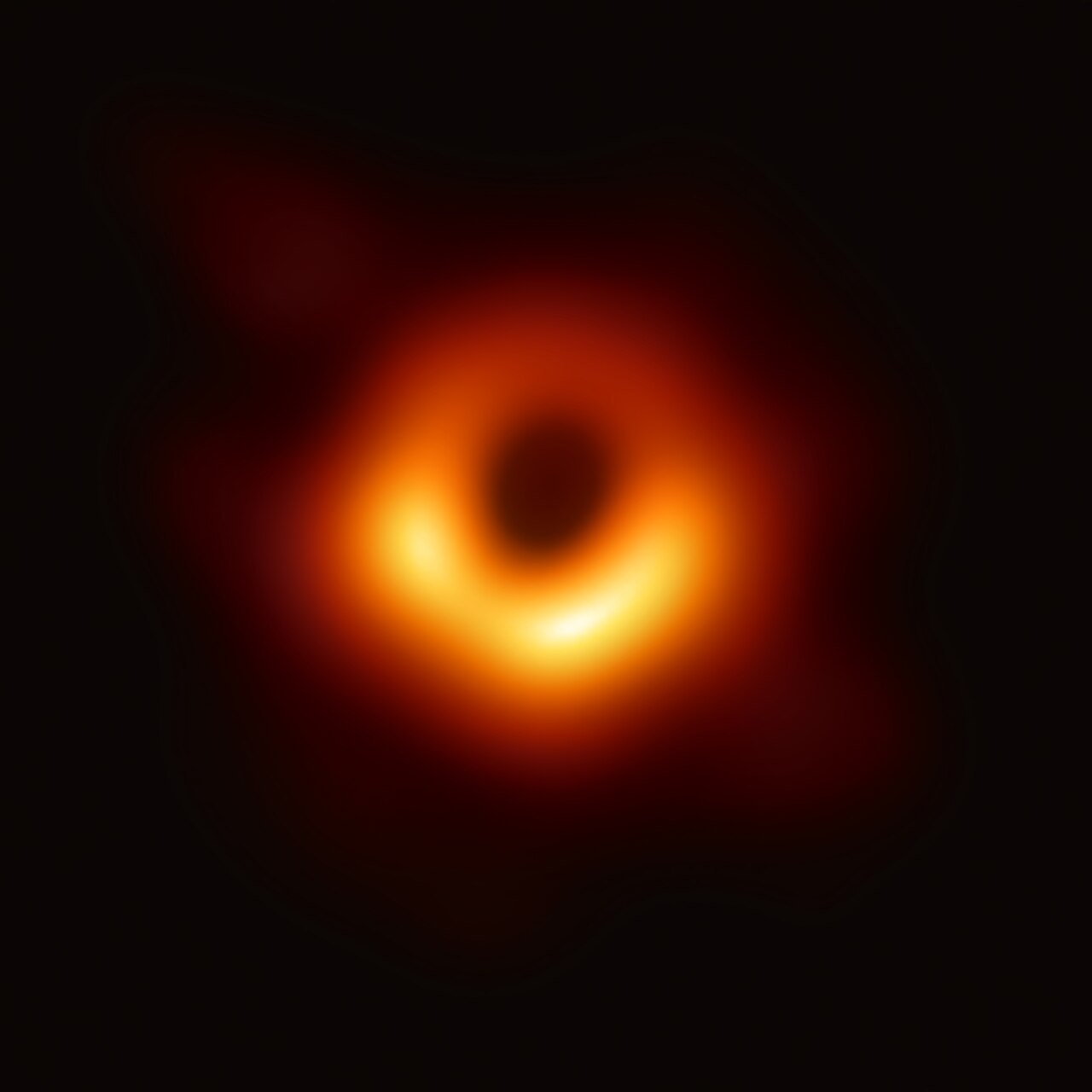
The Event Horizon Telescope Collaboration released the first image associated with a black hole.
Rather than showing the black hole itself, the image revealed a glowing ring of hot gas surrounding the shadow created by the event horizon.
The target was the supermassive black hole at the center of the galaxy Messier 87.
In 2022, the collaboration also released an image of Sagittarius A*, the supermassive black hole at the center of the Milky Way.
These achievements required combining radio telescopes across Earth into a virtual telescope roughly the size of our planet.
14. Black Holes May Hold Clues to the Biggest Problem in Physics
Modern physics rests on two enormously successful theories.
General relativity explains gravity on large scales.
Quantum mechanics describes the microscopic world.
Each theory works remarkably well within its own domain.
Yet when scientists attempt to combine them inside black holes, contradictions appear.
One famous example is the black hole information paradox.
If information entering a black hole disappears forever, quantum mechanics faces serious problems because it predicts that information should ultimately be preserved.
Resolving this paradox may require an entirely new understanding of space, time, and quantum gravity.
Many physicists believe black holes offer one of the best opportunities to uncover a deeper theory of nature.
15. We Still Don’t Fully Understand What Happens Inside One
Despite more than a century of research, the interior of a black hole remains one of science’s greatest unknowns.
General relativity predicts that matter eventually reaches a region called a singularity, where density becomes effectively infinite and known physics breaks down.
Most physicists suspect that this prediction signals the limits of current theory rather than the existence of true infinities in nature.
A future theory of quantum gravity may replace the singularity with something entirely different.
At present, however, no experimentally confirmed theory can describe conditions inside a black hole.
This means that black holes are not merely fascinating astronomical objects.
They represent the frontier of modern physics itself.
Why Black Holes Fascinate Scientists
Black holes combine nearly every major field of physics into a single object.
Gravity reaches its strongest known limits.
Quantum effects become essential.
Space and time behave in unfamiliar ways.
Matter is compressed beyond ordinary understanding.
Even information itself becomes a scientific puzzle.
For astronomers, black holes are not simply cosmic oddities.
They influence galaxy formation, power quasars, generate gravitational waves, shape stellar evolution, and offer natural laboratories for testing Einstein’s theory of general relativity under extreme conditions.
Every new observation provides an opportunity to challenge existing theories.
Every unanswered question points toward discoveries still waiting to be made.
The Universe’s Greatest Cosmic Mystery
Black holes remind us that the universe is stranger than everyday experience suggests.
They reveal that space can bend, time can slow, light can become trapped, and gravity can dominate reality so completely that our current understanding reaches its limits.
What makes black holes truly mind-blowing is not merely their immense gravity or enormous size. It is the fact that they connect some of the deepest questions in science. How did galaxies evolve? What happens to information? Can gravity and quantum mechanics be unified? What is the true nature of space-time?
Despite decades of extraordinary progress, black holes continue to surprise astronomers with every new observation. They remain both cosmic monsters and cosmic teachers—objects that hide their interiors while revealing profound truths about the universe itself.
Somewhere across the observable cosmos, countless black holes continue to grow, collide, spin, and shape the evolution of galaxies. Most will never be seen directly. Yet by studying their influence, scientists are steadily uncovering the secrets of these extraordinary objects, one discovery at a time.