Imagine standing in a vast, silent desert on a clear night. Above you stretches an ocean of stars, galaxies, and darkness. The universe appears calm and ancient, as though it has existed forever. Yet hidden behind this peaceful view is a remarkable secret. No matter where we look in the sky, a faint glow surrounds us. It comes from every direction. It fills all of space. It is incredibly old, unimaginably distant, and astonishingly important.
This glow is known as the Cosmic Microwave Background, often shortened to the CMB.
To astronomers, the Cosmic Microwave Background is far more than a faint signal in the sky. It is a message from the dawn of time itself. It is the oldest light humanity has ever detected, a relic from a universe that was only about 380,000 years old. Considering that the universe is approximately 13.8 billion years old today, this ancient radiation is like a baby picture of the cosmos.
The Cosmic Microwave Background is often called the afterglow of the Big Bang. It is the lingering heat left over from the moment the universe began expanding. Though that heat has cooled dramatically over billions of years, traces of it remain, filling the entire cosmos.
By studying this ancient light, scientists have learned how the universe was born, how it evolved, what it is made of, and even what its future might hold. Few discoveries in the history of science have transformed our understanding of reality as profoundly as the Cosmic Microwave Background.
The Big Bang and the Birth of the Universe
To understand the Cosmic Microwave Background, we must first travel back to the beginning.
According to modern cosmology, the universe began about 13.8 billion years ago in an event known as the Big Bang.
The Big Bang was not an explosion occurring in empty space. Rather, it was the rapid expansion of space itself. Every region of the universe was once compressed into an incredibly hot, dense state.
In the earliest moments, temperatures were so extreme that matter as we know it could not exist.
Atoms could not form.
Stars did not exist.
Galaxies had not yet appeared.
Even atomic nuclei struggled to survive in the overwhelming heat.
The young universe was a seething ocean of energy and particles. Conditions were so intense that the familiar structures of today’s cosmos were impossible.
As the universe expanded, however, it began to cool.
This cooling would eventually allow the formation of atoms, stars, galaxies, planets, and ultimately life itself.
The Cosmic Microwave Background emerged during one of the most important transitions in this entire process.
The Universe Was Once Opaque
Today, space is mostly transparent.
Light from distant galaxies can travel billions of light-years before reaching Earth.
But the early universe was very different.
For hundreds of thousands of years after the Big Bang, the universe was filled with a hot plasma consisting mainly of electrons, protons, and photons.
Photons are particles of light.
Whenever a photon tried to travel through this plasma, it quickly collided with charged particles.
Imagine trying to shine a flashlight through an extremely dense fog.
The light would scatter repeatedly and struggle to travel very far.
The early universe behaved in a similar way.
Light could not move freely.
The cosmos was effectively opaque.
No matter where a photon attempted to go, it was constantly scattered by surrounding particles.
As a result, the universe was filled with light, yet that light was trapped.
The Great Moment of Recombination
Everything changed roughly 380,000 years after the Big Bang.
By this time, expansion had cooled the universe to about 3,000 degrees Celsius.
Although still extremely hot by human standards, this temperature was cool enough for electrons and protons to combine and form neutral hydrogen atoms.
This event is known as recombination.
The name is somewhat misleading because electrons and protons were not actually recombining; they were combining for the first time.
Nevertheless, the term remains standard in cosmology.
The formation of neutral atoms transformed the universe.
Unlike free electrons, neutral atoms interact much less strongly with photons.
Suddenly, light could travel vast distances without constant scattering.
The cosmic fog lifted.
For the first time, the universe became transparent.
Photons that had previously been trapped were released into space.
Many of those photons are still traveling through the cosmos today.
Those ancient photons make up the Cosmic Microwave Background.
The First Light We Can See
The Cosmic Microwave Background represents the oldest light humans can directly observe.
When astronomers study distant galaxies, they are looking back in time because light requires time to travel.
However, even the most distant galaxy formed long after the universe became transparent.
The CMB comes from a much earlier era.
It provides a snapshot of the cosmos when it was only a tiny fraction of its current age.
In effect, it is the earliest photograph of the universe.
Before this moment, light could not travel freely.
Any earlier information is hidden behind the opaque plasma that filled the young cosmos.
For this reason, the Cosmic Microwave Background forms a kind of cosmic horizon.
It marks the furthest point we can see using electromagnetic radiation.
Beyond it lies an even earlier universe that scientists must investigate through indirect methods.
Why It Is Called a Microwave Background
When the Cosmic Microwave Background was first released, it consisted of visible and infrared light produced by the hot universe.
So why is it called a microwave background today?
The answer lies in cosmic expansion.
As space expands, light traveling through it becomes stretched.
Its wavelength grows longer.
This process is known as redshift.
Over billions of years, the expansion of the universe stretched the ancient photons of the CMB dramatically.
Originally energetic visible light gradually shifted into longer wavelengths.
Today, those wavelengths fall within the microwave region of the electromagnetic spectrum.
The radiation has cooled enormously as a result.
Modern measurements show that the Cosmic Microwave Background has a temperature of approximately 2.725 Kelvin, which is only about 2.7 degrees above absolute zero.
What was once the brilliant glow of a hot young universe has become an extremely faint microwave signal.
Yet despite its weakness, it remains detectable.
A Prediction Before a Discovery
One of the most remarkable aspects of the Cosmic Microwave Background is that scientists predicted its existence before finding it.
In the 1940s, physicists working on Big Bang models realized that a hot early universe should leave behind residual radiation.
Among the scientists involved were George Gamow, Ralph Alpher, and Robert Herman.
They calculated that remnants of the Big Bang should still fill space.
At the time, however, technology was not advanced enough to detect such weak radiation.
The prediction received relatively little attention.
For years, the expected signal remained hidden.
Then, in the 1960s, an accidental discovery changed cosmology forever.
The Accidental Discovery
In 1964, radio astronomers Arno Penzias and Robert Wilson were working with a sensitive microwave antenna.
They encountered a mysterious source of noise.
No matter where they pointed the instrument, the signal remained.
It came from every direction.
They checked for equipment problems.
They considered possible interference from nearby sources.
They even cleaned bird droppings from the antenna, suspecting contamination.
Nothing eliminated the signal.
At the same time, another group of scientists was searching for exactly the kind of radiation predicted by Big Bang theory.
Eventually, the connection became clear.
Penzias and Wilson had accidentally discovered the Cosmic Microwave Background.
Their finding provided powerful evidence supporting the Big Bang model.
For this groundbreaking work, they later received the Nobel Prize in Physics.
Why the Discovery Was So Important
Before the discovery of the Cosmic Microwave Background, scientists debated competing ideas about the universe.
One alternative was the Steady State Theory.
This model proposed that the universe had no beginning and looked essentially the same throughout time.
The detection of the CMB dramatically changed the debate.
A hot, dense early universe naturally predicts leftover radiation.
The Steady State Theory does not.
The discovery therefore provided strong support for the Big Bang.
Many cosmologists consider it one of the most important observations in modern science.
It transformed the Big Bang from an intriguing hypothesis into the leading explanation for cosmic origins.
A Nearly Perfect Glow
One of the first surprises about the Cosmic Microwave Background was its remarkable uniformity.
Measurements showed that its temperature is nearly identical in every direction.
Whether astronomers observe the northern sky, southern sky, or any other region, the average temperature remains almost the same.
This extraordinary uniformity suggests that the early universe was astonishingly smooth.
On large scales, matter and energy were distributed with remarkable consistency.
The universe was not perfectly uniform, however.
Tiny differences existed.
Those small imperfections would ultimately shape everything we see today.
Tiny Fluctuations with Enormous Consequences
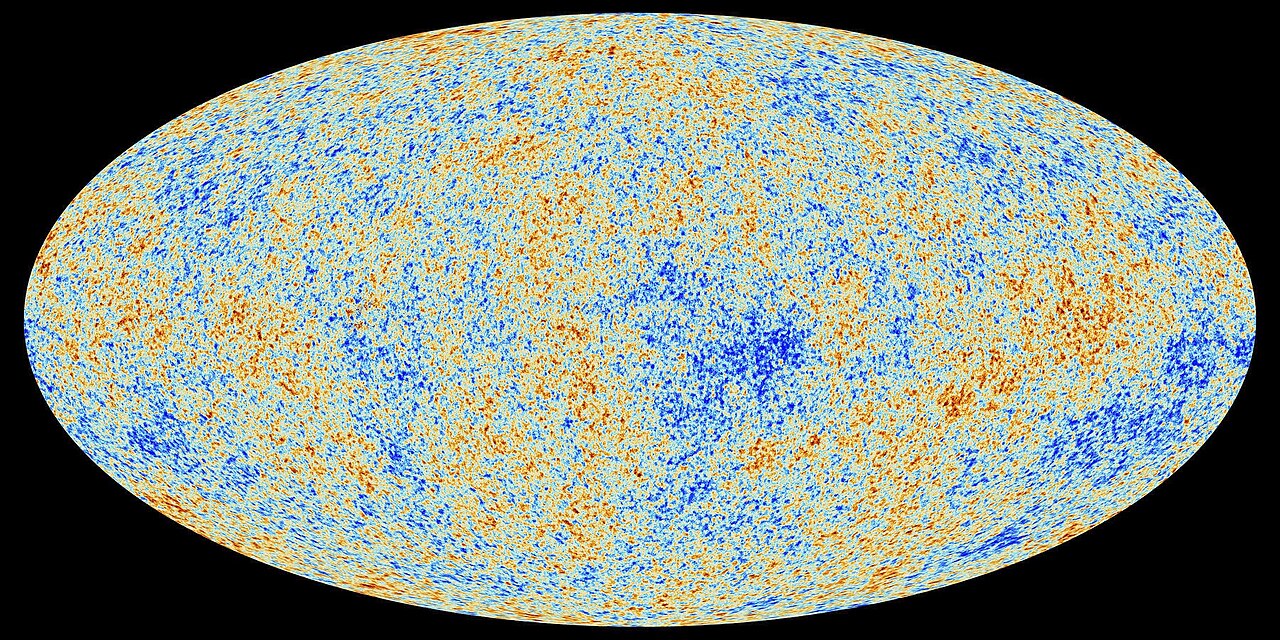
When scientists measured the Cosmic Microwave Background more precisely, they discovered minute temperature variations.
These fluctuations are incredibly small.
Many differ by only a few millionths of a degree.
At first glance, such tiny differences might seem unimportant.
In reality, they are among the most significant features in the universe.
These fluctuations reveal slight variations in density present shortly after the Big Bang.
Regions that were slightly denser contained a little more matter.
Gravity gradually amplified these differences.
Over millions and billions of years, dense regions attracted additional matter.
Eventually they formed stars, galaxies, and galaxy clusters.
Without these tiny irregularities, the universe might remain almost completely featureless.
There would be no galaxies.
No stars.
No planets.
No life.
The structures that define the cosmos today grew from the faint patterns preserved in the Cosmic Microwave Background.
Mapping the Baby Universe
Modern space missions have created detailed maps of the Cosmic Microwave Background.
These maps reveal temperature fluctuations across the entire sky.
One of the earliest major missions was the Cosmic Background Explorer, commonly known as COBE.
Launched in 1989, COBE confirmed that the CMB possessed the precise thermal properties expected from the Big Bang.
It also detected the tiny temperature variations that would later become the seeds of galaxies.
The success of COBE revolutionized cosmology.
Scientists suddenly possessed direct evidence of structures present in the infant universe.
The WMAP Revolution
A later mission called the Wilkinson Microwave Anisotropy Probe, or WMAP, dramatically improved observations.
Launched in 2001, WMAP produced far more detailed maps of the Cosmic Microwave Background.
The spacecraft measured temperature variations with unprecedented precision.
Its observations helped determine the age of the universe, its composition, and its geometry.
For the first time, cosmologists could answer many fundamental questions with remarkable accuracy.
The universe was approximately 13.8 billion years old.
Ordinary matter accounted for only a small fraction of the cosmos.
Dark matter and dark energy dominated the cosmic inventory.
The ancient light of the CMB revealed these astonishing truths.
The Planck Mission and Unprecedented Detail
The most detailed maps yet came from the Planck mission.
Launched by the European Space Agency in 2009, Planck measured the Cosmic Microwave Background with extraordinary sensitivity.
Its observations provided the clearest image ever obtained of the infant universe.
Planck refined measurements of cosmological parameters and helped test theories about cosmic evolution.
The resulting maps look like colorful patterns spread across the sky.
To scientists, these patterns contain an immense amount of information.
They are effectively fingerprints left behind by the early universe.
The Temperature of Empty Space
One of the most fascinating aspects of the Cosmic Microwave Background is that it fills all of space.
Even regions between galaxies contain this ancient radiation.
No matter where you travel in the observable universe, you would encounter the CMB.
Its presence means that space is never truly empty.
Every cubic centimeter of the universe contains hundreds of microwave photons left over from the Big Bang.
These photons have been traveling for nearly 14 billion years.
They are among the oldest objects we can observe.
What the CMB Reveals About Cosmic Composition
The Cosmic Microwave Background provides a powerful tool for determining what the universe contains.
Its subtle patterns encode information about matter, energy, and cosmic expansion.
Through careful analysis, scientists have concluded that ordinary matter makes up only about five percent of the universe.
This includes stars, planets, gas clouds, and everything humans can directly observe.
Dark matter accounts for roughly twenty-seven percent.
Dark energy represents about sixty-eight percent.
These findings were shocking.
The familiar world of atoms constitutes only a tiny fraction of cosmic reality.
The CMB played a central role in uncovering this fact.
Dark Matter and Ancient Light
Dark matter remains invisible.
It does not emit light and cannot be observed directly.
Yet its gravitational influence affects the Cosmic Microwave Background.
The distribution of dark matter influenced how density fluctuations evolved in the early universe.
As a result, traces of dark matter’s effects appear in the patterns observed today.
By studying these patterns, cosmologists can estimate the amount of dark matter present.
The CMB therefore serves as one of the strongest pieces of evidence for dark matter’s existence.
Dark Energy and Cosmic Expansion
The Cosmic Microwave Background also helps scientists investigate dark energy.
Dark energy appears responsible for the accelerated expansion of the universe.
Although its nature remains mysterious, its influence affects large-scale cosmic evolution.
Observations of the CMB, combined with other astronomical data, provide important constraints on dark energy’s properties.
Even though dark energy became dominant billions of years after the CMB formed, the ancient radiation still contains clues about its effects.
This demonstrates the extraordinary power of studying the universe’s earliest light.
Polarization and Hidden Information
The Cosmic Microwave Background contains more than temperature variations.
It also exhibits polarization.
Polarization describes the orientation of light waves.
Certain interactions in the early universe produced subtle polarization patterns in the CMB.
These patterns contain additional information about cosmic history.
By analyzing polarization, scientists can learn about conditions that existed shortly after the Big Bang.
Some researchers hope polarization studies may eventually reveal evidence for inflation, a proposed period of extremely rapid expansion during the universe’s earliest moments.
Cosmic Inflation and the CMB
One of the most influential ideas in modern cosmology is inflation.
According to this theory, the universe underwent an extraordinarily rapid expansion during a tiny fraction of a second after the Big Bang.
Inflation helps explain why the universe appears so uniform on large scales.
It also predicts specific patterns in the Cosmic Microwave Background.
Many observations align remarkably well with inflationary predictions.
Although important questions remain unresolved, the CMB provides some of the strongest evidence supporting inflation.
Ancient photons continue helping scientists investigate events that occurred almost immediately after the birth of the universe.
Looking Back Almost to the Beginning
When astronomers observe the Cosmic Microwave Background, they are looking farther back in time than with any other form of light.
The photons reaching our instruments today began their journey when the universe was only 380,000 years old.
Compared with the universe’s current age, that is astonishingly close to the beginning.
No telescope can directly see earlier using ordinary light.
The CMB therefore represents the ultimate limit of traditional astronomical observation.
It is the oldest visible chapter in the story of existence.
Why the Cosmic Microwave Background Matters
The Cosmic Microwave Background is far more than an interesting astronomical phenomenon.
It is one of the most important discoveries in the history of science.
Without it, many aspects of modern cosmology would remain uncertain.
The CMB provides evidence for the Big Bang.
It reveals the conditions of the infant universe.
It helps measure the universe’s age.
It exposes the presence of dark matter and dark energy.
It sheds light on cosmic inflation.
It explains how galaxies ultimately formed.
Few observations have influenced scientific understanding so profoundly.
The Emotional Power of Ancient Light
Beyond its scientific importance, the Cosmic Microwave Background carries a powerful emotional significance.
Every photon within it has traveled for nearly the entire history of the universe.
These ancient messengers began their journey long before the Earth existed.
Long before the Sun formed.
Long before the Milky Way acquired its current shape.
They crossed billions of light-years of expanding space to reach our detectors.
When scientists study the CMB, they are not merely analyzing data.
They are listening to an ancient echo from the dawn of time.
The signal is faint, but its message is extraordinary.
It tells us that the universe had a beginning.
It tells us how structure emerged from simplicity.
It tells us that everything we know ultimately grew from tiny fluctuations in a hot young cosmos.
The Future of Cosmic Microwave Background Research
Even after decades of study, the Cosmic Microwave Background continues to reveal new secrets.
Future experiments aim to measure its properties with even greater precision.
Scientists hope to detect subtle signatures of inflation.
They seek improved understanding of dark matter and dark energy.
They want to explore the earliest moments of cosmic history.
Advances in technology may uncover details currently hidden within the ancient radiation.
Each new observation has the potential to reshape our understanding of the universe.
The afterglow of the Big Bang still has stories to tell.
Conclusion
The Cosmic Microwave Background is the faint microwave radiation that fills the entire universe, representing the oldest light humans can observe. Released approximately 380,000 years after the Big Bang, it marks the moment when the cosmos became transparent and photons could travel freely through space. Over billions of years, cosmic expansion stretched this ancient light into microwave wavelengths, creating the faint glow detected today.
More than a relic of the distant past, the Cosmic Microwave Background is a powerful scientific tool. It provides compelling evidence for the Big Bang, reveals the composition and age of the universe, exposes the influence of dark matter and dark energy, and preserves the tiny fluctuations that eventually gave rise to stars, galaxies, planets, and life itself.
In many ways, the Cosmic Microwave Background is the universe’s oldest surviving memory. It is a whisper from a time when the cosmos was young, carrying information across nearly fourteen billion years of history. Every time astronomers study this faint afterglow, they are gazing into the deepest past accessible to human observation and uncovering clues about how everything we know came to be.