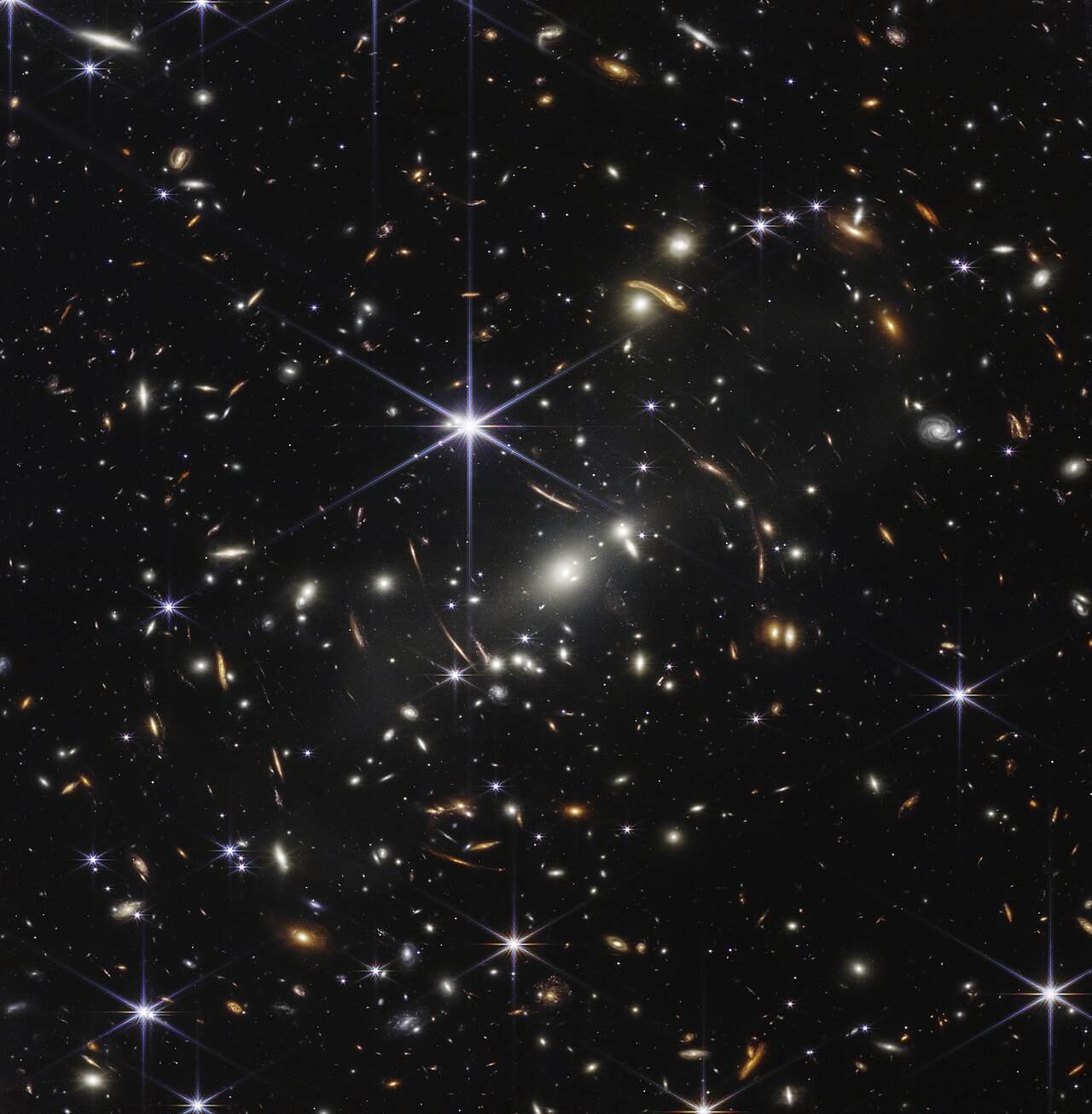
When we look up at the night sky, we see a universe filled with stars. Thousands of points of light shine above us, and through powerful telescopes we discover planets, nebulae, star clusters, and entire galaxies. It is easy to imagine the cosmos as a place crowded with celestial objects.
Yet appearances can be deceiving.
The universe is not primarily made of stars, planets, or galaxies. Most of it is empty space.
Even within our own galaxy, stars are separated by enormous distances. But beyond the boundaries of galaxies lies something even more astonishing: vast regions where the emptiness becomes almost unimaginable. These immense cosmic expanses are known as intergalactic space.
Intergalactic space is the realm that exists between galaxies. It is one of the largest environments in the universe and one of the least familiar to human intuition. At first glance, it seems like nothingness—a dark and lonely void stretching across millions of light-years. But modern astronomy has revealed that intergalactic space is far more fascinating than simple emptiness.
It contains invisible matter, ghostly gases, powerful radiation, magnetic fields, and clues to the history of the cosmos itself. It plays a critical role in galaxy formation, cosmic evolution, and the large-scale structure of the universe.
Far from being a meaningless gap between galaxies, intergalactic space is one of the most important regions in existence.
Understanding the Scale of the Universe
To appreciate intergalactic space, we must first understand the staggering scale of the cosmos.
The Earth seems large from a human perspective. Oceans span continents, mountains rise for kilometers, and journeys across countries can take days.
Yet Earth is tiny compared to the Sun.
The Sun itself is merely an ordinary star among hundreds of billions of stars within the Milky Way.
The Milky Way stretches roughly 100,000 light-years across. A light-year is the distance light travels in one year—about 9.46 trillion kilometers.
Even this enormous galaxy is only one member of a much larger cosmic community.
Beyond the Milky Way lie countless other galaxies scattered throughout the universe. Some are small dwarf galaxies containing a few billion stars. Others are giant systems containing trillions of stars.
The distances between these galaxies are so vast that ordinary human concepts struggle to describe them.
It is within these enormous separations that intergalactic space exists.
What Exactly Is Intergalactic Space?
Intergalactic space refers to the regions of the universe located outside galaxies.
If galaxies are cosmic islands, intergalactic space is the vast ocean surrounding them.
The term may sound simple, but it describes an environment unlike anything on Earth.
Within a galaxy, stars, gas clouds, planets, dust, and dark matter are relatively concentrated. Beyond a galaxy’s visible boundaries, matter becomes dramatically more sparse.
Intergalactic space is therefore one of the least dense environments known.
For long periods of scientific history, astronomers assumed it was essentially empty.
Today we know that this assumption was incorrect.
Intergalactic space contains matter, energy, and structure. It is not a perfect vacuum. Instead, it is an extremely thin and diffuse environment that fills much of the observable universe.
Is Intergalactic Space Truly Empty?
The simplest answer is no.
Intergalactic space is often described as empty because it contains far less matter than galaxies, planets, or stars. However, empty does not mean completely devoid of substance.
Even the most remote regions of intergalactic space contain particles.
There may be only a few atoms per cubic meter, sometimes even fewer, but those particles still exist.
To understand how empty intergalactic space really is, consider Earth’s atmosphere. Every breath contains trillions upon trillions of molecules packed closely together.
Now imagine removing almost all of them.
Then remove nearly all that remain.
Continue until only a tiny handful of particles are left within a volume larger than a house.
That begins to approach the density of intergalactic space.
It is among the closest natural approximations to a vacuum found anywhere in the universe.
Yet it is not absolute emptiness.
The Difference Between Interstellar and Intergalactic Space
Many people confuse interstellar space with intergalactic space.
Although related, they are not the same thing.
Interstellar space exists between stars within a galaxy.
The space separating the Sun from neighboring stars is interstellar space.
Intergalactic space exists between entire galaxies.
The difference is enormous.
Imagine houses within a city. The streets separating individual houses are like interstellar space. The vast distances between different cities are more comparable to intergalactic space.
Both environments are mostly empty, but intergalactic space is generally much less dense and vastly larger.
The distinction is important because different physical processes dominate each region.
The First Clues That Intergalactic Space Was Not Empty
For much of history, scientists lacked the tools needed to investigate intergalactic space directly.
Telescopes excel at observing bright objects such as stars and galaxies.
The nearly invisible matter between galaxies proved much harder to detect.
The situation changed as astronomy advanced during the twentieth century.
Researchers began analyzing light from distant quasars—extremely luminous objects powered by supermassive black holes.
As this light traveled across billions of light-years, it passed through intergalactic space before reaching Earth.
Something interesting happened along the way.
Certain wavelengths of light were absorbed by intervening clouds of hydrogen gas.
These absorption signatures revealed the presence of matter where astronomers had expected emptiness.
The universe between galaxies was not vacant after all.
It contained vast reservoirs of diffuse gas spread across cosmic distances.
The Intergalactic Medium
The material filling intergalactic space is known as the intergalactic medium.
This medium consists primarily of hydrogen and helium, the two lightest elements in the universe.
Hydrogen is especially abundant because it was created in enormous quantities shortly after the Big Bang.
The intergalactic medium is extraordinarily thin.
In many regions, atoms are separated by distances far greater than those found in ordinary matter.
Yet because intergalactic space occupies such immense volumes, the total amount of material adds up to a significant fraction of the universe’s ordinary matter.
For decades, astronomers searched for much of the universe’s missing normal matter.
A substantial portion appears to reside within the intergalactic medium.
The emptiness between galaxies turns out to contain more matter than once imagined.
The Cosmic Web
One of the most remarkable discoveries in modern astronomy is that intergalactic space is not randomly distributed.
Instead, matter forms a gigantic network known as the cosmic web.
On the largest scales, galaxies are not scattered uniformly throughout the universe.
They gather along enormous filaments stretching across hundreds of millions of light-years.
Between these filaments lie vast regions known as cosmic voids.
The result resembles a three-dimensional web.
Galaxies cluster along its strands, while intergalactic gas fills the spaces between them.
Dark matter provides the gravitational framework supporting this immense structure.
The cosmic web represents the largest known pattern in the universe.
Intergalactic space forms the connective tissue holding this structure together.
The Role of Dark Matter
No discussion of intergalactic space is complete without mentioning dark matter.
Dark matter remains one of astronomy’s greatest mysteries.
Unlike ordinary matter, dark matter does not emit or reflect light.
It cannot be observed directly.
Scientists infer its existence through gravitational effects.
Galaxies rotate too rapidly to be held together by visible matter alone.
Galaxy clusters contain more mass than telescopes can detect.
Something invisible contributes additional gravity.
That something appears to be dark matter.
Intergalactic space contains enormous amounts of it.
In fact, dark matter forms much of the scaffolding underlying the cosmic web.
Without dark matter, galaxies might never have formed.
The structure of intergalactic space would look dramatically different.
The Temperature of Intergalactic Space
Many people assume intergalactic space must be extremely cold.
The reality is more complicated.
Some regions are indeed incredibly cold, approaching temperatures only a few degrees above absolute zero.
Other regions are surprisingly hot.
As galaxies form and evolve, they release enormous amounts of energy into their surroundings.
Supernova explosions, black hole activity, and galactic winds can heat nearby intergalactic gas to millions of degrees.
This hot gas remains extremely diffuse.
If a human somehow entered such a region, the sparse particles would transfer very little heat despite their high temperatures.
Temperature in space often behaves differently than our everyday intuition suggests.
Light Traveling Through Intergalactic Space
Every time astronomers observe a distant galaxy, they are studying light that has crossed intergalactic space.
This journey can last millions, billions, or even more than ten billion years.
During that time, photons travel through a vast and largely empty environment.
Intergalactic space acts as the medium through which cosmic information moves.
Without it, we could not observe distant objects.
The light reaching Earth’s telescopes carries messages from the far reaches of the universe.
Each photon serves as a tiny traveler crossing unimaginable distances through darkness.
When we look deep into space, we are also looking through intergalactic space.
Cosmic Radiation in the Void
Intergalactic space is permeated by various forms of radiation.
One of the most important is the cosmic microwave background.
This faint glow fills the entire universe.
It represents leftover radiation from the Big Bang, emitted when the universe was only about 380,000 years old.
Today, the cosmic microwave background bathes all of space.
Intergalactic space is therefore not truly dark.
Invisible radiation passes through it constantly.
Cosmic rays, X-rays, ultraviolet light, and other forms of energy also traverse these regions.
The apparent emptiness hides a surprisingly active environment.
Magnetic Fields Between Galaxies
Magnetic fields exist throughout the universe.
Earth possesses a magnetic field.
The Sun possesses one.
Galaxies possess them as well.
Astronomers have discovered evidence that magnetic fields also extend into intergalactic space.
These fields are generally weak compared to those found in galaxies, but they can influence the motion of charged particles across vast distances.
The origin of intergalactic magnetic fields remains an active area of research.
Some may have formed during the early universe.
Others may have been ejected from galaxies through powerful outflows.
Their presence demonstrates that even seemingly empty regions contain hidden complexity.
The Largest Voids in the Universe
While some intergalactic regions contain filaments of gas and galaxies, others are astonishingly empty.
These regions are called cosmic voids.
A cosmic void may span tens or even hundreds of millions of light-years.
Within these immense volumes, galaxies are extremely rare.
The density of matter drops dramatically.
If a traveler somehow found themselves in the center of a large cosmic void, they might see few nearby galaxies in any direction.
The night sky would appear profoundly different from the one visible from Earth.
Cosmic voids represent some of the emptiest places known.
Yet even they are not completely empty.
Tiny amounts of matter still exist within them.
Can Anything Travel Through Intergalactic Space?
Absolutely.
Light routinely crosses intergalactic space.
Cosmic rays travel through it.
Particles move through it.
Galaxies themselves move through the cosmic web.
In principle, spacecraft could travel through intergalactic space as well.
The challenge is distance.
The nearest major galaxy to the Milky Way, the Andromeda Galaxy, lies about 2.5 million light-years away.
Even the fastest spacecraft humanity has ever built would require an unimaginable amount of time to cover such distances.
Intergalactic travel remains far beyond current technological capabilities.
The emptiness is not the primary obstacle.
The scale is.
What Would It Be Like to Be in Intergalactic Space?
Imagine leaving Earth.
You pass beyond the Solar System.
You continue outward through the Milky Way.
Eventually, you leave the galaxy entirely.
Now you enter intergalactic space.
The view would be extraordinary.
Behind you, the Milky Way would appear as a brilliant spiral island of light suspended in darkness.
Ahead, distant galaxies would shine like faint cosmic cities.
There would be no nearby stars.
No planets.
No nebulae.
Only immense darkness punctuated by remote galaxies scattered across the universe.
The loneliness would be difficult to comprehend.
Human beings evolved in a world rich with landscapes, sounds, weather, and life.
Intergalactic space offers none of these familiar experiences.
It is perhaps the ultimate expression of cosmic isolation.
How Intergalactic Space Influences Galaxy Evolution
Galaxies do not evolve independently.
Their surroundings matter.
The intergalactic medium supplies gas that galaxies can draw inward.
This gas fuels future star formation.
At the same time, galaxies can expel material back into intergalactic space through stellar winds and supernova explosions.
A continuous exchange occurs between galaxies and their environment.
Intergalactic space therefore participates directly in galactic evolution.
It acts as both a reservoir and a recycling system.
Without the intergalactic medium, galaxies would develop differently than they do today.
Black Holes and Intergalactic Space
Supermassive black holes reside at the centers of many galaxies.
When these black holes actively consume matter, they can release extraordinary amounts of energy.
Powerful jets may shoot outward for hundreds of thousands of light-years.
Some even extend beyond the host galaxy and into intergalactic space.
These jets transport energy, magnetic fields, and particles into the surrounding environment.
As a result, black holes influence regions far beyond their immediate neighborhoods.
Their effects can reshape portions of intergalactic space on enormous scales.
The Search for Missing Matter
One of astronomy’s longstanding mysteries involved missing ordinary matter.
Calculations based on the Big Bang indicated that more normal matter should exist than astronomers could account for inside stars and galaxies.
Where was it?
Evidence increasingly points toward intergalactic space.
Much of this missing matter appears to reside within diffuse gas structures spread throughout the cosmic web.
Detecting such tenuous material is difficult.
It neither shines brightly nor forms obvious structures.
Yet modern instruments continue revealing more of this hidden reservoir.
The search has transformed our understanding of what exists between galaxies.
Intergalactic Space in the Distant Future
The future of intergalactic space is tied to the future of the universe itself.
Current observations indicate that cosmic expansion is accelerating.
Galaxies are gradually moving farther apart.
Over immense spans of time, distant galaxies may recede beyond observable reach.
Future observers in faraway eras could find themselves isolated within a single galaxy group, unable to see most of the universe beyond.
Intergalactic space would become even larger and emptier.
The cosmic web would stretch.
Distances would grow.
The universe would appear increasingly lonely.
This possibility offers a fascinating glimpse into the long-term fate of cosmic structure.
Why the Emptiness Matters
At first glance, intergalactic space seems like the least interesting part of the universe.
After all, it lacks stars, planets, and spectacular nebulae.
Yet this perspective misses its importance.
Intergalactic space contains clues about the Big Bang.
It preserves evidence of cosmic evolution.
It hosts much of the universe’s ordinary matter.
It contains vast amounts of dark matter.
It supports the cosmic web connecting galaxies across enormous distances.
Without understanding intergalactic space, we cannot fully understand galaxies themselves.
The emptiness is not merely background scenery.
It is an active participant in the story of the cosmos.
The Emotional Power of Cosmic Emptiness
There is something deeply moving about intergalactic space.
Human life unfolds on a small world crowded with activity. We are surrounded by people, animals, plants, weather, cities, and landscapes.
Intergalactic space is the opposite.
It represents silence on a scale almost impossible to imagine.
Millions of light-years may pass without encountering a single galaxy.
The darkness is profound.
The distances are overwhelming.
Yet this vast emptiness also inspires wonder.
It reminds us how extraordinary galaxies truly are.
Against an ocean of darkness, each galaxy becomes a precious island of light.
Every star, every planet, every living creature exists within these rare concentrations of matter surrounded by incomprehensible emptiness.
The contrast makes the universe feel both larger and more precious.
Conclusion
Intergalactic space is the immense realm that exists between galaxies. Although often described as empty, it is far from a true void. It contains diffuse gas, hidden dark matter, magnetic fields, radiation, and the intricate structures of the cosmic web. Stretching across millions of light-years, it represents one of the largest environments in existence and plays a fundamental role in shaping the universe.
Modern astronomy has transformed our understanding of these seemingly barren regions. What once appeared to be nothingness is now recognized as a dynamic component of cosmic evolution. Intergalactic space connects galaxies, stores vast amounts of matter, and preserves clues about the universe’s origins and future.
Perhaps most importantly, intergalactic space reminds us of the incredible scale of reality. Between the glowing islands of galaxies lies an ocean of darkness so immense that human imagination struggles to grasp it. Yet within that darkness are the hidden threads that bind the cosmos together, proving that even the emptiest places in the universe can hold some of its greatest secrets.