The Sun is much more than a bright object in the daytime sky. It is the powerful engine that makes life on Earth possible. Every second, it releases enormous amounts of light and heat that warm our planet, drive Earth’s climate, and provide the energy that plants use to grow. Most days, the Sun appears calm and steady. But beneath its glowing surface lies an incredibly active and dynamic star that occasionally unleashes massive bursts of energy into space.
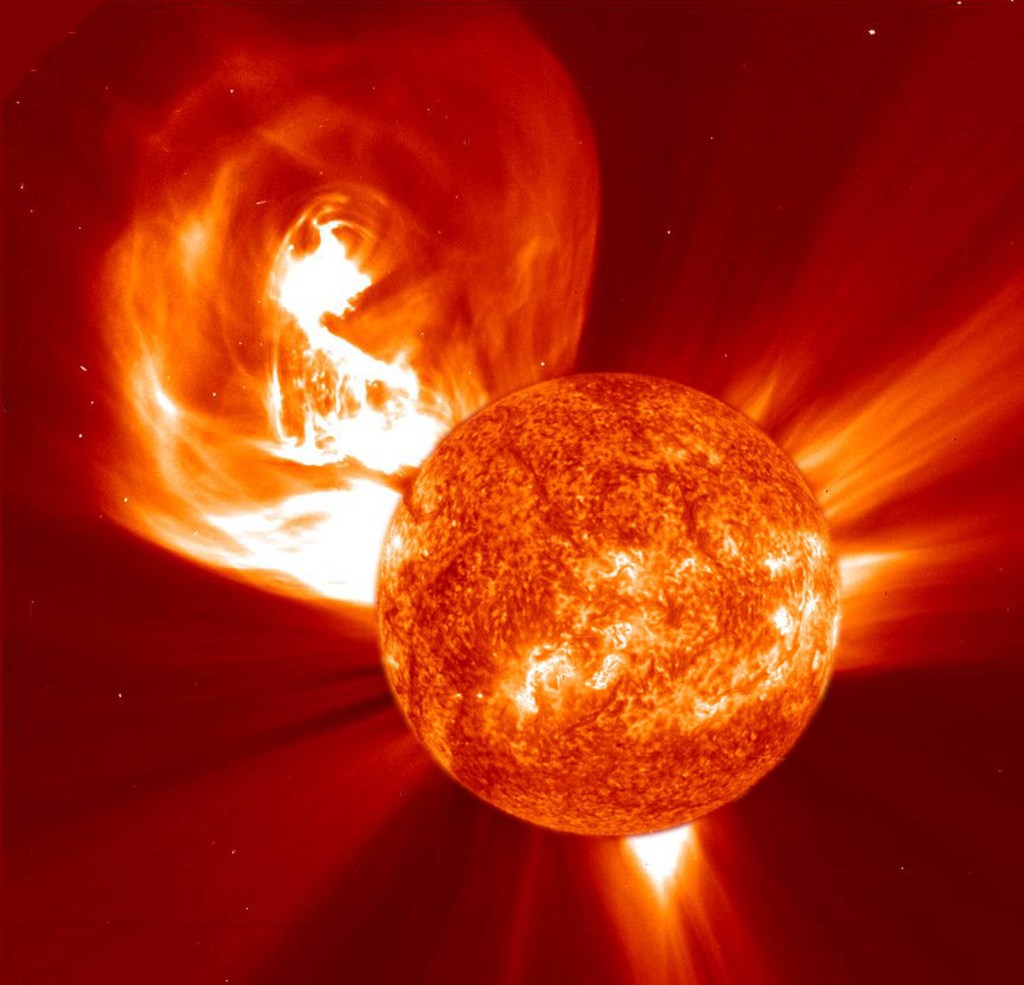
These explosive events are known as solar storms. They can send billions of tons of electrically charged particles racing through the Solar System at incredible speeds. When these storms are directed toward Earth, they can produce breathtaking auroras that dance across the night sky. At the same time, they can also interfere with satellites, disrupt radio communications, affect GPS navigation, damage power grids, and create challenges for astronauts in space.
Although solar storms may sound frightening, they are a natural part of the Sun’s behavior. Scientists have been studying them for decades to better understand their causes and to protect the technology that modern society depends on. Learning about solar storms helps us appreciate not only the power of our nearest star but also the remarkable ways Earth is protected from the harsh environment of space.
What Is a Solar Storm?
A solar storm is a disturbance in space caused by activity on the Sun. It occurs when the Sun suddenly releases enormous amounts of energy, radiation, or charged particles into space.
The term “solar storm” actually refers to several different types of solar activity that often occur together. These include solar flares, coronal mass ejections, and streams of fast-moving charged particles. Some solar storms are relatively small and have little effect on Earth, while others are powerful enough to influence technology around the world.
Because the Sun is about 150 million kilometers (93 million miles) from Earth, the effects of a solar storm are not felt immediately. Depending on the type of event, it may take anywhere from about eight minutes for solar radiation to reach Earth to several days for clouds of charged particles to arrive.
Why Does the Sun Produce Solar Storms?
The Sun is a giant sphere of hot plasma rather than a solid object. Inside it, hot gases constantly move and flow. These motions generate extremely complex magnetic fields that twist, stretch, and become tangled over time.
Sometimes these magnetic fields suddenly rearrange themselves, releasing enormous amounts of stored energy. This process, called magnetic reconnection, powers many solar storms.
Regions of intense magnetic activity often appear on the Sun as dark patches known as sunspots. Although sunspots look darker than the surrounding surface, they are still extremely hot. These regions are frequently the birthplace of powerful solar eruptions.
Solar Flares: Explosions of Light and Energy
One of the most dramatic types of solar activity is the solar flare.
A solar flare is a sudden burst of electromagnetic radiation from the Sun’s atmosphere. It releases energy across a wide range of wavelengths, including visible light, ultraviolet light, and X-rays.
Solar flares travel at the speed of light, so their radiation reaches Earth in about eight minutes. When a strong flare occurs, it can temporarily disturb Earth’s upper atmosphere.
These disturbances may interrupt high-frequency radio communications, especially over the sunlit side of Earth. Airlines, emergency services, ships, and aircraft that rely on certain radio frequencies can experience brief communication problems during particularly powerful flares.
Coronal Mass Ejections: Giant Clouds of Solar Plasma
Another major type of solar storm is called a coronal mass ejection, often abbreviated as CME.
A coronal mass ejection occurs when the Sun ejects an enormous cloud of plasma and magnetic fields into space. These eruptions can contain billions of tons of charged particles traveling at speeds of hundreds to thousands of kilometers per second.
Unlike the radiation from a solar flare, a CME usually takes one to several days to reach Earth.
Not every coronal mass ejection is directed toward our planet. Many travel harmlessly into space. However, when one is aimed at Earth and its magnetic field interacts strongly with Earth’s magnetic field, significant space weather effects can occur.
The Solar Wind and Space Weather
The Sun continuously releases a flow of charged particles called the solar wind. Even during quiet periods, this stream of particles travels throughout the Solar System.
Solar storms can dramatically strengthen the solar wind, creating conditions known as space weather.
Just as Earth’s weather includes calm days and powerful storms, space weather ranges from quiet conditions to intense solar activity that affects planets, satellites, and spacecraft.
Scientists monitor space weather every day because modern technology has become increasingly sensitive to changes in the space environment.
Earth’s Magnetic Shield
Fortunately, Earth has a powerful natural defense against most solar storms.
Our planet generates a magnetic field deep inside its molten outer core. This magnetic field extends far into space, forming a protective region called the magnetosphere.
The magnetosphere acts like an invisible shield. It deflects most of the charged particles coming from the Sun, preventing them from directly striking Earth’s surface.
Without this magnetic protection, life on Earth would face far greater exposure to harmful space radiation. Scientists believe Earth’s magnetic field has played an important role in making our planet habitable over billions of years.
How Solar Storms Create the Aurora
One of the most beautiful effects of solar storms is the appearance of the aurora.
When charged particles from the Sun enter Earth’s magnetosphere, some are guided toward the polar regions by magnetic field lines. There, they collide with atoms and molecules high in Earth’s atmosphere.
These collisions excite atmospheric gases, causing them to emit light.
Oxygen produces beautiful green and red colors, while nitrogen contributes blue, purple, and pink shades. Together they create the shimmering curtains of light known as the Aurora Borealis, or Northern Lights, and the Aurora Australis, or Southern Lights.
During especially strong solar storms, auroras can be seen much farther from the poles than usual, sometimes appearing in regions where they are rarely observed.
Effects on Satellites
Modern life depends heavily on satellites.
They provide communication, television broadcasts, weather forecasting, internet connections, navigation, scientific research, and Earth observation.
Solar storms can interfere with satellite operations in several ways. Charged particles may damage sensitive electronic components, temporarily disrupt onboard systems, or increase electrical charging on satellite surfaces.
Solar activity can also heat Earth’s upper atmosphere, causing it to expand slightly. This increases atmospheric drag on satellites orbiting at relatively low altitudes, gradually changing their orbits if corrections are not made.
Satellite operators closely monitor space weather forecasts to reduce these risks whenever possible.
Effects on GPS Navigation
Global Positioning System (GPS) satellites allow people to navigate using smartphones, cars, ships, and aircraft.
GPS signals must travel through Earth’s ionosphere, a layer of the atmosphere filled with electrically charged particles.
Strong solar storms can disturb the ionosphere, causing GPS signals to slow slightly or become less accurate. Most everyday users may notice little or no effect, but industries requiring extremely precise positioning—such as aviation, surveying, agriculture, and scientific research—can experience temporary reductions in accuracy.
Effects on Radio Communications
Solar storms can affect radio communications around the world.
Powerful solar flares increase ionization in Earth’s upper atmosphere, changing how radio waves travel. Some radio frequencies may become weak or temporarily unusable.
This can affect long-distance radio communications used by aircraft, ships, emergency responders, military operations, and amateur radio operators.
Most communication systems recover once the solar disturbance passes.
Effects on Power Grids
One of the most serious consequences of powerful solar storms involves electrical power systems.
As Earth’s magnetic field changes during a geomagnetic storm, electric currents can be induced in long conductors such as power transmission lines.
These currents may overload transformers and other equipment in electrical grids.
Very strong geomagnetic storms have caused power outages in the past. One well-known example occurred in March 1989, when a geomagnetic storm caused a major blackout in Quebec, Canada, leaving millions of people without electricity for several hours.
Power companies now monitor space weather more carefully and have developed methods to reduce the risks from severe solar storms.
Effects on Astronauts
Astronauts living and working in space face greater risks from solar storms than people on Earth’s surface.
Earth’s atmosphere and magnetic field provide strong protection for those on the ground. Astronauts, however, are exposed to much higher levels of space radiation.
During intense solar storms, astronauts aboard spacecraft or space stations may move into better-shielded areas until radiation levels decrease.
Future missions to the Moon and Mars will require even greater protection because those environments offer much less natural shielding than Earth.
Effects on Air Travel
High-altitude flights, especially those traveling near Earth’s poles, can sometimes be affected by solar storms.
Because the magnetic field offers less protection near the poles, airlines occasionally reroute polar flights during major solar events. These changes help reduce radiation exposure for passengers and crew while maintaining reliable communications.
For most travelers, the effects are minimal, and commercial aviation remains extremely safe.
Can Solar Storms Affect Human Health?
For people on Earth’s surface, solar storms generally pose little direct health risk.
Earth’s atmosphere and magnetic field block most harmful radiation from reaching the ground.
However, astronauts, some airline crews on high-altitude polar routes, and individuals involved in space missions may receive higher radiation exposure during intense solar activity.
There is currently no strong scientific evidence that ordinary solar storms directly cause widespread illness or changes in human behavior among people living on Earth’s surface.
The Solar Cycle
Solar storms do not occur at random.
The Sun follows an approximately 11-year cycle of magnetic activity known as the solar cycle.
During solar maximum, sunspots become more numerous, and solar flares and coronal mass ejections occur more frequently.
During solar minimum, the Sun becomes relatively quiet, with fewer sunspots and fewer major solar storms.
Understanding the solar cycle helps scientists estimate when periods of increased space weather are more likely.
The Strongest Solar Storms in History
One of the most famous solar storms occurred in 1859 and is known as the Carrington Event, named after astronomer Richard Carrington, who observed the associated solar flare.
This extraordinary storm produced brilliant auroras visible far from the polar regions. Telegraph systems around the world experienced electrical disruptions, with some operators receiving electric shocks and some equipment continuing to operate briefly even after being disconnected from power.
If a storm of similar strength occurred today, it could have much greater consequences because modern society depends so heavily on satellites, communication networks, navigation systems, and electrical infrastructure.
Scientists continue studying historical events like the Carrington Event to better understand the potential risks of future extreme solar storms.
How Scientists Monitor Solar Storms
Scientists constantly observe the Sun using both ground-based telescopes and spacecraft.
Specialized solar observatories monitor sunspots, magnetic fields, solar flares, and coronal mass ejections. Spacecraft positioned between Earth and the Sun can detect incoming streams of charged particles before they arrive at our planet.
Using these observations, researchers produce space weather forecasts that help governments, satellite operators, airlines, power companies, and space agencies prepare for significant solar activity.
Although predicting solar storms remains challenging, forecasting has improved greatly over recent decades.
Can We Prevent Solar Storms?
Humans cannot stop solar storms because they are natural processes occurring inside the Sun.
Instead, scientists and engineers focus on reducing their effects.
Power companies can temporarily adjust electrical systems during severe space weather. Satellite operators may place spacecraft into safer operating modes. Airlines can modify flight routes when necessary. Space agencies can protect astronauts by following space weather forecasts.
Preparation and early warning are our best defenses.
Why Solar Storms Matter
For most people, the Sun simply rises each morning and sets each evening without drawing much attention. Yet our nearest star is a powerful and constantly changing object whose activity reaches far beyond its visible surface.
Solar storms remind us that Earth is connected to the wider Solar System. Although our planet is protected by its atmosphere and magnetic field, the technology that supports modern civilization remains linked to conditions in space. Satellites guiding navigation, power grids delivering electricity, spacecraft exploring the Solar System, and communication systems connecting people across the globe can all feel the influence of the Sun’s changing activity.
By studying solar storms, scientists gain valuable knowledge about the behavior of stars, the nature of magnetic fields, and the challenges of living in a spacefaring civilization. As humanity becomes increasingly dependent on advanced technology and prepares for future missions to the Moon, Mars, and beyond, understanding space weather will become even more important.
The Sun gives Earth the energy that makes life possible, but it also reminds us that we live beside a dynamic star. Solar storms are a powerful expression of that energy—sometimes creating spectacular auroras that inspire wonder, and sometimes challenging the technologies we rely on every day. Through science, careful observation, and continued research, we are learning not only to understand these remarkable events but also to live safely under the influence of our extraordinary Sun.