The Sun is often seen as a symbol of warmth, light, and life. Every sunrise reminds us that our closest star makes life on Earth possible. But the Sun also has another side—one that is powerful, unpredictable, and sometimes violent. Deep within its scorching atmosphere, enormous explosions can launch billions of tons of charged particles into space. When these eruptions head toward Earth, they create solar storms, some of the most powerful natural events in the Solar System.
Most solar storms pass with little notice. They may produce beautiful auroras near the poles or cause minor disruptions to radio communications. However, history has shown that the most extreme solar storms can have far greater consequences. They can interfere with satellites, disrupt power grids, damage spacecraft, and affect modern technology on a global scale.
Studying the strongest solar storms in history is not just about understanding the past. It also helps scientists prepare for future events that could affect our increasingly technology-dependent civilization.
What Is a Solar Storm?
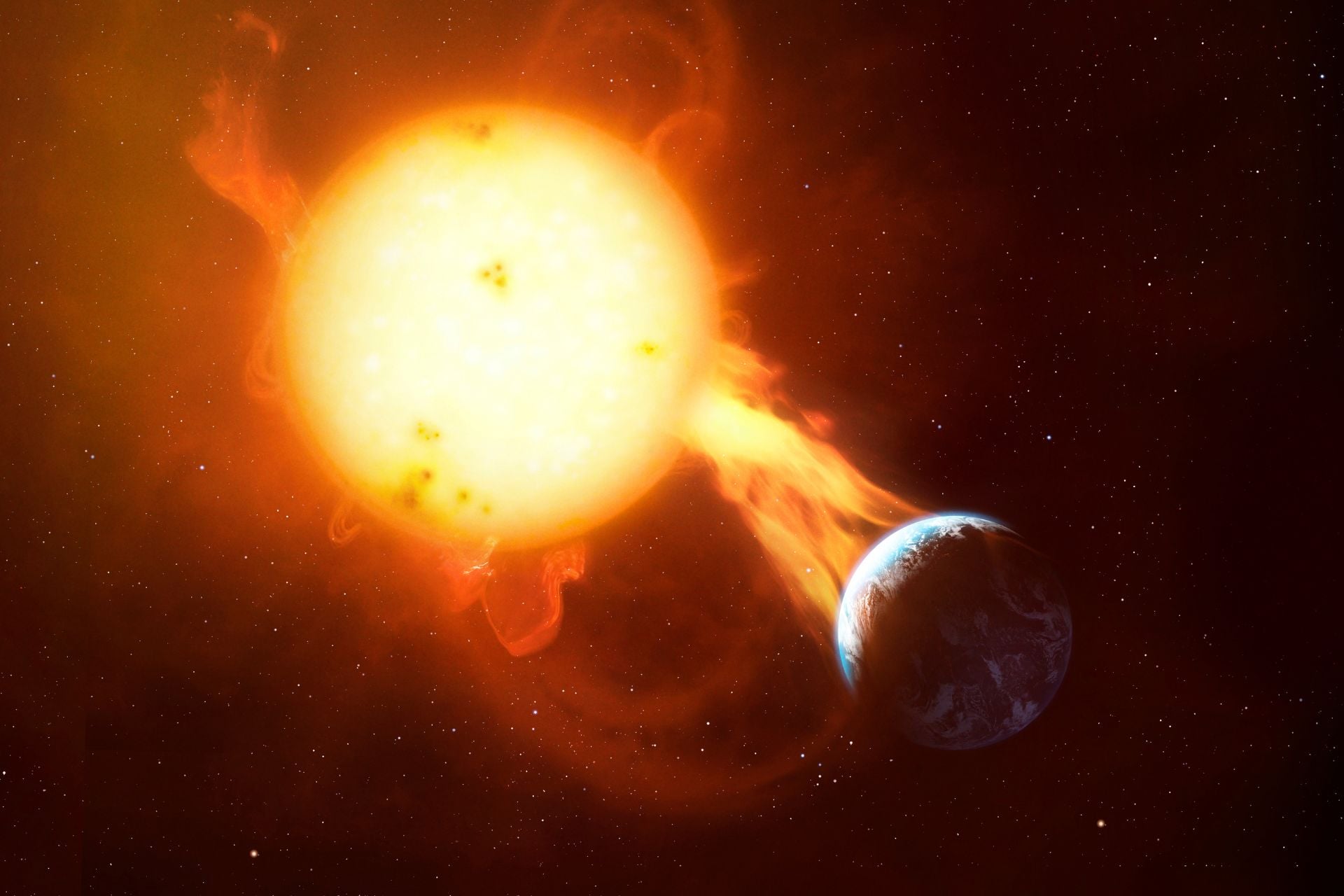
A solar storm is a disturbance in space weather caused by activity on the Sun. These storms usually begin with one or both of two major solar events: a solar flare and a coronal mass ejection, often called a CME.
A solar flare is a sudden burst of electromagnetic radiation released when magnetic energy stored in the Sun’s atmosphere is rapidly released. The radiation travels at the speed of light and reaches Earth in about eight minutes.
A coronal mass ejection is different. It involves billions of tons of electrically charged plasma being hurled into space. If a CME is directed toward Earth, it usually arrives one to three days later, depending on its speed.
When the charged particles from a CME collide with Earth’s magnetic field, they can trigger a geomagnetic storm. These storms can produce dazzling auroras while also disturbing satellites, radio signals, navigation systems, and electrical infrastructure.
Why Some Solar Storms Become Extremely Powerful
The Sun follows an approximately 11-year solar cycle during which its activity rises and falls. Around solar maximum, the number of sunspots, solar flares, and CMEs increases significantly.
The strongest solar storms usually occur when several conditions come together. A large and magnetically complex sunspot region produces an exceptionally energetic flare, followed by a fast-moving CME aimed directly at Earth. The orientation of the CME’s magnetic field is also important. If it is aligned opposite to Earth’s magnetic field, the interaction becomes much stronger, allowing more solar energy to enter Earth’s magnetosphere.
This combination can produce an extreme geomagnetic storm capable of affecting technology around the world.
The Carrington Event of 1859
The most famous solar storm in recorded history occurred in early September 1859. It remains the benchmark against which all other solar storms are measured.
British astronomer Richard Carrington was observing the Sun when he witnessed an unusually bright solar flare. Less than two days later, Earth was struck by an extraordinarily powerful CME.
The effects were astonishing.
Auroras appeared far beyond their usual polar regions. Brilliant red, green, and white lights illuminated skies across much of the world. In some places, people reportedly read newspapers outdoors at night because the sky was so bright.
At the time, the telegraph was the world’s most advanced communication system. The storm caused widespread disruptions. Telegraph operators received electric shocks, equipment malfunctioned, and some telegraph systems continued operating even after their batteries had been disconnected because the storm itself induced electrical currents in the wires.
Although society in 1859 depended far less on electricity than today, the Carrington Event demonstrated that the Sun could directly affect human technology.
Scientists estimate that if a storm of similar strength occurred today, it could cause widespread disruptions to satellites, communications, navigation systems, aviation, and electrical power networks.
The Great Geomagnetic Storm of May 1921
One of the most severe solar storms after the Carrington Event occurred in May 1921. Sometimes called the New York Railroad Storm, it affected electrical and communication systems in several countries.
Telegraph and telephone services experienced widespread failures. Electrical equipment overheated, and fires broke out in some communication facilities because of intense geomagnetically induced currents.
Auroras extended to unusually low latitudes, creating spectacular nighttime displays visible far from the polar regions.
Although this storm occurred before the satellite age, it demonstrated once again that powerful solar activity could significantly affect technological systems.
The Solar Storm of February 1956
In February 1956, Earth experienced one of the strongest recorded solar particle events.
Unlike geomagnetic storms, which mainly affect Earth’s magnetic environment, solar energetic particles travel at extremely high speeds and can reach Earth relatively quickly.
The 1956 event produced an enormous increase in high-energy particles detected by ground-based instruments known as neutron monitors. It remains one of the largest ground-level radiation events ever recorded.
Scientists were particularly interested because such energetic particles pose serious risks to astronauts, satellites, and spacecraft operating beyond Earth’s protective atmosphere.
The August 1972 Solar Storm
During August 1972, an exceptionally fast solar storm traveled from the Sun to Earth in only about 15 hours, making it one of the fastest known CMEs ever observed.
The storm caused significant disruptions to communications and affected satellites operating in space.
This event became especially important years later when scientists realized its timing. It occurred between NASA’s Apollo 16 and Apollo 17 Moon missions. Had astronauts been traveling to or working on the Moon during the peak radiation from this event, they could have received dangerous radiation exposure because the Moon lacks the protective magnetic field and thick atmosphere that shield Earth.
Today, this storm serves as a valuable reminder of the challenges future astronauts may face during long-duration missions to the Moon or Mars.
The March 1989 Quebec Blackout
One of the clearest examples of modern society’s vulnerability to solar storms occurred in March 1989.
A powerful CME struck Earth’s magnetic field and generated intense geomagnetically induced currents. These currents flowed through long electrical transmission lines and overloaded parts of the Hydro-Québec power grid in Canada.
Within minutes, the electrical system collapsed, leaving millions of people without electricity for approximately nine hours.
The storm also affected satellites, radio communications, and navigation systems while producing brilliant auroras visible much farther south than normal.
This event became a turning point in space weather research. Power companies around the world began taking solar storms more seriously and developed better methods for protecting electrical infrastructure.
The Halloween Solar Storms of 2003
Late October and early November 2003 brought one of the most active periods of solar activity in modern history.
A giant sunspot region produced numerous powerful solar flares, including several among the strongest ever measured.
The resulting solar storms disrupted satellite operations, affected GPS accuracy, interrupted radio communications, and forced airlines to reroute some high-latitude flights because of increased radiation and communication concerns.
Several satellites experienced temporary problems, while astronauts aboard the International Space Station took precautions during periods of elevated radiation.
The storms also generated spectacular auroras visible across large portions of Europe, North America, and other regions where such displays are rarely seen.
The Halloween Storms highlighted how deeply modern civilization depends on space-based technology.
The July 2012 Near Miss
One of the most remarkable solar events in recent history did not actually strike Earth.
In July 2012, the Sun produced an extremely powerful CME that crossed Earth’s orbit. Fortunately, Earth had moved beyond that location in its orbit just days earlier.
NASA spacecraft observed the event in detail and found that it was comparable in strength to the Carrington Event.
Had Earth been directly in its path, the consequences could have been severe. Satellites, communication systems, navigation networks, and electrical grids might have experienced widespread disruptions.
This near miss reminded scientists that extreme solar storms are not merely historical curiosities—they remain genuine natural hazards.
The Gannon Storm of May 2024
In May 2024, Earth experienced the strongest geomagnetic storm in more than two decades.
The storm reached the highest level on NOAA’s geomagnetic storm scale, classified as G5, following a series of powerful coronal mass ejections from an active region on the Sun.
Auroras became visible across unusually low latitudes in many parts of the world, delighting millions of people who rarely have the opportunity to witness the northern or southern lights.
The storm also caused temporary disruptions to some satellite operations, high-frequency radio communications, precision GPS services, and agricultural guidance systems. Scientists used the event to improve space weather forecasting and better understand how extreme geomagnetic storms affect modern infrastructure.
Although much weaker than the Carrington Event, the Gannon Storm demonstrated that significant solar storms remain a present-day reality.
How Scientists Measure Solar Storm Strength
There is no single number that defines the strength of every solar storm.
Solar flares are classified using X-ray intensity measured by satellites. They are divided into A, B, C, M, and X classes, with X-class flares being the most powerful. An X2 flare is twice as intense as an X1 flare, while an X10 flare is ten times stronger.
Geomagnetic storms are commonly measured using indices such as the Kp index and the Disturbance Storm Time (Dst) index. Larger disturbances in Earth’s magnetic field indicate stronger geomagnetic storms.
Scientists also measure solar energetic particles, CME speed, and changes in Earth’s magnetic field to understand the overall severity of an event.
How Solar Storms Affect Earth
Earth’s magnetic field acts as a protective shield against much of the Sun’s charged particle radiation. Without this shield, life on Earth’s surface would face much harsher space conditions.
However, even with this protection, strong solar storms can produce noticeable effects.
Satellites may experience charging, radiation damage, or temporary malfunctions. Radio communications can be interrupted, especially over polar regions. GPS accuracy may decrease during intense geomagnetic disturbances.
Power transmission lines can act like giant antennas, allowing geomagnetically induced currents to flow through electrical networks. If these currents become strong enough, they can overload transformers and cause widespread power outages.
Airlines sometimes alter flight routes during major storms to reduce radiation exposure and maintain reliable communications.
Astronauts aboard spacecraft are particularly vulnerable because they operate above much of Earth’s atmospheric protection.
The Beauty Hidden Within Solar Storms
Despite their potential dangers, solar storms also create one of nature’s most breathtaking displays.
As charged particles enter Earth’s upper atmosphere, they collide with oxygen and nitrogen atoms. These collisions release light, producing the shimmering curtains of green, red, purple, and blue known as auroras.
The stronger the solar storm, the farther these colorful displays spread from the poles. During the greatest storms, people living thousands of kilometers from the Arctic or Antarctic can witness skies filled with dancing light.
For many observers, an intense solar storm is remembered not for technological disruptions but for the unforgettable beauty painted across the night sky.
Could an Even Stronger Solar Storm Happen Again?
The evidence suggests that it could.
Studies of tree rings and ice cores have revealed signs of ancient extreme solar particle events that occurred long before modern observations. These findings indicate that exceptionally powerful solar storms have happened multiple times throughout history.
Scientists cannot predict exactly when the next extreme event will occur, but they know the possibility is real.
Fortunately, modern space weather monitoring has improved dramatically. Spacecraft continuously observe the Sun, tracking active regions, solar flares, and coronal mass ejections. While current technology cannot prevent solar storms, early warnings can give satellite operators, power companies, airlines, and governments valuable time to take protective measures.
What the Strongest Solar Storms Teach Us
The history of Earth’s greatest solar storms reveals both the incredible power of our nearest star and the remarkable resilience of our planet. These events remind us that the Sun is not a quiet, unchanging sphere of light but a dynamic star driven by powerful magnetic forces.
Each historic storm—from the Carrington Event of 1859 to the Gannon Storm of 2024—has expanded scientific understanding and improved our ability to prepare for future space weather. As technology becomes ever more central to daily life, understanding the Sun’s behavior is no longer just an astronomical pursuit. It is essential for protecting the systems that connect our modern world.
The strongest solar storms are reminders that even across nearly 150 million kilometers of space, the Sun can still reach out and touch Earth. By studying these extraordinary events, scientists continue to uncover the complex relationship between our planet and the star that makes life possible.