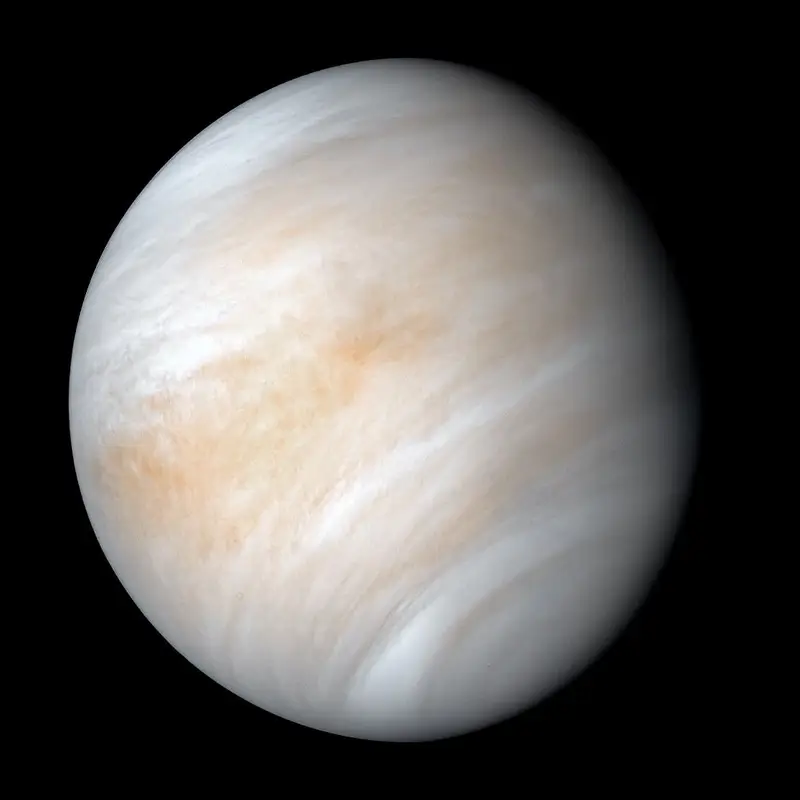
If beauty alone determined a planet’s character, Venus would seem like one of the most inviting worlds in our solar system. It shines brighter than any other planet in the night sky, often appearing as the brilliant “Morning Star” before sunrise or the dazzling “Evening Star” after sunset. For thousands of years, civilizations around the world admired its radiant glow, associating it with love, beauty, and divine power.
Yet beneath that glowing veil lies one of the most hostile environments known to science.
Venus is often called Earth’s “evil twin.” At first glance, the comparison seems appropriate. The two planets are remarkably similar in size, mass, and composition. They likely formed from the same cloud of dust and gas about 4.5 billion years ago. But while Earth became a vibrant world covered with oceans and life, Venus transformed into a scorching landscape where temperatures can melt lead, pressures can crush spacecraft, and clouds rain sulfuric acid.
For planetary scientists, Venus represents one of the greatest natural laboratories in the Solar System. By studying its atmosphere, geology, and climate, researchers hope to answer profound questions about how planets evolve, why Earth remained habitable, and whether similar worlds around other stars could also become uninhabitable.
The more scientists learn about Venus, the more extraordinary it becomes. Here are fifteen incredible facts that reveal why this mysterious world continues to fascinate astronomers and planetary scientists alike.
1. Venus Is Earth’s Closest Twin in Size
Among all the planets in the Solar System, Venus is the one that most closely resembles Earth in physical dimensions.
Its diameter is approximately 12,104 kilometers, compared with Earth’s 12,742 kilometers. That makes Venus about 95 percent as wide as our planet. It also possesses about 81.5 percent of Earth’s mass and roughly 90 percent of Earth’s surface gravity.
If you could somehow stand safely on Venus, you would weigh almost as much as you do on Earth.
This remarkable similarity led scientists to wonder for decades whether Venus might once have resembled our own world.
Both planets likely formed from similar materials during the early Solar System. They possess rocky interiors, metallic cores, and silicate crusts.
Yet despite these similarities, their evolutionary paths diverged dramatically.
Understanding why two nearly identical planets became so different remains one of planetary science’s most important questions.
2. Venus Is the Hottest Planet in the Solar System
Many people assume that Mercury, being closest to the Sun, must be the hottest planet.
Surprisingly, it is not.
Venus holds that title by a wide margin.
The average surface temperature reaches approximately 465°C (869°F) across nearly the entire planet.
That is hot enough to melt lead, zinc, and tin.
Even Mercury experiences cooler temperatures because it lacks a thick atmosphere. During its night, Mercury cools dramatically.
Venus, however, traps heat with extraordinary efficiency.
Its atmosphere consists of about 96.5 percent carbon dioxide, an exceptionally effective greenhouse gas. Incoming sunlight heats the surface, but much of the resulting infrared radiation cannot escape back into space.
This runaway greenhouse effect transformed Venus into a planetary furnace.
Remarkably, temperatures remain almost equally high from the equator to the poles and from day to night.
Few environments anywhere in the Solar System are more uniformly hostile.
3. A Day on Venus Is Longer Than Its Year
Venus possesses one of the strangest rotational behaviors of any planet.
It rotates extremely slowly.
One complete rotation takes about 243 Earth days.
By contrast, Venus completes one orbit around the Sun in only 225 Earth days.
This means a single Venusian day is actually longer than an entire Venusian year.
Even more astonishing, Venus rotates backward compared with most planets.
If viewed from above the Solar System’s north pole, most planets rotate counterclockwise.
Venus rotates clockwise.
This unusual motion is called retrograde rotation.
Scientists are still investigating exactly why this happened.
One possibility involves massive collisions early in the planet’s history.
Another suggests long-term interactions between the atmosphere and the planet’s interior gradually altered its rotation.
Regardless of the cause, sunrise on Venus occurs in the west, while sunset happens in the east.
4. Venus Spins So Slowly That Time Behaves Differently
Because Venus rotates so slowly, the movement of the Sun across its sky would seem incredibly unusual.
A solar day—the interval from one sunrise to the next—lasts about 117 Earth days.
This happens because Venus rotates backward while simultaneously orbiting the Sun.
If an astronaut could survive on Venus’ surface, they would experience weeks of daylight followed by weeks of darkness.
However, because the atmosphere is extraordinarily thick, sunlight reaching the surface would appear dim and heavily filtered rather than bright like Earth’s sunshine.
The slow rotation also influences atmospheric circulation, creating weather patterns unlike those found anywhere else in the Solar System.
5. Venus Has an Atmosphere Thick Enough to Crush Spacecraft
Standing on Venus would be like descending nearly one kilometer beneath Earth’s oceans.
Surface atmospheric pressure reaches approximately 92 times that of Earth’s sea-level pressure.
Every square centimeter experiences immense force.
Most ordinary spacecraft cannot survive these conditions.
Only specially engineered Soviet Venera landers successfully reached the surface and transmitted data before eventually failing.
The crushing pressure, combined with extreme heat, destroyed electronic systems within minutes to a few hours.
The atmosphere itself extends much higher than Earth’s and consists primarily of carbon dioxide with small amounts of nitrogen and trace gases.
Despite being hostile to humans, this dense atmosphere provides scientists with invaluable information about atmospheric physics and planetary evolution.
6. Venus Has Clouds Made of Sulfuric Acid
The bright white appearance of Venus comes not from its surface but from its permanent cloud cover.
These clouds are composed largely of tiny droplets of sulfuric acid mixed with other chemical compounds.
The cloud deck extends roughly 45 to 70 kilometers above the surface.
Although sulfuric acid is highly corrosive, the droplets evaporate before reaching the ground because the lower atmosphere becomes too hot.
In other words, Venus does not experience acid rain reaching the surface in the same way Earth experiences rainfall.
Instead, sulfuric acid forms, falls partially, evaporates, and participates in continuous atmospheric chemical cycles.
These clouds reflect approximately 75 percent of incoming sunlight, making Venus one of the brightest objects visible from Earth.
Ironically, despite reflecting enormous amounts of sunlight, Venus still remains the hottest planet because its thick atmosphere traps heat so effectively.
7. The Surface Is Hidden from Ordinary Telescopes
Unlike Mars, Jupiter, or Saturn, Venus reveals almost nothing through visible-light telescopes.
Its dense clouds completely conceal the surface.
For centuries, astronomers could only speculate about what lay beneath.
The mystery remained until radar technology revolutionized planetary exploration.
Radar waves penetrate the thick clouds and bounce off the surface.
Spacecraft such as NASA’s Magellan used radar mapping to reveal mountains, volcanoes, lava plains, impact craters, and tectonic features.
Without radar, humanity would still know almost nothing about Venusian geography.
8. Venus Is Covered with Volcanoes
Venus possesses one of the most volcanic surfaces in the Solar System.
Scientists have identified more than 85,000 volcanic structures ranging from tiny volcanic cones to enormous shield volcanoes.
Some rival Earth’s largest volcanic mountains.
The tallest known volcano, Maat Mons, rises roughly eight kilometers above the surrounding terrain.
For many years researchers debated whether Venus remained volcanically active.
Increasing evidence now suggests that at least some volcanoes may have erupted in geologically recent times, and spacecraft observations have identified changes that are consistent with ongoing volcanic activity.
If confirmed, Venus would still be a volcanically active planet today.
9. Venus Has Very Few Impact Craters
Compared with the Moon or Mercury, Venus has surprisingly few impact craters.
Scientists believe this is because its surface underwent widespread geological resurfacing several hundred million years ago.
Massive volcanic eruptions likely buried older landscapes beneath enormous lava flows.
As a result, much of Venus’ visible surface appears relatively young in geological terms.
Its dense atmosphere also protects the planet from smaller meteoroids.
Many incoming objects burn up or break apart before reaching the ground.
Only larger asteroids typically create impact craters.
10. Venus Has No Moons
Unlike Earth, Mars, Jupiter, and most major planets, Venus has no natural satellites.
Mercury also lacks moons.
Scientists are not entirely certain why.
Some theories suggest that giant impacts early in planetary history prevented stable moon formation.
Others propose that gravitational interactions with the Sun destabilized any ancient satellites that may once have existed.
Whatever the explanation, Venus travels around the Sun completely alone.
11. The Winds Above Venus Are Faster Than a Hurricane
Although Venus rotates extremely slowly, its upper atmosphere races around the planet at astonishing speeds.
This phenomenon is known as atmospheric super-rotation.
Cloud tops can move at speeds exceeding 360 kilometers per hour (220 mph).
These winds circle the entire planet in only about four Earth days.
Remarkably, the atmosphere rotates roughly sixty times faster than the planet itself.
Scientists continue investigating how this remarkable circulation develops and persists.
Understanding atmospheric super-rotation also helps researchers study similar processes on exoplanets and gas giants.
12. Venus May Once Have Had Oceans
One of the most intriguing scientific questions concerns Venus’ distant past.
Some climate models suggest that early Venus may have possessed liquid water on its surface.
Billions of years ago, before the runaway greenhouse effect intensified, temperatures might have been significantly lower.
If oceans existed, they eventually disappeared.
Ultraviolet radiation from the Sun broke apart water molecules high in the atmosphere.
Hydrogen escaped into space while oxygen reacted with rocks or other atmospheric components.
Today, Venus is extraordinarily dry.
Whether oceans truly existed remains uncertain, but the possibility continues to motivate future exploration.
13. Venus Has Mountains Taller Than Many on Earth
Although often imagined as a flat volcanic world, Venus possesses impressive mountain ranges.
The highest mountain is Maxwell Montes.
It rises approximately 11 kilometers above the average planetary radius.
This makes it taller than Mount Everest when measured from mean planetary surface level, although the comparison differs from Earth’s sea-level measurements.
Scientists believe tectonic forces, volcanic processes, and crustal deformation all contributed to the formation of these elevated regions.
Studying these mountains helps researchers understand how rocky planets evolve without Earth’s style of plate tectonics.
14. Spacecraft Have Struggled to Survive on Venus
Landing on Venus represents one of the greatest engineering challenges in planetary exploration.
The Soviet Union achieved remarkable success with its Venera missions during the twentieth century.
Several spacecraft landed successfully and returned photographs from the surface.
The longest-lived surface mission survived for just over two hours before succumbing to the extreme environment.
Electronics overheated.
Pressure damaged systems.
Corrosive atmospheric conditions accelerated failure.
Modern engineers continue developing technologies capable of operating much longer under Venusian conditions.
Future missions hope to survive for weeks—or even months.
15. Venus May Hold the Key to Earth’s Future
Perhaps the most important fact about Venus is not what it is today but what it teaches us.
Earth and Venus began as remarkably similar rocky planets.
Yet one became habitable while the other evolved into a world of crushing pressure and searing heat.
Understanding why these paths diverged has profound implications.
Scientists studying Venus investigate atmospheric evolution, volcanic activity, planetary interiors, cloud chemistry, and greenhouse processes.
These studies improve climate models used not only for Earth but also for distant exoplanets orbiting other stars.
Venus serves as a natural laboratory for understanding planetary climate change on the largest possible scale.
It reminds us that planetary environments can evolve dramatically over billions of years.
Why Scientists Are Returning to Venus
For decades, Mars attracted most public attention, while Venus remained comparatively neglected.
That is beginning to change.
New missions planned by NASA, the European Space Agency, and other space agencies aim to investigate Venus with advanced radar systems, atmospheric probes, and high-resolution instruments.
Researchers hope to determine whether volcanoes remain active, understand the planet’s geological history, analyze atmospheric chemistry in greater detail, and search for clues about its ancient climate.
Each new mission promises to answer long-standing questions while undoubtedly creating new ones.
The Planet That Continues to Surprise Us
Venus is often described as Earth’s twin, but that description only tells part of the story. It is a world of astonishing contradictions. Similar in size to Earth, yet unimaginably different in climate. Brilliant enough to dominate the night sky, yet hiding its surface beneath opaque clouds. Geologically active, but unlike any landscape found on our own planet. Familiar in appearance from afar, but utterly alien up close.
Every discovery about Venus deepens scientists’ understanding of planetary evolution. It shows how delicate the balance of habitability can be and how dramatically similar worlds can follow different destinies.
Far from being merely a bright point in the evening sky, Venus is one of the Solar System’s greatest scientific mysteries—a planet whose beauty conceals one of the harshest environments known, and whose secrets may ultimately help us understand not only our neighboring world but also the countless rocky planets scattered throughout our galaxy.