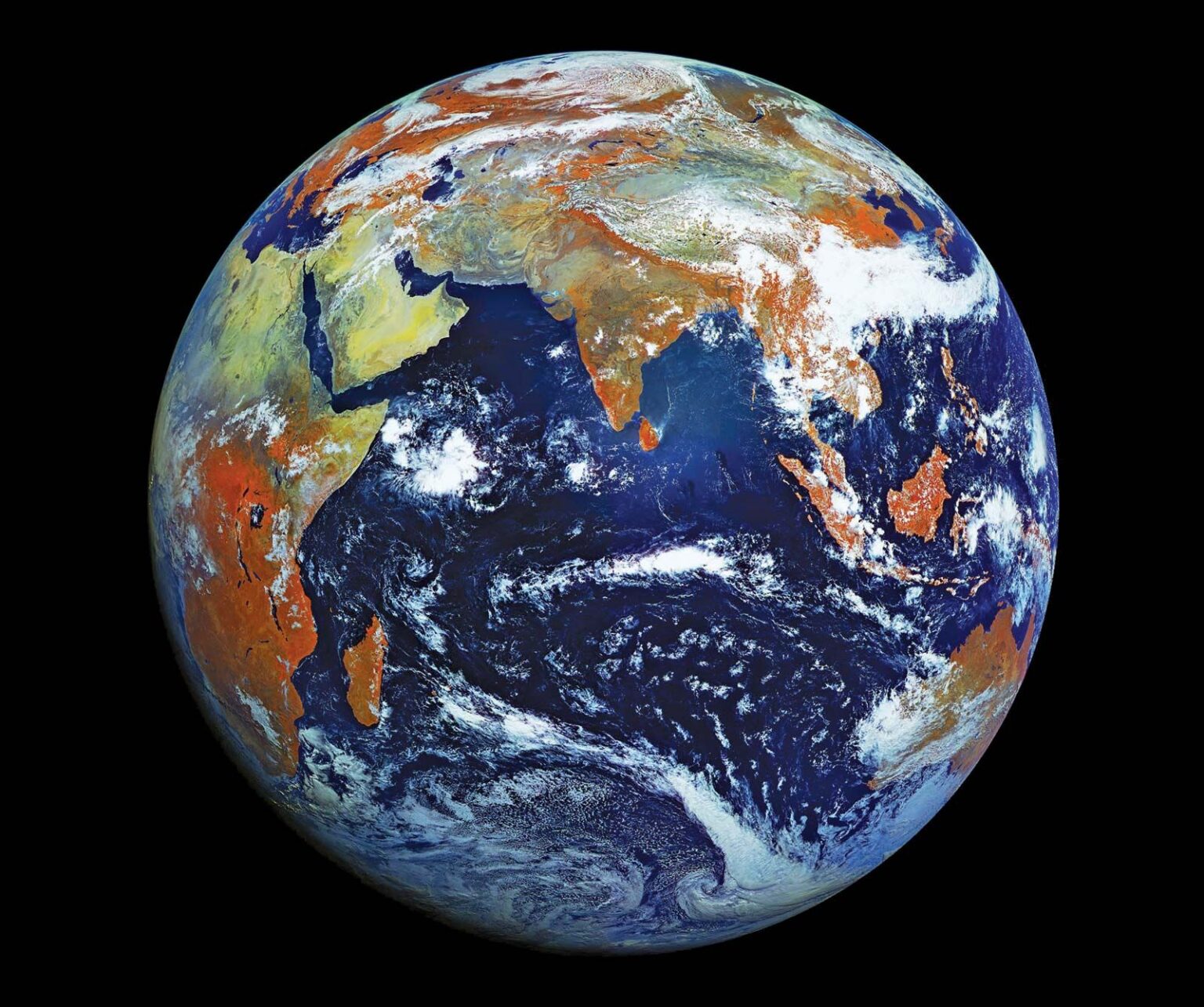
From space, Earth appears as a brilliant blue marble suspended in the darkness of the cosmos. At first glance, it may seem like just another rocky planet orbiting an ordinary star. But the more scientists study our world, the more extraordinary it becomes.
Earth is the only known planet in the universe that supports life. It has survived devastating asteroid impacts, global ice ages, massive volcanic eruptions, and countless other challenges over its 4.5-billion-year history. Its atmosphere protects life from harmful radiation, its oceans regulate climate, and its dynamic interior constantly reshapes the planet’s surface.
Modern science has revealed that Earth is far more complex and fascinating than most people realize. Beneath our feet, continents drift across molten rock. Above us, invisible magnetic fields shield us from deadly solar particles. Deep below the oceans, strange ecosystems thrive without sunlight. Every second, thousands of natural processes work together to maintain the delicate balance that makes life possible.
Here are fifteen incredible facts about Earth that showcase just how remarkable our home truly is.
1. Earth Is the Only Known Planet That Supports Life
Among the thousands of confirmed exoplanets discovered beyond our Solar System, Earth remains unique.
Scientists have found planets larger than Earth, smaller than Earth, hotter than Earth, and colder than Earth. Some orbit multiple stars, while others circle red dwarf suns. Yet despite decades of searching, no world has been confirmed to host life.
Earth possesses a remarkable combination of conditions that allow living organisms to thrive. Liquid water covers about 71% of its surface. Its atmosphere contains oxygen, nitrogen, carbon dioxide, and other gases in proportions that support life. The planet maintains temperatures suitable for liquid water across much of its surface, and its magnetic field protects organisms from harmful charged particles from space.
While scientists continue searching for extraterrestrial life, Earth remains the only place where life is known to exist.
2. Earth Is About 4.54 Billion Years Old
Earth’s history stretches back almost unimaginably far.
Scientists estimate that the planet formed approximately 4.54 billion years ago from the cloud of gas and dust left behind after the Sun formed.
Researchers determine Earth’s age using radiometric dating, which measures the decay of radioactive elements within ancient rocks and meteorites. Although Earth’s oldest rocks have been altered by geological activity, meteorites that formed alongside our planet preserve an accurate record of the Solar System’s age.
If Earth’s entire history were compressed into a single calendar year, modern humans would appear only during the final minutes of December 31.
3. Earth’s Surface Is Constantly Moving
Although the ground beneath our feet feels solid and permanent, Earth’s surface is constantly changing.
The planet’s outer shell is divided into massive tectonic plates that slowly move atop the semi-fluid mantle beneath them. These plates drift at rates comparable to the growth of human fingernails—typically a few centimeters per year.
Over millions of years, these tiny movements reshape entire continents.
The Himalayas continue rising as the Indian Plate pushes into the Eurasian Plate. The Atlantic Ocean grows wider as North America and Europe slowly move apart. New ocean floor forms at mid-ocean ridges while older crust disappears beneath subduction zones.
Plate tectonics creates mountains, triggers earthquakes, fuels volcanic eruptions, and continuously remodels Earth’s surface.
4. Earth’s Core Is Nearly as Hot as the Surface of the Sun
Travel toward Earth’s center, and temperatures rise dramatically.
The planet consists of several layers: the crust, mantle, outer core, and inner core.
The solid inner core is composed primarily of iron and nickel. Scientists estimate its temperature reaches approximately 5,200 to 6,000 degrees Celsius (9,400–10,800°F), comparable to the temperature of the Sun’s visible surface.
Despite these extreme temperatures, immense pressure keeps the inner core solid.
Scientists cannot directly observe the core, so they study it using seismic waves generated by earthquakes. These waves change speed and direction as they pass through different layers, allowing researchers to reconstruct Earth’s internal structure.
5. Earth Has a Powerful Magnetic Shield
One of Earth’s greatest invisible protectors is its magnetic field.
The movement of molten iron within the liquid outer core generates electric currents, producing a global magnetic field through a process known as the geodynamo.
This magnetic field extends tens of thousands of kilometers into space, forming the magnetosphere.
Without this protective shield, the solar wind—a constant stream of charged particles emitted by the Sun—would gradually strip away Earth’s atmosphere, much as it likely did on Mars.
The magnetic field also guides compasses and creates spectacular auroras near the poles when energetic particles collide with atmospheric gases.
6. More Than 70% of Earth Is Covered by Water
Earth is often called the “Blue Planet” for good reason.
Roughly 71% of its surface is covered by oceans, seas, lakes, and rivers.
However, almost 97% of this water is salty.
Only about 3% is freshwater, and most of that is locked away in glaciers, ice sheets, and underground aquifers.
The amount of readily accessible freshwater available for human use is surprisingly small.
Earth’s water continuously circulates through the hydrological cycle, evaporating from oceans, condensing into clouds, falling as precipitation, and returning through rivers and groundwater.
7. Most of Earth Remains Unexplored
Despite centuries of exploration, much of our planet remains unknown.
This is especially true beneath the oceans.
The deep seafloor is difficult and expensive to study because of crushing pressures, darkness, and extreme conditions.
Scientists have mapped much of the ocean floor at low resolution using satellites, but only a relatively small percentage has been surveyed in high detail.
Each year, researchers discover previously unknown underwater mountains, canyons, hydrothermal vents, and marine species.
Earth still contains frontiers waiting to be explored.
8. Earth Is Not a Perfect Sphere
Many people imagine Earth as a perfect ball.
In reality, it is slightly flattened at the poles and bulges around the equator.
This shape is called an oblate spheroid.
Earth rotates once every 24 hours, and this rotation produces centrifugal effects that cause the equatorial region to bulge outward.
The equatorial diameter is about 43 kilometers (27 miles) greater than the pole-to-pole diameter.
Modern satellites measure Earth’s shape with extraordinary precision, revealing even subtle variations caused by mountains, ocean trenches, and changes in gravity.
9. Earth Has an Atmosphere That Protects Life
Earth’s atmosphere does far more than provide air to breathe.
It shields life from harmful ultraviolet radiation through the ozone layer.
It burns up countless meteoroids before they reach the ground.
It traps enough heat through the natural greenhouse effect to keep average temperatures suitable for liquid water.
Without the atmosphere, Earth would experience extreme temperature swings similar to those on the Moon, where daytime temperatures soar while nighttime temperatures plunge far below freezing.
The atmosphere also supports weather, distributes heat around the planet, and enables the water cycle.
10. Earth’s Rotation Is Gradually Slowing Down
Earth does not spin at exactly the same speed forever.
The gravitational pull of the Moon creates tides in Earth’s oceans. These tidal interactions gradually transfer rotational energy away from Earth.
As a result, Earth’s day becomes longer by roughly 1.7 milliseconds every century.
This change is tiny on human timescales but significant over millions of years.
Hundreds of millions of years ago, a day on Earth lasted only about 22 hours.
Eventually, the slowing rotation will continue, although the process is extremely gradual.
11. Earth’s Highest and Deepest Points Are Astonishingly Different
The tallest point above sea level is the summit of Mount Everest, reaching approximately 8,849 meters (29,032 feet).
Meanwhile, the deepest known location in Earth’s oceans is the Challenger Deep.
Its depth exceeds 10,900 meters (35,700 feet).
If Mount Everest were placed inside Challenger Deep, its summit would still remain more than two kilometers below sea level.
The pressure at the bottom of Challenger Deep exceeds one thousand times atmospheric pressure at Earth’s surface.
Yet even there, scientists have discovered living organisms adapted to these extreme conditions.
12. Earth Recycles Its Surface
Unlike most rocky planets in the Solar System, Earth constantly renews its surface.
Plate tectonics causes old oceanic crust to sink back into the mantle through subduction while new crust forms along mid-ocean ridges.
Wind, water, glaciers, and biological activity continually erode mountains and transport sediments.
Volcanoes create entirely new landscapes.
Over millions of years, this geological recycling erases many traces of Earth’s ancient past.
This is one reason why relatively few rocks older than four billion years remain today.
13. Earth’s Climate Has Changed Dramatically Throughout History
Earth has never possessed a completely stable climate.
Its history includes periods when glaciers covered much of the continents and warmer intervals when tropical forests reached high latitudes.
Scientists study ancient climates using ice cores, sediment layers, fossil pollen, coral growth rings, and chemical signatures preserved in rocks.
These records reveal that Earth’s climate naturally changes over geological timescales due to factors including volcanic activity, orbital variations, continental movement, and atmospheric composition.
Understanding these long-term changes helps scientists better interpret present-day climate processes.
14. Every Living Thing Shares a Common Ancestry
One of biology’s most remarkable discoveries is that all known life on Earth is related.
Whether examining giant whales, towering redwood trees, microscopic bacteria, or humans, scientists find the same fundamental genetic code based on DNA.
Cells use many of the same molecular mechanisms.
Proteins are built from the same twenty standard amino acids.
Energy is stored using similar biochemical systems.
These shared characteristics provide overwhelming evidence that all modern organisms descended from ancient common ancestors over billions of years through evolution.
Earth’s incredible biodiversity emerged from this long and continuous history of life.
15. Earth Is Constantly Changing—and So Are We
Perhaps the most incredible fact about Earth is that it has never stopped changing.
Mountains rise and erode.
Oceans open and close.
Species evolve and disappear.
Continents drift across the globe.
Magnetic poles occasionally reverse.
Climate fluctuates.
Even the atoms within our own bodies participate in Earth’s continuous cycles.
The oxygen we breathe has passed through countless living organisms. The water we drink may once have flowed through ancient rivers or frozen inside glaciers. The carbon in our cells was forged inside long-dead stars before becoming part of Earth’s rocks, oceans, atmosphere, and eventually, life itself.
Earth is not a static planet.
It is a dynamic, interconnected system where geology, biology, chemistry, physics, and astronomy all work together.
Why Earth Is Truly Extraordinary
The more scientists study Earth, the more remarkable it appears.
It is a planet with a molten heart, moving continents, protective magnetic shield, life-supporting atmosphere, and vast oceans that regulate climate. It hosts millions of species connected through billions of years of evolution, while its landscapes continue to transform through powerful natural forces.
At the same time, Earth reminds us how much remains unknown. New species are discovered every year. Hidden geological processes continue to surprise researchers. The deep oceans still conceal mysteries, and Earth’s climate system reveals new complexities with every scientific advance.
Among the countless worlds scattered throughout the universe, Earth is, so far, the only known place where oceans shimmer beneath blue skies, forests breathe, animals roam, and human beings can look upward, wonder about the cosmos, and uncover the remarkable story of the planet they call home.