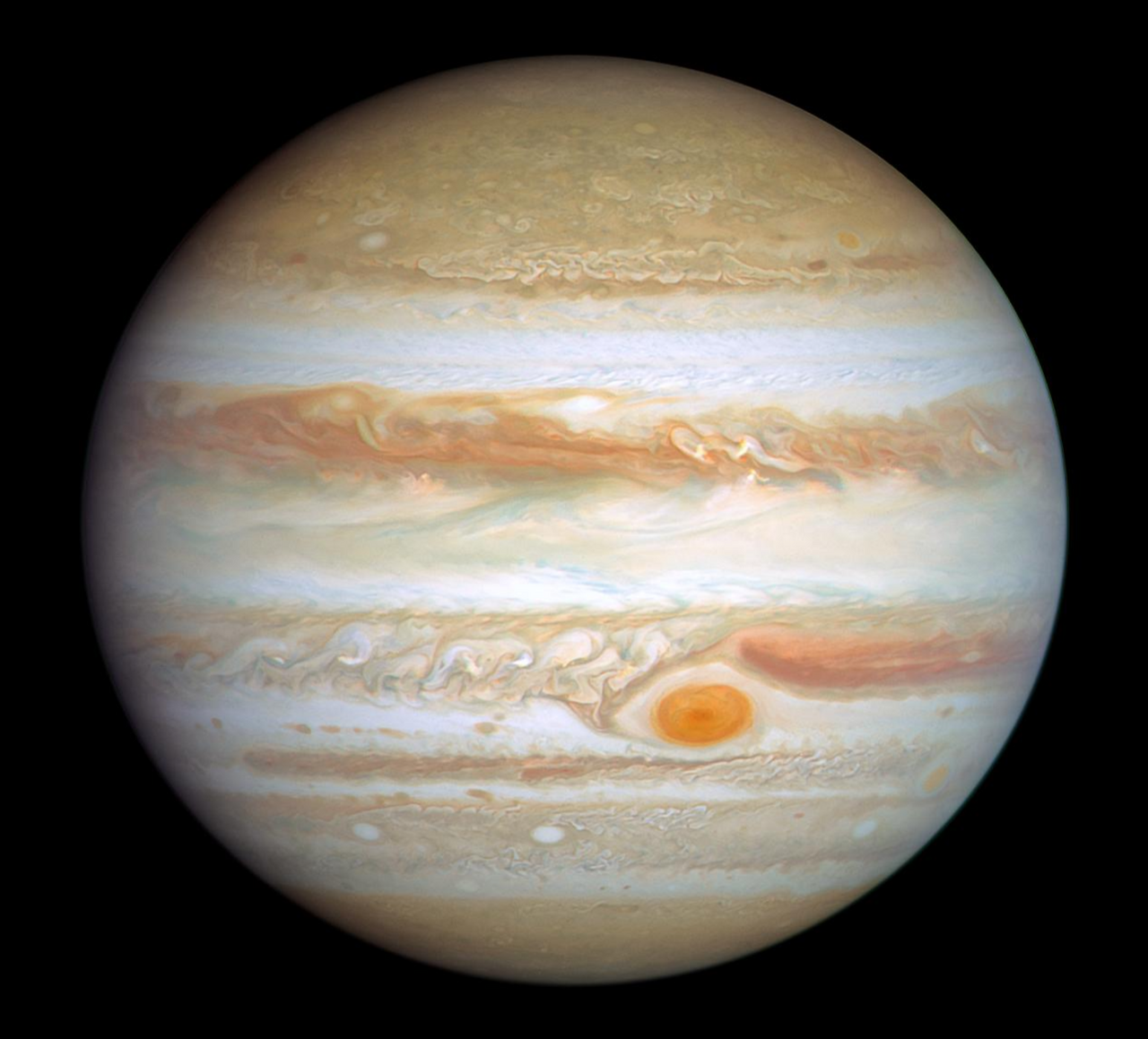
Far beyond the warmth of Earth’s familiar skies, beyond the rocky worlds of Mars and the scattered asteroids that orbit the Sun, a colossal planet dominates the outer Solar System. This is Jupiter—a world so immense that it contains more than twice the mass of every other planet combined. It is a planet of towering storms, crushing pressures, dazzling auroras, mysterious moons, and powerful magnetic fields unlike anything found on Earth.
For thousands of years, Jupiter has fascinated humanity. Ancient civilizations watched it drift among the stars, recognizing it as one of the brightest objects in the night sky. Through telescopes, astronomers discovered its changing cloud bands and four large moons, revealing that not everything revolved around Earth. In modern times, robotic spacecraft have transformed Jupiter from a distant point of light into one of the most scientifically important worlds ever explored.
Yet despite decades of research, Jupiter still guards many secrets. Its interior remains hidden beneath thousands of kilometers of clouds. Scientists continue to investigate how its enormous magnetic field forms, why its iconic Great Red Spot has survived for centuries, and what lies beneath its colorful atmosphere.
Every new mission reveals another surprise.
Here are fifteen incredible facts that show why Jupiter is one of the most extraordinary planets in our Solar System.
1. Jupiter Is the Largest Planet in the Solar System
Everything about Jupiter is enormous.
Its diameter measures approximately 143,000 kilometers (about 88,800 miles), making it roughly eleven times wider than Earth. If Earth were the size of a grape, Jupiter would be about the size of a basketball.
Its sheer volume is even more astonishing. More than 1,300 Earth-sized planets could fit inside Jupiter if it were hollow.
Mass tells an equally remarkable story. Jupiter contains about 318 times Earth’s mass and more than twice the combined mass of every other planet in the Solar System.
Despite this immense size, Jupiter is still far too small to become a star. Astronomers estimate it would need roughly 75 to 80 times its current mass before nuclear fusion could ignite in its core.
Instead, Jupiter remains the undisputed giant among planets—a world occupying the boundary between ordinary planets and the smallest stars.
2. Jupiter Spins Faster Than Any Other Planet
Although Jupiter is enormous, it rotates incredibly quickly.
A single day on Jupiter lasts only about 9 hours and 56 minutes, making it the shortest planetary day in the Solar System.
Imagine a world more than eleven times wider than Earth completing an entire rotation in less than ten hours.
This rapid spin dramatically affects the planet’s shape.
Rather than being a perfect sphere, Jupiter bulges around its equator. Its equatorial diameter is significantly larger than its polar diameter because centrifugal forces push the planet outward as it rotates.
The rapid rotation also helps drive Jupiter’s spectacular atmospheric circulation, contributing to the formation of its colorful cloud bands and massive storms.
3. The Great Red Spot Is a Storm Larger Than Earth
Among Jupiter’s most recognizable features is the famous Great Red Spot.
This enormous storm has raged for at least 190 years, and historical observations suggest it may have existed for more than 350 years.
Unlike hurricanes on Earth, which weaken after days or weeks as they move over land or cooler water, Jupiter has no solid surface to disrupt storms.
The Great Red Spot is an enormous anticyclonic vortex with wind speeds exceeding 400 kilometers per hour (250 miles per hour).
Although the storm has gradually shrunk during recent decades, it remains larger than Earth.
Scientists still do not fully understand why it has persisted for centuries.
Its distinctive reddish color is also mysterious. Researchers suspect that ultraviolet sunlight triggers chemical reactions involving compounds such as ammonia and sulfur-containing materials in Jupiter’s upper atmosphere, but the exact mechanism remains uncertain.
4. Jupiter Has More Than 90 Known Moons
Jupiter is not merely a planet—it is an entire miniature planetary system.
Astronomers have confirmed more than 90 natural satellites orbiting Jupiter, and additional small moons continue to be discovered.
These moons vary enormously in size.
Some are tiny objects only a few kilometers across.
Others rival or exceed the size of planets.
The four largest moons—Io, Europa, Ganymede, and Callisto—were discovered in 1610 by Galileo Galilei.
Known as the Galilean moons, they transformed astronomy forever by demonstrating that celestial bodies could orbit something other than Earth.
Each of these moons is a fascinating world in its own right.
Together, they make Jupiter one of the richest destinations for planetary exploration.
5. Ganymede Is the Largest Moon in the Solar System
One of Jupiter’s moons holds an extraordinary distinction.
Ganymede is the largest moon in the Solar System.
Its diameter measures approximately 5,268 kilometers (3,273 miles), making it larger than the planet Mercury.
If Ganymede orbited the Sun independently instead of Jupiter, it might easily be classified as a planet.
Ganymede is also unique because it possesses its own magnetic field—the only known moon with this feature.
Evidence suggests that beneath its icy crust lies a deep subsurface ocean containing more water than all of Earth’s surface oceans combined.
Scientists consider Ganymede one of the most intriguing worlds for understanding planetary evolution.
6. Europa May Hide a Global Ocean Beneath Ice
Among Jupiter’s moons, Europa has become one of the most exciting targets in the search for extraterrestrial life.
Its bright icy surface is covered with long fractures and ridges rather than large mountains or impact craters.
These features strongly suggest that the ice floats above a global ocean of liquid water.
Scientists estimate that Europa’s ocean may contain roughly twice as much water as all of Earth’s oceans combined.
The water remains liquid because Jupiter’s immense gravity continually stretches and squeezes Europa, generating internal heat through tidal forces.
This process may also create hydrothermal activity on the ocean floor.
On Earth, hydrothermal vents support rich ecosystems entirely independent of sunlight.
If similar environments exist on Europa, they could potentially provide conditions suitable for microbial life.
Future missions hope to investigate this remarkable possibility.
7. Io Is the Most Volcanically Active World Known
While Europa hides oceans beneath ice, another moon experiences extraordinary violence.
Io is the most volcanically active object in the Solar System.
Hundreds of active volcanoes continuously reshape its surface.
Some eruptions send material hundreds of kilometers above the moon.
This extreme activity results from tidal heating.
As Io orbits Jupiter, gravitational forces from both Jupiter and neighboring moons repeatedly flex its interior.
This constant squeezing generates tremendous heat, melting rock beneath the surface.
Instead of icy landscapes like Europa, Io displays colorful plains coated with sulfur compounds, lava flows, and volcanic deposits.
Its surface changes so rapidly that maps require continual updating.
8. Jupiter’s Magnetic Field Is Enormously Powerful
Jupiter possesses the strongest planetary magnetic field in the Solar System.
Near the planet, it is roughly twenty thousand times stronger than Earth’s magnetic field.
The magnetic field extends astonishingly far into space.
The resulting magnetosphere is the largest continuous structure in the Solar System after the Sun itself.
If the magnetosphere were somehow visible from Earth, it would appear larger than the full Moon despite Jupiter’s enormous distance.
This immense magnetic environment traps charged particles, creating intense radiation belts that pose serious challenges for spacecraft.
Exploring Jupiter requires specially designed radiation shielding because prolonged exposure can damage electronics.
9. Jupiter Produces Spectacular Auroras
Earth is famous for its northern and southern lights.
Jupiter also has auroras—but on an entirely different scale.
Its auroras shine continuously rather than appearing only during periods of strong solar activity.
Powered both by the solar wind and particles originating from Io’s volcanic eruptions, Jupiter’s auroras rank among the brightest anywhere in the Solar System.
They are especially intense in ultraviolet wavelengths.
Space telescopes and planetary spacecraft have observed dazzling rings of light encircling Jupiter’s poles.
These displays reveal the complex interaction between magnetic fields, charged particles, and atmospheric gases.
10. Jupiter Has Faint Rings
When people think of planetary rings, Saturn usually comes to mind.
However, Jupiter also possesses a ring system.
Unlike Saturn’s bright icy rings, Jupiter’s rings are extremely faint and composed mainly of microscopic dust particles.
They were discovered in 1979 by NASA’s Voyager Program spacecraft.
The dust originates primarily from tiny meteoroid impacts on several small inner moons.
Each impact ejects particles into space, where they gradually spread into diffuse rings.
Although invisible to ordinary backyard telescopes, these rings reveal that ring systems are not unique to Saturn.
11. Jupiter Emits More Heat Than It Receives
One of Jupiter’s most surprising characteristics lies beneath its clouds.
The planet radiates significantly more energy into space than it receives from the Sun.
This additional heat originates largely from Jupiter’s slow gravitational contraction.
As the planet gradually compresses under its own immense gravity, gravitational energy converts into heat.
This process, known as the Kelvin–Helmholtz mechanism, has continued for billions of years.
The internal heat helps power atmospheric circulation and contributes to the formation of Jupiter’s giant storms.
Unlike Earth, whose climate is driven primarily by sunlight, Jupiter’s atmosphere is strongly influenced by energy rising from deep within the planet.
12. Jupiter Helped Shape the Solar System
Jupiter’s immense gravity has influenced the Solar System since its earliest history.
Many planetary scientists believe Jupiter played a major role in determining the final arrangement of planets.
Its gravity affects asteroid orbits, redirects comets, and creates regions where stable planetary formation became impossible.
Some studies suggest Jupiter may even have migrated inward and then outward during the Solar System’s earliest millions of years, influencing the formation of Mars and the asteroid belt.
Today, Jupiter continues acting as a powerful gravitational force.
Some comets are captured into stable orbits.
Others are ejected entirely from the Solar System.
Its influence extends across vast distances.
13. Jupiter Can Capture and Redirect Comets
Jupiter’s gravity is so powerful that it regularly alters the paths of passing objects.
One of the most dramatic examples occurred in 1994.
The comet Comet Shoemaker–Levy 9 had previously been captured by Jupiter’s gravity.
Tidal forces eventually tore the comet apart into multiple fragments.
Those fragments later collided with Jupiter, producing enormous explosions visible from Earth-based telescopes.
The impact scars exceeded Earth’s diameter.
This event provided scientists with an unprecedented opportunity to study both comet composition and Jupiter’s atmosphere.
It also demonstrated that giant planets continue to experience significant impacts today.
14. Jupiter Has No Solid Surface
Unlike Earth, Jupiter does not possess a traditional solid surface.
Its visible clouds mark only the uppermost layers of a vast atmosphere composed primarily of hydrogen and helium.
As one descends deeper, atmospheric pressure increases enormously.
The gases become progressively denser until hydrogen eventually behaves like a liquid.
Farther down, under extreme pressures millions of times greater than Earth’s atmospheric pressure, hydrogen transforms into an exotic state known as metallic hydrogen.
In this phase, hydrogen conducts electricity like a metal.
Scientists believe metallic hydrogen plays a major role in generating Jupiter’s powerful magnetic field.
Whether Jupiter possesses a distinct rocky core remains an active area of research.
Recent spacecraft observations suggest that if a core exists, it may be diffuse rather than sharply defined.
15. Jupiter Continues to Surprise Scientists
Despite centuries of observation and numerous spacecraft missions, Jupiter remains full of mysteries.
NASA’s Juno spacecraft, which entered orbit around Jupiter in 2016, has revolutionized our understanding of the giant planet.
Juno has revealed that Jupiter’s atmospheric bands extend much deeper than previously believed.
It has discovered enormous cyclones surrounding both poles.
It has improved measurements of the planet’s gravity and magnetic field.
It has shown that Jupiter’s interior is more complex than simple models predicted.
Instead of answering every question, Juno has generated many new ones.
Scientists continue investigating how Jupiter formed, how its atmosphere evolves, why its magnetic field is so unusual, and what lies deep beneath its swirling clouds.
Every close flyby uncovers another surprise.
Why Jupiter Matters
Jupiter is far more than the largest planet in the Solar System.
It represents a natural laboratory for understanding giant planets throughout the universe.
Thousands of exoplanets discovered around other stars resemble Jupiter in size and composition. By studying Jupiter in detail, scientists gain valuable insight into these distant worlds that cannot yet be explored directly.
Its moons may also hold some of the best opportunities for discovering environments capable of supporting life beyond Earth.
Europa’s hidden ocean.
Ganymede’s underground seas.
Io’s volcanic energy.
Each offers a different window into planetary evolution.
Jupiter also reminds us that planets need not resemble Earth to be fascinating.
Its storms dwarf continents.
Its magnetic field spans millions of kilometers.
Its gravity shapes the architecture of an entire planetary system.
Its moons are worlds unto themselves.
A Giant Still Waiting to Be Understood
From the earliest astronomers who watched it move across the night sky to modern spacecraft diving through its powerful radiation belts, Jupiter has inspired generations of curiosity.
It is a world of extremes—extreme size, extreme gravity, extreme weather, and extreme scientific importance.
Yet for all that humanity has learned, Jupiter remains wonderfully mysterious.
Beneath its colorful clouds lies a planet unlike any other, still challenging scientists to understand its origins, its hidden interior, and the remarkable family of moons that orbit it.
As future missions continue exploring this giant world, Jupiter will undoubtedly reveal even more astonishing secrets, reminding us that the largest planet in our Solar System is also one of its greatest scientific adventures.