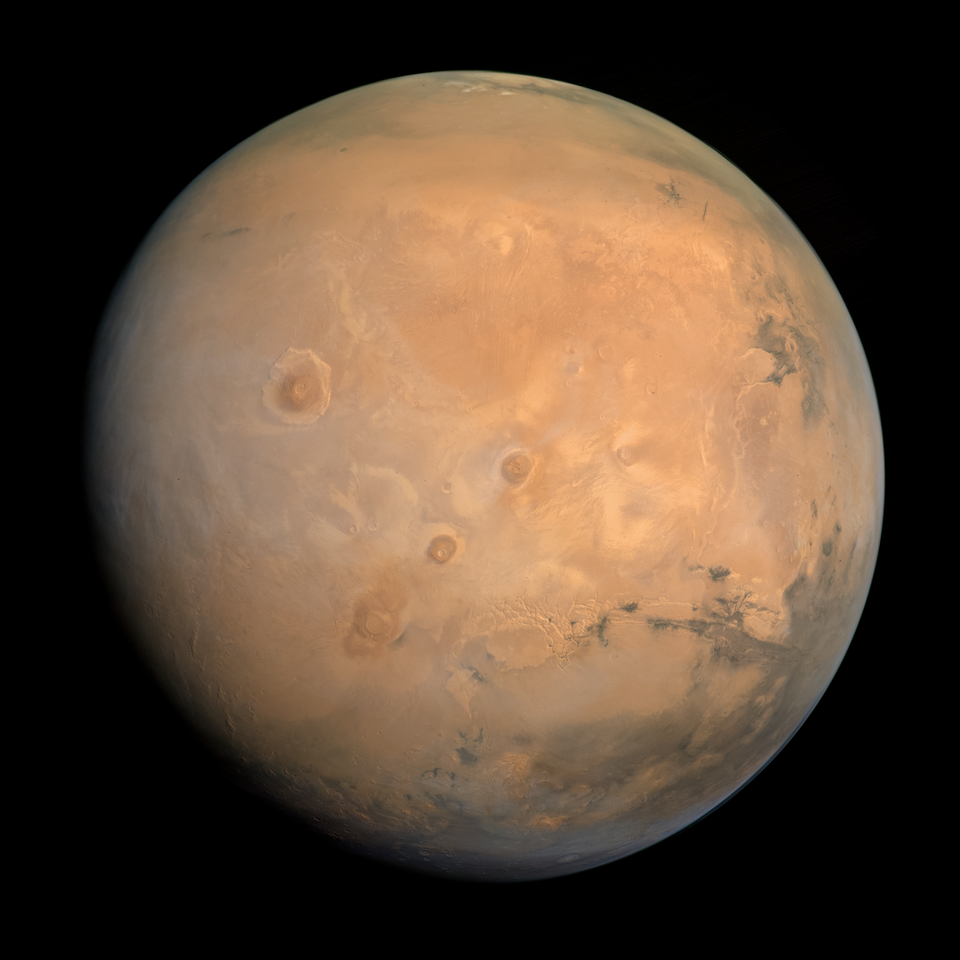
For thousands of years, Mars has captured the human imagination. Ancient civilizations watched its reddish glow move steadily across the night sky, associating it with war, fire, and mystery. In modern times, it has become something even more extraordinary—a scientific frontier. No other planet, except perhaps Earth itself, has been studied with such intensity. Orbiters map its surface in stunning detail, rovers crawl across its dusty plains, and spacecraft continue to reveal new clues about its ancient past.
Mars is often called Earth’s sibling, but it is a world of dramatic contrasts. It has towering volcanoes that dwarf anything on our planet, canyons so immense they stretch across continents, dust storms that can engulf the entire globe, and polar ice caps that grow and shrink with the seasons. Billions of years ago, it may have been warmer, wetter, and potentially capable of supporting microbial life. Today, it is cold, dry, and exposed to intense radiation—but far from lifeless in terms of scientific intrigue.
Every new mission uncovers surprises that reshape our understanding of the Red Planet. What once seemed like a barren desert has become a world filled with geological activity in the distant past, complex climate history, and tantalizing evidence that liquid water once flowed across its surface.
Here are fifteen incredible facts that reveal why Mars remains one of the most fascinating places in our solar system.
1. Mars Was Once Home to Rivers, Lakes, and Possibly Oceans
One of the greatest discoveries about Mars is that it was not always the dry, frozen world we see today.
Orbital images reveal ancient river valleys stretching for hundreds of kilometers. Delta formations, dried lakebeds, and sedimentary rocks indicate that liquid water once flowed across the planet. Some regions contain minerals that form only in the presence of water, including clay minerals and hydrated sulfates.
Evidence collected by NASA’s rovers, particularly Curiosity and Perseverance, has strengthened the conclusion that billions of years ago Mars possessed stable bodies of water for extended periods. Jezero Crater, where Perseverance is exploring today, was once a lake fed by a river delta.
Some researchers even propose that northern Mars may have contained a vast ocean covering millions of square kilometers during its early history. Although scientists continue to debate the ocean’s exact size and duration, the evidence for abundant ancient water is overwhelming.
This wetter past makes Mars one of the most promising places in the solar system to search for signs of ancient microbial life.
2. Olympus Mons Is the Largest Volcano in the Solar System
Earth’s Mount Everest is impressive, but compared to Olympus Mons, it seems almost modest.
Olympus Mons rises approximately 22 kilometers (14 miles) above the surrounding plains, making it nearly three times taller than Mount Everest when measured from its base. It spans roughly 600 kilometers (370 miles) across, an area larger than many countries.
Its immense size became possible because Mars lacks the system of moving tectonic plates that constantly reshapes Earth’s surface. On Earth, volcanoes move away from their magma sources as tectonic plates shift. On Mars, the crust remained largely stationary, allowing repeated eruptions to build the volcano upward over immense periods.
The volcano’s summit contains several overlapping calderas formed after repeated volcanic collapses.
Although Olympus Mons is considered dormant rather than active today, its existence demonstrates that Mars once possessed extraordinary volcanic activity capable of reshaping entire regions of the planet.
3. Mars Has the Largest Canyon in the Solar System
If you could fly over Valles Marineris, you would witness one of the most spectacular landscapes in the solar system.
This gigantic canyon system stretches approximately 4,000 kilometers (2,500 miles), reaches depths exceeding 7 kilometers (4 miles), and extends across nearly one-quarter of Mars’ circumference.
For comparison, Earth’s Grand Canyon is about 446 kilometers long and around 1.8 kilometers deep at its deepest point.
Scientists believe Valles Marineris formed primarily through crustal stretching associated with volcanic activity in the nearby Tharsis region rather than erosion by rivers alone. Later landslides, groundwater activity, and limited water erosion further modified the landscape.
Some of its walls expose ancient layers of Martian crust, providing valuable clues about the planet’s geological history.
4. A Day on Mars Is Surprisingly Similar to a Day on Earth
One reason Mars attracts interest for future exploration is the length of its day.
A Martian day, called a “sol,” lasts approximately 24 hours, 39 minutes, and 35 seconds.
That makes it only about 39 minutes longer than a day on Earth.
This similarity simplifies planning for robotic missions. Scientists operating Mars rovers often work on a Martian schedule during active exploration phases.
The familiar daily rhythm also makes Mars more appealing than many other destinations in the solar system from the perspective of future human missions.
Despite this similarity, a Martian year is much longer.
Because Mars orbits farther from the Sun, it takes approximately 687 Earth days to complete one orbit.
5. Mars Experiences Four Distinct Seasons
Mars tilts on its axis by about 25 degrees, remarkably close to Earth’s tilt of approximately 23.5 degrees.
This means Mars experiences spring, summer, autumn, and winter much like Earth.
However, because its year is nearly twice as long, each season lasts roughly twice as long as those on Earth.
Seasonal changes influence weather patterns, atmospheric pressure, and the growth and retreat of the polar ice caps.
Scientists have observed frost forming, carbon dioxide freezing onto the poles during winter, and dust storm activity varying with seasonal temperature changes.
These predictable cycles make Mars a dynamic world rather than a static desert.
6. Mars Has Two Tiny, Oddly Shaped Moons
Unlike Earth’s large, nearly spherical Moon, Mars possesses two small irregular moons named Phobos and Deimos.
Discovered in 1877 by astronomer Asaph Hall, both moons resemble captured asteroids in appearance, although their exact origins remain debated.
Phobos, the larger moon, orbits extremely close to Mars. In fact, it circles the planet faster than Mars rotates, causing it to rise in the west and set in the east.
Phobos is slowly spiraling inward due to gravitational interactions.
Scientists estimate that within tens of millions of years it may either crash into Mars or break apart to form a temporary ring around the planet.
Deimos orbits farther away and moves more slowly across the Martian sky.
7. Mars Has Massive Dust Storms That Can Cover the Entire Planet
Dust storms on Earth can affect regions or even continents.
Mars can experience storms that engulf the entire planet.
These global dust storms occur when fine particles become suspended in the thin atmosphere, sometimes remaining aloft for weeks or even months.
Although the Martian atmosphere is less than one percent as dense as Earth’s, strong winds can still lift enormous quantities of dust because of the planet’s low gravity and extremely dry surface.
Global storms reduce sunlight reaching the surface, affecting temperatures and limiting the power available to solar-powered spacecraft.
Several Mars missions have experienced operational challenges because of dust accumulation or prolonged darkness during these storms.
8. Mars Has Polar Ice Caps Made of More Than Water
Mars possesses permanent polar ice caps visible even through small telescopes.
Unlike Earth’s polar regions, however, these caps contain both water ice and frozen carbon dioxide, commonly known as dry ice.
During winter, carbon dioxide from the atmosphere freezes onto the poles, dramatically increasing the size of the seasonal ice caps.
When spring returns, the frozen carbon dioxide sublimates directly into gas, creating spectacular seasonal changes.
Radar observations indicate that beneath these layered deposits lie enormous reserves of water ice.
If melted, this water could cover the entire planet with a significant global layer.
9. The Martian Atmosphere Is Extremely Thin
Standing on Mars would feel dramatically different from standing on Earth.
The atmospheric pressure at the Martian surface averages only about 0.6 percent of Earth’s sea-level pressure.
The atmosphere consists primarily of carbon dioxide, with smaller amounts of nitrogen and argon.
Because the air is so thin, liquid water is generally unstable at the surface under present conditions.
The thin atmosphere also provides limited protection from cosmic radiation and allows temperatures to fluctuate dramatically between day and night.
This challenging environment presents one of the greatest obstacles for future human exploration.
10. Mars Is Home to Ancient Organic Molecules
One of the most exciting discoveries in recent years involves organic molecules detected within Martian rocks.
NASA’s Curiosity rover has identified preserved organic compounds in ancient sedimentary rocks inside Gale Crater.
Organic molecules contain carbon and are fundamental components of life on Earth.
However, it is important to understand what this discovery means.
Organic molecules do not prove that life existed on Mars.
They can also form through non-biological geological processes or arrive on meteorites.
Nevertheless, their preservation demonstrates that Mars once possessed environments capable of preserving complex carbon chemistry for billions of years.
This strengthens the case for continued exploration.
11. Mars Has Blue Sunsets
Sunsets on Earth usually glow orange and red because the atmosphere scatters shorter wavelengths of sunlight.
Mars produces a surprising reversal.
Fine dust particles suspended in its atmosphere scatter red light differently, causing the sky near the setting Sun to appear bluish.
The rest of the sky often retains reddish or butterscotch colors.
Images captured by multiple Mars rovers have confirmed these unusual sunsets, offering one of the planet’s most visually striking phenomena.
12. Thousands of Meteorites Have Traveled Between Earth and Mars
Powerful asteroid impacts can eject rocks from planetary surfaces into space.
Scientists have identified hundreds of meteorites on Earth that originated from Mars.
These Martian meteorites were blasted into space by ancient impacts, traveled through the solar system for millions of years, and eventually landed on Earth.
Laboratory analysis of these rocks provides direct information about Martian geology without requiring sample-return missions.
Researchers study their mineral composition, trapped gases, and isotopic signatures to understand the planet’s volcanic history and interior.
Future sample-return missions will provide even more precise geological context.
13. Mars May Still Contain Vast Underground Ice
Although liquid water is rare on today’s surface, Mars appears to possess enormous underground ice deposits.
Radar instruments aboard orbiting spacecraft have detected buried glaciers beneath protective layers of dust and rock.
Some mid-latitude regions contain glaciers almost completely hidden beneath surface debris.
These ice deposits represent valuable scientific resources because they preserve records of ancient Martian climate.
They are also potentially important for future astronauts, who could use the water for drinking, oxygen production, and rocket fuel manufacturing.
Understanding the distribution of underground ice remains a major goal of planetary exploration.
14. Mars Has Been Explored by an Extraordinary Fleet of Robots
Few worlds beyond Earth have received as much robotic attention as Mars.
Beginning with the Viking landers in the 1970s, dozens of spacecraft have attempted to explore the Red Planet.
Orbiters continuously map its surface and atmosphere.
Landers study local environments.
Rovers travel across ancient lakebeds, volcanic plains, and sedimentary formations.
The Sojourner rover demonstrated the feasibility of mobile exploration.
Spirit and Opportunity exceeded their expected lifetimes by years, with Opportunity operating for nearly fifteen years.
Curiosity continues investigating ancient habitability inside Gale Crater.
Perseverance is collecting carefully selected rock samples that future missions aim to return to Earth.
The tiny Ingenuity helicopter achieved the first powered flight on another planet, proving that aerial exploration is possible even in Mars’ thin atmosphere.
Together, these missions have transformed Mars from a distant point of light into one of the best-understood worlds beyond Earth.
15. Mars Could Hold the Answer to One of Humanity’s Greatest Questions
Perhaps the most incredible fact about Mars is not something scientists have already discovered.
It is what they are still searching for.
Did life ever exist there?
Billions of years ago, Mars possessed rivers, lakes, groundwater, volcanoes, and a thicker atmosphere. These are conditions that, on Earth, supported microbial life remarkably early in our planet’s history.
Scientists are not searching for dinosaurs, advanced civilizations, or other sensational ideas.
Instead, they are looking for subtle chemical signatures, fossilized microbial structures, preserved organic chemistry, and isotopic evidence that might reveal whether simple life once emerged independently on another world.
Finding even microscopic evidence of ancient Martian life would transform biology, astronomy, geology, and philosophy.
It would demonstrate that life is not unique to Earth.
Even if Mars ultimately proves never to have hosted life, that result would be equally important. It would help scientists understand why two neighboring planets with similar beginnings followed dramatically different evolutionary paths.
Why Mars Continues to Fascinate Scientists
Mars occupies a unique position in planetary science because it preserves a record of processes that have long since disappeared from Earth.
Earth’s active tectonic plates, erosion, oceans, and abundant life constantly recycle and reshape its surface.
Mars has remained comparatively stable for billions of years, preserving ancient impact craters, volcanic provinces, river valleys, and sedimentary rocks that offer an extraordinary window into the early history of rocky planets.
Every rover, orbiter, and future astronaut will continue adding pieces to this immense scientific puzzle.
The Red Planet is no longer simply a distant world glowing in the night sky. It is a natural laboratory where scientists investigate planetary evolution, climate change, geology, chemistry, and the potential origins of life beyond Earth.
With every new mission, Mars becomes a little less mysterious—and somehow even more fascinating.