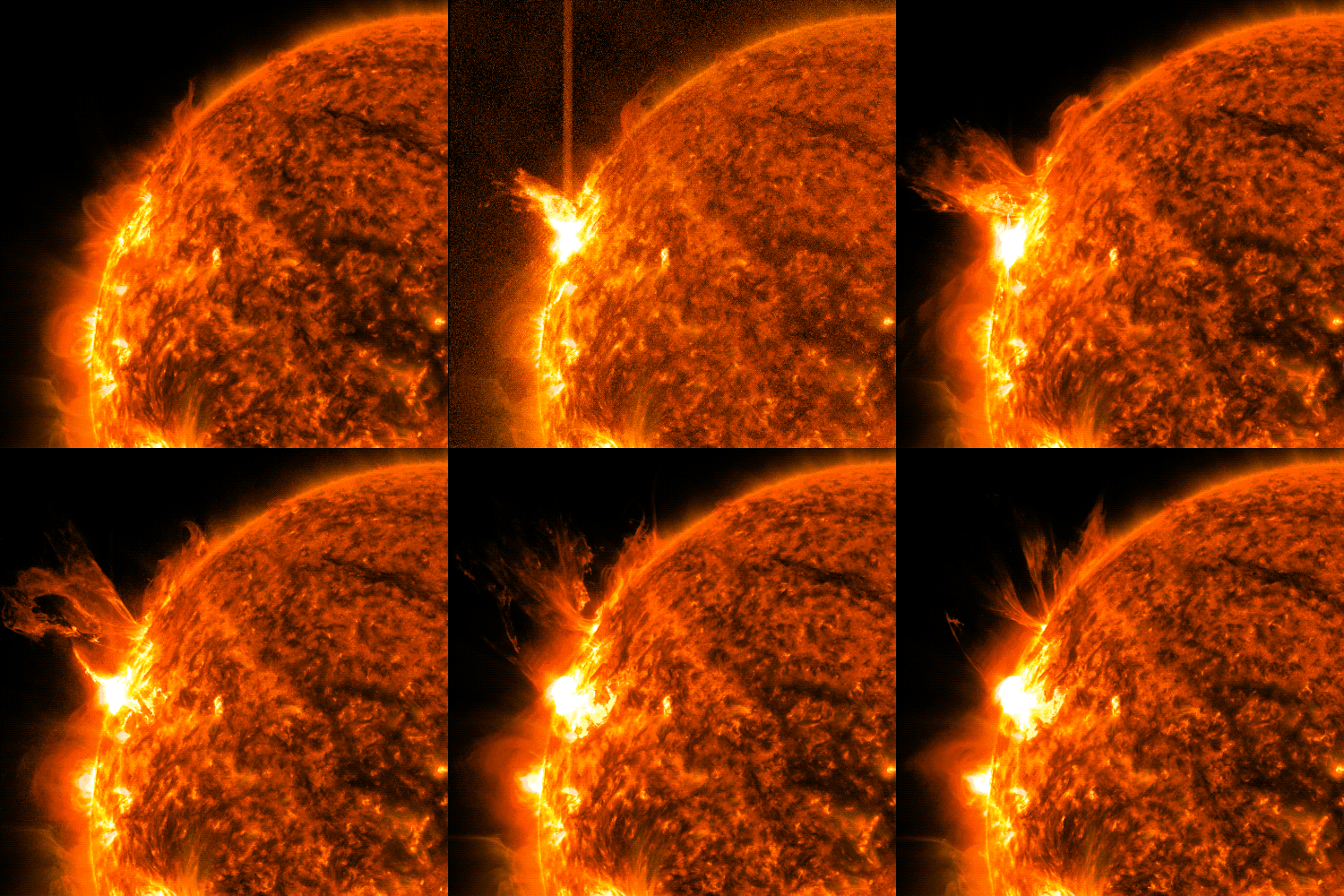
Every second of every day, the Sun quietly sustains life on Earth. It warms our planet, drives our weather, powers photosynthesis, and provides the energy that makes our world habitable. From our perspective, it often appears calm and unchanging—a brilliant yellow disk crossing the sky with reassuring predictability.
But beneath that peaceful appearance lies one of the most violent environments in the Solar System.
The Sun is not a solid object but an enormous sphere of superheated plasma, where temperatures reach millions of degrees and magnetic fields twist into incredibly complex shapes. Occasionally, these magnetic fields become so stressed that they suddenly snap and reconnect, releasing an unimaginable amount of energy in just a few minutes. The result is a solar flare—one of the most powerful explosions in the Solar System.
A single large solar flare can release energy equivalent to billions of nuclear bombs exploding simultaneously. It can send intense bursts of radiation racing across space at the speed of light, affect satellites orbiting Earth, disrupt radio communications, and even contribute to spectacular auroras dancing across the night sky.
Despite decades of research, solar flares continue to surprise scientists. Modern spacecraft observe them in extraordinary detail, revealing new insights about how our star works and how its activity influences the entire Solar System.
Here are fifteen fascinating facts about solar flares that reveal just how extraordinary these stellar explosions truly are.
1. Solar Flares Are the Most Powerful Explosions in the Solar System
When most people think of explosions, they imagine volcanoes, nuclear weapons, or supernovae. While supernovae are far more energetic overall, they occur on distant stars. Within our own Solar System, nothing surpasses the energy released by a major solar flare.
Large flares can release approximately 10²⁵ joules of energy in only a matter of minutes. That is comparable to the energy humanity would consume over millions of years.
This enormous energy originates not from chemical reactions or nuclear explosions but from the sudden release of magnetic energy stored in the Sun’s atmosphere.
Scientists refer to this process as magnetic reconnection. Twisted magnetic field lines suddenly rearrange themselves into more stable configurations, converting stored magnetic energy into heat, light, and particle acceleration.
2. They Happen Far Above the Sun’s Surface
Although solar flares appear to erupt from the Sun’s visible surface, they actually occur primarily in the solar atmosphere, especially within the corona.
The corona extends millions of kilometers into space and reaches temperatures exceeding one million degrees Celsius—far hotter than the visible surface below.
This surprising temperature difference remains one of solar physics’ major mysteries. Solar flares are among the events that help scientists investigate why the corona is so extraordinarily hot.
3. A Solar Flare Can Reach Earth in Just Over Eight Minutes
Light travels incredibly fast—about 300,000 kilometers per second.
Because the average distance between Earth and the Sun is approximately 150 million kilometers, electromagnetic radiation from a solar flare reaches Earth in only about 8 minutes and 20 seconds.
This means that by the time astronomers observe a flare, its radiation is already on its way toward our planet.
Fortunately, Earth’s atmosphere blocks most of the harmful high-energy radiation before it reaches the surface.
4. Solar Flares Are Not the Same as Coronal Mass Ejections
These two events are often confused because they frequently occur together.
A solar flare is an intense burst of electromagnetic radiation.
A coronal mass ejection (CME) is a gigantic cloud of electrically charged plasma hurled into space.
Many large flares are accompanied by CMEs, but not always.
Likewise, some CMEs occur with little or no flare.
The distinction is important because radiation from flares reaches Earth within minutes, while CMEs typically take one to several days to arrive.
5. Earth’s Atmosphere Protects Us Better Than Many People Realize
The phrase “solar flare” often sounds frightening, leading some people to imagine dangerous radiation reaching Earth’s surface.
Fortunately, our atmosphere acts as an extraordinarily effective shield.
Most X-rays, gamma rays, and ultraviolet radiation generated during solar flares are absorbed high above the ground.
Without this protective atmosphere—and Earth’s magnetic field—life as we know it would not exist.
Astronauts outside Earth’s protective environment, however, face much greater risks from intense solar activity.
6. They Can Temporarily Disrupt Radio Communications
One of the first noticeable effects of powerful solar flares often occurs in radio communications.
Intense X-rays reaching Earth’s upper atmosphere increase ionization in the ionosphere.
This changes how radio waves propagate.
High-frequency radio signals may weaken, become distorted, or disappear entirely for minutes or even hours.
Such disruptions can affect aviation, maritime communication, emergency services, and military operations that rely on long-distance radio transmission.
7. Scientists Classify Solar Flares by Their X-Ray Brightness
Not all solar flares are equally powerful.
Scientists classify them into five primary categories:
A-class flares are the weakest.
B-class flares are slightly stronger.
C-class flares are relatively common and usually have little impact on Earth.
M-class flares are medium-sized and can produce moderate space weather effects.
X-class flares are the most powerful and potentially disruptive.
Within each category, numerical values provide additional detail.
For example, an X2 flare is twice as powerful as an X1 flare, while an X10 flare is ten times stronger.
8. The Largest Solar Flare Ever Recorded Was Truly Extraordinary
On November 4, 2003, the Sun produced one of the largest solar flares ever directly observed.
The event became so intense that it overwhelmed the sensors designed to measure it.
Scientists estimated its strength at approximately X28, although the true intensity may have been even greater.
The flare originated from an enormous sunspot region containing exceptionally complex magnetic fields.
Events of this magnitude remain rare but demonstrate the incredible power stored within our star.
9. Solar Flares Begin with Invisible Magnetic Changes
The brilliant flash visible during a flare is actually the final stage of a much longer process.
For days or even weeks beforehand, magnetic fields near sunspots slowly twist, stretch, and store energy.
Because the Sun consists of moving plasma rather than solid rock, different regions rotate at different speeds.
This differential rotation continually distorts magnetic field lines.
Eventually, the magnetic configuration becomes unstable.
When reconnection occurs, enormous amounts of stored energy are released almost instantaneously.
10. Solar Flares Accelerate Particles to Nearly the Speed of Light
One of the most remarkable aspects of solar flares is their ability to accelerate charged particles.
Electrons and protons can reach velocities approaching the speed of light.
These energetic particles travel throughout the Solar System.
When they interact with spacecraft electronics, they can damage sensitive instruments.
When they encounter Earth’s magnetic field, they contribute to space weather phenomena, including enhanced auroras.
Understanding these energetic particles remains a major focus of heliophysics research.
11. They Can Produce Light Across the Entire Electromagnetic Spectrum
A solar flare is not simply a bright flash visible through telescopes.
It emits radiation across nearly the entire electromagnetic spectrum.
Scientists observe flares in radio waves, microwaves, infrared radiation, visible light, ultraviolet light, X-rays, and gamma rays.
Each wavelength reveals different physical processes occurring within the flare.
Modern solar observatories monitor all these wavelengths simultaneously, allowing researchers to reconstruct the event in remarkable detail.
12. Solar Flares Help Scientists Understand Other Stars
The Sun is the only star close enough for researchers to study in fine detail.
By understanding solar flares, astronomers gain insight into similar explosions occurring on distant stars.
Many stars produce flares much larger than anything our Sun has ever generated.
Some young red dwarf stars unleash “superflares” thousands of times more energetic than typical solar flares.
Studying our own star provides a natural laboratory for understanding stellar magnetic activity throughout the galaxy.
13. Solar Flares Follow the Sun’s Approximately 11-Year Activity Cycle
The Sun is not equally active every year.
Its magnetic activity rises and falls in a cycle lasting about eleven years.
Near solar minimum, relatively few sunspots appear, and major flares become uncommon.
Near solar maximum, sunspots become numerous.
Because solar flares usually originate in magnetically active sunspot regions, they occur much more frequently during solar maximum.
This predictable cycle helps scientists estimate periods of increased space weather activity.
14. They Can Make the Northern and Southern Lights Even More Spectacular
One of the most beautiful consequences of strong solar activity is the appearance of brilliant auroras.
When energetic particles from solar activity interact with Earth’s magnetic field and upper atmosphere, oxygen and nitrogen atoms become excited.
As these atoms return to lower energy states, they emit light.
Green is the most common auroral color, produced primarily by oxygen.
Red, purple, blue, and pink can also appear depending on altitude and atmospheric composition.
While solar flares alone do not directly produce auroras, flares associated with coronal mass ejections often contribute to geomagnetic storms that make auroras brighter and visible much farther from the poles.
15. Scientists Still Cannot Predict Exactly When One Will Occur
Despite decades of observation and sophisticated computer modeling, accurately predicting individual solar flares remains one of space science’s greatest challenges.
Researchers can identify active regions where flares are more likely.
They can estimate probabilities based on magnetic complexity.
However, they cannot yet predict the exact moment when magnetic reconnection will occur.
This situation resembles earthquake forecasting.
Scientists understand the underlying processes and recognize hazardous regions, but determining the precise timing remains extremely difficult.
Future missions, improved computer simulations, artificial intelligence, and better understanding of solar magnetism may eventually improve forecasting accuracy.
Why Solar Flares Matter More Than Ever
Centuries ago, solar flares would have passed largely unnoticed by humanity.
Today, civilization depends on technologies that extend far beyond Earth’s atmosphere.
Thousands of satellites provide communication, navigation, weather forecasting, scientific observation, and global internet services. Aircraft routinely fly polar routes that rely on radio communication. Astronauts live and work aboard spacecraft outside much of Earth’s atmospheric protection.
As our technological dependence grows, understanding solar flares becomes increasingly important.
Modern space weather forecasting helps satellite operators protect sensitive electronics, allows power grid managers to prepare for geomagnetic disturbances, and enables airlines to adjust flight operations when necessary.
The better scientists understand the Sun, the better they can protect the technologies that connect our modern world.
Watching Our Star with New Eyes
Humanity has entered an extraordinary era of solar exploration.
Spacecraft such as Parker Solar Probe have flown closer to the Sun than any previous mission, traveling directly through the outer corona. Meanwhile, Solar Orbiter provides detailed observations from unique viewing angles, including unprecedented views of the Sun’s polar regions.
These missions are transforming our understanding of solar flares.
Scientists can now observe magnetic fields, plasma flows, energetic particles, and high-energy radiation with levels of detail unimaginable just a few decades ago.
Each observation brings researchers closer to answering fundamental questions about how our star works.
A Constant Reminder That the Sun Is Alive
From Earth, the Sun often appears calm, constant, and eternal.
Yet every solar flare reminds us that our nearest star is an active, dynamic, and constantly changing object powered by extraordinary physical processes.
Its magnetic fields twist and reconnect. Plasma races through its atmosphere. Radiation streams across space. Enormous explosions unfold on scales that challenge human imagination.
At the same time, these eruptions have shaped the scientific understanding of stars, plasma physics, and space weather. They have driven the development of sophisticated observatories and inspired generations of researchers to look more closely at the star that makes life on Earth possible.
Every sunrise is a reminder that we orbit a living star—not a quiet lamp in the sky, but a colossal nuclear engine capable of astonishing power. Solar flares are among its most dramatic expressions, revealing both the beauty and the complexity of the universe that surrounds us.