Every morning, the Sun rises looking calm and steady, giving the impression that it never changes. For most of human history, people believed the Sun was an unchanging celestial object—a perfect, glowing sphere that shone with the same intensity every day. But modern astronomy has revealed a very different story.
The Sun is alive with constant activity. Its surface bubbles with hot plasma, powerful magnetic fields twist and snap, enormous explosions send billions of tons of charged particles into space, and dark patches called sunspots appear and disappear over time. None of this activity happens randomly. Instead, the Sun follows a fascinating rhythm known as the 11-year solar cycle.
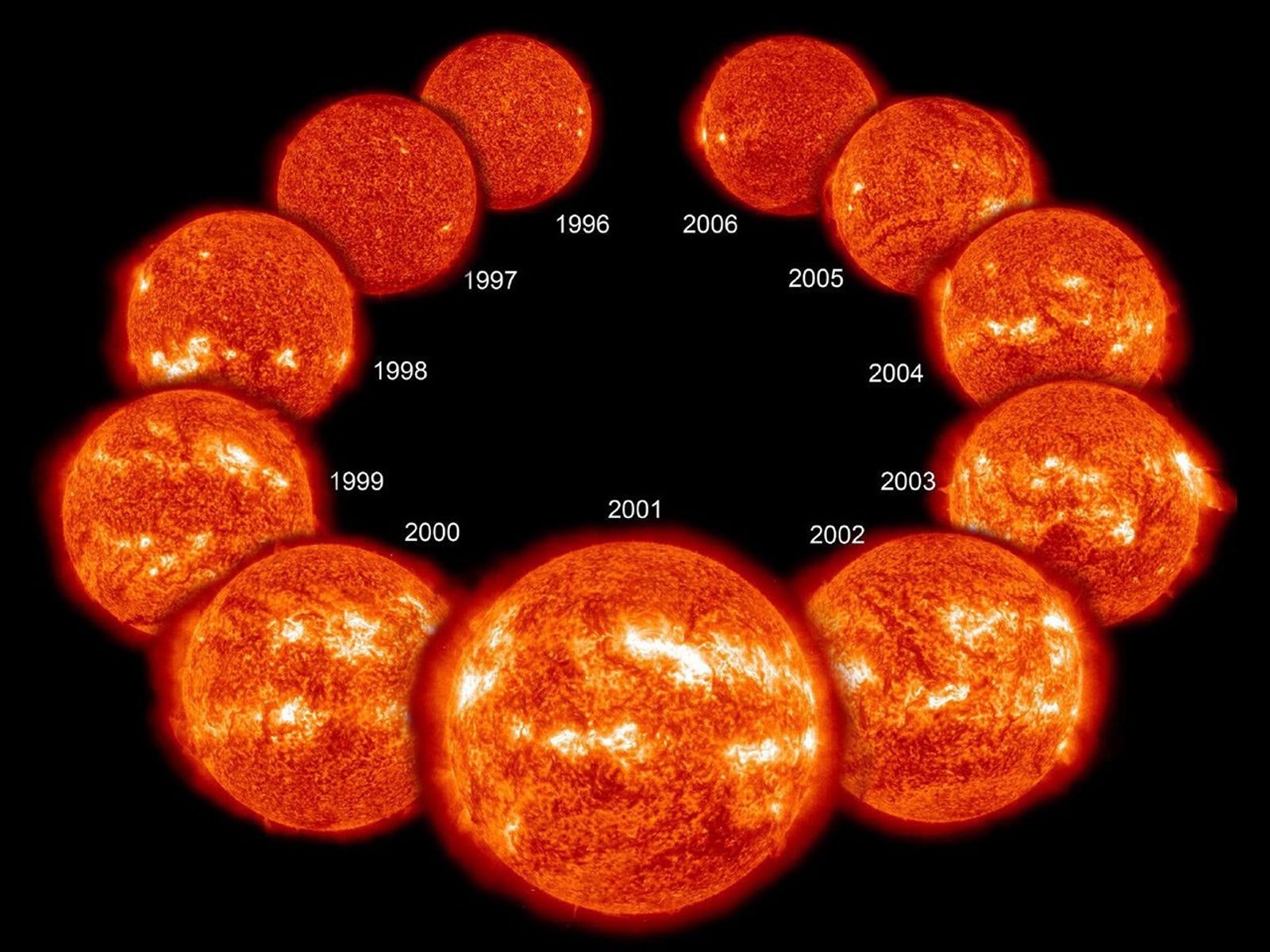
During some years, the Sun is relatively quiet, with only a few sunspots and fewer solar storms. Several years later, it becomes dramatically more active, producing countless sunspots, brilliant solar flares, and massive eruptions called coronal mass ejections. Then, after reaching its peak, the activity gradually declines until the Sun becomes quiet again—only for the cycle to begin once more.
But why does this happen? What causes the Sun to change in such a regular pattern? The answer lies deep inside the Sun, where enormous flows of superheated plasma continuously generate and reshape its magnetic field.
The Sun Is Not a Solid Object
To understand the solar cycle, it is important to first understand what the Sun actually is.
Unlike Earth, the Sun has no solid surface. It is a gigantic sphere of extremely hot plasma—a state of matter in which atoms have been stripped of many of their electrons, allowing electricity to flow freely.
This plasma behaves like a moving, electrically conducting fluid. As it moves inside the Sun, it generates powerful magnetic fields through a process known as the solar dynamo.
The Sun’s magnetic field is responsible for nearly every form of solar activity, from sunspots and solar flares to giant eruptions that can affect the entire Solar System.
What Is the 11-Year Solar Cycle?
The 11-year solar cycle is the average period over which the Sun’s magnetic activity rises and falls.
Scientists measure the cycle mainly by counting the number of sunspots visible on the Sun’s surface.
At the beginning of a cycle, known as solar minimum, very few sunspots appear. The Sun is relatively calm, and large eruptions become less common.
As the years pass, more sunspots begin forming. Solar flares become more frequent, and enormous clouds of plasma erupt into space more often.
Eventually, the Sun reaches solar maximum, when sunspot numbers are at their highest and magnetic activity becomes extremely intense.
After the maximum, the number of sunspots gradually decreases over several years until another solar minimum arrives. Then the entire process repeats.
Although people commonly refer to an “11-year cycle,” the exact length varies. Some cycles last about nine years, while others continue for fourteen years or even longer. On average, however, the cycle lasts approximately eleven years.
Sunspots Reveal the Sun’s Changing Activity
Sunspots are among the most visible signs of the solar cycle.
Despite appearing dark, sunspots are still incredibly hot. They look darker only because they are cooler than the surrounding solar surface.
Sunspots form where powerful magnetic fields emerge from beneath the Sun’s visible surface. These magnetic fields interfere with the normal flow of heat from the Sun’s interior, creating regions that are several thousand degrees cooler than their surroundings.
When the Sun is near solar minimum, only a few sunspots may appear, and sometimes none are visible for days.
Near solar maximum, hundreds of sunspots can be present across the Sun’s surface at the same time.
Because sunspots closely track solar activity, they provide scientists with one of the longest continuous records of the solar cycle.
The Real Engine Behind the Cycle Is Magnetism
The true driving force of the solar cycle is the Sun’s magnetic field.
Deep inside the Sun, hot plasma constantly moves in enormous circulating currents. Unlike a solid planet, different parts of the Sun rotate at different speeds. The equator completes one rotation in about 25 Earth days, while regions closer to the poles rotate more slowly, taking around 35 days.
Astronomers call this behavior differential rotation.
As the Sun rotates, its magnetic field lines become stretched, twisted, and tangled. Imagine repeatedly twisting a rubber band. Eventually, the rubber band becomes tightly wound and stores enormous tension. Something similar happens to the Sun’s magnetic field.
Over several years, the twisting grows stronger until the magnetic field becomes unstable. The tangled magnetic field rises through the Sun’s surface, producing sunspots, solar flares, and giant eruptions.
Eventually, the magnetic field reorganizes itself, reducing solar activity before the entire process starts once again.
The Solar Dynamo Powers the Cycle
Scientists believe the solar cycle is driven by a mechanism called the solar dynamo.
A dynamo is a process that converts motion into magnetic energy.
Inside the Sun, hot plasma continuously rises toward the surface, cools, and sinks back down. At the same time, the Sun rotates at different speeds from equator to poles.
These two motions work together to generate and reshape magnetic fields over time.
Although researchers understand the general idea of the solar dynamo, many details remain active areas of scientific research. The Sun is an incredibly complex system, and scientists continue improving computer models to better understand exactly how its magnetic field evolves.
Every 11 Years, the Sun Flips Its Magnetic Poles
One of the most remarkable aspects of the solar cycle is something most people never see.
Around every solar maximum, the Sun’s magnetic north and south poles switch places.
In other words, the Sun’s magnetic field completely reverses its polarity.
After another eleven years, the poles switch back again.
This means the Sun actually follows a full 22-year magnetic cycle, known as the Hale cycle. The familiar 11-year solar cycle represents only half of this larger magnetic rhythm.
This regular reversal is one of the strongest pieces of evidence that the cycle is controlled by the Sun’s magnetic field rather than by changes in its nuclear energy production.
Solar Flares Become More Common During Solar Maximum
As magnetic fields become increasingly tangled, they sometimes suddenly reconnect.
This process releases enormous amounts of energy in just a few minutes.
The result is a solar flare, an intense burst of radiation that travels across the Solar System at the speed of light.
Large solar flares release energy equivalent to millions of hydrogen bombs exploding simultaneously.
Fortunately, Earth’s atmosphere blocks the harmful radiation produced by most solar flares, protecting life on the surface.
Coronal Mass Ejections Can Affect Earth
Not every solar flare produces a giant eruption, but many do.
These eruptions are called coronal mass ejections, or CMEs.
A CME launches billions of tons of electrically charged plasma into space at speeds that can exceed several million kilometers per hour.
If Earth lies in the path of a CME, the incoming charged particles can interact with our planet’s magnetic field.
This interaction can trigger geomagnetic storms, producing spectacular auroras while also affecting satellites, radio communication, GPS systems, and electrical power grids.
Large geomagnetic storms are much more likely during solar maximum because the Sun produces more eruptions during this phase.
The Solar Cycle Changes Space Weather
Just as Earth has weather in its atmosphere, space also experiences changing conditions known as space weather.
Space weather includes solar flares, coronal mass ejections, streams of charged particles, and variations in the solar wind.
The solar cycle strongly influences these conditions.
During solar maximum, astronauts face greater exposure to radiation, satellites experience increased risk, and communication systems become more vulnerable to disruption.
During solar minimum, space weather is generally calmer, although significant solar storms can still occur.
Because modern society depends heavily on satellites, understanding space weather has become increasingly important.
Does the Solar Cycle Affect Earth’s Climate?
This question often attracts considerable public interest.
The amount of energy the Sun sends toward Earth changes slightly during the solar cycle, but these changes are relatively small.
Measurements from satellites show that the Sun’s total energy output varies by only about 0.1% over an average solar cycle.
These small variations can influence Earth’s upper atmosphere and may contribute to subtle changes in atmospheric circulation. However, they cannot explain the rapid global warming observed over recent decades.
Extensive scientific evidence shows that the current long-term warming trend is primarily driven by increasing greenhouse gas concentrations produced by human activities rather than by changes in the solar cycle.
Scientists carefully monitor both solar activity and Earth’s climate to understand how each contributes to natural and human-driven changes.
How Scientists Study the Solar Cycle
Today, astronomers observe the Sun continuously using both ground-based observatories and space missions.
Specialized solar telescopes reveal sunspots, magnetic fields, and hot plasma in extraordinary detail.
Spacecraft such as NASA’s Solar Dynamics Observatory, the joint ESA–NASA Solar and Heliospheric Observatory (SOHO), and NASA’s Parker Solar Probe provide continuous observations of the Sun from space. These missions allow scientists to monitor solar activity without interference from Earth’s atmosphere.
Researchers also study historical records of sunspots dating back more than four centuries. This long record helps scientists compare modern cycles with those of the past and improve predictions of future solar activity.
Can Scientists Predict the Next Solar Cycle?
Scientists can estimate the timing and approximate strength of future solar cycles, but making precise predictions remains difficult.
The Sun is an extremely complex magnetic system.
Small changes deep inside the Sun can influence the intensity of an entire cycle years later.
Modern computer simulations have improved forecasts considerably, yet researchers still cannot predict every detail with complete accuracy.
Understanding the solar cycle remains one of the major challenges of solar physics.
Why the Solar Cycle Matters
The 11-year solar cycle is much more than an astronomical curiosity.
It influences the radiation environment throughout the Solar System, affects astronauts and spacecraft, shapes space weather around Earth, influences radio communications, and helps scientists understand the behavior of stars throughout the universe.
Studying the solar cycle also provides valuable insight into how magnetic fields behave inside stars, allowing astronomers to better understand stellar evolution beyond our own Sun.
Because our civilization depends so heavily on satellites, navigation systems, telecommunications, and electrical infrastructure, understanding the Sun has become increasingly important for protecting modern technology.
The Sun’s Ever-Changing Heartbeat
Although the Sun appears constant in the sky, it is constantly changing beneath its brilliant surface. Deep within its vast interior, rivers of superheated plasma continuously twist and reshape powerful magnetic fields. Over roughly eleven years, these invisible magnetic forces build, strengthen, erupt, weaken, and begin again, creating one of the most remarkable natural rhythms in our Solar System.
The solar cycle reminds us that even the seemingly unchanging Sun is a dynamic star, driven by powerful physical processes that continue to challenge and inspire scientists. Every sunspot, every solar flare, and every shimmering aurora on Earth is part of this ongoing magnetic dance—a cycle that has repeated for millions of years and will continue long into the future, connecting our planet to the restless heart of the star that makes life possible.