The Sun may appear calm and unchanging as it rises every morning, but beneath its brilliant surface lies a world of extraordinary activity. Enormous explosions send billions of tons of charged particles into space. Powerful magnetic fields twist and snap. Dark spots appear and disappear across the Sun’s surface. These dramatic changes are not random. They are part of a repeating pattern known as the solar cycle.
The solar cycle is one of the most fascinating natural rhythms in our solar system. It influences space weather, affects satellites orbiting Earth, impacts radio communications, creates dazzling auroras, and can even pose challenges for astronauts traveling beyond our planet. While life on Earth continues much as usual, scientists carefully monitor every stage of this cycle because the Sun’s activity reaches far beyond its glowing surface.
Understanding the solar cycle helps us better appreciate our closest star and its profound influence on the entire solar system.
What Is the Solar Cycle?
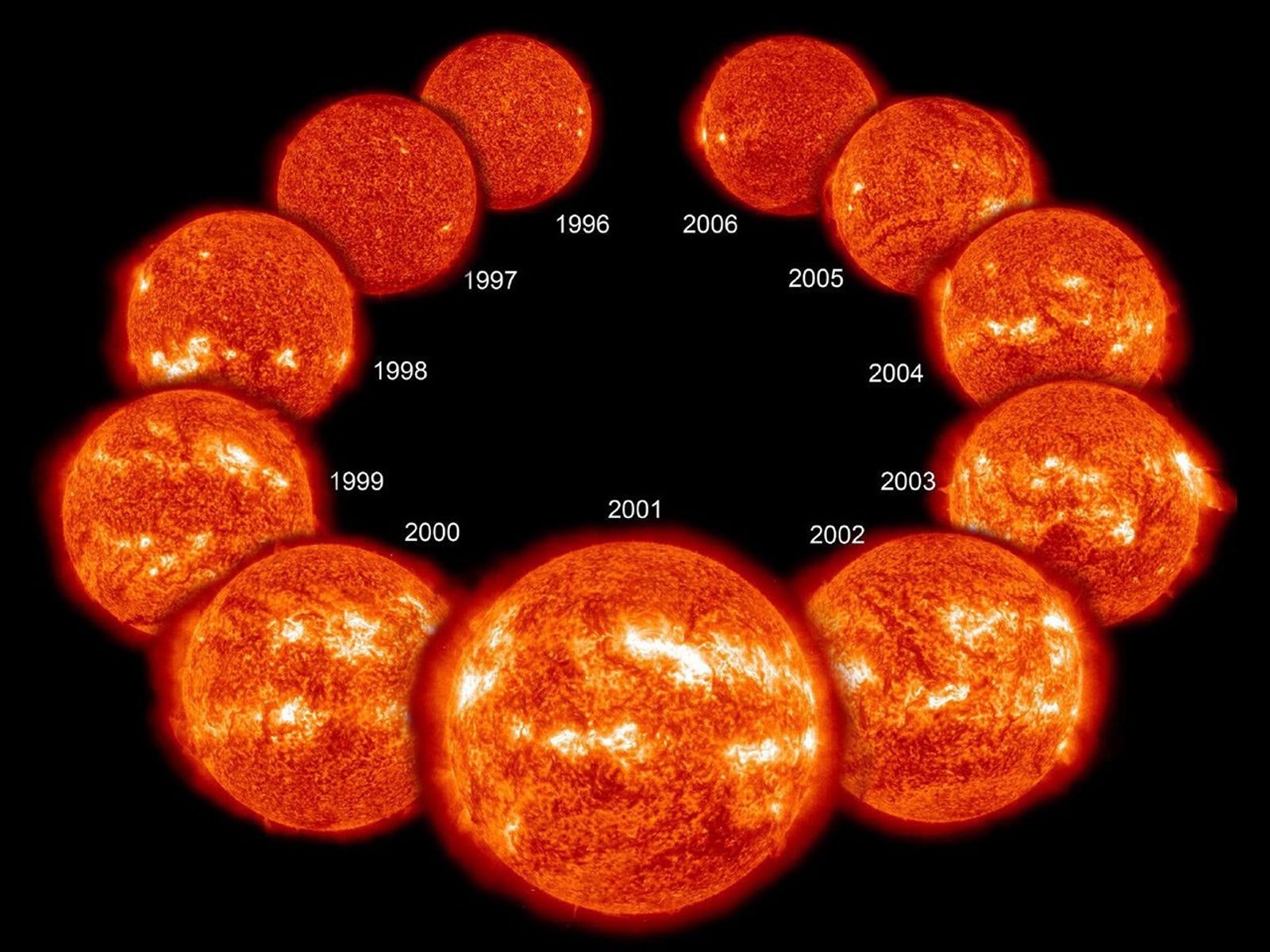
The solar cycle is a roughly 11-year period during which the Sun’s magnetic activity increases and decreases. During this cycle, the number of sunspots, solar flares, and other forms of solar activity rises to a peak before gradually declining and then beginning the process again.
Although people often describe the solar cycle as lasting 11 years, the exact length varies. Some cycles have lasted less than 10 years, while others have extended beyond 12 years. On average, however, each cycle takes about 11 years to complete.
Scientists have identified and numbered solar cycles since the eighteenth century. Each cycle represents a complete rise and fall in solar activity.
Why Does the Solar Cycle Happen?
The solar cycle is driven by the Sun’s magnetic field.
Unlike Earth, which has a mostly stable magnetic field, the Sun’s magnetic field is constantly changing. The Sun is made of extremely hot, electrically charged gas known as plasma rather than solid rock. Because plasma can conduct electricity, it generates powerful magnetic fields.
The Sun also rotates differently from a solid object. Its equator rotates faster than its poles, a phenomenon known as differential rotation. This uneven spinning twists, stretches, and tangles the Sun’s magnetic field over time.
As these magnetic fields become increasingly distorted, they eventually reorganize themselves, producing periods of intense activity followed by quieter phases. This repeating magnetic process creates the solar cycle.
The Sun’s Magnetic Heart
Deep inside the Sun lies a region where powerful flows of hot plasma continuously move energy outward. These moving electrically charged gases generate magnetic fields through a process called the solar dynamo.
The solar dynamo acts like an enormous natural generator. It continually creates and reshapes magnetic fields throughout the Sun.
As magnetic fields strengthen and become more complex, they rise through the Sun’s surface. These magnetic regions become the birthplace of sunspots, solar flares, and coronal mass ejections.
The solar cycle is therefore not simply a cycle of visible activity—it is fundamentally a magnetic cycle.
The Hidden 22-Year Magnetic Cycle
Although solar activity rises and falls approximately every 11 years, the Sun’s complete magnetic cycle actually lasts about 22 years.
At the end of each 11-year solar cycle, the Sun’s magnetic poles reverse. The north magnetic pole becomes the south magnetic pole, and the south becomes the north.
After another 11-year cycle, the poles reverse again, returning to their original orientation.
This complete magnetic reversal, known as the Hale cycle, spans about 22 years.
What Are Sunspots?
Sunspots are dark regions that appear on the Sun’s visible surface, called the photosphere.
Despite looking dark, sunspots are still incredibly hot, with temperatures around 3,000 to 4,500 degrees Celsius (5,400 to 8,100 degrees Fahrenheit). They only appear dark because the surrounding solar surface is even hotter, reaching nearly 5,500 degrees Celsius (9,900 degrees Fahrenheit).
Sunspots form where magnetic fields become exceptionally strong. These intense magnetic fields reduce the flow of heat from the Sun’s interior, making the affected regions slightly cooler than their surroundings.
Sunspots vary enormously in size. Some are smaller than Earth, while others are several times larger than our planet.
Their number changes dramatically throughout the solar cycle.
Solar Minimum: The Quiet Phase
Every solar cycle begins near a period called solar minimum.
During solar minimum, relatively few sunspots appear on the Sun. Solar flares become less frequent, and coronal mass ejections occur less often.
The Sun does not become inactive during this phase. Instead, its overall magnetic activity reaches one of its lowest levels.
Scientists use solar minimum as the starting point for measuring a new solar cycle.
Although the Sun appears quieter, researchers continue monitoring it carefully because activity can gradually increase as the cycle progresses.
Solar Maximum: The Active Phase
Several years after solar minimum, the Sun enters solar maximum.
This is the most energetic stage of the solar cycle.
Hundreds of sunspots may cover the Sun’s surface at the same time. Solar flares become much more frequent, and powerful coronal mass ejections can launch enormous clouds of plasma into space.
The Sun’s magnetic field becomes highly complex during this period. Magnetic loops stretch far above the solar surface before suddenly reconnecting and releasing tremendous amounts of energy.
Solar maximum represents the peak of solar activity before the Sun gradually returns toward another minimum.
What Are Solar Flares?
Solar flares are sudden bursts of energy released when magnetic fields near sunspots rapidly reconnect.
These explosions produce intense radiation across the electromagnetic spectrum, including radio waves, visible light, ultraviolet radiation, X-rays, and gamma rays.
A single powerful solar flare can release energy equivalent to billions of nuclear explosions.
Fortunately, Earth’s atmosphere blocks the most dangerous forms of this radiation, protecting life on the surface.
However, solar flares can temporarily disrupt radio communications, navigation systems, and satellite operations.
Coronal Mass Ejections
Sometimes the Sun launches gigantic clouds of plasma and magnetic fields into space. These events are called coronal mass ejections, often abbreviated as CMEs.
A single CME can contain billions of tons of charged particles traveling at speeds exceeding one million kilometers per hour.
If one of these enormous plasma clouds is directed toward Earth, it can interact with our planet’s magnetic field.
This interaction produces geomagnetic storms that may interfere with satellites, power grids, navigation systems, and radio communications.
Coronal mass ejections are among the most significant forms of space weather associated with the solar cycle.
The Solar Wind Never Stops
Even when the Sun appears quiet, it continuously releases a stream of charged particles known as the solar wind.
This flow of electrons, protons, and other particles travels throughout the solar system, carrying part of the Sun’s magnetic field with it.
During periods of high solar activity, the solar wind often becomes stronger and more variable.
The solar wind shapes the enormous bubble surrounding our solar system, called the heliosphere, which extends far beyond the orbit of Pluto.
How the Solar Cycle Affects Earth
Although Earth lies about 150 million kilometers (93 million miles) from the Sun, changes in solar activity still influence our planet.
Most people never notice these effects directly because Earth’s magnetic field and atmosphere provide excellent protection.
However, modern technology is much more sensitive.
Increased solar activity can disturb satellite communications, interfere with GPS accuracy, affect aviation routes near the poles, disrupt high-frequency radio communications, and increase radiation exposure for astronauts and high-altitude flights.
Powerful geomagnetic storms can also induce electrical currents in long transmission lines, occasionally affecting power grids.
Scientists continuously monitor solar activity to help operators prepare for these potential impacts.
The Beautiful Auroras
One of the most spectacular effects of the solar cycle is the creation of auroras.
When charged particles from the Sun collide with gases in Earth’s upper atmosphere, they excite oxygen and nitrogen atoms.
As these atoms return to lower energy states, they emit light.
This produces the shimmering curtains of green, red, purple, and blue known as the aurora borealis in the Northern Hemisphere and the aurora australis in the Southern Hemisphere.
During solar maximum, auroras often become brighter, more frequent, and visible at lower latitudes than usual.
How Scientists Observe the Solar Cycle
Modern scientists monitor the Sun using a combination of ground-based observatories and space missions.
Powerful telescopes observe sunspots and magnetic fields on the solar surface.
Spacecraft positioned around the Sun continuously measure solar radiation, the solar wind, and magnetic activity.
These observations allow researchers to estimate whether solar activity is increasing or decreasing and to issue space weather forecasts when major eruptions occur.
Computer models combined with decades of observations help scientists understand the complex magnetic processes driving the solar cycle.
A Brief History of Solar Cycle Research
Sunspots have been observed for thousands of years, especially during periods when particularly large spots were visible without telescopes through atmospheric haze.
Systematic scientific observations began after the invention of the telescope in the early seventeenth century.
In the nineteenth century, German astronomer Samuel Heinrich Schwabe carefully studied sunspots over many years. In 1843, he recognized that their numbers followed a repeating cycle lasting about a decade.
Later observations confirmed this pattern and established the approximately 11-year solar cycle that scientists study today.
Not Every Solar Cycle Is the Same
Although the solar cycle follows a general pattern, no two cycles are identical.
Some cycles produce exceptionally large numbers of sunspots, while others remain relatively weak.
The timing of solar maximum also varies.
Scientists continue investigating why some cycles become much stronger than others. The Sun’s magnetic field is extraordinarily complex, making long-term prediction difficult.
Improving forecasts remains an active area of solar physics research.
The Solar Cycle and Climate
The Sun is Earth’s primary source of energy, so scientists naturally study whether changes in the solar cycle influence climate.
The Sun’s total energy output varies only slightly across the approximately 11-year solar cycle. These small variations can produce subtle effects in Earth’s upper atmosphere and contribute modestly to natural climate variability.
However, extensive scientific evidence shows that the recent long-term warming of Earth’s climate cannot be explained by the solar cycle alone. Measurements indicate that the increase in global average temperatures over the past century is primarily driven by the accumulation of greenhouse gases produced by human activities, while changes associated with the solar cycle are much smaller.
Understanding the distinction between short-term solar variability and long-term climate change is an important part of modern climate science.
Why Predicting the Solar Cycle Matters
As humanity becomes increasingly dependent on satellites, communication networks, navigation systems, and space exploration, understanding the solar cycle becomes more important than ever.
Space agencies use solar forecasts to protect astronauts from increased radiation exposure.
Satellite operators prepare for periods of heightened solar activity.
Electric utility companies monitor geomagnetic storm forecasts to reduce risks to power systems.
Aviation authorities also consider space weather forecasts for flights over polar regions.
Improved prediction helps reduce the risks posed by our active star.
The Solar Cycle Reminds Us That the Sun Is Alive
From Earth, the Sun appears as a steady golden disk, faithfully rising each morning. Yet beneath that familiar appearance lies a dynamic, constantly changing star powered by immense magnetic forces.
The solar cycle is the heartbeat of this activity—a repeating rhythm of quiet periods and powerful outbursts that has continued for billions of years. Every sunspot, every solar flare, every shimmering aurora, and every stream of charged particles tells part of this ongoing story.
By studying the solar cycle, scientists not only learn how the Sun works but also gain valuable insight into the relationship between our star and the planets that orbit it. As technology advances and humanity ventures farther into space, understanding the Sun’s changing behavior will become even more essential.
The solar cycle reminds us that even the brightest and most familiar object in our sky is far from static. It is a living, evolving star whose magnetic rhythm shapes the environment of the entire solar system, quietly influencing our world from nearly 150 million kilometers away.