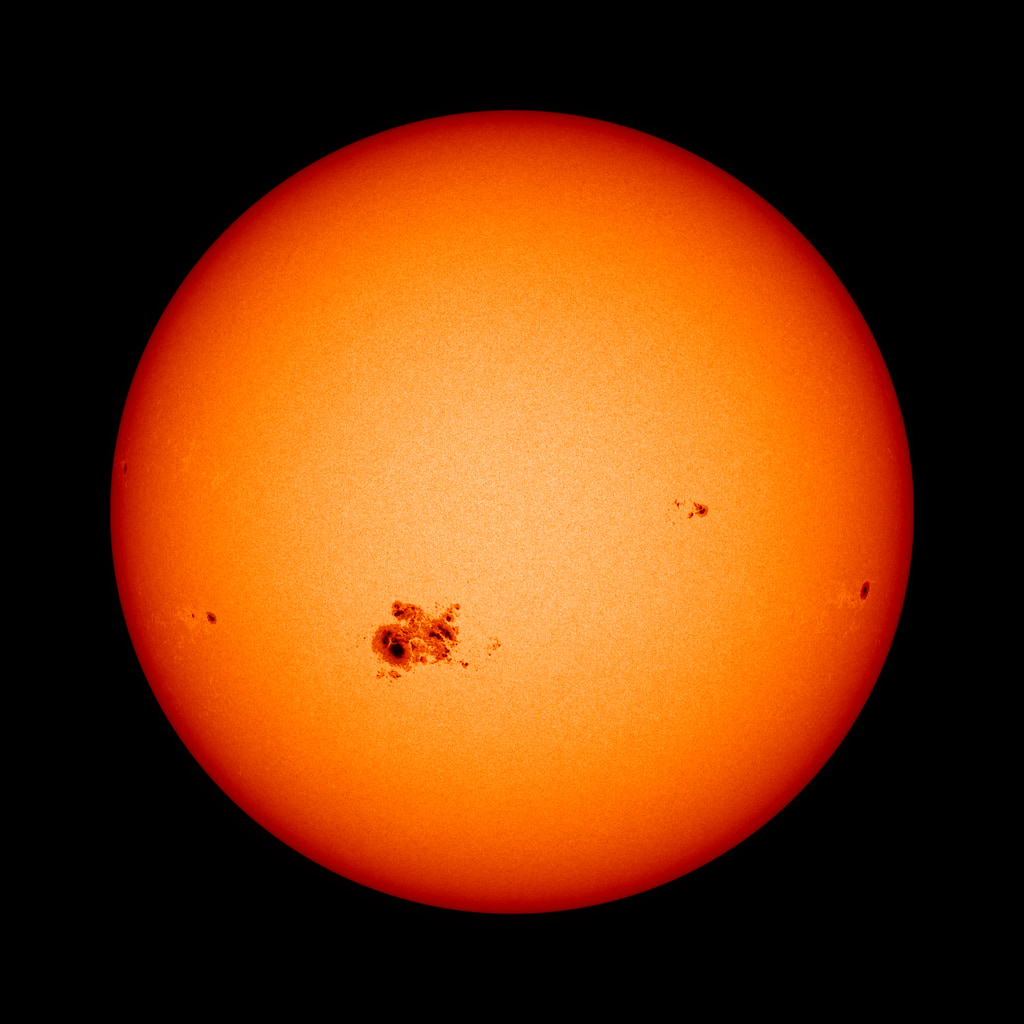
If you could safely look at the Sun through a powerful solar telescope, you might notice something surprising. Instead of appearing as a perfectly smooth, glowing ball of light, the Sun’s surface is often dotted with dark spots of different sizes. Some are tiny, while others are enormous—so large that several Earths could fit inside them.
These mysterious features are called sunspots. For centuries, they puzzled astronomers. Why would the hottest object in our solar system have dark patches? Were they holes in the Sun? Were they clouds floating above its surface? Or were they signs that something unusual was happening deep inside our star?
Today, thanks to centuries of observations and modern space missions, scientists know that sunspots are not holes or clouds. They are regions where the Sun’s powerful magnetic field temporarily disrupts the normal flow of heat from its interior. Although they appear dark, sunspots are still incredibly hot—just cooler than the surrounding surface.
Understanding why sunspots form helps scientists better understand the Sun itself. It also reveals how activity on our nearest star can influence Earth, affecting satellites, radio communications, power grids, and even the beautiful auroras seen near the poles.
What Are Sunspots?
Sunspots are temporary dark regions that appear on the Sun’s visible surface, known as the photosphere. They form when intense magnetic fields interfere with the movement of hot plasma rising from the Sun’s interior.
The photosphere has an average temperature of about 5,500 degrees Celsius (about 9,900 degrees Fahrenheit). A typical sunspot is cooler, with temperatures ranging from about 3,000 to 4,500 degrees Celsius (roughly 5,400 to 8,100 degrees Fahrenheit). Although these temperatures would melt almost anything on Earth instantly, they are cool enough compared with the surrounding surface to appear dark.
If a sunspot could somehow be placed in the night sky without the bright Sun around it, it would actually shine brighter than the full Moon.
Why Do Sunspots Look Dark?
The Sun shines because its surface is extremely hot. The hotter an object becomes, the more light it emits.
Since sunspots are cooler than the surrounding photosphere, they emit less visible light. This difference in brightness makes them appear dark against the much brighter surface around them.
The contrast is similar to placing a glowing piece of hot metal next to an even hotter one. The cooler piece would appear darker, even though it is still glowing intensely.
This is why photographs of the Sun often show sunspots as black patches, even though they are far from cold.
The Sun Is Not Solid
To understand why sunspots form, it is important to remember that the Sun is not a solid object like Earth.
The Sun is a giant sphere of extremely hot plasma—a state of matter in which atoms are so energetic that electrons are separated from their nuclei. This electrically charged plasma behaves differently from solids, liquids, or gases because it responds strongly to magnetic fields.
Deep inside the Sun, enormous amounts of energy are produced through nuclear fusion. This energy slowly moves outward until it reaches the surface, where it escapes into space as sunlight.
Near the surface, hot plasma constantly rises while cooler plasma sinks, creating a process known as convection. This churning motion resembles boiling water, except it occurs on an unimaginable scale.
It is within this restless, moving plasma that sunspots are born.
The Powerful Role of Magnetic Fields
The real cause of sunspots is the Sun’s magnetic field.
The Sun generates magnetic fields because its electrically conducting plasma is constantly moving. Unlike Earth, which rotates as a mostly solid body, the Sun rotates at different speeds depending on latitude. The equator rotates faster than the polar regions, a phenomenon called differential rotation.
As the Sun rotates, its magnetic field lines become stretched, twisted, and tangled over time.
Eventually, some magnetic field lines become so tightly wound that they burst through the Sun’s surface in pairs, forming concentrated regions of magnetic activity.
Where these magnetic fields emerge, they suppress the normal upward flow of hot plasma from below. Since less heat reaches the surface in these areas, they become cooler than their surroundings.
These cooler regions are what we observe as sunspots.
How Magnetic Fields Block Heat
The magnetic field inside a sunspot is extraordinarily strong—often thousands of times stronger than Earth’s magnetic field.
Normally, convection carries hot plasma upward, continually replacing cooler material at the surface.
However, intense magnetic fields act like invisible barriers. They interfere with the motion of the electrically charged plasma, making it much more difficult for hot material to rise.
Because less heat reaches the surface, the affected region cools slightly.
Although the temperature difference is only a few thousand degrees, it is enough to make the region appear much darker than the surrounding photosphere.
The Structure of a Sunspot
A sunspot is not simply one dark patch. It has a complex structure.
The darkest central region is called the umbra. This is where the magnetic field is strongest and the temperature is lowest.
Surrounding the umbra is a lighter region known as the penumbra. Here, the magnetic field spreads outward in filament-like structures, and the temperature is somewhat higher than in the center.
High-resolution observations reveal beautiful patterns within the penumbra, showing how plasma flows around the powerful magnetic field.
Sunspots Often Appear in Pairs
Sunspots rarely form alone.
They usually appear in groups or pairs because magnetic field lines emerge from one location and re-enter the Sun at another.
One sunspot marks where magnetic field lines leave the surface, while another marks where they return below it.
These paired regions have opposite magnetic polarity, similar to the north and south poles of a magnet.
Large active regions on the Sun may contain dozens or even hundreds of individual sunspots connected by intricate magnetic structures.
How Big Can Sunspots Become?
Sunspots vary enormously in size.
Some are only a few hundred kilometers across and disappear within a day.
Others grow to astonishing dimensions, stretching tens of thousands of kilometers across the solar surface.
The largest sunspots can exceed 100,000 kilometers (about 62,000 miles) in diameter. Earth, with a diameter of about 12,742 kilometers (7,918 miles), could fit comfortably inside some of these giant sunspots several times over.
These enormous magnetic structures are among the largest features visible on the Sun.
How Long Do Sunspots Last?
Sunspots are temporary features.
Small sunspots may survive only a few hours or days before fading away.
Larger sunspots can remain visible for several weeks or even a few months.
Eventually, the magnetic field that created the sunspot weakens or rearranges itself. Once convection resumes normally, the cooler region warms, and the sunspot gradually disappears.
The Sun is constantly creating and destroying sunspots as its magnetic field evolves.
The Sunspot Cycle
Sunspots do not appear randomly over long periods.
Their numbers rise and fall in a regular pattern known as the solar cycle, which averages about 11 years.
Near the beginning of a cycle, very few sunspots are visible.
As the cycle progresses, magnetic activity increases, producing more sunspots, solar flares, and eruptions.
Eventually, the Sun reaches solar maximum, when sunspots become abundant across its surface.
Afterward, activity gradually declines until the Sun reaches solar minimum, when only a few sunspots remain.
The cycle then begins again.
Although the average cycle lasts about eleven years, individual cycles may be somewhat shorter or longer.
Sunspots and Solar Flares
Sunspots are closely connected to some of the most energetic events in the solar system.
Because sunspots contain highly twisted magnetic fields, they can suddenly release enormous amounts of stored magnetic energy.
This release produces solar flares, powerful bursts of electromagnetic radiation.
Sometimes the Sun also ejects billions of tons of plasma into space during events called coronal mass ejections (CMEs).
Not every sunspot produces these eruptions, but the largest and most magnetically complex sunspot groups are often associated with the strongest solar storms.
How Sunspots Affect Earth
Although sunspots are nearly 150 million kilometers (93 million miles) away, they can influence our planet.
Powerful solar eruptions originating near sunspots can send charged particles toward Earth.
When these particles interact with Earth’s magnetic field, they can create spectacular auroras, also known as the Northern and Southern Lights.
However, intense solar storms can also disrupt satellite operations, interfere with radio communications, affect GPS accuracy, and in rare cases disturb electrical power systems.
Scientists carefully monitor sunspots every day because they provide valuable clues about upcoming space weather.
How Scientists Observe Sunspots
Sunspots have been observed for hundreds of years.
Today, scientists use both ground-based telescopes and spacecraft equipped with specialized instruments that safely observe the Sun.
Modern observatories can measure not only the size and shape of sunspots but also the strength and direction of their magnetic fields.
Space missions have revealed remarkable details, including swirling plasma flows, rapidly changing magnetic structures, and the complex evolution of active regions.
Continuous monitoring allows researchers to improve forecasts of solar activity and better understand the Sun’s magnetic behavior.
A Brief History of Sunspot Discovery
People occasionally noticed unusually large sunspots with the naked eye when the Sun was dimmed by thick clouds or haze.
After the invention of the telescope in the early seventeenth century, astronomers began studying sunspots systematically.
Their observations showed that sunspots moved across the Sun’s surface, providing strong evidence that the Sun rotates.
Over time, careful records revealed the regular rise and fall of sunspot numbers, eventually leading to the discovery of the solar cycle.
Today, sunspots remain one of the most closely monitored indicators of solar activity.
Are Sunspots Dangerous?
Sunspots themselves pose no direct danger to Earth.
They are simply cooler regions on the Sun’s surface caused by intense magnetic fields.
The potential hazards arise from the energetic events sometimes associated with sunspots, such as solar flares and coronal mass ejections.
Fortunately, Earth is protected by its magnetic field and atmosphere, which shield us from much of the harmful radiation and charged particles produced during solar storms.
Scientists also monitor the Sun continuously, helping governments, satellite operators, airlines, and power companies prepare for significant space weather events.
Why Sunspots Matter
Sunspots are far more than dark marks on the Sun. They are visible signs of the powerful magnetic engine operating inside our nearest star. By studying them, scientists gain insight into processes that cannot be seen directly beneath the Sun’s glowing surface.
These seemingly simple dark patches reveal how magnetic fields are generated, how energy moves through stars, and how our Sun changes over time. They also help researchers predict solar activity that can influence modern technology and life on Earth.
Every sunspot tells a story about the dynamic nature of the Sun. Rather than being a calm, unchanging ball of fire, our star is a constantly evolving world of swirling plasma, immense magnetic forces, and extraordinary energy. Understanding why sunspots form not only deepens our knowledge of the Sun but also strengthens our understanding of stars throughout the universe, reminding us that even the brightest object in our sky still holds many fascinating secrets waiting to be explored.