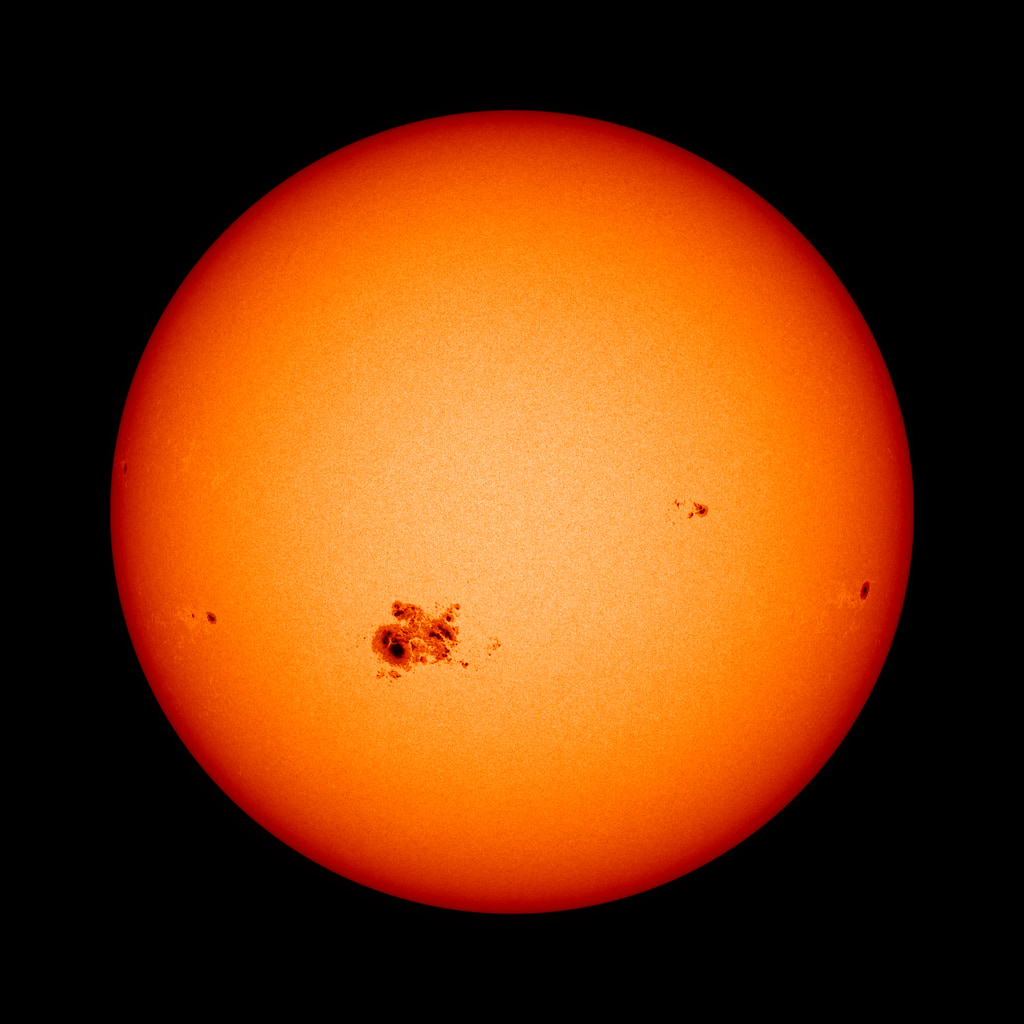
The Sun is the brightest object in our sky. Every morning it rises with a warm, glowing face that seems smooth and unchanging. To the naked eye, the Sun appears as a perfect ball of brilliant light. But if scientists observe it through specially designed solar telescopes, a very different picture emerges. Its surface is constantly changing, swirling, and bursting with activity. Among the most fascinating features visible on the Sun are mysterious dark regions known as sunspots.
At first glance, these dark patches might seem like holes in the Sun or places where the Sun is cooling down. In reality, they are neither. Sunspots are some of the most active and energetic places on the Sun, revealing the immense power of its magnetic field. They play a major role in solar storms, influence space weather, and can even affect modern technology here on Earth.
Understanding sunspots helps us understand not only our nearest star but also the powerful forces that shape the space environment throughout the Solar System.
What Are Sunspots?
Sunspots are temporary dark regions on the visible surface of the Sun, known as the photosphere. They appear darker than the surrounding areas because they are significantly cooler, although they are still incredibly hot by Earthly standards.
The surface of the Sun outside a sunspot has a temperature of about 5,500°C (9,900°F). A typical sunspot, however, has a temperature between 3,000°C and 4,500°C (5,400°F to 8,100°F). While this difference makes sunspots appear dark in comparison, they would still glow brighter than almost anything on Earth if seen by themselves.
Sunspots are not permanent. Some exist for only a few hours, while others survive for several weeks or even months before fading away.
Why Do Sunspots Look Dark?
The darkness of a sunspot is actually an illusion created by contrast.
Imagine placing a glowing piece of red-hot metal next to an even hotter white-hot flame. The metal would appear darker even though it remains extremely hot. The same thing happens on the Sun.
The surrounding photosphere is so bright that the cooler sunspot appears almost black. If a sunspot could somehow be removed from the Sun and placed alone in space, it would shine brilliantly.
Their dark appearance simply reflects a lower temperature compared to the surrounding solar surface.
How Do Sunspots Form?
Sunspots form because of the Sun’s incredibly powerful magnetic field.
Unlike Earth, which has a mostly stable magnetic field, the Sun’s magnetic field is constantly changing. The Sun is made almost entirely of hot, electrically charged gas called plasma. This plasma moves continuously as the Sun rotates and as hot material rises and cooler material sinks.
These motions twist, stretch, and tangle the Sun’s magnetic field lines.
In some regions, magnetic fields become extremely concentrated. These powerful magnetic fields suppress the normal movement of hot plasma rising from the Sun’s interior.
Because less heat reaches the surface in these areas, the temperature drops, creating a darker, cooler region—a sunspot.
The Structure of a Sunspot
A sunspot is not simply a dark circle. It has two distinct parts.
At the center lies the umbra, the darkest and coolest region. This area contains the strongest magnetic fields and appears almost black against the bright solar surface.
Surrounding the umbra is the penumbra, a lighter ring made up of long, filament-like structures. Although brighter than the center, the penumbra is still cooler than the surrounding photosphere.
The complex magnetic field within these regions creates beautiful patterns that can only be observed using powerful solar telescopes.
How Large Can Sunspots Become?
Sunspots vary tremendously in size.
Some are so small they disappear within a day, while others grow larger than Earth itself.
A typical large sunspot may measure 20,000 to 50,000 kilometers (12,000 to 31,000 miles) across. The largest sunspots ever observed have exceeded 100,000 kilometers (62,000 miles) in diameter.
Considering that Earth’s diameter is about 12,742 kilometers (7,918 miles), many sunspots are several times larger than our planet.
Sometimes multiple sunspots form together in large groups connected by powerful magnetic fields.
Are Sunspots Dangerous?
Sunspots themselves do not directly threaten Earth.
However, they often serve as the birthplace of some of the Sun’s most violent events.
Strong magnetic fields around sunspots can suddenly rearrange themselves, releasing enormous amounts of stored energy. This process can produce solar flares, which are intense bursts of radiation.
Sunspots are also associated with coronal mass ejections (CMEs), enormous clouds of charged particles launched into space at millions of kilometers per hour.
If one of these eruptions is directed toward Earth, it can create powerful geomagnetic storms.
Sunspots and Space Weather
Space weather refers to conditions in space that are influenced by activity on the Sun.
Large groups of sunspots often signal increased solar activity. When solar flares and coronal mass ejections occur, they send radiation and charged particles across the Solar System.
When these particles reach Earth, they interact with our planet’s magnetic field.
Most of the time, Earth’s magnetic field protects us from harmful effects. However, powerful solar storms can still disrupt satellites, interfere with radio communication, affect GPS accuracy, and in rare cases damage electrical power grids.
Astronauts working outside spacecraft also face increased radiation exposure during periods of intense solar activity.
For this reason, scientists carefully monitor sunspots every day.
Sunspots and the Northern Lights
One of the most beautiful consequences of solar activity begins with sunspots.
When charged particles from the Sun reach Earth, they are guided by Earth’s magnetic field toward the polar regions.
There, these particles collide with atoms high in the atmosphere.
These collisions produce glowing curtains of light known as the aurora borealis, or Northern Lights, and the aurora australis, or Southern Lights.
The brighter and more energetic the solar storm, the farther from the poles these spectacular displays can be seen.
Thus, sunspots can indirectly contribute to one of nature’s most breathtaking sights.
The Sunspot Cycle
One of the most remarkable discoveries in solar astronomy is that the number of sunspots rises and falls in a regular pattern.
This pattern is known as the solar cycle, lasting approximately 11 years.
During solar minimum, only a few sunspots may appear on the Sun.
As the cycle progresses, more sunspots form, eventually reaching solar maximum, when hundreds of sunspots may be visible over time.
After reaching maximum activity, the number gradually decreases until another minimum occurs, and the cycle begins again.
Although the average cycle lasts about 11 years, individual cycles can vary slightly in length and intensity.
Why Does the Solar Cycle Happen?
The solar cycle is driven by changes in the Sun’s magnetic field.
As the Sun rotates, different latitudes spin at different speeds because the Sun is not solid. Its equator rotates faster than its poles.
This uneven rotation twists and strengthens magnetic field lines over time.
Eventually, the magnetic field becomes so tangled that it reorganizes itself, leading to increased sunspot formation and eventually reversing the Sun’s magnetic polarity.
In fact, every 11-year sunspot cycle is part of a larger 22-year magnetic cycle, during which the Sun’s magnetic poles switch places and then return to their original orientation.
How Scientists Observe Sunspots
Looking directly at the Sun without proper protection is extremely dangerous and can permanently damage eyesight.
Astronomers observe sunspots using specially designed solar telescopes equipped with certified solar filters that block nearly all of the Sun’s intense light and harmful radiation.
Modern spacecraft also continuously monitor the Sun.
Space observatories provide high-resolution images of sunspots, magnetic fields, ultraviolet radiation, X-rays, and other forms of solar activity around the clock.
These observations allow scientists to study sunspots in remarkable detail and improve forecasts of space weather.
The Discovery of Sunspots
People have occasionally noticed exceptionally large sunspots through atmospheric haze or during sunrise and sunset for thousands of years.
Ancient Chinese astronomers recorded possible naked-eye sunspots more than two thousand years ago.
However, the true scientific study of sunspots began after the invention of the telescope in the early seventeenth century.
One of the first astronomers to systematically observe sunspots was Galileo Galilei. His observations showed that sunspots move across the Sun’s surface, providing strong evidence that the Sun rotates.
This discovery challenged long-held beliefs that celestial bodies were perfectly unchanging.
Can Sunspots Predict Solar Storms?
While not every sunspot produces dangerous solar storms, large and magnetically complex sunspot groups are much more likely to generate powerful solar flares and coronal mass ejections.
Scientists analyze the size, structure, and magnetic configuration of sunspots to estimate the likelihood of future eruptions.
Although forecasting solar activity has improved significantly, predicting the exact timing and strength of individual eruptions remains a major scientific challenge.
Do Other Stars Have Sunspots?
The Sun is not unique.
Many other stars also possess magnetic fields and experience magnetic activity similar to our own star.
Astronomers have detected starspots, which are the stellar equivalents of sunspots.
Some starspots are vastly larger than any sunspot observed on the Sun, covering significant portions of a star’s surface.
Studying these distant starspots helps scientists understand how magnetic fields operate throughout the universe.
What Can Sunspots Teach Us?
Sunspots offer a window into processes occurring deep inside the Sun.
Although they appear only on the surface, they reveal the hidden behavior of the Sun’s magnetic field, its internal plasma flows, and its cycles of activity.
By studying sunspots, scientists gain insights into stellar magnetism, nuclear fusion, space weather, and the evolution of stars.
This knowledge also helps protect modern technologies that depend on satellites, communication systems, navigation, and electrical infrastructure.
Why Sunspots Matter
At first glance, sunspots may seem like simple dark blemishes on the Sun. In reality, they are signs of extraordinary magnetic power and intense activity within our nearest star.
These cooler regions reveal the invisible magnetic forces that shape the Sun’s behavior, trigger powerful solar eruptions, and influence the space environment surrounding Earth. They remind us that the Sun is not a quiet, unchanging ball of light but a dynamic, living star whose activity reaches far beyond its visible surface.
Every sunspot tells a story about the hidden engine inside the Sun. By watching these dark patches appear, grow, and disappear, scientists continue to unlock new secrets about the star that makes life on Earth possible. In many ways, sunspots are not imperfections at all—they are some of the clearest clues to understanding the remarkable and ever-changing nature of our closest star.