For thousands of years, humans have looked up at the night sky and wondered what lies beyond the stars. Ancient civilizations saw mysterious points of light scattered across the darkness. Later, astronomers used simple telescopes to reveal moons orbiting distant planets and galaxies far beyond our own. Each new generation of instruments expanded humanity’s view of the universe, showing that space is far larger, stranger, and more beautiful than anyone had imagined.
Yet despite centuries of progress, some of the universe’s greatest mysteries remained hidden.
How did the first stars form after the birth of the universe?
What did the earliest galaxies look like?
How do planets emerge around distant stars?
Could alien worlds possess the ingredients necessary for life?
To answer questions like these, scientists needed a telescope unlike any ever built.
They needed an observatory capable of seeing farther back in time than any previous instrument. They needed a telescope powerful enough to detect faint light that had traveled for more than 13 billion years across expanding space. They needed a machine so sensitive that it could analyze the atmospheres of planets orbiting stars hundreds of light-years away.
That telescope is the James Webb Space Telescope.
Often called JWST, it is one of the most ambitious scientific instruments ever created. Since beginning operations, it has transformed astronomy, revealing astonishing details about the cosmos and providing some of the most breathtaking images humanity has ever seen.
More than just a telescope, the James Webb Space Telescope is a time machine, a cosmic detective, and humanity’s most powerful eye in the sky.
The Dream of Seeing Deeper into the Universe
Every telescope has a limit.
No matter how powerful an instrument may be, there comes a point where distant objects become too faint to detect.
The famous Hubble Space Telescope revolutionized astronomy after its launch in 1990. It revealed stunning views of galaxies, nebulae, and distant stars. It also helped determine the age of the universe and expanded our understanding of cosmic evolution.
Yet even Hubble had limitations.
Astronomers wanted to see farther than Hubble could reach. They wanted to observe the earliest galaxies that formed after the Big Bang. They wanted to investigate planetary systems hidden inside clouds of dust. They wanted to study the atmospheres of exoplanets in unprecedented detail.
Accomplishing these goals required an entirely new kind of telescope.
Scientists envisioned a giant observatory optimized for infrared light, equipped with a mirror far larger than Hubble’s and sensitive enough to detect some of the faintest signals in the universe.
The result would eventually become the James Webb Space Telescope.
Who Was James Webb?
The telescope is named after James E. Webb, an American government official who served as NASA administrator from 1961 to 1968.
Webb oversaw NASA during much of the Apollo era, helping guide the agency through one of the most important periods in space exploration history.
Although he was not a scientist himself, he strongly supported scientific research and space exploration.
NASA chose to honor his contributions by naming its next-generation space telescope after him.
Today, his name is associated with one of humanity’s greatest scientific achievements.
Why Build Another Space Telescope?
At first glance, some people wonder why a new telescope was necessary.
After all, Hubble was already producing remarkable discoveries.
The answer lies in the nature of light itself.
The universe emits light across a vast spectrum. Human eyes can see only a small portion known as visible light.
Beyond visible light lies infrared radiation.
Infrared light is especially important for studying distant objects because of a phenomenon called redshift.
As the universe expands, light traveling across space becomes stretched. The farther light travels, the more its wavelength increases.
Light that originally left ancient galaxies as visible or ultraviolet radiation can arrive at Earth billions of years later as infrared light.
To observe the earliest galaxies, astronomers needed a telescope specialized for infrared observations.
Hubble could detect some infrared wavelengths, but it was not designed primarily for that purpose.
The James Webb Space Telescope was built specifically to excel in infrared astronomy.
Understanding Infrared Light
Infrared light is invisible to human eyes, but it surrounds us constantly.
Anything with a temperature above absolute zero emits infrared radiation.
Warm objects, including people, animals, planets, and stars, all produce infrared energy.
Infrared observations offer unique advantages.
Dust clouds that block visible light often become transparent in infrared wavelengths.
This allows astronomers to peer into stellar nurseries where new stars are forming.
Infrared observations also reveal cool objects that emit little visible light, such as brown dwarfs and distant planets.
Most importantly, infrared light enables scientists to study the earliest chapters of cosmic history.
Without infrared astronomy, much of the universe would remain hidden.
The Long Journey from Idea to Reality
Building the James Webb Space Telescope was one of the most challenging engineering projects ever attempted.
The concept emerged during the 1990s as scientists began planning a successor to Hubble.
Initial proposals envisioned a large infrared observatory capable of addressing major scientific questions for decades.
However, transforming that vision into reality proved extraordinarily difficult.
The telescope required entirely new technologies.
Engineers had to design a giant mirror capable of folding for launch and unfolding in space.
They needed instruments sensitive enough to detect extremely faint infrared signals.
They had to create a massive sunshield capable of keeping the telescope incredibly cold.
The project experienced delays, redesigns, technical challenges, and budget increases.
Many times, critics questioned whether the telescope would ever launch.
Yet scientists and engineers persisted.
Their determination ultimately paid off.
The Launch of JWST
On December 25, 2021, the James Webb Space Telescope finally launched into space.
The launch occurred aboard an Ariane 5 rocket from the Guiana Space Centre in French Guiana.
For the teams who had worked on the project for decades, the moment was emotional.
Years of effort had led to this single event.
Yet launch was only the beginning.
Unlike many spacecraft, JWST could not function immediately after reaching space.
It first needed to complete one of the most complicated deployment sequences ever attempted.
A Telescope That Had to Unfold in Space
The James Webb Space Telescope is enormous.
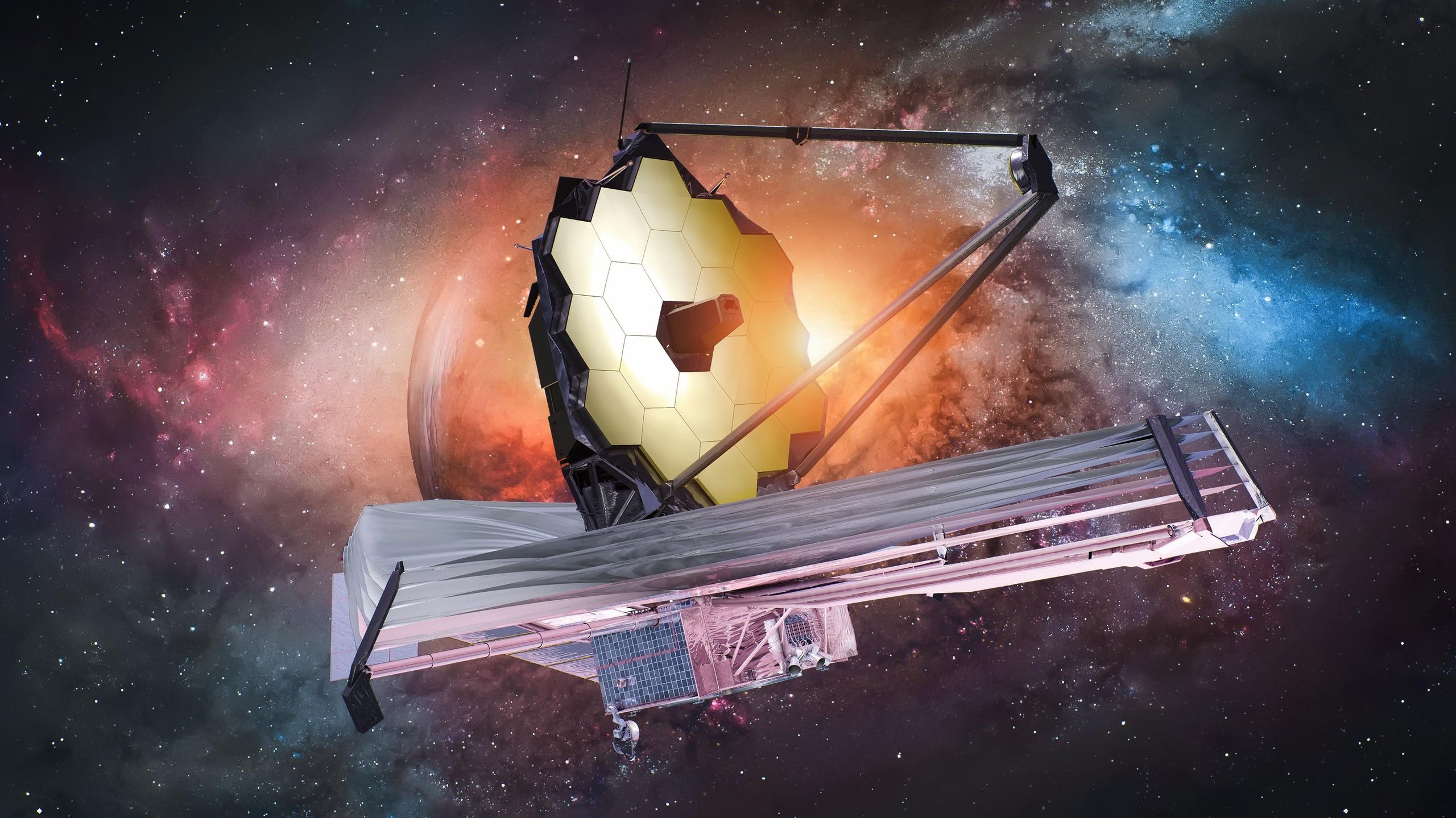
Its primary mirror spans approximately 6.5 meters, making it far larger than Hubble’s mirror.
Unfortunately, a mirror that large could not fit inside a rocket.
Engineers solved this problem by designing the telescope to fold.
During launch, parts of JWST were carefully packed into a compact configuration.
After reaching space, hundreds of mechanisms had to operate perfectly as the telescope gradually unfolded.
The process resembled opening an intricate cosmic origami structure.
Mirrors unfolded.
Support structures extended.
The massive sunshield deployed.
Each step carried risk.
A single major failure could have ended the mission.
Fortunately, the deployment sequence succeeded beyond expectations.
One of the most ambitious engineering challenges in history had been accomplished.
The Remarkable Golden Mirror
Perhaps the telescope’s most recognizable feature is its giant golden mirror.
This mirror consists of eighteen hexagonal segments working together as a single optical surface.
The segments are made primarily from beryllium, a lightweight metal chosen for its stability at extremely low temperatures.
Each segment is coated with a thin layer of gold.
The gold coating is not decorative.
Gold reflects infrared light extremely efficiently, making it ideal for Webb’s scientific mission.
Together, the eighteen segments collect far more light than Hubble’s mirror.
This enormous light-gathering capability allows Webb to detect incredibly faint objects billions of light-years away.
The mirror functions as the telescope’s giant eye, capturing precious photons that have traveled across the cosmos for unimaginable periods of time.
The Giant Sunshield
One of the most extraordinary parts of JWST is its sunshield.
The telescope’s instruments must remain extremely cold to detect faint infrared signals.
If the telescope became warm, it would generate infrared radiation that could overwhelm the observations.
To solve this problem, engineers created a giant multilayer sunshield.
Roughly the size of a tennis court, the shield blocks heat from the Sun, Earth, and Moon.
Its five layers work together to reduce temperatures dramatically.
The sun-facing side can become quite hot, while the telescope side remains extraordinarily cold.
This temperature difference is crucial for successful infrared astronomy.
Without the sunshield, Webb could not perform its mission.
Where Is the James Webb Space Telescope?
Unlike Hubble, which orbits Earth relatively closely, JWST operates much farther away.
The telescope resides near a location called the second Lagrange point, commonly known as L2.
This region lies approximately 1.5 million kilometers from Earth.
At L2, the gravitational influences of Earth and the Sun create a stable environment that allows Webb to maintain its position with minimal fuel usage.
This location offers several advantages.
The Sun, Earth, and Moon remain on the same side of the telescope.
The sunshield can continuously block their heat.
The telescope enjoys an unobstructed view of deep space.
This makes L2 an ideal location for infrared observations.
Seeing Back in Time
One of the most fascinating aspects of astronomy is that looking far away means looking back in time.
Light travels at a finite speed.
The Sun appears as it was about eight minutes ago because sunlight takes eight minutes to reach Earth.
The nearest star beyond the Sun appears as it was years ago.
Distant galaxies appear as they existed millions or billions of years ago.
When JWST observes galaxies more than 13 billion light-years away, it is essentially viewing the universe during its infancy.
The telescope allows scientists to study cosmic history directly rather than merely theorizing about it.
This ability makes Webb one of the closest things humanity has to a time machine.
Exploring the First Galaxies
One of JWST’s primary scientific goals is investigating the first galaxies.
After the Big Bang, the universe was initially hot, dense, and relatively simple.
Over time, matter began gathering under gravity.
The first stars formed.
Galaxies emerged.
Complex cosmic structures developed.
Understanding this transition is one of astronomy’s greatest challenges.
Within months of beginning operations, Webb discovered surprisingly mature galaxies existing much earlier than many scientists expected.
These observations are helping researchers refine theories about galaxy formation and cosmic evolution.
Every new image from Webb provides valuable clues about the earliest epochs of the universe.
Stellar Nurseries and the Birth of Stars
Stars are born inside enormous clouds of gas and dust.
Visible-light telescopes often struggle to observe these regions because dust blocks their view.
Infrared observations change everything.
Webb can peer through dusty clouds and reveal hidden stellar nurseries.
Its images show young stars emerging from cocoons of gas.
Jets of material stream outward from newborn stars.
Complex structures sculpted by stellar winds become visible in stunning detail.
These observations help scientists understand how stars form, evolve, and influence their environments.
In many cases, Webb reveals cosmic scenes that were previously invisible.
Studying Exoplanets
Perhaps one of the most exciting areas of Webb’s research involves exoplanets.
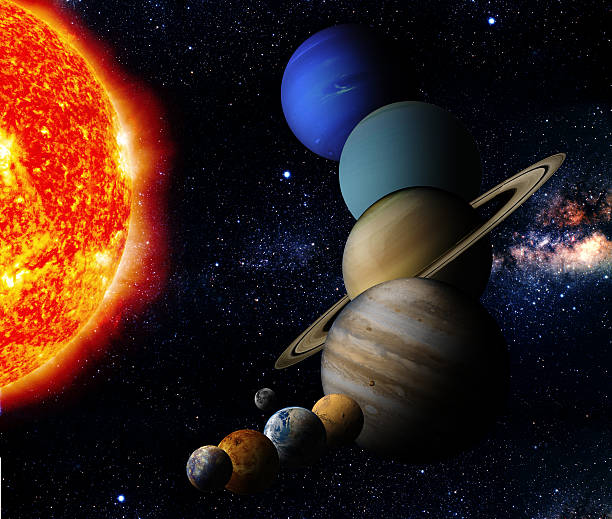
Exoplanets are planets orbiting stars beyond our solar system.
Thousands have already been discovered.
Some are giant gas worlds larger than Jupiter.
Others are rocky planets resembling Earth.
JWST can analyze the atmospheres of certain exoplanets by studying starlight passing through them.
As light travels through an atmosphere, specific gases absorb particular wavelengths.
This creates unique fingerprints that scientists can detect.
Using this technique, Webb has identified molecules such as water vapor, carbon dioxide, methane, and other compounds in distant planetary atmospheres.
These observations are transforming our understanding of planetary systems throughout the galaxy.
Could Webb Help Find Life?
One question captivates humanity more than almost any other.
Are we alone?
The James Webb Space Telescope was not specifically designed to detect extraterrestrial life.
However, it plays an important role in the search.
By studying exoplanet atmospheres, Webb can identify chemical compounds associated with planetary environments.
Certain combinations of gases may indicate conditions favorable for life.
Future telescopes may build upon Webb’s discoveries and search for more definitive biosignatures.
While JWST has not found evidence of alien life, it is helping scientists identify the most promising worlds for future investigation.
The telescope brings humanity one step closer to answering one of history’s greatest questions.
The Scientific Instruments of JWST
The telescope carries several sophisticated scientific instruments.
Each instrument serves a specialized purpose.
Some capture images.
Others analyze spectra.
Some focus on near-infrared wavelengths, while others examine mid-infrared radiation.
Together, these instruments function as a complete scientific toolkit.
They allow astronomers to investigate stars, galaxies, planets, black holes, and countless other objects.
The versatility of Webb means it can contribute to nearly every field of modern astronomy.
Its capabilities extend far beyond any single mission objective.
Black Holes and Extreme Physics
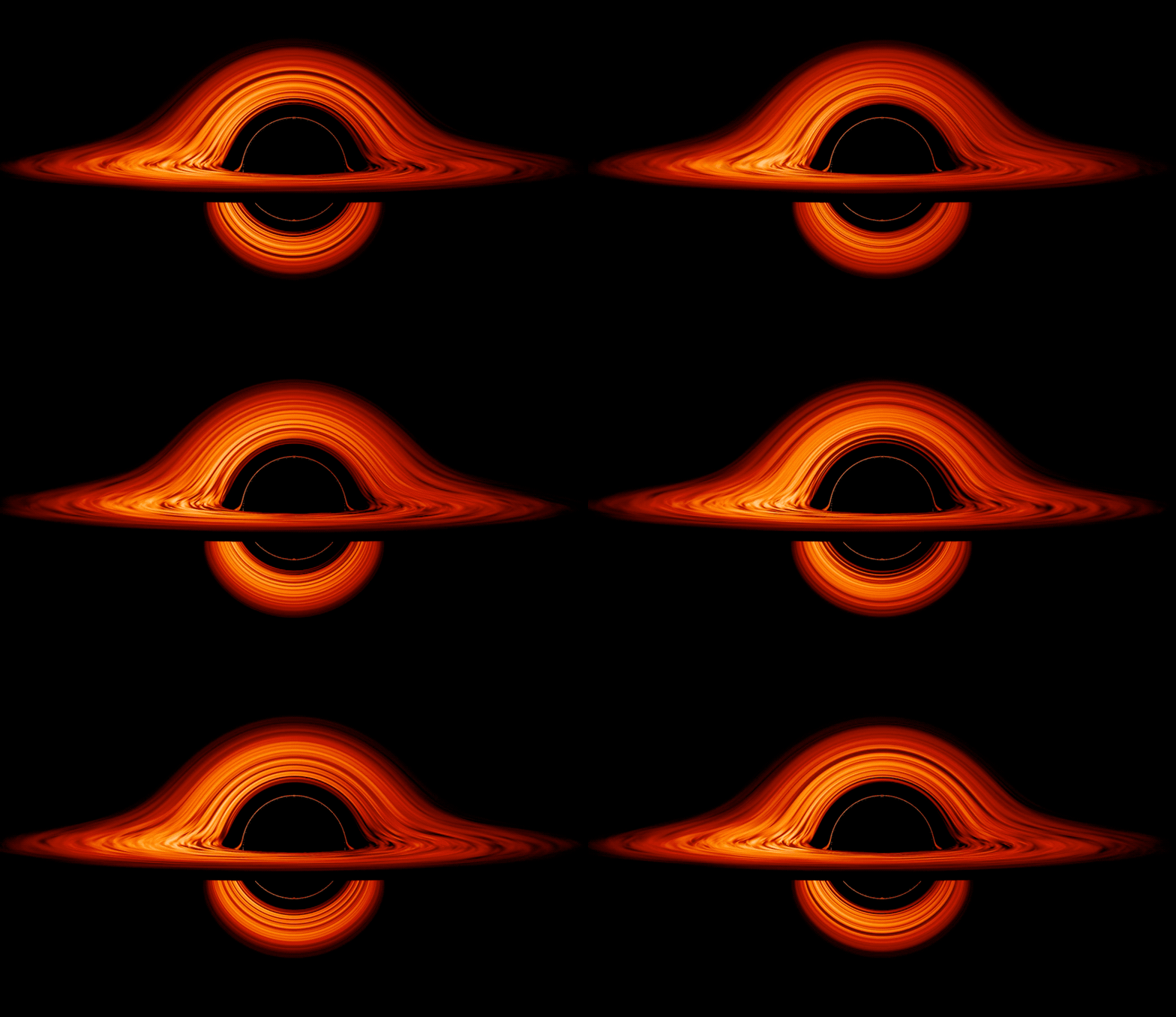
Black holes rank among the most mysterious objects in the universe.
Their gravity is so powerful that not even light can escape once it crosses a boundary known as the event horizon.
Webb is helping scientists study black holes across cosmic history.
Observations have revealed supermassive black holes existing surprisingly early in the universe.
These discoveries raise important questions.
How did such enormous black holes form so quickly?
What role did they play in shaping galaxies?
How do black holes influence their surroundings?
By investigating these extreme objects, Webb is expanding our understanding of gravity, galaxy evolution, and the nature of the cosmos itself.
The Stunning Images That Captivated the World
When the first Webb images were released, they immediately captured global attention.
The images combined scientific importance with breathtaking beauty.
Ancient galaxies appeared in unprecedented detail.
Star-forming regions glowed with intricate structures.
Nebulae revealed delicate filaments and hidden stars.
The images were more than photographs.
They were windows into cosmic history.
Many people described feeling awe while viewing them.
For some, the images inspired curiosity about astronomy.
For others, they offered a profound reminder of humanity’s place within an immense universe.
The visual impact of Webb’s discoveries has become one of its most celebrated achievements.
How JWST Differs from Hubble
Comparisons between Webb and Hubble are common.
Both are extraordinary observatories, but they serve different purposes.
Hubble primarily observes visible and ultraviolet light, although it possesses some infrared capability.
Webb specializes in infrared astronomy.
Webb’s mirror is significantly larger, allowing it to collect much more light.
Its instruments are more sensitive to faint infrared signals.
Its location at L2 provides advantages for thermal stability.
Rather than replacing Hubble, Webb complements it.
Together, the two telescopes provide a broader view of the universe than either could achieve alone.
International Cooperation Behind the Mission
The James Webb Space Telescope is an international achievement.
The project involved collaboration among multiple organizations.
NASA led the mission, while European Space Agency and Canadian Space Agency contributed essential technologies, instruments, expertise, and launch support.
Thousands of scientists, engineers, technicians, and support personnel participated.
The telescope demonstrates what humanity can accomplish when nations work together toward a common goal.
Its success belongs not to one country but to the global scientific community.
Unexpected Discoveries
History shows that great scientific instruments often make discoveries nobody anticipated.
The same is true for Webb.
Although designed to address specific scientific questions, the telescope has already produced surprises.
Unexpectedly mature early galaxies.
New details about planetary atmospheres.
Previously unseen structures in star-forming regions.
Fresh insights into black holes.
Each surprise reminds scientists that nature often has more imagination than humanity.
Some of Webb’s most important discoveries may involve questions researchers have not even thought to ask yet.
The Future of the Mission
The James Webb Space Telescope was designed for a long operational life.
Because the launch and deployment were exceptionally successful, mission planners believe Webb may function for decades.
This extended lifespan provides tremendous opportunities.
Astronomers around the world continue proposing new observations.
Every year brings fresh discoveries.
New theories emerge.
Old assumptions are challenged.
As technology and scientific understanding advance, researchers will undoubtedly find innovative ways to use the telescope.
Its scientific journey is only beginning.
Why the James Webb Space Telescope Matters
The significance of JWST extends beyond astronomy.
The telescope represents humanity’s desire to understand its origins.
It reflects centuries of curiosity about the universe.
It demonstrates what science and engineering can achieve through persistence and cooperation.
The questions Webb investigates are deeply human questions.
Where did we come from?
How did galaxies form?
How do planets emerge?
Could life exist elsewhere?
By exploring these mysteries, the telescope enriches not only scientific knowledge but also humanity’s sense of wonder.
Conclusion
The James Webb Space Telescope is the most powerful space observatory ever built. Designed primarily for infrared astronomy, it allows scientists to look deeper into space and farther back in time than any previous telescope. Its giant gold-coated mirror, enormous sunshield, advanced instruments, and unique location near the second Lagrange point make it one of the most sophisticated scientific machines in history.
Since its launch in 2021, Webb has transformed our understanding of the universe. It has revealed ancient galaxies from the dawn of cosmic history, peered inside stellar nurseries where stars are born, studied the atmospheres of distant exoplanets, and provided new insights into black holes, galaxy formation, and planetary evolution.
More than a technological triumph, the James Webb Space Telescope is a symbol of humanity’s endless curiosity. It allows us to explore the deepest reaches of the cosmos, uncover hidden chapters of the universe’s story, and ask profound questions about our place among the stars. As it continues its mission, this remarkable observatory will undoubtedly reveal wonders that no one has yet imagined, proving once again that the universe is far richer, stranger, and more beautiful than we ever dreamed.